AI’s Weakest Link Isn’t GPUs — It’s the Circuit Board Material Nobody Talks About
Everyone watches NVIDIA earnings. Almost nobody watches the circuit board material that makes NVIDIA’s chips usable.
Panasonic’s MEGTRON series of high-speed, low-loss copper clad laminate — CCL, the substrate that carries signals between chips and boards — is the industry benchmark for AI server PCBs. You’ll find it inside the switches, routers, and accelerator boards that connect GPUs at scale. It’s unglamorous. It’s also indispensable.
On November 4, an explosion and fire struck Panasonic’s Hukou plant in Hsinchu, Taiwan, damaging its core MEGTRON production line. By November 5 and 6, the supply chain was doing the math — and the number it landed on was about 4% of global high-end CCL supply at risk, with recovery potentially taking months.
That’s a small-sounding number with an outsized implication: the AI buildout has a bottleneck that almost no one pricing the trade is watching.
The Incident: What We Know for Certain
Here’s what is solid. The fire occurred at Panasonic Industrial Devices Materials Taiwan (PIDMTW) in Hukou, Hsinchu County, on November 4. Panasonic’s own Taiwan corporate profile lists the plant’s address and describes its business as producing multilayer PCBs, IC substrates, and high-frequency materials — the exact categories that matter for AI hardware.
TrendForce, a well-regarded supply-chain research firm, reported that the plant is a key production site for the MEGTRON series and that the fire damaged a core production line.
What we don’t have, as of November 6, is a complete official damage assessment from Panasonic: no confirmed list of affected product codes, no confirmed capacity loss, and no confirmed recovery timeline. That distinction is important. Much of what circulated in the first 48 hours was analysis, not disclosure.
The 4% Math: An Estimate, Not a Fact
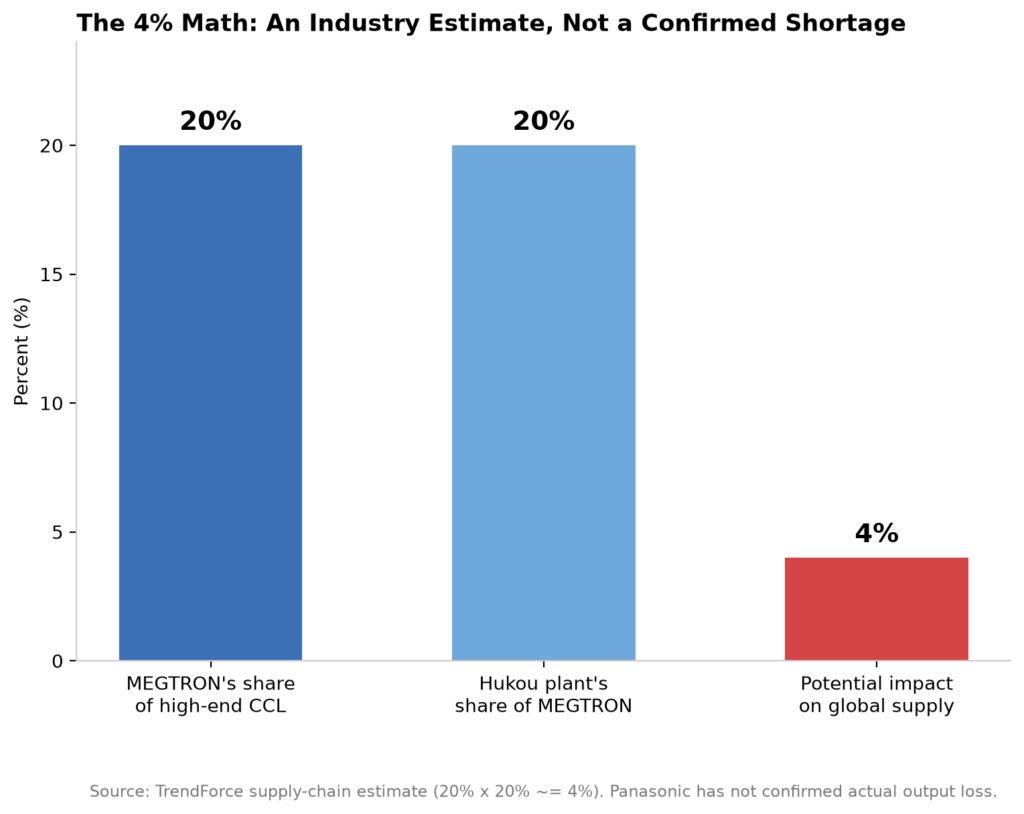
The “4% of global high-end CCL supply” figure is the number everyone quoted. It deserves a closer look.
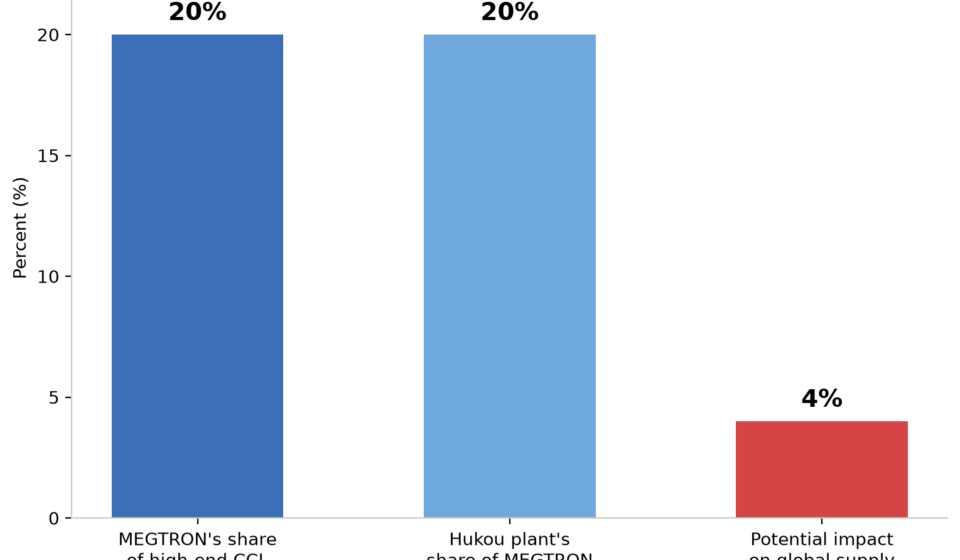
Here’s how it’s built. TrendForce’s supply-chain sources estimate that the MEGTRON series accounts for roughly 20% of the global high-end CCL market, and that the Hukou plant accounts for roughly 20% of MEGTRON’s production capacity. Multiply the two and you get about 4% of global high-end supply potentially affected.
That’s a reasonable back-of-the-envelope estimate. It is not, however, a confirmed supply disruption. Nobody has said “4% of global output is gone.” What they’ve said is: if the affected capacity stays offline, the potential impact is in that neighborhood.
There’s a further wrinkle. Taiwanese media reports suggest the Hukou plant primarily mass-produces M6-grade material, with M8 possibly still in trial production. That means not all MEGTRON grades are equally affected — a detail that gets lost when the story is reduced to a single headline number.
Who Gains? The Potential Beneficiaries
When a key supplier stumbles, the market immediately asks who picks up the slack. The names that surface are Taiwan Union Technology (台光电), TUC (台燿), Iteq (联茂), and Ventec.
Here’s the caveat that matters more than the names: these are potential alternative suppliers, not confirmed order recipients. High-end CCL isn’t a commodity you swap overnight. Customer qualification cycles are long, product specifications must match precisely, and available capacity has to actually exist. A fire at Panasonic doesn’t automatically redirect orders to its competitors — it creates an opportunity for them to compete for that business, over months, not days.
So treat the beneficiary list as a watchlist, not a scorecard.
Why CCL Is the Forgotten AI Bottleneck
Step back and the strategic picture comes into focus.
Every AI accelerator, every high-speed switch, every server motherboard depends on specialized CCL. When people talk about AI supply chains, they talk about GPUs, HBM memory, advanced packaging, and power. They rarely talk about the laminate that ties it all together — because it’s a materials business, not a silicon business, and it doesn’t produce the benchmark numbers that make headlines.
But that’s exactly why it’s fragile. The high-end CCL market is concentrated. Panasonic’s MEGTRON dominates the top segment, with alternatives from Isola, Rogers, and Taiwanese manufacturers. Those alternatives exist — but qualifying a new material into an AI server design is a months-long process, not a plug-and-play substitution.
A single fire at a single plant can therefore ripple through the entire chain, not because the material is rare in absolute terms, but because the qualified, high-end supply is concentrated in a few hands.
The Recovery Question
Analysts have floated “months to resume” as a timeline. That’s a reasoned guess, not a company statement.
Recovery depends on three things: equipment replacement (fire damage to production machinery can be extensive), facility repair (cleanroom and safety systems), and — the slowest part — customer re-qualification. Even after the line is rebuilt, customers who shifted to alternatives may not shift back immediately. Trust in supply continuity is rebuilt one qualification cycle at a time.
If the outage stretches beyond the first quarter of 2027, PCB manufacturers serving AI customers could face material allocation decisions — the kind that turn into price spikes and delivery delays.
What This Means for the AI Buildout
The story here isn’t “Panasonic had a fire.” It’s that the AI supply chain has layers most investors don’t see, and those layers have their own concentration risks.
The GPU shortage got all the attention in 2023 and 2024. HBM and advanced packaging got it in 2025. In 2026, the spotlight may finally fall on materials — the laminates, glass fabrics, and copper foils that make AI hardware physically possible.
None of this means the AI buildout stops. It means it gets more expensive and less predictable at exactly the moment, post-midterms, when predictability is in short supply.
What to Watch Next
Three signals will clarify the real impact.
Watch for any official Panasonic disclosure of affected product lines and recovery timing. Until that lands, the 4% figure is an estimate, not a fact.
Watch the Taiwanese CCL makers’ order books. If Taiwan Union Technology, TUC, and Iteq start reporting meaningful new AI-server design wins, the substitution is real. If they don’t, the supply stays tight.
And watch AI server lead times. If PCB material shortages start pushing out server delivery schedules, the fire will have graduated from a supply-chain footnote to a genuine constraint on the AI buildout.
The Bottom Line
The Panasonic Hukou fire is a reminder that the AI revolution runs on physical materials, not just software and silicon. A 4% potential hit to high-end CCL supply sounds small — until you remember that “4% of global supply” in a concentrated, slow-to-qualify market can mean a lot more than 4% of the pain.
The bottleneck was always there. The fire just made it visible. And in a year when the AI trade is already being repriced for political risk, the last thing it needs is a reminder that it’s also vulnerable to a single spark in a single factory.