China’s Content-Commerce Fusion: The Model the West Keeps Half-Copying
The West has spent five years bolting buy buttons onto feeds. China spent fifteen years deleting the seams between watching, deciding, paying, and coming back. Those are not the same project, and the 2026 numbers have started saying so out loud.
The part everyone copies is the cheap part
Picture the standard Western playbook in 2026. A brand signs three creators, ships them product, gets forty short videos, puts media behind the good ones, and points every ad at a product page with a checkout on it. The click-through rate looks fine. The conversion rate does not. Somewhere between the video and the confirmation email, most of the money quietly leaves the building.
Now picture the Chinese version of the same afternoon. A shopper sees a fifteen-second clip of a rice cooker in a Douyin feed. She taps the profile, reads three Xiaohongshu notes about the same model, opens a livestream where a store clerk is demonstrating it to four hundred people, buys it inside the app with a saved payment credential, receives it the next morning, and joins a WeChat group where the brand posts a cleaning guide and a coupon for the replacement inner pot. At no point did she leave an ecosystem, create an account, or wait for a redirect to finish.
Both journeys contain the same nouns: content, creator, product, payment. Only one of them contains a system. The gap is not a feature gap. It is a seam gap.
The short version
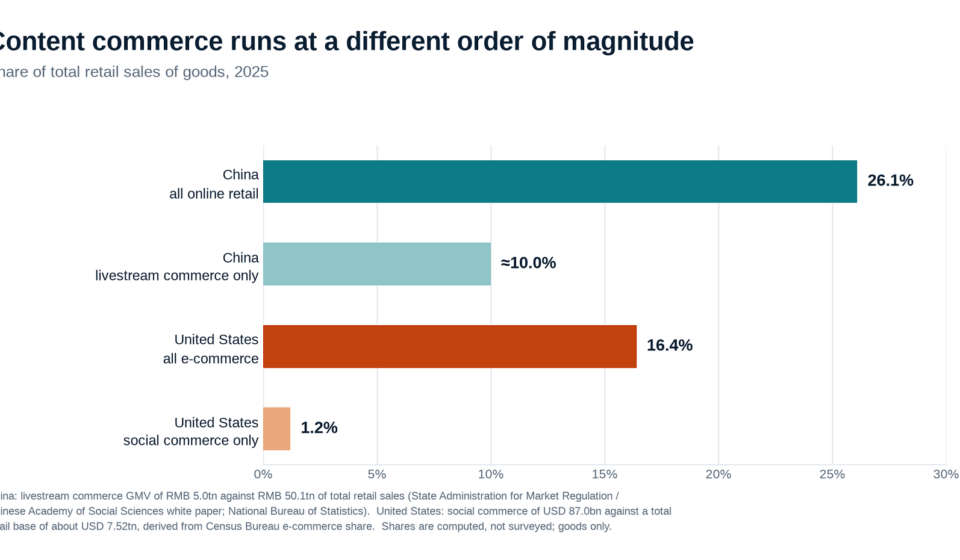
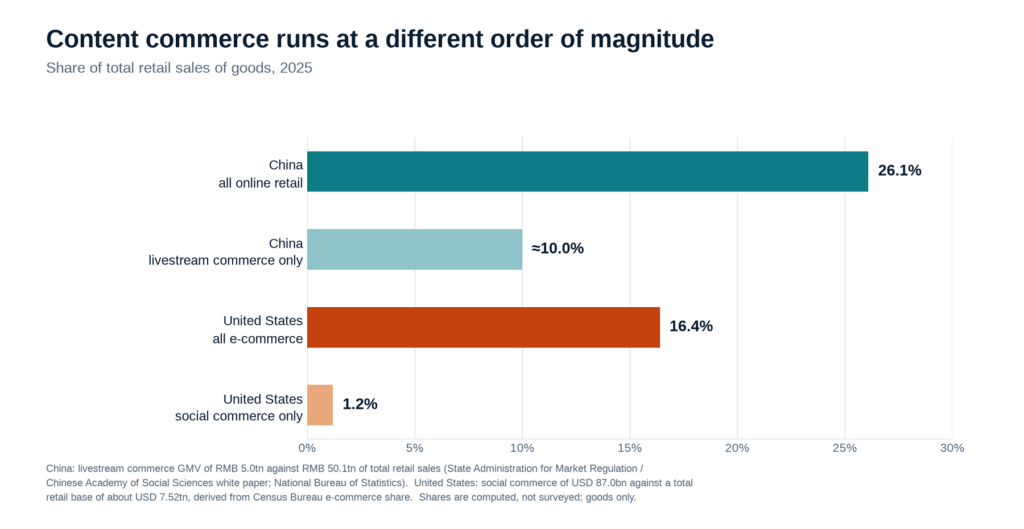
China’s livestream commerce alone turned over more than RMB 5 trillion in 2025, about a third of everything Chinese shoppers bought online and close to a tenth of everything they bought, anywhere. America’s entire social commerce market, every platform combined, came in at USD 87 billion in 2025 and is expected to clear USD 100 billion in 2026. On a like-for-like basis, China’s livestream channel is roughly eight times the size of America’s entire social commerce market.
That ratio is the headline. The reason behind it is the story. The West has copied the visible layer — the buy button, the creator clip, the live host — and left the invisible layer on the table: one wallet, one identity, a delivery promise, a creator supply so deep that an account with nine hundred followers can close a sale, and a place for the customer to go after the parcel arrives. Copy the button without the seams and you get a very expensive content operation with a checkout attached.
What content-commerce fusion actually means
The phrase gets used loosely in English, usually to describe a video with a product link. That is not what the term means in China, and that mistranslation is where most Western strategy goes wrong.
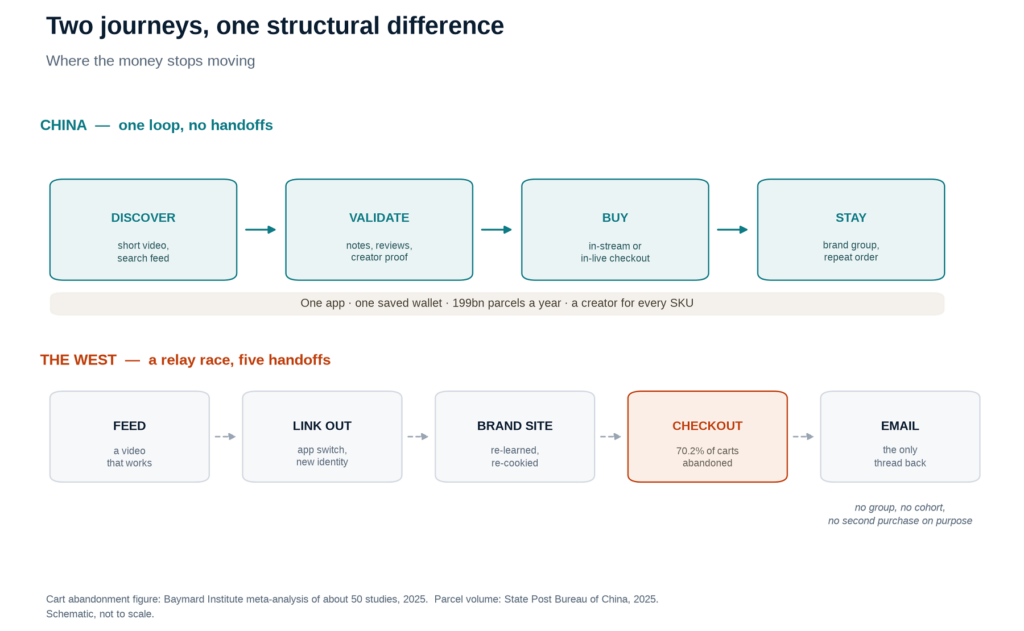
Content-commerce fusion is the collapse of four separate jobs into one uninterrupted session, with no change of ownership in between. The four jobs are discovery, validation, transaction, and retention. In the West, each job belongs to a different company with a different business model, and each handover costs money, time, and intent. In China, one app can do all four, and the handover cost rounds to zero.
That definition matters because it explains the numbers better than any cultural argument does. Chinese shoppers are not more impulsive than American ones. They are less interrupted.
Four jobs, one loop
Walk the loop once and the design logic becomes obvious.
Discovery happens in the feed, driven by interest rather than a search query. China had 1.074 billion short-video users as of December 2025, or 95.4 percent of its 1.125 billion internet users, according to the national CNNIC survey. That is not a media channel sitting next to commerce. It is the front door of commerce.
Validation happens in a second app that Western analysts routinely underestimate. Xiaohongshu, with roughly 300 million monthly active users, functions less like Instagram and more like a pre-purchase search engine: people look up the product, read strangers’ notes, check the complaints, and then go buy somewhere else. The review layer and the transaction layer are separate companies, but they are wired to each other by habit.
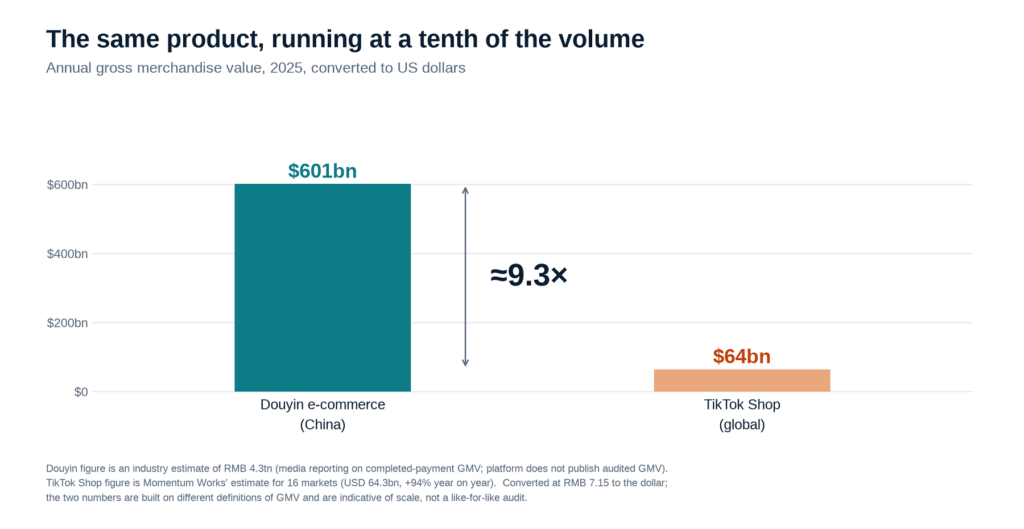
Transaction happens wherever the shopper already is. Douyin’s e-commerce business is estimated at RMB 4.0 trillion to RMB 4.3 trillion for 2025 — roughly a quarter of the country’s e-commerce market, and an extraordinary number for a platform that only set up a dedicated e-commerce unit in 2020. And note the internal mix: by 2024, shelf-style storefronts were already producing more than 40 percent of Douyin’s GMV, with store-run livestreams above 30 percent and creator livestreams the remainder. The feed gets the credit; the storefront takes the money.
Retention happens in a chat app. After purchase, the customer joins a brand group or a store assistant’s contact list inside WeChat, whose combined monthly active users reached 1.414 billion in the third quarter of 2025, according to Tencent. This is what Chinese marketers call private domain, and it is the single most under-copied part of the model. The second purchase does not depend on an algorithm deciding to show you the brand again.
The infrastructure nobody photographs
Four pieces of plumbing make the loop work, and none of them photograph well.
One wallet. Chinese consumers buy inside content because the payment credential is already there and already trusted. A Western shopper reaching a checkout page is, in effect, being asked to prove who she is to a company she met six seconds ago. Baymard Institute’s meta-analysis of roughly fifty studies puts average documented cart abandonment at 70.22 percent. Ask why, and three of the most commonly cited reasons are instructive: 26 percent of abandoners blame mandatory account creation, 23 percent blame slow delivery, 22 percent a checkout that was too long or too complicated. Every one of those three reasons is a seam. China removed all three.
A delivery promise that survives contact with reality. China’s express network handled 198.95 billion parcels in 2025, up 13.6 percent, on revenue of RMB 1.5 trillion; the State Post Bureau credits the sector with supporting more than RMB 14 trillion of physical-goods online sales. That works out to about 141 parcels per person per year. The bureau expects 214 billion parcels in 2026. You cannot promise next-day in a livestream unless an actual network keeps that promise, and no Western market has that network at that cost structure.
Creator supply at every price point. China has 2.57 million companies registered in live commerce, and the industry white paper published in early 2026 found that top-tier hosts now account for only 10.66 percent of livestream GMV, with mid-tier and small hosts taking 89.34 percent. Store-run livestreams contribute roughly half of the total. That distribution is the point: the long tail is not a rounding error; it is the market.
A place to put the customer afterwards. WeChat mini-programs, with roughly 950 million monthly users, let a brand run a store, a loyalty program, and a service desk inside a chat app without an app download. When Tencent reported third-quarter 2025 results, it pointed to mini-shop transaction growth as a driver of merchant technology fees. That is a retention channel with a P&L line attached.
What the West did copy, and copied well
It is worth being fair here, because the lazy version of this argument says the West copied nothing.
TikTok Shop has native in-app checkout. That is real, and it is a bigger deal than most coverage admits: the single hardest seam to close in Western commerce is the one between a feed and a payment form, and ByteDance closed it. TikTok Shop’s global GMV reached USD 64.3 billion in 2025, up 94 percent, across sixteen markets, according to Momentum Works. Its US business did about USD 15.8 billion, more than double the year before. Amazon Live exists. Instagram and YouTube both ship shoppable formats. Affiliate infrastructure is now table stakes.
So the West did not fail to copy. It copied the parts that can be shipped by a product team in a quarter and skipped the parts that require a decade of infrastructure, a payments business, and a regulatory environment that permits all of it inside one company.
The tell: livestream is eight percent of TikTok Shop’s American business
Here is the number I would put in front of any brand team still treating livestream as the Chinese secret.
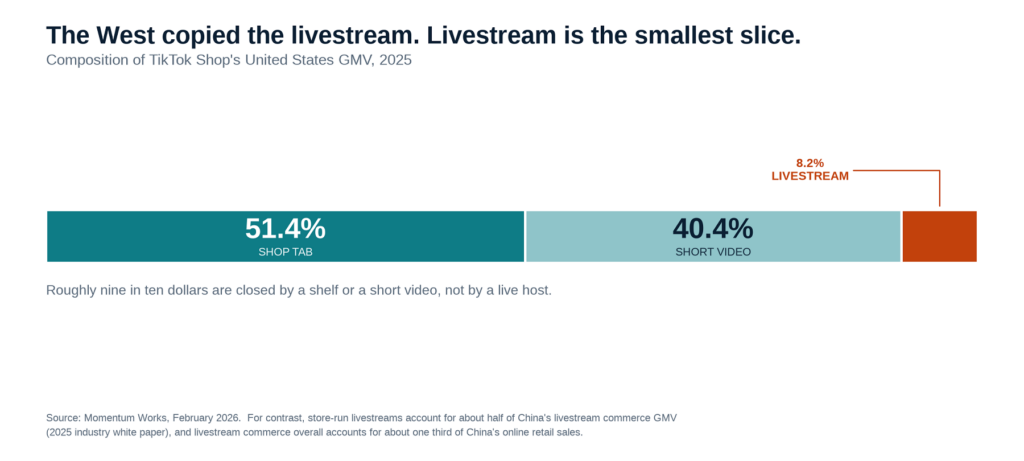
Inside TikTok Shop’s US GMV in 2025, livestream accounted for 8.2 percent. Short video accounted for 40.4 percent. The in-app shop tab — the boring, searchable, grid-shaped shelf — accounted for 51.4 percent.
Sit with that for a second. The format Western marketers spent five years flying to Shanghai to study is the smallest slice of the American business. What actually works in the US is content as a discovery layer feeding a conventional shelf inside the app. That is precisely the opposite of the Chinese structure, where store-run livestreams alone carry about half of livestream GMV and content is the transaction surface, not merely the advert.
Scale tells the same story from another angle. TikTok Shop’s entire US GMV in the third quarter of 2025 — somewhere between USD 4 billion and USD 4.5 billion — represented less than 1.5 percent of total US e-commerce sales in that quarter. Amazon, by contrast, carries roughly 40 percent of US e-commerce on its own, and Amazon plus Walmart are forecast to top half the market in 2026. The feed is growing fast off a small base. The shelf is still the shelf.
The three handoffs the West never built
If the button is not the model, what is? Three handoffs, each of which a Western brand can partly build even without a super-app.
The validation handoff. In China, a stranger’s note on Xiaohongshu changes what happens on Tmall. In the West, reviews live inside the destination — on Amazon, on the brand site, on Trustpilot — and the feed that created the desire has no idea what those reviews say. Fix: capture and surface social proof inside the content environment, not three clicks later on a product page.
The post-purchase handoff. In China, buying is the start of a relationship: a group, a service contact, a repurchase cycle. In the West, buying is the end of a funnel and the start of an email sequence. Email is a thread. A group is a room. Rooms retain; threads get unsubscribed.
The creator-economics handoff. China’s long tail of small hosts moves 89 percent of livestream GMV. Western creator programs are still shaped like talent deals: a small number of large accounts, negotiated one at a time. Until a brand can onboard ten thousand micro-creators without ten thousand phone calls, the supply curve stays steep and the handoff stays expensive.
Why the West cannot simply build it
Three structural reasons, and none of them is about capability.
Incentives. The company that owns the shelf has no interest in becoming a feed, and the company that owns the feed has no interest in becoming a warehouse. Amazon at roughly 40 percent of US e-commerce has every reason to remain a destination. Meta has every reason to keep the transaction at arm’s length so it can sell the click. Shopify’s entire proposition is merchant independence. The Chinese model required one company to own all four jobs, and Western market structure punishes that ambition before regulators even get involved.
Payments. A saved wallet inside a content app is not a UI decision; it is a business model with interchange economics attached. Card rails were designed for a merchant-initiated transaction, not for a scroll. Rebuilding them is a decade-long project, and the incumbent economics argue against starting.
Regulation. Privacy regimes and antitrust enforcement in Europe and the US are, quite deliberately, designed to prevent the concentration of identity, payment, and behavioral data that makes the Chinese loop frictionless. Even a willing Western platform would be building against the grain of the law.
What global brands should do now
Stop waiting for a super-app. It is not coming, and the wait has a cost: every quarter spent waiting is a quarter of handoff tax paid at full price.
- Budget for seams, not buttons. Your constraint is not the checkout widget. It is the number of places a customer has to re-identify herself. Count them. Then remove one per quarter.
- Run one identity across content, site, and CRM. If your creator campaign and your email list cannot be joined at the customer level, you are running two businesses and paying for both.
- Build the validation layer where the desire happens. Put reviews, UGC, and creator proof into the feed and the ad, not only on the product page. The Chinese review layer sits upstream of the transaction; Western review layers mostly sit downstream.
- Replace the email thread with a room. Owned community is the cheapest retention infrastructure ever built and the least fashionable. A WhatsApp or Discord cohort that survives the third purchase is the Western approximation of a WeChat group.
- Price the handoff tax explicitly. Measure drop-off at each seam — feed to site, site to cart, cart to payment, payment to second order. Baymard’s 70 percent is an industry average, not your fate. The brands that win the next three years will be the ones that can name their own number.
What would prove this thesis wrong
Good analysis should be falsifiable, so here are the four things I would watch.
First, a Western platform owning payment, delivery, and post-purchase community end to end, not as a partnership but as a P&L. Second, US social commerce passing five percent of total retail, roughly a fourfold move from where it sits now. Third, livestream climbing above twenty percent of TikTok Shop’s US GMV, which would mean the format finally transferred rather than the shelf absorbing it. Fourth, credible cohort data showing Western owned-community retention matching the repeat rates Chinese brands report from private-domain groups.
Any one of those would soften the argument. All four together would break it, and I would happily rewrite this piece.
The takeaway
China did not invent shoppable video. It invented the absence of handoffs around shoppable video, and then spent fifteen years making that absence cheap: one wallet, one identity, a parcel network that keeps a next-day promise, a creator supply curve with a fat tail, and a chat app where the relationship continues after the box is opened.
The West copied the video. The video was never the hard part.
Frequently asked questions
Is content-commerce fusion just another name for social commerce?
No. Social commerce usually means selling on a social platform. Fusion means the four jobs — discovery, validation, transaction, and retention — share one owner and one session. A TikTok video with a checkout link is social commerce. The same purchase followed by a group chat, a service contact, and a repeat order inside one ecosystem is fusion.
Why is China’s livestream commerce so much larger than the West’s?
Mostly infrastructure, not culture. A saved payment credential, a parcel network handling 199 billion deliveries a year, and a creator market where small hosts move 89 percent of livestream GMV all lower the cost of trying. Lower the cost of trying and more people try.
Didn’t TikTok Shop already solve the checkout problem?
It solved the hardest single seam, and that is a genuine achievement. It did not solve what happens before (validation across platforms) or after (community and repurchase). The 8.2 percent livestream share inside its own US business suggests the format is still doing discovery work rather than closing.
Can a Western brand build the missing handoffs without a super-app?
Partly, and expensively. You can unify identity across content, site, and CRM; you can push social proof upstream into the feed; you can build an owned community that outlives the third purchase. What you cannot do alone is rebuild payment rails or a next-day network.
What is the single most useful metric to track?
Drop-off at each handoff, measured as a chain rather than in isolation. Feed to site, site to cart, cart to payment, payment to second order. A brand that knows its own four numbers is in a better position than one quoting the industry’s 70 percent average.