The 140 Million: Who Actually Buys in China’s Silver Economy
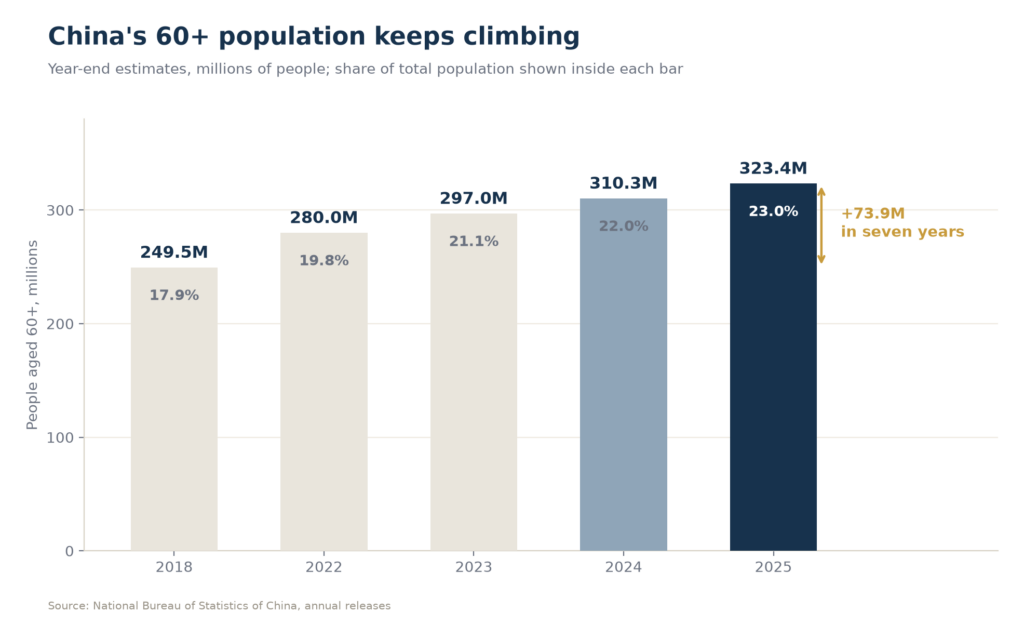
At the end of 2025, China had 323.38 million residents aged 60 or older — 23.0% of the population, and more people than live in Japan, Germany and the United Kingdom combined. The cohort has grown by more than 13 million a year for three consecutive years. Were it a country, it would be the third most populous on earth, behind only India and the United States.
Ask a global brand team what its China plan is for this group and you will usually get a pause, then the word “healthcare,” then a swift pivot back to Gen Z. In most Western marketing departments, “senior” still means thin margins, small budgets and the pharmacy aisle.
That reflex is getting expensive. Not because 323 million people are waiting to buy your product — most of them are not — but because about 140 million of them are, and almost nobody is competing for them properly.
The scale is not the interesting part
Big numbers invite lazy strategy: huge market, ship product, localize the packaging. The useful questions sit elsewhere. Where is the money? Who taps “pay”? And why does the official market size — quoted everywhere from board decks to bond prospectuses — keep understating the thing it claims to measure?
The demographic math, without the panic
China ended 2025 with 323.38 million people aged 60 and over, and 223.65 million aged 65 and over — 15.9% of the population. Four years earlier the 60-plus figure was 280.04 million. In 2018 it was 249.49 million. That is 74 million additional seniors in seven years, a pace with few precedents.
Three forces did this. The one-child policy removed a generation of siblings who would normally have shared the burden of care. Life expectancy reached 79.25 years in 2025, up 1.32 years since 2020. And fertility has fallen to roughly one child per woman, less than half the rate needed for a stable population.
Speed matters more than level. China moved from a 7% to a 14% share of over-65s in about two decades. France took well over a century, the United States about 72 years, Japan 24. No large economy has ever had to retrofit its consumer infrastructure for old age this quickly.
There are two silver economies, and only one has money
Here is where most English-language coverage goes soft. “China’s seniors are the wealthiest generation in Chinese history” is a line you will read often. It is half true in a way that will wreck your media plan.
China runs two pension systems. Retirees from enterprises and public institutions — roughly 140 million people — draw an average of about ¥3,300 a month. Recipients of the rural-urban resident scheme — roughly 188 million people, most of them rural — draw about ¥280. The gap is roughly twelve to one.
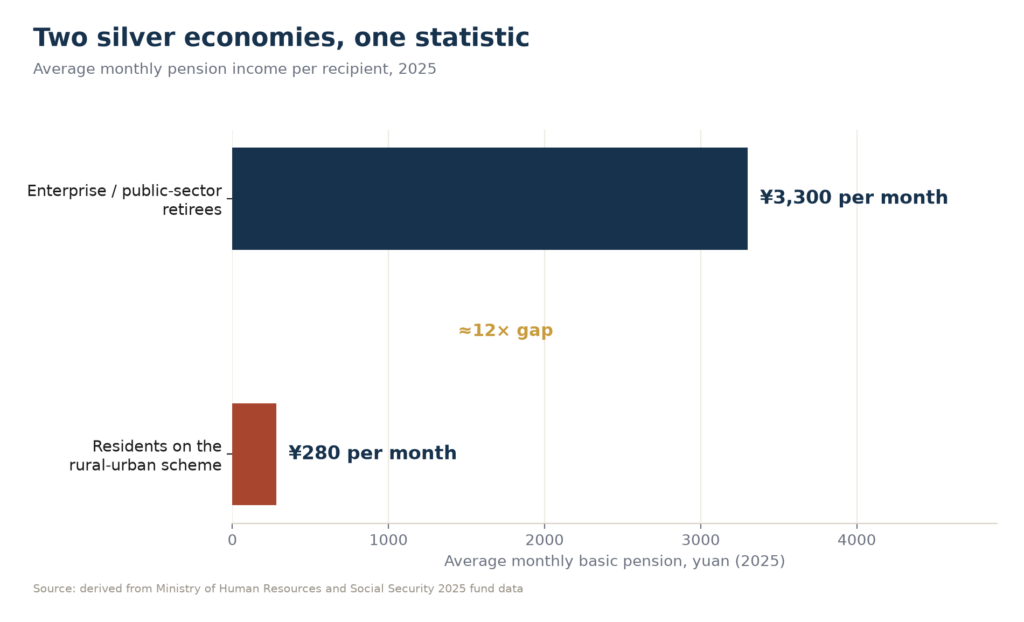
So the addressable market is not 323 million. It is closer to 140 million people with real discretionary income, plus the adult children who spend on their behalf. That is still a market bigger than the population of Japan, and it is the one worth building a strategy around.
The failure mode is predictable. A brand launches a “senior” line, prices it for the mass market, reaches the ¥280 cohort, sees no traction, and concludes that Chinese seniors do not spend. They do. Just not on what you made, at the price you set, through the channel you chose.
Spending peaks before retirement
China’s official silver economy starts at 60. The buying starts earlier.
A 2025 study by the China Research Center on Aging and Taotian’s research arm found that users aged 50 to 59 — the pre-retirement cohort — accounted for 67.08% of silver users on the platform, 70.12% of orders and 74.97% of spend. A brand that targets “60-plus” is therefore aiming just past the center of gravity.
This is not a quirk of one platform. It is what retirement arithmetic does. The fifties are when the mortgage is nearly paid, earnings peak and the pension is close enough to feel real. By 70, spending shifts from acquisition to maintenance. By 80, someone else is usually deciding.
Nine trillion yuan, and a definition that hides the rest
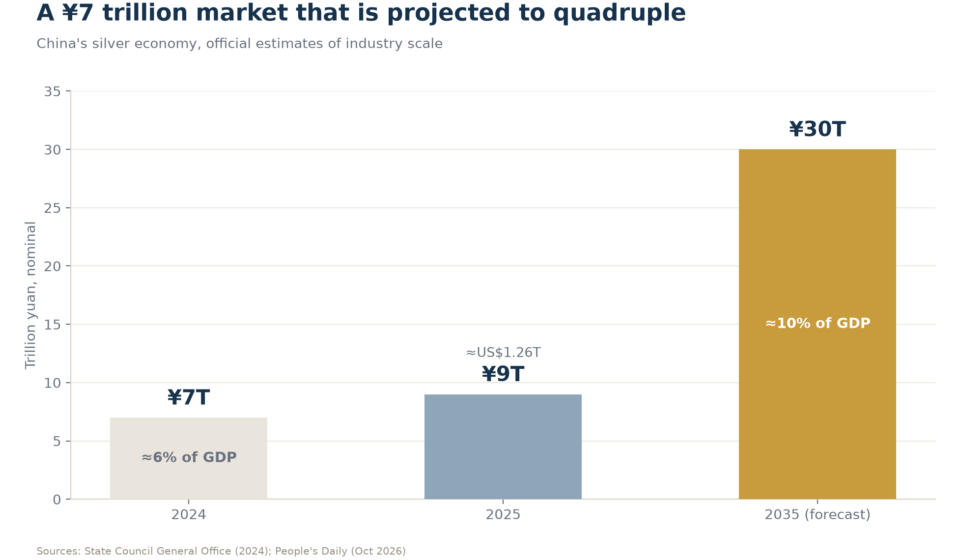
Official estimates put the silver economy at about ¥7 trillion in 2024, roughly 6% of GDP, and around ¥9 trillion in 2025. Projections point to ¥30 trillion by 2035, about 10% of GDP.
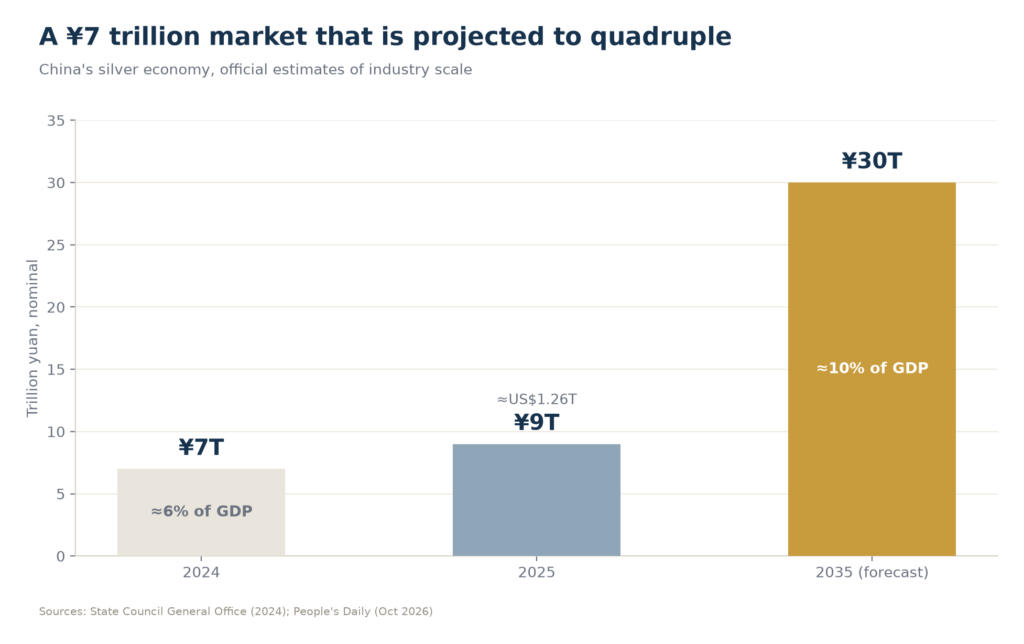
Treat the level with suspicion and the direction with respect. A 29% rise in a single year is faster than plausible organic growth; it reflects expanded categories and revised measurement as much as new spending. The definition also leaves out two enormous pools — the fifty-somethings described above, and the purchases adult children make on their parents’ behalf.
Myth one: Chinese seniors are offline
They are not. The 57th CNNIC report, published in February 2026 with data through December 2025, puts China at 1.125 billion internet users and 80.1% penetration. Among people aged 60 and over, the internet usage rate is 53.7% — 173 million people, or 15.4% of all netizens.
QuestMobile’s November 2025 read is sharper. Monthly active users aged 50 and over reached 351 million, up 5.8% year on year. They averaged 135 hours a month inside apps — about four and a half hours a day, 11.1% more than a year earlier — and opened their phones 1,345 times. Nearly half, 46.6%, carry a handset that cost more than ¥3,000.
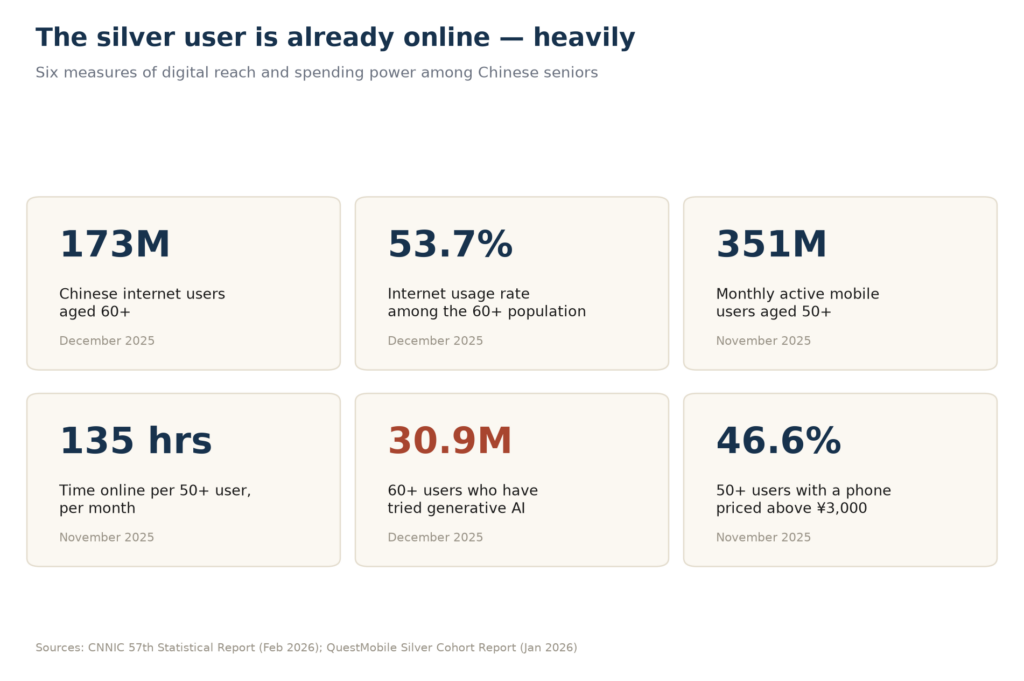
They are not only watching, either. On Taobao, 205 million of them shop each month; on Pinduoduo, 159 million; on JD, 101 million. WeChat counts 301.45 million monthly active users aged 50 and over, Douyin 213.7 million, Douyin Lite 120.6 million, Kuaishou 105.7 million. Hongguo, a free short-drama app, has 35.9 million. DeepSeek alone holds 10.8 million, before you count Doubao and the other assistants. Nationally, 30.9 million people aged 60 and over have used a generative AI tool.
The stereotype of the confused elder squinting at a phone is a decade out of date. What is still true is that the interface was not designed for them. That is a product problem, not a user problem.
Myth two: they only buy medicine
Medicine is big. It is not the whole story, and not even the majority of it.
On Taotian, clothing, footwear, daily necessities and food and drink together accounted for 44.81% of senior spending in 2025. The fastest-growing categories were accommodation services, Chinese and Western medicines, gold and jewelry, cosmetics, and travel services. Customized domestic travel bookings rose 61.92%. Sales of cleaning robots to this group grew 178-fold; toilet sterilizers, 17-fold.
Then there is the physical world, which still takes a large share of senior spending. In a 2025 survey of Shanghai’s Pudong district, 52% of elderly purchases were made in store against 47% online, and nearly half of local seniors there spend more than ¥30,000 a year.
The purchase is usually not made by the senior
This is the part Western teams consistently miss, and the most actionable finding in the data.
Of the ¥36.2 billion spent on age-friendly product categories on Taotian in 2025, only 25.11% came from accounts belonging to people aged 50 and over. The other 74.89% came from younger buyers — children and grandchildren buying for parents and grandparents.
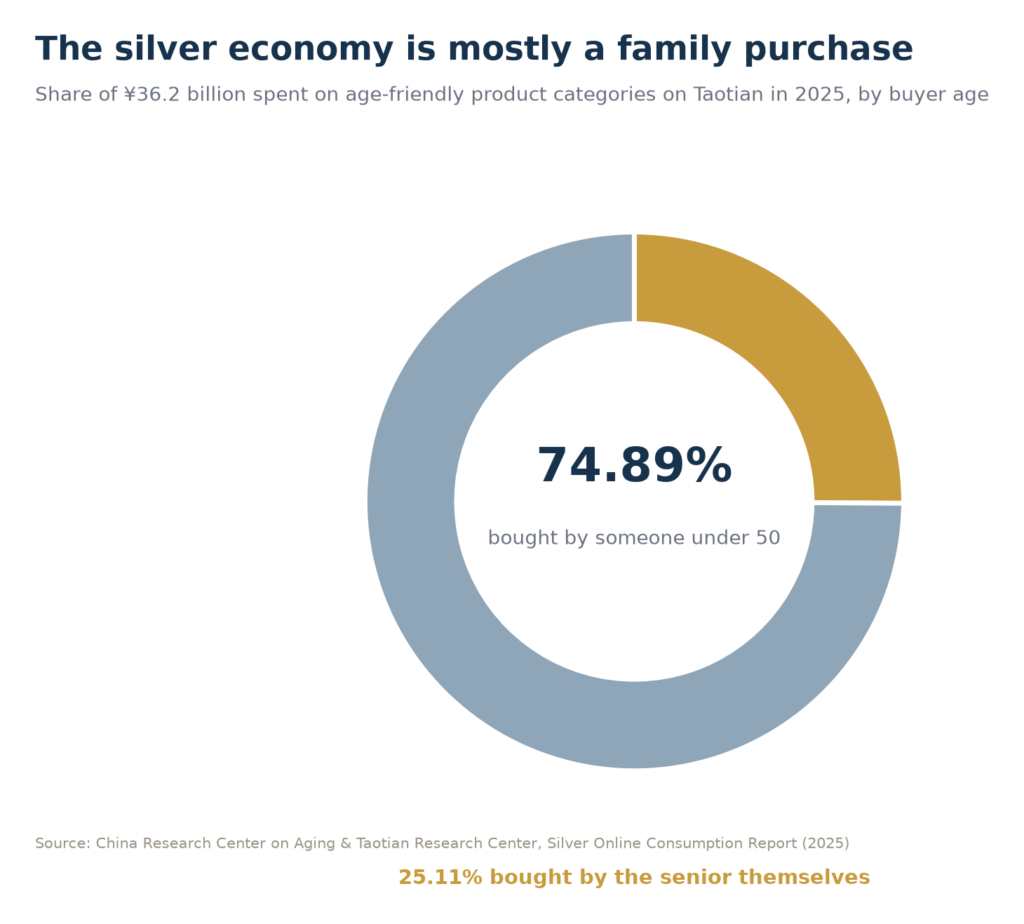
The filial-piety economy, as Chinese analysts call it, peaks among buyers aged 35 to 39, who place close to a quarter of orders and a quarter of the spend in the category. Your media plan therefore has a second front, and it is not the one most brand teams staff.
Why global brands keep missing this
Three structural reasons, none of them about the market itself.
The panel problem. Consumer panels, brand trackers and syndicated research in Western markets skew young, because that is where agencies expect growth. Aging data lives in government statistics and pension administration, not in the dashboard your CMO opens on Monday.
The org-chart problem. Brands aimed at young consumers are staffed by young teams, briefed by young agencies, and measured on cultural relevance. A 62-year-old buyer appears in nobody’s incentive structure.
The narrative problem. Global brand stories are growth stories, and aging reads as decline in the countries most multinationals call home. China inverts that: aging is where household wealth concentrates, because the generation now retiring is the one that bought urban property early.
The playbook: seven moves that fit the market
WeChat is the operating system, not a channel. Its 301 million users aged 50 and over dwarf every other platform in the country. The strategic point is not reach; it is that WeChat hosts the family group chat, the payment, the mini-program, the service account and the referral in one place. A campaign that ends at a landing page has stopped one step before the transaction.
Sell to the daughter, then let her sell to her mother. The 35-39 buyer decides a large share of senior purchases. Talk to her about safety, installation, maintenance, after-sales, and whether the thing will embarrass her parent in front of the neighbors. She is not buying a product; she is buying the removal of a worry.
Design for hands, eyes and ears. China has a word for this — shilaohua, age-friendly adaptation — and it is now a policy requirement rather than a courtesy. Larger type, fewer steps, louder prompts, physical buttons where possible. Treating this as charity is a mistake. It is conversion rate.
Trust is the channel. The China Consumers Association logged 995,971 complaints in the first half of 2025, up 27.23% year on year, and named elderly consumption traps among its top eight problem areas: clickbait that triggers silent auto-renewals, hotel-ballroom sales events in rural counties, livestream hosts selling ordinary food as a cure-all. Seniors know they are targets. Authority figures, community institutions, a physical store and a phone number that a human answers do more work than any creative.
Price is not the lever. Certainty is. Discounting reads as risk to a cohort that has been burned. What sells is a plain promise that the thing will not break, a visible service network, a return policy in language a 70-year-old can follow. Premium positioning works, provided it arrives with proof.
Segment by decade, not by “60-plus.” A 62-year-old still running a small business, a 72-year-old managing a household budget and an 85-year-old with limited mobility share a birth-certificate category and nothing else. Their channels, price sensitivity, decision rights and care needs diverge completely. One silver strategy is a contradiction in terms.
Build for the household, not the individual. With three-quarters of age-friendly purchases made by younger family members, packaging, delivery, installation and customer service all need a second user in mind — the person who will actually call you when something goes wrong.
Policy is doing your category education for free
In January 2024, China’s State Council published the first national document to carry “silver economy” in its title, setting out 26 measures across services, products, demand and industrial support. Since then the state has been subsidizing demand and standardizing supply at a pace no brand could match.
Nine government bodies launched a silver tourism-train program in early 2025. Rail operators ran 1,860 tourist trains in 2024 carrying more than a million passengers, roughly 80% of them elderly. By 2025 the figure had reached 2,485 trains, alongside more than 80 million person-trips of long-stay retirement travel. A national voucher scheme for moderately and severely disabled seniors had, by mid-2026, redeemed 10.8 million vouchers worth ¥6.5 billion and pulled ¥29.1 billion of care spending behind it. During the 14th Five-Year Plan, 2.24 million households received subsidized age-friendly renovations, and 86,000 community meal points opened.
Under the 9073 model, about 90% of Chinese seniors age at home, 7% in community settings and 3% in institutions. Read the whole package as a market signal: the state is paying to create demand, and it buys through procurement. For a foreign brand, the entry point is often a tender, not a billboard.
Where AI actually fits
The interesting number is not that seniors use AI. It is that 30.9 million of them already have, on interfaces designed for someone else.
Three uses are pulling ahead. Voice-first assistance, because typing on glass is the hardest part of the phone for anyone over 75. Health monitoring, because 75% of this cohort lives with at least one chronic condition, and the daily routine of measuring, recording and reporting is tedious enough to automate. And companionship, which is the commercial opportunity nobody wants to name: a great many older Chinese live apart from their children, and the products that address loneliness honestly will earn more trust than the ones that address it euphemistically.
The trap is designing “AI for the elderly” as a separate, simplified, faintly patronizing product. The cohort that already uses DeepSeek does not want a special edition. It wants the real thing, with bigger targets.
What can go wrong
Trust is a fragile asset here, and the ways to lose it are unusually cheap. Fraud using AI face-swaps and cloned voices now targets older users specifically. A single recommendation that leads a customer into a fraudulent livestream can cost a decade of brand equity.
The digital divide is real. A 53.7% national usage rate conceals a rural figure far lower, and the 188 million people on ¥280 pensions sit largely outside digital commerce altogether. If your China strategy is e-commerce only, you are addressing roughly half the cohort.
Regulation is tighter than in most consumer categories. Health claims, supplements, medical devices, financial products and travel packages aimed at seniors all sit under closer scrutiny, and enforcement tends to follow complaints rather than precede them.
Finally, the category has a structural weakness worth naming. Chinese analysts describe silver products as having categories but no brands. That is a warning about quality and a vacancy sign at the same time.
Five things to do in the next twelve months
- Recut your China addressable market by pension scheme and city tier rather than by age band. The number will shrink. It will also become usable.
- Build a WeChat-native purchase path — mini-program, payment, service account, human follow-up — instead of redirecting to a web store.
- Add the 35-44 buyer as a first-class audience, with her own creative, her own landing page and her own objection list.
- Pick one category where supply is fragmented and trust is scarce — home safety, mobility, hearing, sleep, companionship — and win it on service rather than price.
- Stand up a complaint-response capability before launch, not after. In this market, service is the marketing.
The long view
China’s over-60 population is expected to pass 400 million around 2035, on its way to a peak near 500 million mid-century. Every year until then, another 13 million or so cross the line, and another cohort of their children starts shopping for them.
The brands that win will not be the ones that discovered aging last quarter. They will be the ones that did the unglamorous work early: segmenting honestly, designing for real hands, earning trust where trust is actually manufactured, and treating the family rather than the individual as the unit of purchase.
There are 323 million reasons to start. About 140 million of them can afford to say yes.