China’s AI Customer Service Is Eating the Global BPO Market
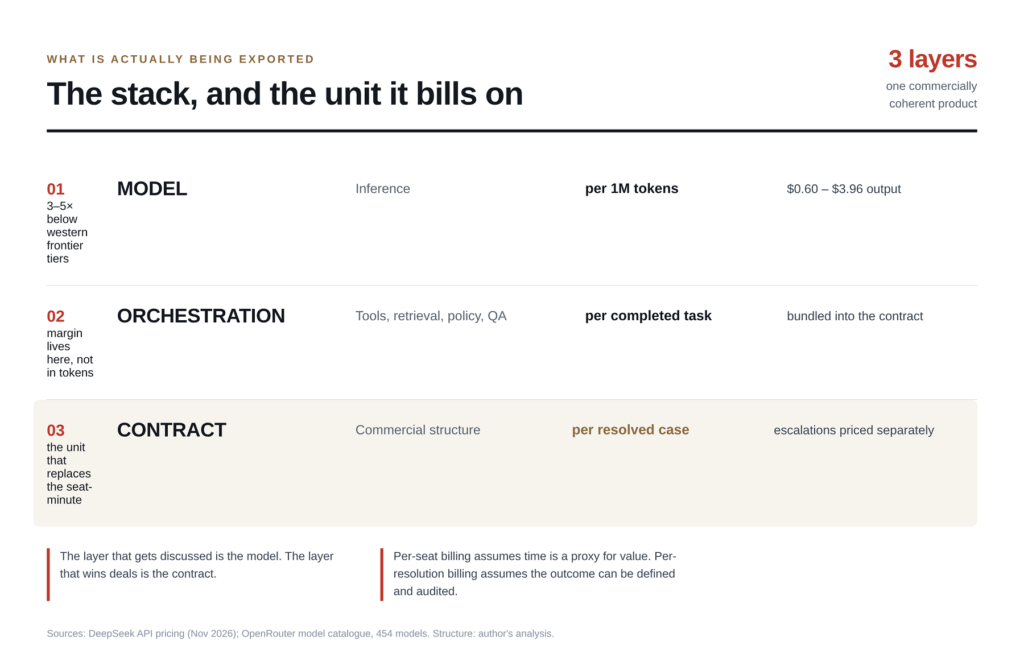
The thing China is exporting is not a chatbot. It is a stack: a model cheap enough to sell at a loss, an orchestration layer that turns conversations into completed transactions, and a pricing model that bills per outcome instead of per seat.
That stack does not compete with outsourcing on politeness. It competes on the definition of the billable unit — and that is where the damage happens.
But here is the part most decks get wrong. The discount is real at the level of compute and labor hours. It is far less real in the price a buyer actually pays per resolved case. By 2030, Gartner expects the fully loaded cost of an AI resolution to exceed three dollars — higher than what many B2C offshore human agents cost per case today. So the arbitrage exists. The question is who keeps it.
1. What changed: it is agents, not chatbots
For about four years, “AI customer service” meant a decision tree wearing a language model as a costume. It answered FAQs, handed off anything with a number in it, and generated a satisfaction score that nobody trusted.
The current generation is different in kind, not degree. An agent takes an action: it reads the order record, checks the return window, issues the refund, reschedules the delivery, writes back into the ticketing system, and closes the loop. The conversation is the interface. The work is the product.
That shift matters commercially because it moves the product out of the software budget and into the labor budget. Software is priced per user per month. Labor is priced per hour, per minute, or per resolved case. Once an AI system is doing labor, it gets compared to labor — and the comparison is brutal for anyone selling hours.
It also changes what “containment” means. A chatbot that deflects a question to a help page has contained nothing. An agent that refunds the correct amount on the correct card has finished a job. Only the second one can be billed per outcome without an argument.
The reframe: The unit of competition is no longer the conversation. It is the completed task.
2. The unit that matters: cost per contact
Two numbers get used interchangeably in this debate, and they should not be.
Cost per contact is what you spend to touch a customer once — a call, a chat, an email. Cost per resolution is what you spend to close the reason they contacted you. The gap between the two is where outsourcing economics have always lived.
Take an offshore seat priced the way the industry actually prices it. A Philippine IT-BPM operation generates roughly 21,800 dollars of revenue per full-time employee per year. Strip out occupancy, shrinkage, and unpaid breaks, and a productive hour lands somewhere near thirteen dollars. A ten-minute contact costs about two dollars and ten cents. A fifteen-minute contact costs a little over three.
Now bill it the way buyers usually see it: a seat-month rate, a minimum commitment, a per-minute overage. Every one of those mechanisms hides the same thing — the buyer is purchasing time, and time is a terrible proxy for value. A two-minute call that saves a subscription is worth more than a nine-minute call about a password reset. The invoice cannot tell them apart.
That is the opening Chinese vendors are driving a wedge into. Not by being nicer on the phone. By refusing to sell time.
3. Why Chinese inference is three to five times cheaper
Model list prices are public, which makes this unusually easy to check.
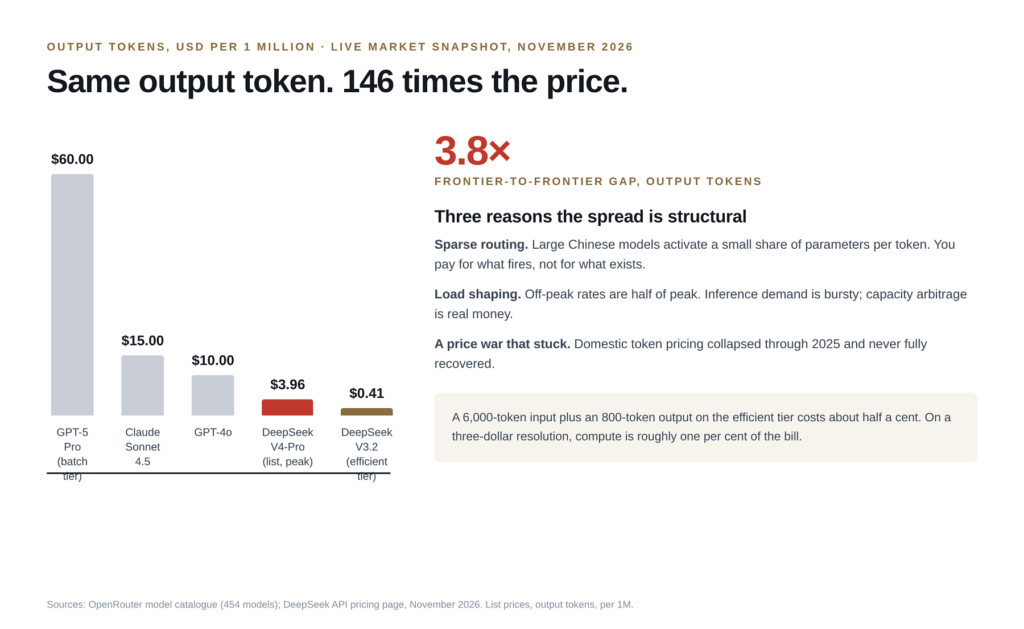
As of November 2026, DeepSeek’s own API lists its frontier model at 1.98 to 3.96 dollars per million output tokens depending on peak or off-peak hours, and its cheaper tier at 0.60 to 1.20. Off-peak rates are half of peak. Cached input is billed at a fraction of a cent per million.
Put that beside the Western market, and the spread is not subtle. On a live cross-provider catalog tracking 454 models, GPT-4o sits at ten dollars per million output tokens, Claude Sonnet 4.5 at fifteen, and the batch tier of a top-end reasoning model at sixty. DeepSeek’s efficient tier trades at 0.41.
Three forces produce that gap, and only one of them is a subsidy.
- Architecture. Sparse mixture-of-experts routing means a large model activates a small fraction of its parameters per token. You pay for what fires, not for what exists.
- Load shaping. Off-peak pricing is not generosity. It is capacity arbitrage, and it works because inference demand is bursty.
- Competition. Domestic Chinese model pricing collapsed into a price war through 2025 and never fully recovered. Token buyers in China behave like buyers of electricity.
The honest caveat: token price is not stack price. A customer service agent that resolves a case might burn six thousand input tokens and eight hundred output tokens. On the frontier tier above, that is roughly half a cent. Even at peak rates, call it a cent.
So compute is about one percent of a three-dollar resolution. Which tells you where the other ninety-nine percent lives — and it is not in the model.
4. The adoption number that actually holds up
The widely circulated claim that seventy percent of CX leaders plan full generative-AI integration is hard to trace to a primary survey. Treat it as folklore. The numbers that do survive scrutiny are stranger and more useful.
Gartner’s August 2026 survey of 3,566 customers found that 87 percent say a company using generative AI for service must still offer a seamless route to a human. In the same research program, only 27 percent of customers said they would try a chatbot again after one bad experience. Meanwhile AI spending by customer service leaders rose 38 percent year over year.
Read those three together and you get the actual market condition: budgets are being approved faster than outcomes are being delivered.
Gartner’s own 2025 survey found that only 11 percent of service leaders said generative AI had met its primary business objective. That is not a failure of technology. It is a failure of scoping. Teams bought a model and expected a workforce.
Which produces the strategic opening. In markets where buyers have already been disappointed once, the pitch that wins is not “our model is smarter.” It is “our stack is auditable, our escalations are clean, and we will only bill you for cases we actually closed.”
5. From seat pricing to outcome pricing
Per-resolution pricing is spreading because it solves a political problem, not just an economic one.
IBM’s Institute for Business Value found 83 percent of business leaders prefer pricing aligned with performance, and 66 percent would pay a premium for it. That is a remarkable number. Buyers are volunteering to pay more in exchange for not carrying the risk of unused capacity.
The mechanics are simple to state and hard to run.
- Define the resolution narrowly. A case counts only if the customer does not contact you again about the same issue within a defined window, and no human touched it. Seventy-two hours is a common window. Any shorter and you are measuring optimism.
- Price the escalation separately. Human-handled cases carry a seat-hour or per-minute rate. Otherwise the vendor is incentivized to escalate everything and bill twice.
- Cap the tail. Adversarial or legally sensitive categories should sit outside the outcome contract entirely, on a managed-service basis.
- Audit the sample, not the dashboard. Pull two hundred closed cases a month and re-open them by hand. Containment numbers that cannot survive a manual audit are marketing.
The strategic consequence is bigger than the pricing table. Once the billable unit becomes the resolved case, the vendor’s incentive flips. Under per-seat pricing, more volume is more revenue. Under per-resolution pricing, more volume per agent is more margin — and the vendor starts behaving like a software company that happens to employ operators, rather than an operator that happens to own software.
That is the actual transfer of power in this market. Not price. Incentive alignment.
6. Where the BPO still wins
Anyone telling you the outsourcing industry is finished has not read a regulated disclosure script out loud.
Five categories stay human, and they stay human for reasons a language model cannot argue with.
- Regulated advice. Anything that constitutes a financial recommendation, a medical triage decision, or a legal position needs an accountable license holder. The model can draft. It cannot be liable.
- Grief, dispute, and escalation. Complaint handling at the top of an escalation ladder is emotional labor. Voice, silence, and pacing carry meaning that text cannot.
- Long-tail languages. A stack that handles thirty languages fluently may handle the thirty-first badly, and the thirty-first is often the one with the regulatory filing attached.
- Physical-world coordination. Courier disputes, field engineer dispatch, damaged-goods inspection. The bottleneck is not conversation.
- Brand voice under scrutiny. Public-facing statements during an incident are a communications function with a legal review attached.
There is a sixth, less flattering reason. Enterprises are bad at change management. Replatforming a service operation requires retraining supervisors, rewriting knowledge bases, renegotiating SLAs, and re-architecting QA. Many buyers will pay a premium to avoid doing that this year. That inertia is a real asset on the incumbent’s balance sheet, and it depreciates slowly.
7. The export routes: Southeast Asia, the Gulf, Latin America
Chinese service-AI vendors are not entering these three markets the same way, because the three markets do not want the same thing.
Southeast Asia buys on price and speed. Indonesia, Thailand, Vietnam, and the Philippines combine high messaging volumes, young mobile-first populations, and thin domestic AI infrastructure. Localization is cheap because the languages are well represented in training data. The constraint is payments and procurement, not technology.
The Gulf buys on sovereignty. Arabic quality matters, but what matters more is where the data sits and who can audit the weights. Deals are structured as joint ventures, local cloud regions, and government-anchored programs. Margin is higher, cycles are longer, and the compliance file has to be immaculate.
Latin America buys on proximity. Spanish and Portuguese coverage plus United States time zones make nearshore economics work, and the region’s outsourcing incumbents are themselves rebuilding on agentic stacks rather than resisting them.
The pattern underneath all three: the vendor that wins is the one that arrives with a referenceable operating model — staffing ratios, escalation design, QA sampling — not the one with the best benchmark score. Models are commoditizing at roughly the speed of bandwidth. Operating discipline is not.
8. Compliance and data residency
This is the section that quietly decides which vendors get shortlisted.
The European picture shifted in 2026. High-risk obligations under the EU AI Act were deferred to December 2, 2027 under the Digital Omnibus package — deferred, not cancelled. Transparency duties for customer-facing systems are already live, which means disclosing that a customer is talking to a machine is now table stakes in Europe, not a differentiator.
Add GDPR’s rules on automated decision-making, China’s cross-border data transfer regime, and a growing list of sector regulators with their own views on offshore processing, and the practical requirement becomes architectural:
- Residency tiers. Route by data class, not by customer. Payment data stays in the region. Transcript data may leave. Nothing leaves without a logged basis.
- Model routing with a paper trail. If a request is served by a model in a different jurisdiction, that has to be visible in the audit log, not buried in an architecture diagram.
- Human-in-the-loop as a compliance control, not a courtesy. The 87 percent who want a route to a human are also why a documented escalation path is now an audit item.
- Shadow inventory. The Cloud Security Alliance reported in April 2026 that 82 percent of enterprises have unknown AI agents operating in their environments. Any serious service-AI deployment should start with discovery, because you cannot govern an agent you did not know you had.
Vendors who treat compliance as a sales obstacle will lose the Gulf and Europe. Vendors who treat it as product will find that it is the moat that survives the price war.
9. How to run a vendor shortlist test
Most evaluations measure the demo. Demos are curated. Here is a protocol that measures the operation.
Step one: build a blinded set. Pull 500 real historical tickets and chats across ten categories, with the resolution outcome stripped out. Send the identical set to every shortlisted vendor. No prompt tuning, no warm-up week, no curated knowledge base.
Step two: score five things, not one.
| Dimension | Weight | What “good” looks like |
|---|---|---|
| Containment without recontact | 30% | Resolution holds for 72 hours, no human touch |
| Escalation quality | 20% | Correct routing, useful summary, no customer repetition |
| Cost per resolved case | 20% | Fully loaded, including integration and QA labor |
| Adversarial robustness | 20% | Refuses unsafe actions, escalates on ambiguity |
| Time to first response | 10% | Under 10 seconds at p95 |
Step three: price the exit. Ask what happens at month 13 when you want to move the knowledge base and the conversation logs. A vendor that cannot answer that question cleanly is planning to keep you.
Step four: run it in your own languages. Not the vendor’s demo languages. Yours, including the messy code-switching ones your customers actually use.
The vendors worth talking to will welcome this. The ones selling a model wrapper will stall.
10. The employment story nobody tells
The Philippines is the cleanest read on where this goes, because the industry publishes its own numbers and revises them in public.
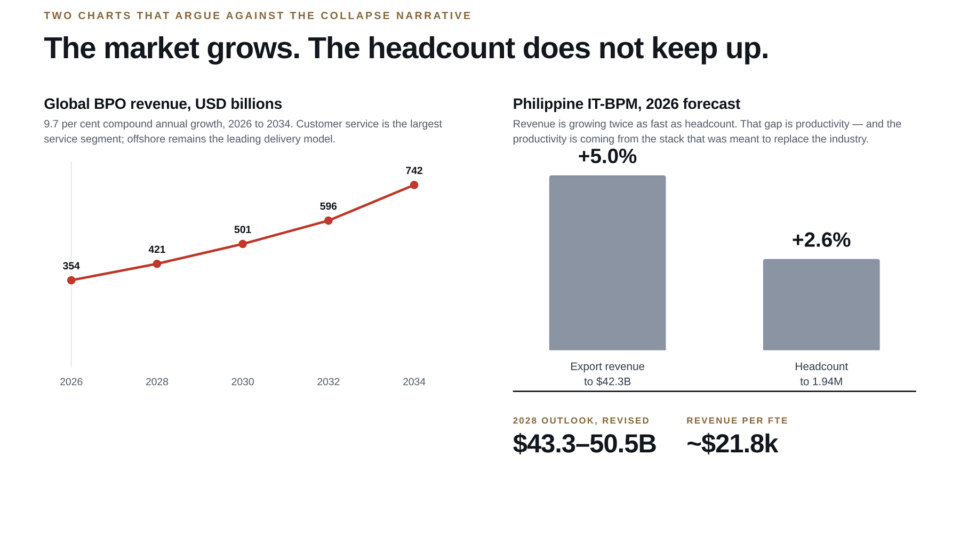
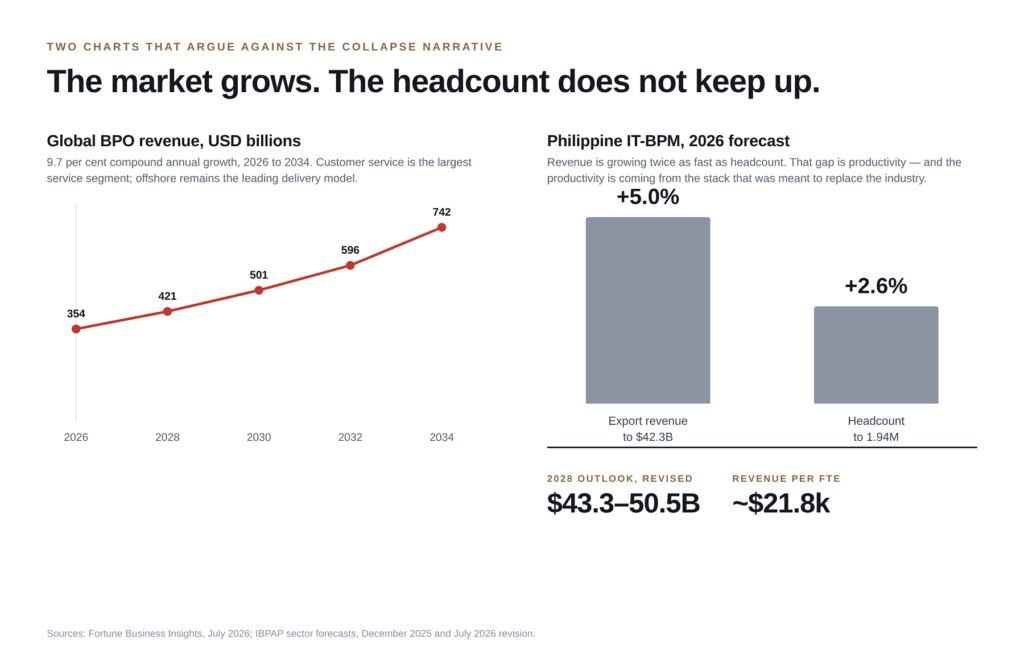
IT-BPM closed 2025 at roughly 38 billion dollars in revenue and 1.82 million workers. The 2026 forecast puts it at 42.3 billion and about 1.94 million — growth of 5 percent and 2.6 percent respectively. In July 2026 the association cut its 2028 outlook to a range of 43.3 to 50.5 billion dollars, down from a more ambitious trajectory.
Look at those two growth rates side by side. Revenue is growing twice as fast as headcount. That is the whole story in one line: the industry is not shrinking; it is getting more productive per seat — and that productivity is coming from the same stack that was supposed to replace it.
Two things follow, and both are uncomfortable for the simple narrative.
First, the job being destroyed is not the entry-level agent. It is the volume of entry-level agent hours. The role that survives is the supervisor, the QA sampler, the escalation specialist, the prompt-and-policy owner. Those roles pay better and there are fewer of them per thousand contacts.
Second, the political economy is real. When a sector employs two million people and a neighboring government starts asking whether AI-handled service constitutes an unfair trade practice, the answer stops being a technology question. Expect labor-adjustment programs, disclosure requirements, and procurement preferences to arrive before any outright restriction does.
11. The unit economics table
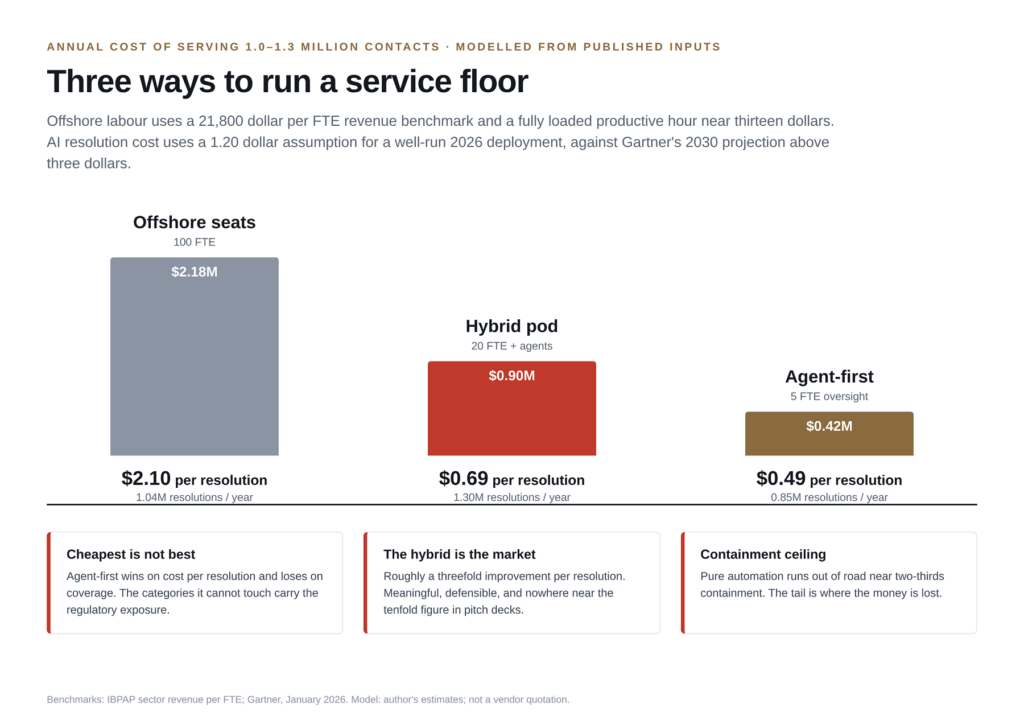
Numbers below are built from published inputs, not from any single vendor’s claim. Offshore labor uses the 21,800 dollars per FTE per year revenue benchmark and a fully loaded productive hour near thirteen dollars. AI resolution cost uses Gartner’s 2030 projection of more than three dollars, discounted to 1.20 dollars for a well-run 2026 deployment. Token costs use current list prices.
| Model | Annual cost | Resolutions / year | Cost per resolution | Notes |
|---|---|---|---|---|
| Offshore seats (100 FTE) | ~2.18M | 1.04M | ~2.10 | 10-minute average handle time |
| Hybrid pod (20 FTE + agents) | ~0.90M | 1.30M | ~0.69 | 65% containment, humans on the tail |
| Agent-first (5 FTE oversight) | ~0.42M | 0.85M | ~0.49 | Lower ceiling; fails on regulated categories |
Read the third row carefully. It is the cheapest per resolution and the least useful, because the categories it cannot touch are the ones that generate the most regulatory exposure. Pure automation is a margin story that runs out of road at about two-thirds containment.
The hybrid row is where the market is actually transacting. It is roughly a threefold improvement in cost per resolution — meaningful, defensible, and nowhere near the tenfold figure that gets printed in pitch decks.
Which brings us to the last honest point in this piece. A tenfold discount exists — but at the level of compute and labor minutes, not at the level of the invoice. Chinese vendors can hold a healthy gross margin at a price Western competitors cannot match, and still charge the buyer somewhere near the incumbent’s number. The difference between those two facts is the business model.
12. What 2027 looks like
Four calls, with the reasoning attached so you can disagree with the reasoning rather than the conclusion.
One: per-resolution becomes the default commercial structure in new service contracts, but not the only one. Hybrid pricing — a platform fee plus a resolution fee plus a managed escalation rate — will dominate, because pure outcome pricing is unbankable for a vendor with a young book of business.
Two: containment plateaus between 60 and 75 percent for consumer categories. The remaining tail is where the money is lost and the regulation lives. Vendors claiming 95 percent are measuring the wrong thing.
Three: the compliance cliff arrives in late 2027 and consolidates the field. When EU high-risk obligations land in December 2027, documentation quality becomes a distribution advantage. Small vendors without audit trails exit Europe.
Four: the BPO market keeps growing — just not the way it did. A market compounding near 10 percent a year to 741 billion dollars by 2034 is not a market in collapse; it is a market being repriced and re-mixed, with fewer seats, more software, and a premium tier for the work machines cannot be trusted with.
The stack is not replacing the BPO. It is buying the BPO’s margin and renting out its headcount.
The bottom line, in four sentences
Chinese service-AI vendors are exporting a model-plus-orchestration stack priced per resolved case, and that unit undercuts per-minute outsourcing by somewhere between threefold and tenfold depending on how you count. Inference is genuinely three to five times cheaper at the frontier tier, which gives those vendors room to win deals on price while keeping margin. But fully loaded resolution cost is drifting up toward the offshore seat, because orchestration and QA — not tokens — dominate the bill. The industry that loses is the one selling hours. The industry that survives sells outcomes and charges a premium for the cases a machine should not touch.
Frequently asked questions
Is per-resolution pricing actually cheaper than per-seat pricing, or just differently risky?
Both. It is cheaper per completed task in most hybrid deployments, and it transfers volume risk from the buyer to the vendor. The catch is that “resolution” is a definition, not a fact. If the definition is loose, you have bought a discount on a metric rather than a discount on cost.
If token prices keep collapsing, why is cost per resolution going up?
Because tokens were never the expensive part. Integration, retrieval quality, policy design, QA sampling, escalation handling, and audit logging are. Falling unit prices also invite heavier consumption — more retries, longer context, more tool calls — so a cheaper token often produces a bigger bill.
Can a Chinese model be deployed in a regulated Western market at all?
Yes, with architecture rather than promises: in-region hosting, regional model endpoints, logged routing, and a documented escalation path. The constraint is rarely model capability. It is data provenance and auditability, which are engineering problems with legal consequences.
What should a buyer do first — pilot a vendor, or rewrite the SLA?
Rewrite the SLA. A pilot run against a per-seat contract will optimize for seats, because that is what the contract pays for. Change the billable unit first, then pilot, or you will measure the wrong thing beautifully.
Does this kill outsourcing jobs?
It compresses the volume of entry-level hours and raises the value of supervisory, quality, and escalation roles. The sector’s own forecasts show revenue growing faster than headcount, which is exactly what that looks like in aggregate data. Whether the transition is managed or abrupt is a policy question, not a technology one.