Nobody Budgeted for Verification: Creator Marketing’s 2026 Cost Shock
Influencer Marketing After Deepfakes: The Trust Rebuild Nobody Planned
Argument in one line: disclosure did not restore trust — it displaced it. Audiences now price process signals (uncut footage, live interaction, receipts) above faces.
1. What actually changed in eighteen months
Eighteen months ago, a disclosure line was insurance. Today it is a receipt that proves very little.
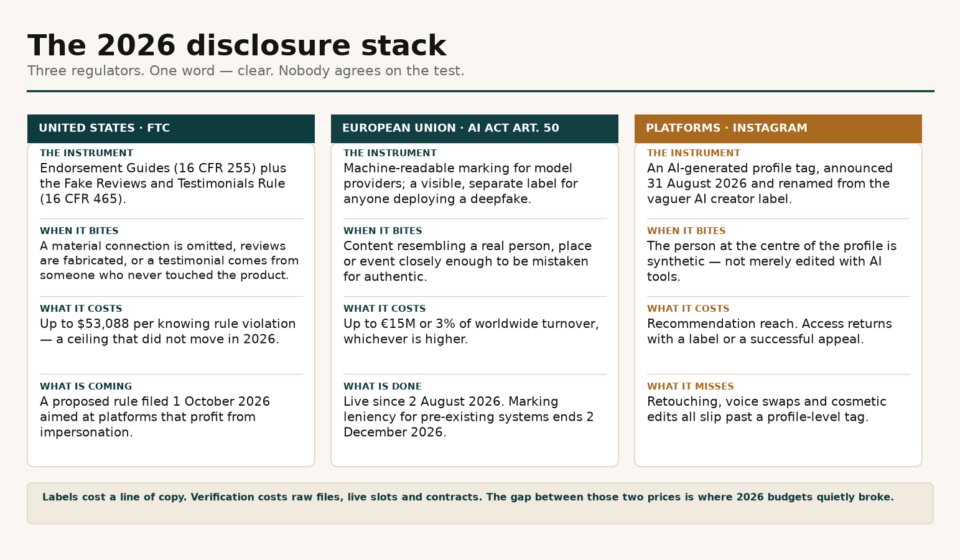
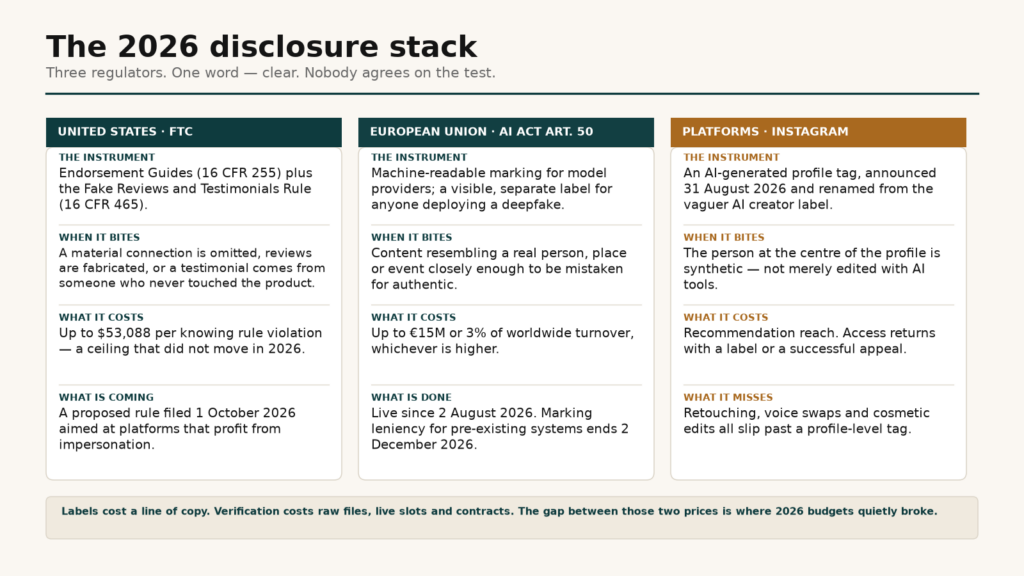
Three clocks moved at once. Europe’s transparency rules for synthetic content became enforceable on August 2, 2026, with fines reaching €15 million or 3% of worldwide turnover, whichever is higher. Instagram renamed its vaguer “AI creator” tag to “AI-generated profile” on August 31, 2026, and started treating an unlabeled synthetic persona as a distribution problem rather than a creative one — profiles that fail to disclose can lose recommendation eligibility. And in the United States, the penalty ceiling under the FTC Act stayed flat at $53,088 per violation, which sounds like a freeze until you notice that the ceiling multiplies by the number of assets.
So the compliance question got easier to answer, and the commercial one got harder. That is the whole story, and almost nobody budgeted for it.
The consumer data landed at the same time. Cint surveyed roughly a thousand US consumers in August 2026 and found that 74% believe brands and creators have a duty to disclose AI use in advertising, while 44% say discovering undisclosed AI-generated advertising would reduce their trust in the brand. Read the ranking twice, though. 43% name undisclosed AI or synthetic media as a major reason for losing trust, ahead of partnerships with controversial influencers at 38% and disguised sponsored content at 37%. Synthetic deception now outranks the two failures the industry spent a decade policing.
Nor is this abstract anxiety. 46% say they dislike seeing AI-generated people in ads, making synthetic humans the most disliked category tested, while realistic landscapes — no body, no claim — were the most liked. 93% say trust affects purchase decisions.
Put those three together and the industry’s assumption collapses. The assumption was: label it, and trust survives. The data says: label it, and trust transfers to something else.
2. The disclosure stack, and the three different questions it asks
Most teams treat disclosure as one obligation. It is three, and they do not measure the same thing.
| Layer | Who enforces | The question it asks | The object being judged |
|---|---|---|---|
| Conduct rules | US FTC | Was a material connection disclosed? | The relationship |
| Transparency rules | EU member states | Was synthetic content disclosed? | The artifact |
| Distribution rules | Platforms | Is this persona synthetic? | The account |
Look at the right-hand column. The FTC polices the relationship between seller and speaker. Europe polices the artifact — did a machine make this, and did you say so? Instagram polices the account’s identity. None of them asks the only question a buyer cares about: is the claim true?
That gap is not a drafting error. Regulators can verify a missing disclosure in an afternoon. Verifying whether a skincare claim holds requires evidence nobody has. So the law regulates what it can see.
The European version is the most technically demanding, and also the most misunderstood. Under Article 50(2), providers of generative systems must mark outputs in a machine-readable way. Under Article 50(4), anyone who deploys a deepfake must visibly disclose it. Under 50(5), that disclosure must be “clear and distinguishable” and delivered “at the latest at the time of the first interaction or exposure.”
Read that last clause twice. The European Commission’s final guidance, published July 20, 2026, states that a provider’s machine-readable mark does not discharge the deployer’s duty — the visible label has to be added by whoever publishes. Which means the obligation falls on the agency and the creator, not the model vendor. The vendor ships a watermark; you carry the liability.
3. The arithmetic nobody ran
Start with the number. $53,088 is the maximum civil penalty for a knowing violation of a trade regulation rule under section 5(m)(1)(A) of the FTC Act, as set out in 16 CFR 1.98. It has applied since January 2025, and in September 2026 the Commission confirmed it would not rise in 2026 — not as a policy choice, but because the inflation adjustment was canceled after the Bureau of Labor Statistics could not publish the October 2025 CPI-U during the government shutdown. A procedural accident froze the number at the moment synthetic output was scaling.
Do not read “frozen” as “small.” The penalty is per violation, and a violation is an asset. One brief that produces twelve undisclosed posts creates twelve potential exposures: $637,056. Twenty-four assets come to $1,274,112 — and an always-on program at four posts a week crosses a million dollars of theoretical exposure in about five weeks. Whether one post is one violation is an enforcement question rather than a settled one, but procurement should plan on the harsher reading. The arithmetic is already doing the arguing.
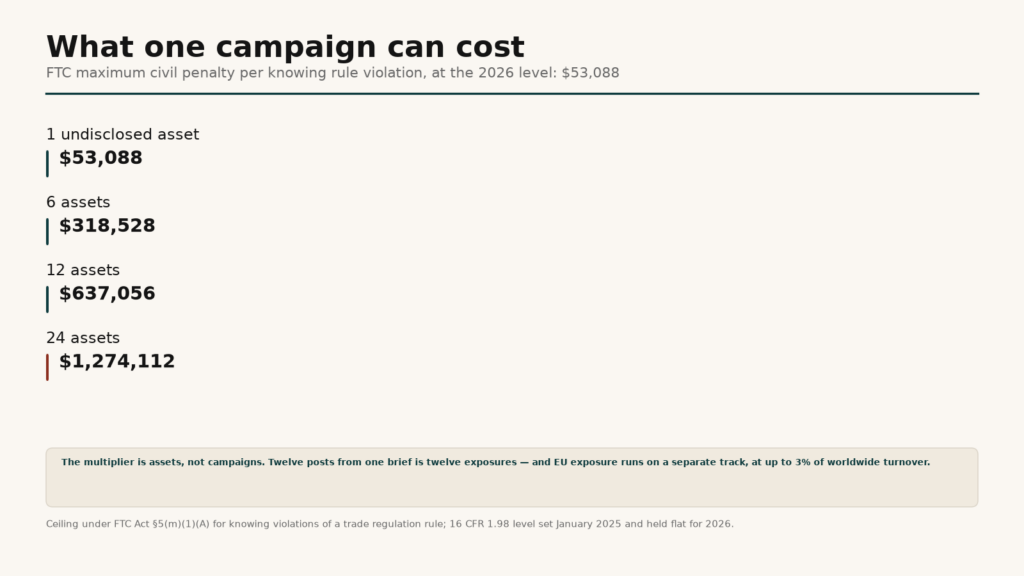
Here is the part that should worry a procurement lead. A fixed penalty per asset means the marginal cost of the twelfth post equals the marginal cost of the first. There is no volume discount, no learning curve, no economies of scale. Yet synthetic content is the only creative format on earth that gets cheaper per unit as you produce more of it. Regulation built a linear penalty and the market built an exponential supply curve, and the two are now pointed at each other.
Europe adds a second track that does not care about asset counts: up to €15 million or 3% of worldwide turnover, whichever is higher, for breaching Article 50. At $50 million in revenue the percentage test yields $1.5 million, comfortably under the €15 million floor — so at that scale the floor is the number that bites. The percentage only starts to matter above roughly €500 million in worldwide turnover.
4. Why a label cannot carry the weight we put on it
Three failures, stacked. Any one alone would be survivable. Together they explain why disclosure has not rebuilt trust.
The timing failure. Article 50(5) mandates disclosure at first exposure. Think about what that means in practice. The label appears at the same instant as the persuasion, on the same screen, competing with a hook designed by professionals to hold attention. A disclosure delivered at the start of a fifteen-second video is not a warning. It is a caption. Legally correct, cognitively useless.
The technical failure. Article 50(2) requires marking that is effective, interoperable, robust, and reliable. As of the enforcement date, no single technology meets all four. C2PA content credentials — the cryptographically signed provenance record developed with Adobe, Microsoft, the BBC, and the New York Times, and now built into camera firmware from Sony, Nikon, and Canon — can be stripped by a screenshot or a re-upload. Imperceptible watermarks such as Google DeepMind’s SynthID survive compression better, but as of this writing there is no shared, independent benchmark for comparing reliability across providers. The Commission’s own Code of Practice responds by mandating a layered approach: metadata, watermark, and logging. Not because one layer works, but because each covers a failure mode the others cannot.
The behavioral failure. A label answers “was this made by a machine?” It does not answer “should I believe the claim?” Those are different questions, and the second one is the only one that changes a purchase. Worse, mandatory labeling creates an adverse selection problem: once non-compliance is common, the absence of a label stops being informative. Audiences learn to ignore the tag, and the honest advertiser pays the cost of a disclosure that no longer functions.
There is a fourth consequence, quieter and more expensive. Disclosure transfers the interpretive burden to the viewer at the worst possible moment — mid-scroll, mid-pitch, with no time to act on the information. Trust is not a verdict people reach in half a second. It is a prediction about future behavior. A label says nothing about anyone’s future behavior.
5. The signals that do work — because they are expensive
Forget psychology for a minute and think like a forger. A signal is only worth trusting when faking it costs more than the trust it buys. That is the entire mechanism, and it explains the migration better than any survey.
Faces are cheap now. Voices are cheap. Follower counts were never expensive. Production polish is a template. So the market re-priced, and it moved to three things that remain stubbornly costly to fake at volume.
Continuity. One take. Visible timecode. No cut between the claim and the object. A raw file, not a delivery file. The reason this works is not aesthetic: editing is where deception hides. A cut is a place where a product can be swapped, a claim can be stitched to a different shot, a face can become another face. An unbroken minute is a liability transfer, and it is expensive because it forbids the retake.
Liveness. Unscripted questions, answered badly in real time. Objection handling that goes sideways. The commercial logic is brutal: latency and improvisation are the two hardest things to synthesize convincingly at scale, and a live audience is an adversarial tester. A pre-recorded synthetic host can be perfect. A live one has to be present, and presence is not renderable.
Receipts. An order ID. An invoice. A named seller. A returns route that a person can actually use. This is the signal most marketers underrate, because it is not creative at all — it is operational. But it is the only one that answers the question trust is really about: if this goes wrong, who absorbs the loss? A receipt is a promise with a remedy attached.
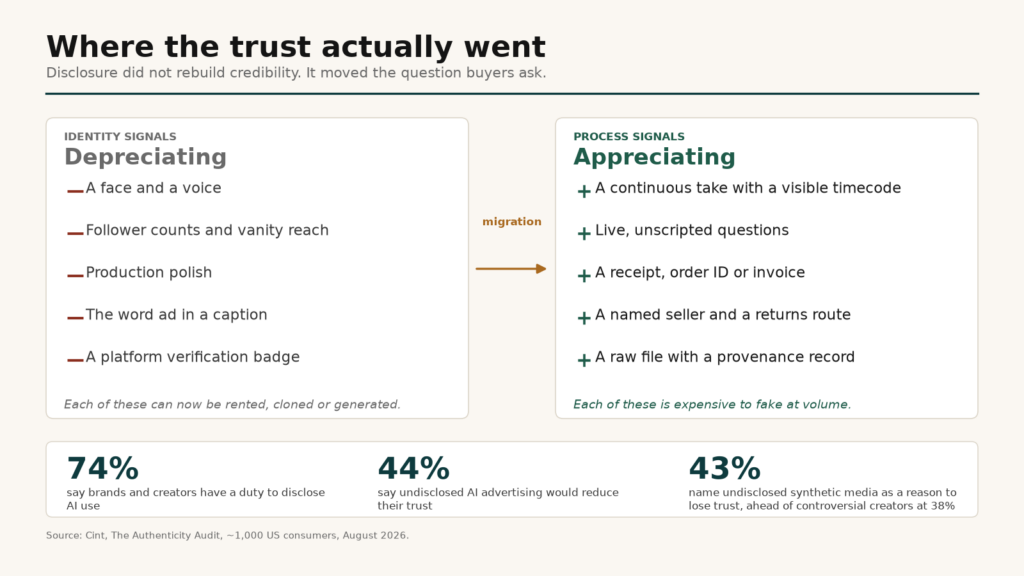
Notice what these have in common. None of them is a statement about identity. All of them are statements about production and recourse. Disclosure tried to restore trust by clarifying what the audience was looking at. The market restored a thinner, harder kind of trust by clarifying how it was made and what happens next.
6. Live versus synthetic, on cost
The honest version of this comparison is uncomfortable for both sides.
Synthetic wins on cost per asset, decisively. No talent fee, no usage window, no studio day, no call time, no reshoot because a claim shifted or the packaging changed color. You can produce forty variants before lunch and localize them into nine languages by Thursday.
Live wins on cost per trusted conversion — and that is the only number that survives contact with a finance team.
| Cost line | Live / human | Synthetic | What decides it |
|---|---|---|---|
| Talent and usage rights | Fee plus a defined usage window | License to a model or a persona | Whether the likeness is exclusive |
| Production | Crew, studio, schedule | Prompting, review, versioning | Number of variants, not hours |
| Compliance | Label only if AI-assisted | Visible label plus marking records | Number of assets |
| Reshoot risk | High — humans change, products change | Low on visuals, high on claims | Claim volatility |
| Distribution | No penalty | Reach risk if unlabeled | Platform enforcement |
| Trust drag | Baseline | Measured discount on conversion | Category and claim type |
Treat the shape of that table as the model and your own rate card as the inputs. Then apply a single rule: if the asset carries an embodiment claim — skin, hair, teeth, fit, taste, sweat, dosage, “I use this every morning” — the synthetic saving is not a saving. It is a loan against future conversion, and the interest rate is whatever your returns rate does next quarter.
The break-even is easy to state. Synthetic pays until the trust discount exceeds the production delta. If a synthetic asset costs 30% of a live one, it can afford to convert at 70% of the live rate and still win. Most categories do not clear that bar when the claim is physical. Most do when the product is an object and the claim is a specification.
7. Contracts became the real trust instrument
Here is an uncomfortable thought for anyone who still thinks of disclosure as a marketing task. The label has no remedy attached. The contract does. Which means the most credible trust artifact your brand produces in 2026 may be a clause.
Eight terms worth adding or tightening this quarter:
- Likeness, defined broadly. Cover the person, their voice, their name, their signature gestures, and any synthetic twin derived from them. “Image rights” is too narrow a phrase for a model trained on forty hours of footage.
- No training without written consent. Explicit prohibition on using delivered footage, audio, or drafts to train or fine-tune any model, including the creator’s own.
- No substitution. The creator warrants that the person appearing in approved content is the person contracted. Any synthetic stand-in is a material breach, not a creative choice.
- Disclosure warranty. The creator and agency warrant that every asset complies with the disclosure rules of each market where it runs, and that the label text and placement will be supplied for approval.
- Raw-file delivery. Continuous takes, original audio, ungraded footage, delivered on a schedule — not on request. Files withheld until a dispute are worthless as evidence.
- Audit right. You can inspect source files and account status on reasonable notice. Cheap to ask for, and it changes behavior before anyone uses it.
- Indemnity, with clear eyes. An indemnity allocates cost; it does not transfer regulatory liability. Regulators fine the advertiser whose ad ran. Price the indemnity accordingly.
- Termination and moratorium. Immediate termination on a deepfake incident involving the contracted person, plus a defined period after termination during which their likeness cannot be licensed to a third party.
One more clause, increasingly non-negotiable: a ban on sublicensing delivered content to AI vendors. Most agencies would not do it deliberately. Some have already done it by accident, through a platform’s default terms.
8. Verification is an operations problem, not a legal one
The instinct is to make this a policy. It should be a process with tiers, because verification costs money and the temptation is to apply it evenly — which means applying it where it is cheap and skipping it where it matters.
Tier the risk by likeness value, not by fee. A nano-creator with no public profile is low-risk to impersonate and cheap to check. A celebrity likeness is the most impersonated object in the category and the least likely to be checked, because the deal is expensive and the contract took four months. Risk-weighting by exposure to impersonation rather than by spend fixes the inversion.
Verify in four passes. Identity (government ID plus liveness, not a selfie). Ownership (account creation history, admin changes, login geography). Provenance (does the content carry credentials, or can a raw file be produced on demand). Behavior (follower growth curves that do not look bought, engagement ratios that survive a manual read).
Sample the raw files. Not every asset. A random slice, every cycle, with a consequence attached. Announce the sampling rate and never announce which assets.
Monitor impersonation in both directions. Creators get cloned to sell to their audience; brands get cloned to sell to everyone else. Most teams monitor neither, then discover the problem from a customer complaint.
Set a takedown SLA and a named owner. Forty-eight hours, one person, one tracker. A policy without a queue is a wish.
9. How to measure something as slippery as trust
Four metrics and one guardrail. Nothing here replaces a brand tracker, but together they tell you whether the process signals are doing work.
Synthetic suspicion rate. The share of comments, replies, and DMs asking whether the content or the person is real. Rising suspicion on live content is a red flag; falling suspicion on synthetic content with a clear label is a green one. It is a sentiment proxy you can actually extract at scale.
Process proof coverage. The percentage of paid assets that have both a raw file on record and a provenance record. This is a supply-chain metric, and unlike most trust metrics it cannot be gamed by a creative director.
Trust-adjusted CPA. Conversion cost on assets with process proof, against a matched holdout without it, in the same geo and week. If the delta sits inside the noise band, you bought reassurance you cannot charge for.
Recourse rate. Return rate, complaint rate, and refund rate by content type. This is trust revealed by behavior rather than stated in a survey, and it is the metric least likely to flatter you.
The guardrail: track disclosure recall, but only as a leading indicator. Recall can climb while purchase intent falls, and a team optimizing recall will produce beautifully labeled content that nobody buys from. Watch the pair or watch neither.
One warning about method. Register the hypothesis before the campaign, not after. Trust measurement is uniquely vulnerable to post-rationalization, because everyone can find a number that supports the creative they already approved.
10. Where synthetic genuinely wins
The argument is not that synthetic content is bad. It is that synthetic content is narrow, and the industry keeps buying it broadly.
It wins when the product is an object, not a body. Electronics, furniture, packaging, tools, machinery, ingredients on a counter. The claim is a specification, and a specification can be shown without a person warranting it.
It wins on catalog scale. Forty colorways, nine markets, three aspect ratios, four price points. Here the human alternative is not “better,” it is “not happening.”
It wins on explanation of the abstract. B2B process flows, financial mechanics, how a service works. Nobody needs a body to believe a diagram.
It wins on localization. Dubbing and re-performance across languages, where the alternative is either subtitles or a budget line nobody approves.
It wins where the label is the brand promise. A tool, a platform, a studio selling AI capability. Disclosure is not a cost there; it is the pitch.
It loses wherever the claim requires a body to have been somewhere. Skin texture. Hair fall. Teeth whitening. Fit across a size range. Food texture on the first bite. Health outcomes. Financial advice. Safety claims. Any first-person usage testimony. In these categories the synthetic asset is not a cheaper version of the proof — it is the absence of proof wearing the proof’s clothes.
One test, and it is worth applying to every brief: does the claim require that a specific body was in a specific place at a specific time? If yes, no synthetic asset can warrant it, and no label can rescue it. If no, the only question left is price.
11. Disclosure templates that do not insult the audience
Most disclosure copy fails for the same reason most legal copy fails: it answers the regulator’s question and ignores the viewer’s. These six blocks answer both, and each one is short enough to survive a creative review.
Short-form overlay (six words or fewer). “AI presenter. Product footage unedited.” Two facts, one line, no hedging.
Caption block. “This video uses an AI-generated presenter. The product demonstrations are unedited and were filmed on [date]. Raw files and content credentials available on request.” The date matters more than it sounds — it is checkable.
Live pinned comment. “No cuts, no edits. Questions open for the next 40 minutes — ask anything, including the awkward ones.” The invitation is the signal. A live session that dodges hard questions burns more trust than it builds.
Audio and podcast read. “The voice you are hearing is synthetic. The interview answers were recorded with a human, unedited.” Audio needs a second clause because the ear cannot check the way the eye can.
Process note, three lines, for static and landing pages. What is synthetic. What is unedited. Where the receipt is. Three lines, no paragraph, no asterisk leading to a wall of terms.
Machine-readable line, for the asset record. A structured statement of generation method, tool, date, and human review, sitting alongside the C2PA credentials rather than replacing them. This is the one block written for machines, and it is the one that will matter most as procurement systems start reading metadata.
The principle behind all six: never let the label be the only thing you say. A disclosure that stands alone reads as a confession. A disclosure attached to evidence reads as competence.
12. What to stop buying
Eight line items, in descending order of how much they cost you.
- Deals priced on follower count. The metric is purchasable, the audience is not, and the number has been unreliable since long before synthetic media arrived.
- Engagement-only KPIs. Engagement is the metric synthetic content is best at manufacturing, because synthetic content is optimized for attention by construction.
- Celebrity likeness without a synthetic-twin clause. You are buying the most impersonated face in the market and insuring none of it.
- “AI influencer” packages with no profile-level disclosure. On Instagram since August 31, 2026, that is a reach problem; in Europe it is a turnover problem.
- Agencies that will not hand over raw files. The refusal is the finding. Whatever the reason, you cannot verify what you cannot see.
- Disclosure by hashtag only. A buried tag is the compliance equivalent of a disclaimer in the footer, and regulators on both sides of the Atlantic have said so repeatedly.
- Uncapped always-on synthetic volume. A fixed penalty multiplied by unlimited assets is a risk model, not a media plan.
- Third-party “authenticity scores.” If the vendor will not tell you what the score measures and how it was validated, you have bought a number with a logo on it.
Summary
Eighteen months of regulation did not rebuild trust in influencer marketing; it relocated it. Disclosure rules made synthetic content legible and, in doing so, made the label ordinary — and an ordinary label stops functioning as evidence. What audiences did next was rational: they stopped asking whether a face was real and started asking whether the claim could be checked and who would absorb the loss if it could not. That is why unedited footage, live interaction, and receipts now outperform polish, follower counts, and badges. The economics point the same way. A fixed penalty per asset punishes exactly the volume model that synthetic production exists to serve, and no brand has budgeted for the verification layer that would make the penalty irrelevant. The rebuild nobody planned is not a disclosure project. It is a procurement, contracting, and operations project, and the brands that win the next two years will be the ones that stop treating a label as a substitute for evidence.
Frequently asked questions
If disclosure is legally required anyway, what does it add to talk about trust?
Because compliance and credibility are different products. A label satisfies a regulator and, at best, informs a viewer. Trust is a prediction about future behavior, so it responds to signals about process and recourse — not to a statement about origin. You can be fully compliant and still be the least trusted brand in the category, and the 2026 data suggests that is a common outcome rather than an edge case.
Does the $53,088 figure apply to every misleading influencer post?
No, and the imprecision matters. It is the maximum civil penalty for a knowing violation of a trade regulation rule under section 5(m)(1)(A) of the FTC Act, as set in 16 CFR 1.98 — the route that runs through rules such as the Fake Reviews and Testimonials Rule. Ordinary deception cases are litigated under section 5 without that per-violation ceiling. The number is best read as the top of the range for a rule-based violation, multiplied by assets, and it should shape procurement rather than legal strategy alone.
Can watermarking and content credentials just solve this?
Not yet, and possibly not alone. C2PA metadata is stripped by a screenshot or a platform re-upload; imperceptible watermarks survive more processing but have no shared independent benchmark. The EU’s own compliance architecture responds by requiring a layered approach and a separate visible label from the deployer — an implicit admission that no single technical layer is sufficient. Provenance tells you where a file came from. It does not tell you whether the claim inside it is true.
Is a virtual influencer always a bad buy?
No. It is a bad buy when the claim is embodiment — skin, fit, taste, health, first-person usage — and a good buy when the claim is a specification, a process, or a price. It is also a bad buy when the persona is undisclosed, because that turns a creative decision into a distribution and turnover risk. The category of the claim, not the nature of the presenter, decides the answer.
What is the cheapest credible process signal for a small brand?
Receipts, because they already exist. Publish an order ID format, name the seller, show the returns route, and date the footage. None of that requires a studio, a live slot, or a provenance pipeline. The second cheapest is a single unbroken take — a phone, a timer, and no cuts — which costs nothing but discipline and outperforms most production budgets on the one dimension that now matters.