What Martech Teams Should Ask Before Signing an AI Contract in 2027
Open-weight models were supposed to win on quality. They mostly did not. What they won is duller and far more useful to the person who signs the invoice: a price you can plan against.
TL;DR
- The three flagship APIs now sit within 2.5× of each other on input price. In 2025, the same three vendors were 12× apart.
- The comparison that moves budgets is no longer frontier against frontier. It is frontier against workhorse, and on verified list prices that gap runs from roughly 10× to 50×.
- Cheap tokens do not shrink spend. They raise volume and multiply retries. The only number that survives contact with a finance team is cost per accepted outcome.
- Open weights buy a frozen artifact and a price ceiling. Closed APIs buy a moving target and a deprecation calendar.
- The 2027 question is not which model is cheapest. It is which vendor can change your unit economics without asking you first.
1. One chart that settles the argument
Frontier list prices have converged. As of November 2026, the three flagship APIs cost between $2 and $5 per million input tokens and between $12 and $30 per million output tokens. Twelve months earlier, the same three vendors were 12× apart on input price: $15 against $1.25.
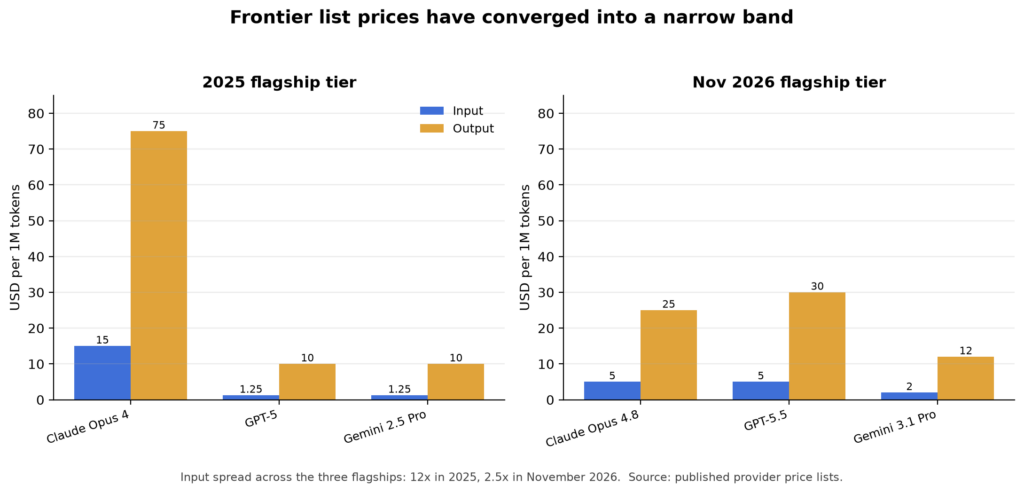
Convergence happened for reasons that have nothing to do with good manners. Capability at the top of the market compressed into a four-point band: on Epoch AI’s capability index, the three leading models sit within four points of each other, near the top of a scale that reaches 166. No vendor can sustain a 5× premium on that gap without a story to carry it. And every vendor now competes on the same public benchmarks, which means every buyer arrives with the same comparison table.
What the chart means for a budget
When three suppliers charge roughly the same for the top tier, model selection stops being a procurement lever and becomes an architecture lever. You cannot halve your bill by switching flagships; the top tier is within 2.5× of itself. You can halve it by deciding that 70% of your traffic never needed a flagship.
That is the whole shift in one sentence. The top of the market flattened. The bottom of the market collapsed.
What the chart hides
Two things.
The first is that price per token is not price per unit of work. A model that needs 1,800 output tokens to say what another says in 900 is twice as expensive at identical list prices. Verbosity is a hidden tariff, and it is not published next to the rate card.
The second is that the flagship tier is not where the volume sits. Marketing workloads are repetitive, templated, and high-volume. Most of that traffic belongs one tier below the thing you put in the pitch deck.
2. The 10–50× spread that actually moves the line item
Here is the number worth taking to your CFO. Between the flagship tier and a competent workhorse tier, the gap is not 20%. On published list prices it runs from roughly 10× to 50× on input, and from 8× to 60× on output.
A definition before the table, because the term gets used loosely. Open weights means the model’s parameters can be downloaded and run outside the vendor’s infrastructure. It does not mean open source in the licensing sense; several open-weight releases carry commercial conditions that an OSI license would not allow.
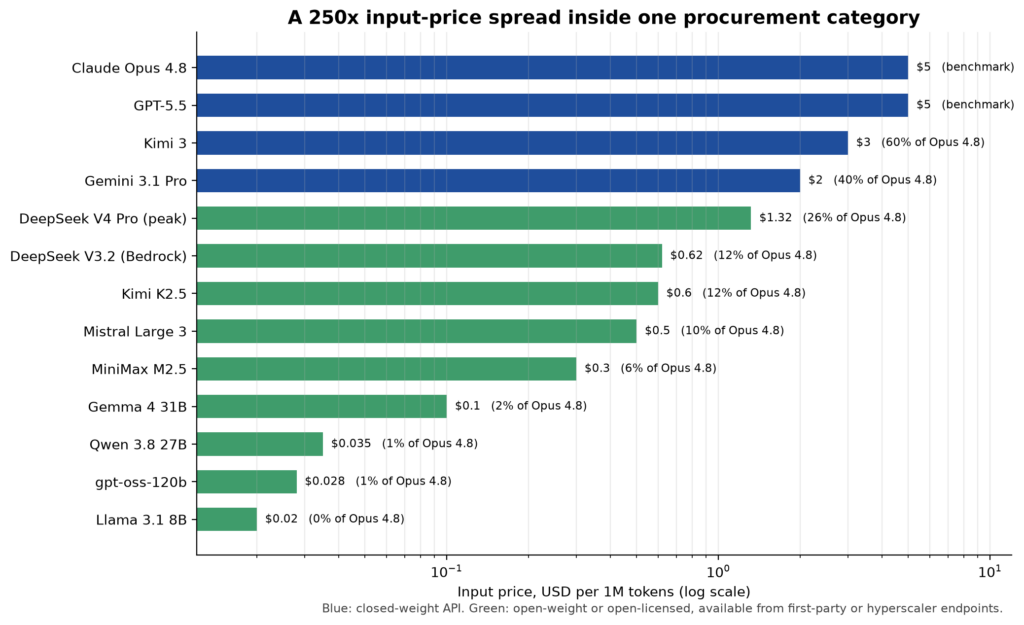
Representative published prices, USD per million tokens, November 2026. Every row below comes from a provider’s own price list or from a hyperscaler’s official on-demand schedule, not from a reseller.
| Model | Weights | Input | Output | Cached input |
|---|---|---|---|---|
| Claude Opus 4.8 | Closed | 5.00 | 25.00 | 0.50 |
| GPT-5.5 | Closed | 5.00 | 30.00 | 0.50 |
| Claude Opus 5.5 | Closed | 4.00 | 20.00 | 0.20 |
| Gemini 3.1 Pro | Closed | 2.00 | 12.00 | 0.20 |
| Kimi 3 | Open | 3.00 | 15.00 | 0.30 |
| DeepSeek V4 Pro, peak hours | Open | 1.32 | 3.96 | 0.044 |
| DeepSeek V4 Pro, off-peak | Open | 0.66 | 1.98 | 0.022 |
| DeepSeek V3.2 on Bedrock | Open | 0.62 | 1.85 | — |
| Kimi K2.5 on Bedrock | Open | 0.60 | 3.00 | — |
| Mistral Large 3 on Bedrock | Open | 0.50 | 1.50 | — |
| MiniMax M2.5 on Bedrock | Open | 0.30 | 1.20 | — |
| Gemma 4 31B on Bedrock | Open | 0.14 | 0.40 | — |
Read that table by column, not by row. The input column tells you what it costs to give a model context. The output column tells you what it costs to let the model talk. For marketing work, input dominates: briefs, brand guidelines, product catalogs, and prior conversation all arrive as context, and the same context arrives a thousand times a day.
Why the spread survives convergence
Three reasons, and none of them will disappear in 2027.
Serving costs differ. A 27-billion-parameter model does not cost the same to run as a frontier model with a million-token context window. The price gap partly reflects compute, honestly.
Vendors price to task value, not to cost. A model used for legal review can carry a higher rate than a model used for product descriptions, even at identical compute. Rate cards embed an assumption about what your work is worth.
The cheap tier sells fewer guarantees. Shorter effective context. More variance in instruction-following. Less safety tuning. Thinner support. Sometimes a license clause that constrains commercial use, or a weight release that lags the hosted version by a quarter.
A 50× gap is not a discount
It is a different product with a different risk profile.
If you buy the 50× cheaper tier and it silently mangles 6% of your product descriptions, you have not saved money. You have moved the cost from the cloud bill to the merchandising team, where it is invisible, unbudgeted, and much harder to fix. The cheap tier is only cheap where you can measure its failures.
There is also a residency premium hiding inside the same price list. DeepSeek V3.2 costs $0.62 per million input tokens in US East and $0.74 in European regions. Gemma 4 31B costs $0.14 in US East and $0.17 in Frankfurt. That is a 19% to 21% surcharge for keeping data in-region, stated openly by the hyperscaler. Put it in the model before someone discovers it in an audit.
3. Cost per outcome, not cost per token
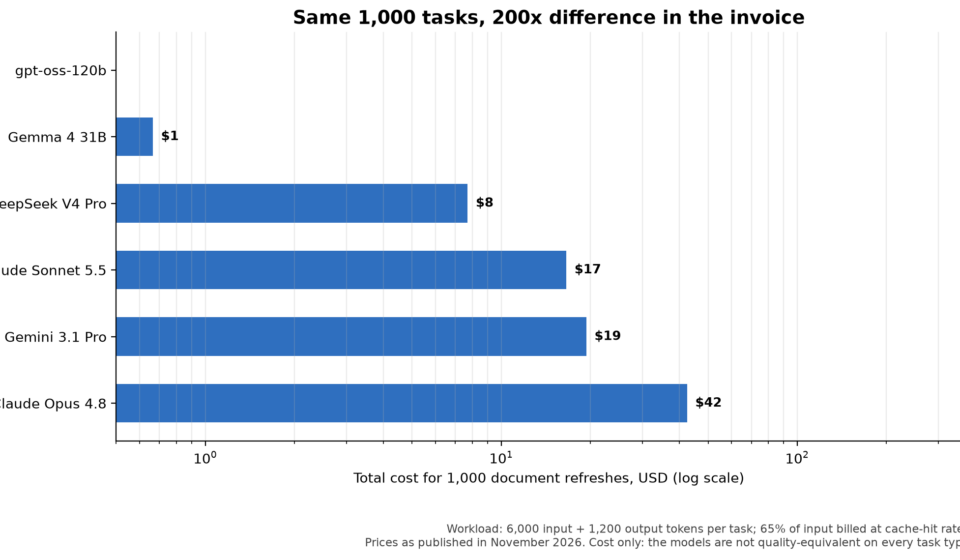
Take a realistic marketing workload and price it properly. One thousand document refreshes. Six thousand input tokens each, because the brand guide and the prior version travel with every request. Twelve hundred output tokens each. Sixty-five percent of the input is a stable prefix that qualifies for cache-hit pricing.
The invoice ranges from about $42 on the flagship tier to about $0.21 on a small open-weight model served through a marketplace endpoint. Same task count. Same token counts. A 200× difference in what finance sees.
Now the correction that matters. Those two numbers describe the same work only if both models produce usable output at the same rate. They do not. The denominator nobody puts in the deck is acceptance: what share of generated assets ship without a human rewrite.
Cost per accepted outcome = (unit cost × attempts) ÷ acceptance rate
Run the arithmetic both ways. A cheap model that needs 1.8 attempts and passes 80% of drafts costs about 2.25 units per accepted outcome. A model that needs 1.05 attempts at 25× the price, passing 95%, costs about 27.6. The cheap model wins by an order of magnitude. Now reverse one assumption: the cheap model fails quietly on 6% of outputs, and the failure surfaces downstream, in a customer email or a product page, where fixing it costs a hundred times the token. It loses to almost anything.
The research literature has been pointing at this for three years. FrugalGPT showed that a learned cascade could match the strongest single model’s performance with up to 98% lower cost, by learning which queries needed which model. RouteLLM showed routers cutting cost by more than 2× in some settings without a measurable quality loss, and, more usefully, that the routers kept working when the underlying models were swapped. Both results point the same way: the money sits in the routing decision, not in the rate card.
The measurement you can run this quarter
Pick your highest-volume generative workflow. Sample 200 outputs. Have a human mark each one ship, light edit, or rewrite. Multiply by your real token volumes. You now have an acceptance rate, a cost per accepted outcome, and a defensible number for the next budget cycle.
Most teams skip this because it takes two days and produces an unflattering number. That unflattering number is the only one that will survive a CFO review.
4. Self-hosting economics, without the fairy tales
Self-hosting an open-weight model is a capital allocation decision wearing a costume labeled engineering.
The arithmetic has four lines:
Annual cost = (GPU hours × hourly rate) + storage + operations + amortized engineering
Break-even volume = annual cost ÷ the price per token you would otherwise pay
If your break-even volume sits below your actual volume, self-hosting wins. If it sits above, you are funding a hobby with a procurement justification.
Three variables decide the answer, and only one of them is the GPU rate.
Utilization is the first. A cluster that runs at 15% average utilization costs roughly six times per useful token what the same cluster costs at 90%. Marketing traffic is diurnal and seasonal: it spikes before campaigns and goes quiet on Sundays. If you size for the peak, you pay for idle silicon most of the month.
Refresh cycles are the second. Inference hardware has a useful commercial life measured in a couple of years, not five. Any model that amortizes a purchase over four years is hiding a write-down.
Operations are the third, and the most under-quoted. On-call rotation, security patching, quantization work, evaluation harnesses, and the standing cost of the two engineers who understand why throughput dropped on Tuesday.
Try the boring discounts first
Before any of that, exhaust the discounts already on the rate card. Batch inference on Bedrock is priced at 50% below on-demand for supported models. DeepSeek prices off-peak hours at exactly half its peak rate, with peak defined narrowly enough that most European and American working hours fall outside it. Cache hits cut input costs by 90% or more. Committed capacity trades flexibility for a lower unit rate.
Those four levers routinely beat a self-hosting business case, and they take a week to implement instead of a quarter.
What self-hosting actually buys
Not primarily price. Predictability.
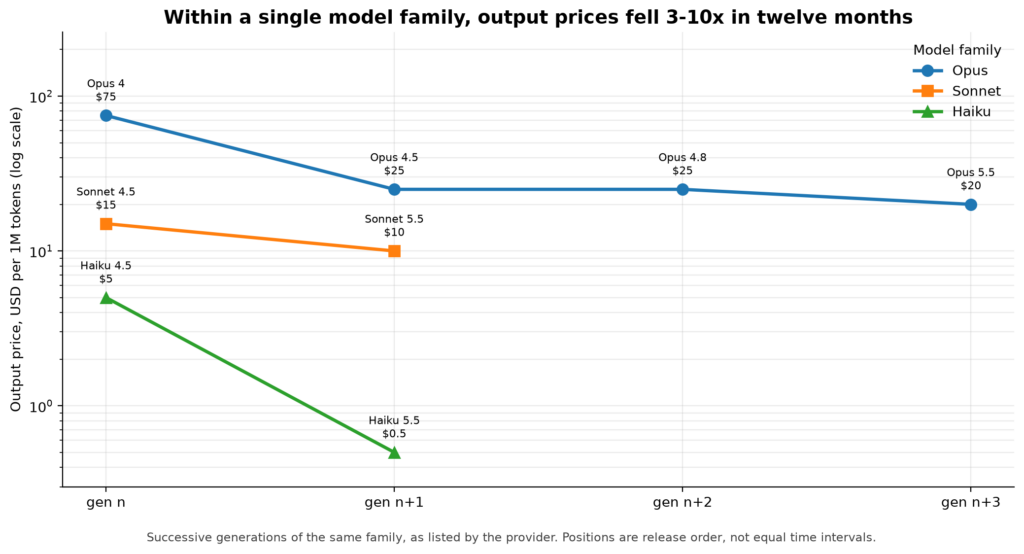
A signed GPU contract is a price ceiling and a supply guarantee. It converts a variable cost that a vendor can re-price into a fixed cost your board already approved. That has real value in a category where list prices moved by more than half in twelve months.
It also buys the right to refuse. When your largest model vendor announces a change to terms, residency, or rate, an organization with a working open-weight deployment negotiates from a different position than one that cannot move.
5. Latency and caching decide more than the rate card
Two line items shape a martech bill more than headline token prices, and neither appears in the summary table.
The first is cache pricing. Claude Opus 4.8 charges $5.00 per million input tokens but $0.50 for a cache read, a 90% discount, and $6.25 for a cache write, a 25% premium. Gemini 3.1 Pro charges $0.20 against $2.00. DeepSeek charges $0.044 against $1.32 on its pro model, and $0.003 against $0.15 on its flash model: a 98% discount.
Read those ratios as an instruction. Prompt architecture is financial architecture. Anything stable that sits at the front of the prompt — brand rules, taxonomy, tone guide, product schema — is bought at a tenth of the price or less. Anything volatile that sits at the front invalidates the cache on every call and pushes the whole input line back to full rate. Two teams can run identical workloads on identical models and see input costs 10× apart purely because of where they put the customer’s name.
The second is latency, and it is not one number. Time to first token governs perceived speed for anything interactive. Output throughput governs how long an agent loop takes to close. Caching improves both, which is why a caching redesign often reads as a performance project and pays out as a cost project.
For marketing specifically, the split matters. Asset generation can run in batch overnight at half price. On-site personalization and conversational commerce cannot: a four-second first token is a lost session. Budget the two separately, or you will overpay for the first and underspend on the second.
6. Compliance and data residency, where the price is not the price
The regulatory calendar is no longer abstract. Under the EU AI Act, the remainder of the regulation applies from August 2, 2026. Systems that generate synthetic audio, image, video, or text and were placed on the market before that date must meet the Article 50(2) transparency obligations by December 2, 2026. Providers of general-purpose models already on the market before August 2, 2025 must be compliant by August 2, 2027.
For a martech team, three practical consequences follow.
Disclosure becomes a product feature. Synthetic creative, synthetic voice, synthetic product imagery: each needs a labeling or disclosure path that works in every market you ship to. That is a workflow question, not a model question, but it is easier to answer when you control the generation layer.
Holding weights changes your role. A team that deploys a model under its own brand may take on provider-style obligations that an API customer never carries. Control and liability arrive in the same box. Get the analysis from counsel, not from the vendor’s trust page.
Residency has a sticker price. As noted, in-region serving costs 19% to 21% more on the models where the hyperscaler publishes both schedules. That premium is the cheapest compliance line item you will ever buy, and the easiest to forget in a spreadsheet built on US East rates.
7. Vendor risk is a line item too
Open the price list and count the generations. One vendor’s catalog lists Opus 4, 4.1, 4.5, 4.6, 4.7, 4.8, 5, and 5.5, plus fast variants and a research tier. Another lists more than seventy models, many of them retired from active promotion but still priced.
That catalog is a deprecation calendar with a marketing budget.
Two risks sit inside it. Price risk: the vendor re-prices the tier you depend on, and your annual plan becomes a renegotiation. Continuity risk: the vendor retires the exact model you tuned your prompts against, and your regression suite lights up.
Open weights convert both risks into engineering work. A weight release is a frozen artifact: it does not change its behavior on a Tuesday, it does not get re-priced, and it does not disappear from a catalog. It ages instead, which is a slower and more manageable failure mode than a surprise.
The practical mitigations are unglamorous. Run a two-vendor minimum on every workflow that touches revenue. Keep prompts and evaluation sets in a layer that belongs to neither vendor. Ask what the notice period is, in writing, and what migration support the vendor will fund. If the answer is a blog post and good wishes, price that in.
8. Routing is the architecture that captures the spread
The 10× to 50× spread does not arrive by itself. Somebody has to decide, per request, which tier handles it.
A workable routing stack has three layers. A classifier or a cheap heuristic decides the request type: template fill, summarization, rewrite, reasoning, extraction. A dispatcher sends the request to the cheapest tier that historically clears the acceptance bar for that type. A confidence gate inspects the output, by rule or by a scoring model, and escalates to the expensive tier when the output trips a threshold.
The tuning knob that matters is the escalation threshold, not the model list. Set it too loose and you save tokens while shipping errors. Set it too tight and you pay flagship rates for work a small model does fine. Either way, the router optimizes exactly what you told it to optimize, which is why a router measured only on cost will produce impressively cheap, impressively bad output.
Log four numbers per workflow: escalation rate, acceptance rate, cost per accepted outcome, and p95 latency. Everything else is dashboard decoration.
One failure mode deserves a name. Silent model updates: when a vendor improves the model behind an unchanged name, your router’s calibration can drift without a single alert firing. Pin versions where the vendor allows it, and re-run the evaluation set whenever the pinned string changes.
9. What should stay closed
Cheap tiers are not a universal solvent. Four categories still belong at the top of the market, and pretending otherwise is how budgets get wasted in the other direction.
Work where a single error is expensive. Legal review of claims, financial disclosures, regulated product copy. A 1% error rate on a piece whose downside is a regulatory letter is not a rounding error, whatever the token price.
Long-context reasoning over dense documents. Contracts, research reports, policy documents. Quality differences that look like noise on a benchmark show up as missed clauses in production.
Consumer-facing generation at scale, where tone failures become screenshots.
Tasks that sit at the capability frontier right now. Epoch AI’s October 2026 analysis put the best open-weight model roughly six to seven months behind the closed frontier on a cybersecurity capability index. That is the useful way to read the lag: not as a verdict on open weights, but as a schedule. If your task needs today’s frontier, pay for it. If it needs the frontier of two quarters ago, the price has already fallen by an order of magnitude.
Paying frontier prices for mid-tier work is the most common waste in an AI budget, and the least visible, because nobody ever gets in trouble for buying the best model.
10. Building a budget that survives a price change
Most AI budgets are built the way software budgets were built in 2015: by vendor line, with a seat count and a growth assumption. That structure cannot absorb a category where list prices halve in a year and a workflow can migrate tiers in a week.
Rebuild it by workflow instead. Five columns per workflow: accepted volume, unit cost, acceptance rate, cost per accepted outcome, and annual spend. Then a sixth column that nobody likes: switch cost in engineering days.
| Workflow | Accepted volume | Unit cost | Acceptance | Cost per accepted outcome | Annual spend |
|---|---|---|---|---|---|
| Product description refresh | 240,000 | $0.042 | 96% | $0.044 | $10,500 |
| Campaign copy variants | 90,000 | $0.019 | 88% | $0.022 | $1,940 |
| Support macro rewrite | 60,000 | $0.0077 | 93% | $0.0083 | $500 |
| Catalog Q&A indexing | 1,200,000 | $0.0007 | 99% | $0.0007 | $850 |
The volumes are illustrative; substitute your own. Note the unit of account: volume counts accepted outputs, so spend is accepted volume multiplied by cost per accepted outcome, and the retries are already inside the arithmetic.
The point is structural. Once cost per accepted outcome exists as a column, three things become visible that a vendor line hides: which workflow is actually expensive, which one has an acceptance problem disguised as a model problem, and which one is cheap enough that optimization is a waste of engineering time.
Add a reserve line of 15% to 20% for churn and experimentation. Not because experiments are optional, but because a twelve-month plan built on November prices is a plan built on a snapshot of the fastest-moving cost curve in your stack. Re-forecast quarterly. Cheap to do, embarrassing to skip.
One more discipline: separate fixed from variable. Reserved capacity, GPU contracts, and platform fees are fixed. Token spend is variable and should be governed by volume, not by a cap set in January and forgotten in June.
11. Six questions procurement should ask
- What is the price per accepted outcome for our workload? A good answer includes your volumes and a defined acceptance test. A bad answer is a rate card with the word “competitive” in the covering note.
- What happens to the price on a cache hit, and what breaks the cache? You want the ratio and the invalidation rules, not the marketing line about efficiency.
- How much notice before this model is retired, and who pays for migration? Thirty days and goodwill is a warning. A published deprecation policy with dates is a green light.
- Which region serves our data, and what is the in-region premium? Ask for the number in writing. On published schedules it is often 19% to 21%, and it belongs in the model on day one.
- What is the escalation path when output fails our gate, and who pays for the retry? Retries are the hidden multiplier. A vendor who has never thought about this has never operated your workload.
- If this price doubles next quarter, what is our switch cost in engineering days? The answer tells you whether you are buying a service or a dependency.
12. What 2027 looks like
Five calls, each falsifiable.
The flagship tier stays clustered. Input prices between $2 and $6, with differentiation moving to context length, throughput, and tooling rather than headline rate.
The workhorse tier collapses further. The $0.10 to $0.50 band expands as open-weight releases keep arriving on a quarterly cadence and hyperscalers keep undercutting each other on the same catalog.
The capability lag shortens on general tasks and persists on specialized ones. Six to seven months becomes three to four for mainstream work, while safety-critical and cyber-adjacent capability keeps a longer shadow.
Budgets move from licenses to usage, and finance notices. The moment AI spend becomes a variable line tied to volume, it acquires everything a license never needed: unit economics, demand forecasting, and an owner who is accountable for it.
Evaluation data becomes the moat. When every vendor sells a model within 2.5× of the next, the thing that lets you route confidently is your own acceptance data. Buy the cheapest model you can measure. Pay whatever it takes for the measurement.
The through-line is the same as the opening. The winning move is not buying cheap. It is buying the right to change your mind at a price you already budgeted.
The summary
Frontier prices converged, which removed the easy savings. Below the frontier, the spread widened to 10× and 50×, which created a harder and much larger opportunity. Open weights did not win on quality; they won on the properties a budget actually contains: a price that holds, an artifact that does not move, a supply that cannot be withdrawn, and a residency story you can defend.
None of that is free. Cheap tiers fail quietly, self-hosting hides utilization risk in the third year, and routers optimize whatever you measure. So measure acceptance, budget by workflow, keep two vendors, and price the switch.
Predictability is the product now. Everything else is a discount you can renegotiate.
FAQ
If token prices keep falling, will my AI bill fall too?
Usually not, and the reason is volume. When a unit cost drops 5×, teams run 5× more of it, then add workflows that were previously unaffordable. Spend tracks usage, and usage tracks ambition, not price. The organizations that see bills fall are the ones that capped volume per workflow and re-forecast quarterly; the ones that see bills rise treated a price cut as a license to expand scope.
Can I realistically self-host a mid-size open-weight model?
Yes, with one condition: you can keep the hardware busy. The break-even test is annual cost divided by the per-token price you would otherwise pay. If that volume is below your actual demand, self-hosting wins on cost. If it is above, you are buying an option, and you should say so in the business case rather than pretending it is a saving. Budget for a two-year hardware refresh and for the two engineers who will own it.
Are open-weight models good enough for customer-facing copy?
For templated, constrained, high-volume copy: frequently yes, and the economics are compelling. For anything with regulatory exposure, brand-defining tone, or a legal claim in it: test before you assume. The honest test is not a benchmark score, it is a blind acceptance test on 200 of your own outputs. If acceptance drops more than a few points, the saving is gone once you price in review time.
What is the practical difference between open weights and open source?
Open weights mean you can download and run the parameters. They do not necessarily mean you can use them commercially without conditions, inspect the training data, or redistribute derivatives freely. Licenses vary from permissive to restricted to non-commercial, and some carry acceptable-use clauses that constrain exactly the marketing use cases you have in mind. Read the license before the benchmark table.
If prices keep falling, why sign anything longer than a month?
Because what you buy with a longer commitment is not a lower price, it is a known price. If your finance team needs a defensible annual number, a cap on rate increases is worth more than a discount that can be repriced. Structure it with a floor as well as a cap, so the vendor can commit, and keep one workflow deliberately on a month-to-month contract as a live price reference.