When Your Ad Funds a Model’s Mistake
When Your Ad Funds a Model’s Mistake
Brand safety in the AI era, and the adjacency you never actually bought
The sentence that stopped meaning what it said
Every brand safety schedule I have read in the past year contains some version of the same promise: the advertiser may exclude inventory adjacent to specified categories of content. On a web page, that sentence describes something a vendor can actually do. On an AI interface it describes something nobody can do, because there is no page.
What exists instead is a model completing a request. The reply is written for one person, at one moment, in a conversation the advertiser will never see. The ad unit renders beneath that reply. Matching uses signals the advertiser supplies at the ad group level, together with whatever the platform infers about the exchange. Ask the same question twice and you may get two different answers, and two different sets of advertisers eligible to appear under them.
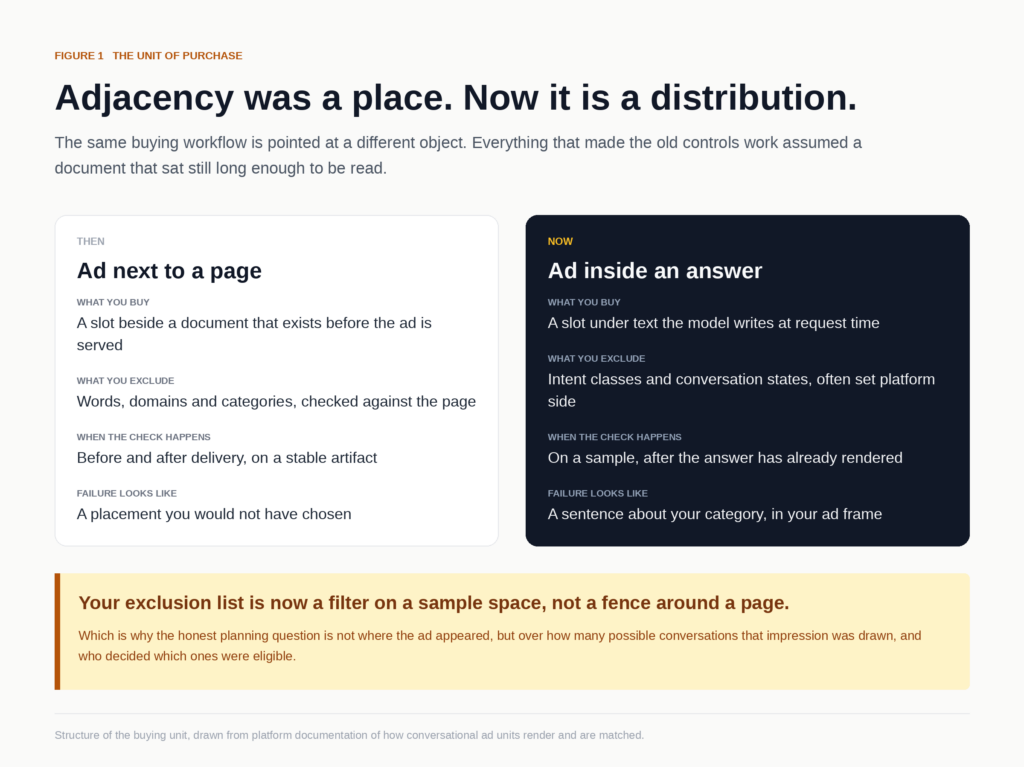
So what sits on the invoice is not a position, and it’s not quite a context either. It is a draw from a distribution of contexts: one sample from the space of conversations a platform considers acceptable for your brand, filtered by a suitability judgment you did not make and usually cannot inspect.
That is a legitimate product. It is also a different product from the one the contract language describes. The distance between those two sentences is where brand safety now lives.
From adjacency to generation
Adjacency is a relationship between an ad and something that already exists. Generation removes the antecedent. When context is produced at request time, the advertiser is buying a probability, not a placement.
Three controls were built for the old arrangement. Each one degrades in a specific way.
Keyword targeting assumes a stable map from vocabulary to meaning. In a conversation, vocabulary is a poor proxy for intent: a sentence about a parent’s diagnosis and a sentence about a clinical trial share most of their words and none of their risk profile.
Post-bid page scanning assumes a document with a stable structure that can be fetched and parsed. There is no document. There is an output that may differ between the impression and the audit.
Exclusion lists assume the risky material sits on the page, waiting to be found. In a conversation, the material that creates the risk is frequently the answer itself, written after the eligibility decision was made.
None of this makes the channel unusable. It makes the instrument panel obsolete.
What you actually hold, and what you do not
Take the largest conversational ad product as a reference case, because it is the one with the most documentation. ChatGPT Ads runs in more than sixty markets, on a platform that reaches 1.2 billion weekly users, and the ad business was running at roughly a billion dollars of annualized revenue within seven months of its pilot. The unit renders below the end of a response. Context hints are supplied at the ad group level.
The suitability layer belongs to the platform. OpenAI describes automated review, human oversight and ongoing monitoring, with the stated aim of keeping ads out of conversations that are emotionally vulnerable, sensitive or otherwise unsuitable. A negative phrase control exists for what the company calls qualifying advertisers with narrow placement requirements. Eligibility criteria, phrase limits and matching logic have not been published. Independent verification arrived later and narrower: two measurement vendors began suitability pilots in a controlled testing environment that does not expose private conversations, and one of them started reporting to a select group of advertisers in October 2026.
Read that list twice, because it is more precise than the version circulating on conference panels. It is not true that nothing is configurable. It is true that the decision that actually matters — whether this conversation is appropriate for this brand — is made on the platform side and applied uniformly, while advertiser control sits at the margin as a gated phrase list whose rules you cannot read.
What you do not hold: a campaign-level switch for the exclusion you would actually want, the answer text as a reviewable artifact, a published taxonomy for the guardrail, a pre-delivery assurance, or a published method behind the post-delivery verification you are offered.
Eighty-seven percent say it matters. The console has no switch for it
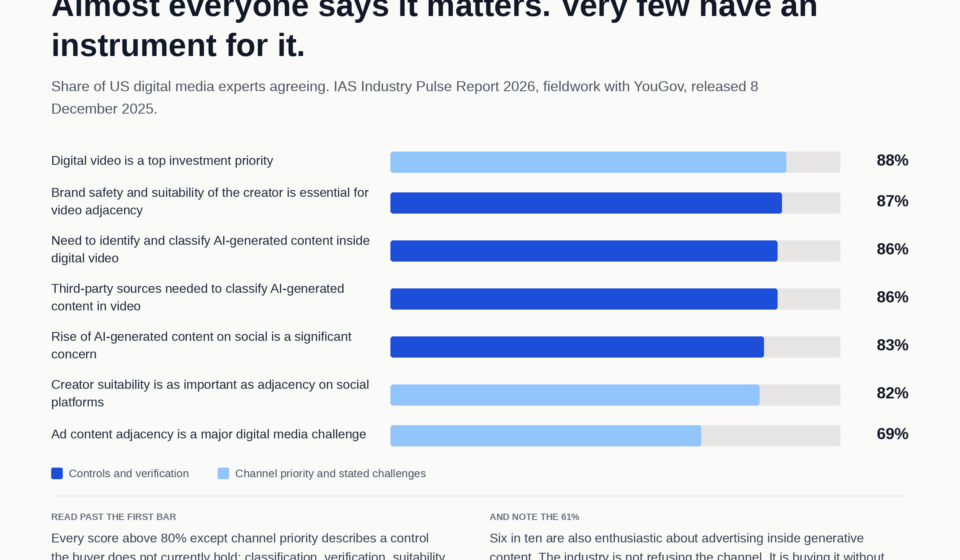
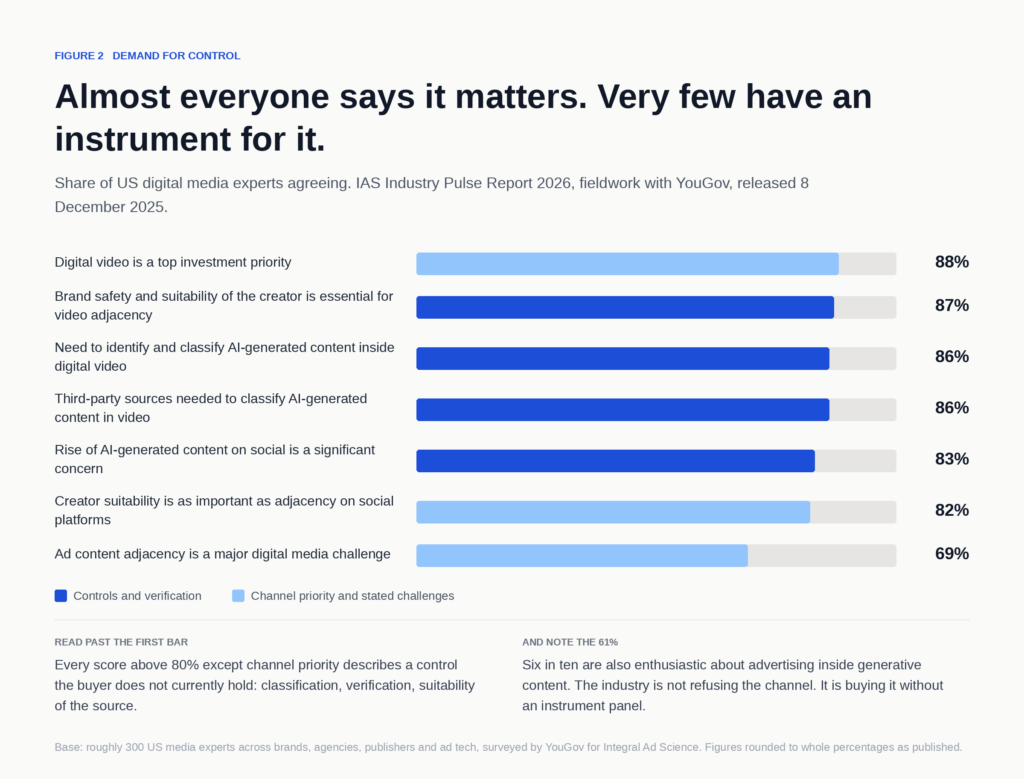
In December 2025 Integral Ad Science published its annual Industry Pulse research, fielded by YouGov among roughly three hundred US media experts. Eighty-seven percent said the brand safety and suitability of the influencer or creator is essential when advertising alongside digital video. Eighty-six percent said they need to identify and classify AI-generated content inside video, and the same share said third-party sources are important to the task. Eighty-three percent called the rise of AI-generated content on social a significant concern. Sixty-nine percent named ad content adjacency as a major challenge, with deepfakes and synthetic content cited most often as the adjacency types that worry them.
Then there is the number that usually gets skipped. Sixty-one percent said they were enthusiastic about advertising inside generative content.
Those figures are usually quoted as evidence of concern. They read better as evidence of demand with no supplier yet. The market is not hesitating. It is buying, and asking for instruments it does not have. Two of its highest scores are requests that somebody else perform the classification.
Three risks, three owners
Risk in a generated environment does not arrive as one thing. It arrives in three forms, each with a different failure point, which is why a single control never covers it.
The model invents a claim
OpenAI’s SimpleQA benchmark consists of 4,326 short, fact-seeking questions with one indisputable answer, built deliberately to be hard. GPT-4o scored below forty percent. The same evaluation found that models systematically overstated their confidence: wrong answers delivered in the register of right ones.
Put that beside an ad unit. A user asks a factual question in your category. The answer that frames your creative has a meaningful chance of being wrong, and it will be fluent, specific and unhedged. Your ad did not make the claim. It merely sat underneath it, in the same visual frame, on the same screen, at the moment of decision.
A face that is not a person
On 31 August 2026 Instagram renamed its AI creator label to AI-generated profile and began limiting the reach of profiles presenting an AI-generated person without carrying it. Labeled accounts keep recommendation eligibility; unlabeled ones lose it until they label or win an appeal.
The policy draws a line that matters commercially. AI-assisted work by a real creator does not require the label. An account built around a synthetic person does. For a buyer, that converts label status into a delivery variable: unlabeled synthetic inventory is now both a compliance exposure and a performance problem, because the platform is quietly reducing its distribution.
The conversation is hostile, or becomes hostile
Three mechanisms, none of them lexical. A user arrives in a vulnerable state and asks a question containing no sensitive keyword. A conversation drifts across turns, beginning in safety and ending elsewhere. Or the user’s own text steers the answer the ad will sit under, because text is an instruction to the model, not a description of a page.
This is the risk class that vintage brand safety handles worst, because it has no keyword footprint and no publisher to call.
Why a keyword list cannot see a prompt
In October 2025 the Media Rating Council tightened what the phrase brand safety is allowed to mean: verification based on property-level signals such as keywords and domains cannot be positioned as brand safety without content-level analysis of images, video and audio. The compliance grace period ended in April 2026.
That decision is more useful to buyers than it first appears. It did not create a new problem; it named an old one. A blocklist was never brand safety. It was a cheap proxy that worked while the risky thing and the keyword appeared together.
On a conversational surface the proxy fails in both directions. What gets filtered is a prompt plus its history. What often creates the risk is the generated answer, which no phrase list can pre-screen because it does not exist when the list runs. And the party best placed to read the conversation — the model provider — is also the party that has told advertisers it will not hand over private conversations.
So the honest description of the current state is this: eligibility is decided before the risky text exists, and verification happens afterwards, on a sample, using a method nobody has published.
The creator layer is now the AI layer
Creator suitability used to be a judgment about a person’s history. It is now partly a judgment about whether a person exists.
The survey numbers say buyers already know. Eighty-three percent flag AI-generated content as a significant concern, eighty-two percent say creator suitability matters as much as adjacency on social, and the most cited adjacency risks are synthetic rather than editorial.
The operational consequence is small, boring and easy to skip: provenance questions belong in the creator brief. Was the face filmed or generated? Does the account carry a platform label? And if the label is missing, what happens to reach? Ask those three before the rate card, not after the campaign.
Clauses that price the uncertainty
The contract is where an unpriced risk becomes somebody’s problem. Eight clauses carry most of the weight.
Environment, defined at content level. Replace references to properties, pages and domains with a definition that mirrors the rating council’s content-level language. If the schedule cannot describe the environment without naming a page, it does not cover the channel you are buying.
Two guarantees, named separately. Pre-delivery assurance is what the platform promises before the impression. Post-delivery verification is what an independent party measures afterwards. They are different products with different failure modes, and bundling them lets one hide behind the other.
Answer-level evidence. A sampling right to the rendered answers your impressions appeared under, in aggregated or redacted form. Without it, a failure cannot be evidenced, and an unevidenced failure is not a claim.
Change notification. Model versions, guardrail taxonomy and exclusion logic will all change during the flight. Thirty days’ notice, a materiality test, a defined effective date.
Exclusion control. Who may edit the phrase list, how quickly edits take effect, whether edits alter delivery commitments, and what happens when the list is the only lever you have.
A remedy formula tied to failure rate. Credits triggered by a verified failure rate, not by under-delivery. Impressions can be delivered perfectly and still be worthless.
Regulatory allocation. Article 50 duties attach to providers and deployers. Synthetic creative makes the advertiser a deployer for some purposes. The contract should say who holds the marking obligation and who indemnifies whom.
Exit and audit. A termination right if the guardrail changes materially, an annual audit right, and a described taxonomy on file rather than on a marketing page.
What to log, starting Monday
If the answer is the risky object, the log has to contain the answer. Seven fields are enough to make a failure arguable.
- Surface and unit: answer-embedded or page-adjacent, recorded per impression.
- Intent class of the conversation, against a named taxonomy version.
- Semantic distance between ad and answer: topically attached, or merely nearby.
- Assertions about your brand or category appearing in the answer.
- Provenance and label status of any creator or synthetic asset in the frame.
- Guardrail and taxonomy version in force at the time of the impression.
- Verifier identity and method version.
Most brand safety reports currently in circulation contain none of these. That is why the failure, when it happens, arrives as a screenshot rather than a metric.
The option not to advertise
Seventy-five percent of advertisers in an IAS survey said they would not want their ads next to AI-generated content. By August 2026, independent traffic analysis was finding sponsored placements in roughly a quarter of replies on the largest conversational surface. Stated preference and revealed preference are pointing in different directions, which is normal, and worth stating in the plan rather than discovering in the quarterly review.
Three positions are defensible. Full exclusion is coherent for regulated categories and for brands whose entire equity is trust. Capped presence with defense creative is where most large advertisers will land: a small share of spend, creative written to be read beside a possibly wrong answer, and no performance targets attached. Sponsorship framing means buying presence and association rather than conversion, and no longer pretending the attribution is clean.
What staying out costs is not zero. The answer forms whether or not you are in it. Your competitors’ ads sit inside it. And the model’s account of your category becomes the version a growing share of buyers meets first, with no correction mechanism available to you.
The regulatory tail
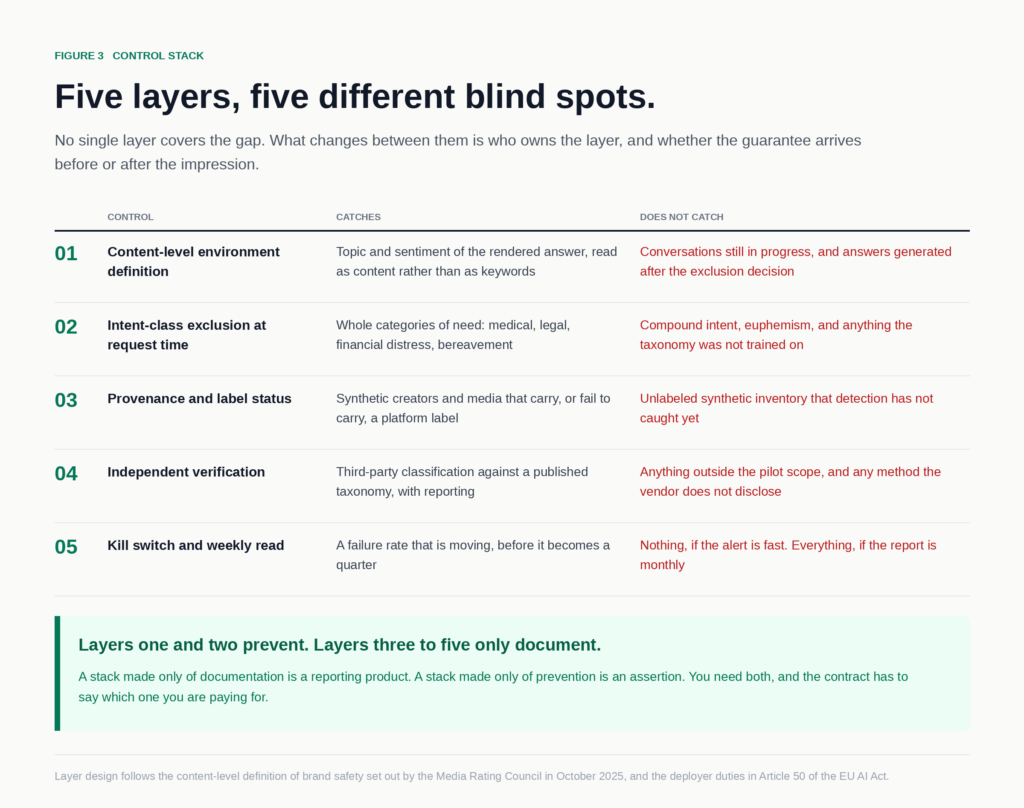
Article 50 of the EU AI Act applied from 2 August 2026. Deployers of AI systems generating synthetic image, audio or video content must disclose the deepfake at first exposure, clearly and distinguishably. A machine-readable mark alone does not discharge that duty. Synthetic text published to inform the public on matters of public interest must be labeled where it has not been subject to human review or editorial control. Superficial checks do not count. Penalties run to fifteen million euros or three percent of worldwide annual turnover.
Two details matter for advertising specifically. A narrow exemption from the marking duty exists for systems used in industrial or professional settings, and it does not travel with creative later shown to consumers. And the marking obligation for generative systems already on the market before August 2026 was deferred to 2 December 2026, which means provenance becomes machine-checkable at roughly the moment the 2027 planning cycle opens.
In the United States there is still no federal statute aimed at advertising inside generated answers. Section 5 of the FTC Act does not care who drafted the copy: a claim in an ad remains the advertiser’s claim, and substantiation remains the advertiser’s job. State synthetic-media and digital-replica statutes are filling gaps the federal legislature has left.
The inversion is worth sitting with. Compliance used to be a question about the claim. It is now also a question about the provenance of the pixels and the pipeline that produced them.
Five controls that survive the shift
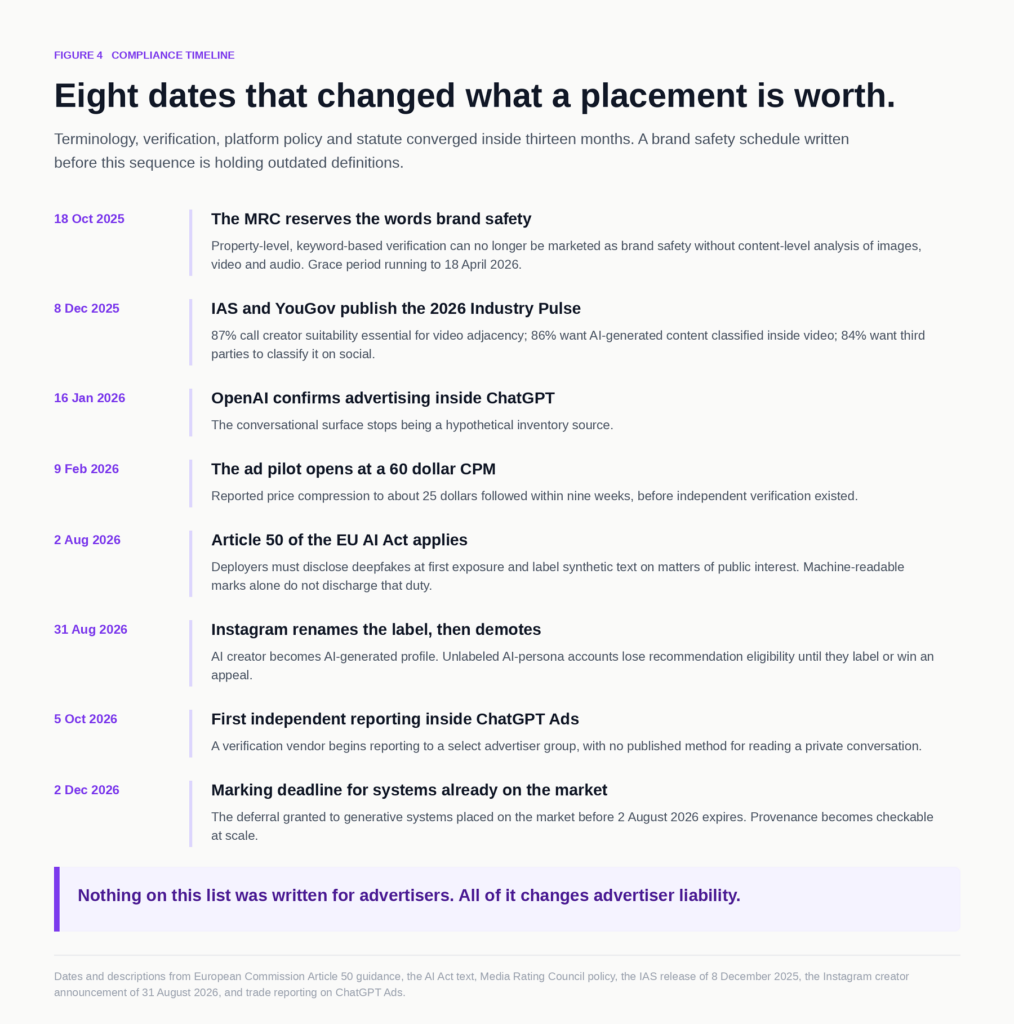
- Define the environment at content level, in writing, in the schedule.
- Replace keyword lists with intent-class exclusions at request time, and answer-level sampling after delivery. Keep the lists for what they are good at, which is not this.
- Make provenance a line item in every creator and synthetic-media buy, with label status recorded.
- Buy verification only where the method is published, then read the method before you read the dashboard.
- Install a kill switch with a named owner and a weekly read. Monthly reporting is a post-mortem schedule.
What to demand in the 2027 upfront
Conversational inventory is no longer a science project. It has a sales team, measurement partners and a slot inside major buying platforms. That means it will be negotiated in the same rooms as streaming, and it should be negotiated with better questions.
Ask what the unit of adjacency actually is, and whether you can see one. Ask for sampled access to the answers your ads appear under. Ask which taxonomy the guardrail uses and who accredited it. Ask for the change-notification timeline on model and guardrail updates. Ask what the remedy formula is when a guardrail fails, and what evidence triggers it. Ask whether the suitability pilot results will be published, and whether the method will be readable. Ask whether the model version can be pinned for the flight, or whether the environment drifts mid-campaign.
None of those questions is hostile. All of them are answerable. The ones that come back vague are the ones that tell you what you are buying.
The short version
The industry spent twenty years making adjacency measurable. Generative surfaces replaced the object being measured while keeping the vocabulary. What remains is a purchase of probability: a draw from the conversations a platform deems acceptable, framed by an answer nobody at your company wrote.
You can still buy it. But the controls have to move from the page to the request, the contract has to separate assurance from verification, the log has to contain the answer, and the calendar now carries dates that were not written for advertisers.