China’s Open-Weight Race Splits in Two: Kimi Bets on Scale, Tencent’s Hy4 Bets on Agents
On consecutive days in early November, two of China’s most closely watched AI labs released flagship open-weight models. Moonshot AI published the full weights for Kimi K3.1 Pro on Hugging Face. Tencent launched the general-availability version of Hy4, a 770-billion-parameter model that, for the first time in the Hunyuan line, can see images and operate a computer.
The juxtaposition is instructive. Both models are labeled open, both are competitive with the global frontier on many tasks, and both are being pitched to developers as a cheaper, more controllable alternative to closed APIs from OpenAI, Anthropic and Google. Yet they represent two very different theories about what an open AI model should be.
Kimi K3.1 Pro: scale as a strategy
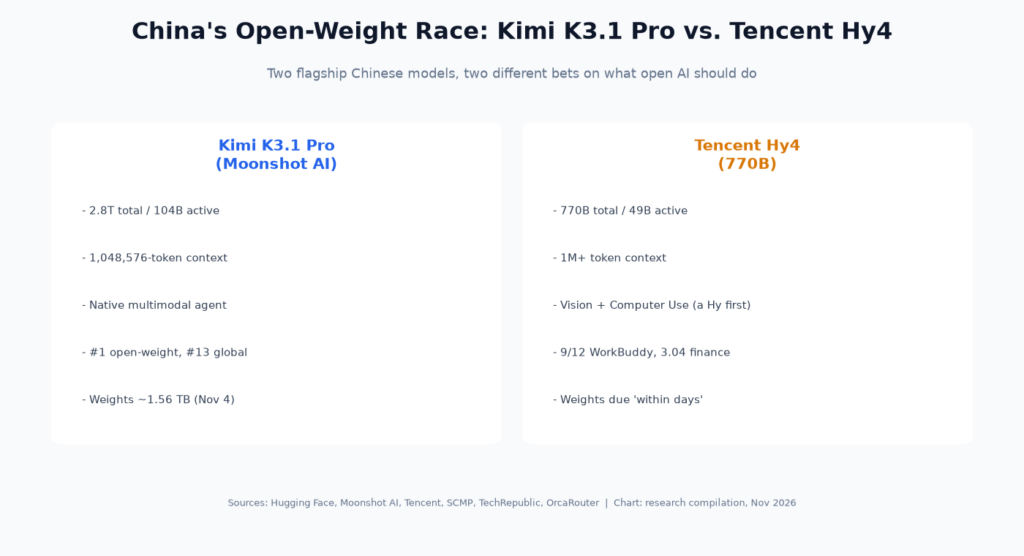
Kimi K3.1 Pro is, by the numbers, one of the largest open-weight models ever released. It carries 2.8 trillion total parameters with 104 billion activated per token — a mixture-of-experts architecture that keeps inference costs manageable while preserving the capacity of a much larger model. The context window stretches to 1,048,576 tokens, enough to hold entire code repositories or long operational histories in a single pass.
Moonshot first shipped the model through its API on October 23, at $2 per million input tokens and $10 per million output. It then published the full weights on November 4 under a custom Kimi K3.1 Pro License, roughly two weeks later. The weights themselves are reported to take up around 1.56 terabytes — a reminder that open does not mean easy to run. Self-hosting this model requires serious hardware, and the license carries conditions that teams should read carefully before committing.
The benchmark story is aggressive. According to Moonshot’s published figures, Kimi K3.1 Pro beat Claude Opus 5.5 on 16 of 37 benchmark tests. On the Agent Arena leaderboard, it ranked first among open-weight models and 13th globally, with a net improvement rate of +5.1% over the previous Kimi K3 (Max), which sat at +0.9%. It is described as a natively multimodal agentic model — designed, from the start, to reason across text and images and to take actions rather than simply answer questions.
For Moonshot, scale is the brand. The pitch is straightforward: if you want the closest open-weight approximation of a frontier model, this is it. The trade-off is that you pay for that approximation in hardware, latency and engineering effort.
Tencent Hy4: the agentic turn
Tencent’s Hy4 tells a different story. It is smaller on paper — 770 billion total parameters, 49 billion active — but it leans hard into capabilities rather than raw size. The headline additions are vision understanding and Computer Use, which lets the model operate desktop software through both command-line and graphical interfaces. Tencent says it trained Hy4 specifically on tools such as Blender and CAD, and on long, cross-application tasks.
The benchmark claims are, again, vendor-reported. Tencent says Hy4 won 9 of 12 scenarios in its internal WorkBuddy office suite, with an average score of 83.18 and a 96.15% task pass rate. In a blind finance evaluation involving 213 professionals and 579 real tasks, it scored 3.04 out of 4 — ahead of DeepSeek V4.1 Flash at 2.97, and well ahead of Kimi K3.1 Pro and GLM-5.3, both at 2.68. Tencent also reports a drop in its hallucination rate from 15.76% to 5.45%, though the methodology behind that figure is not public.
Crucially, Tencent has been candid about the limits. It acknowledges that Hy4 still trails top proprietary models such as Claude Opus 5.5 and GPT-6.1 on advanced visual question answering, high-level mathematics and long-horizon software engineering. And it has not yet published the full weights; it says they are coming within days, along with a system card and a fuller safety evaluation.
Pricing is a weapon. Hy4 is listed at roughly $0.83 per million input tokens and $2.50 per million output — a fraction of what frontier closed models charge, and a deliberate bid to win cost-sensitive enterprise workloads.
Two philosophies, one market
Put the two together and a pattern emerges. Kimi is betting that the most valuable thing an open model can offer is frontier-scale intelligence: the biggest, most capable open brain you can download and fine-tune. Tencent is betting that the most valuable thing is agency: a model that can actually do things inside the software people use every day.
Both bets are shaped by their creators’ commercial logic. Moonshot, a startup, needs to differentiate on raw capability to justify its valuation and attract developers who want to build on a powerful base. Tencent, a platform giant, already owns the software — WeChat, enterprise collaboration tools, cloud — where an agentic model can create immediate, monetisable value.
This divergence is itself a signal. A year ago, the open-weight conversation in China was almost entirely about closing the gap with GPT-class models on static benchmarks. Now the conversation has moved to what those models can do: read a chart, operate a design tool, complete a multi-step task. The competitive axis has rotated from intelligence to utility.
The evidence problem
There is a caveat that deserves more attention than it usually gets: almost none of these benchmark numbers are independent. Both companies are publishing results from their own test suites and expert panels. The absence of standardised public benchmarks — particularly for Hy4, whose release omitted the Terminal-Bench and SWE-bench rows that had made its earlier preview credible — makes it difficult to compare the two models on neutral ground.
This is not unique to China. Every major lab, East and West, cherry-picks benchmarks. But for buyers deciding where to invest engineering resources, the gap between vendor claims and independent validation is a real risk. The safest reading is directional: both models are genuinely competitive, and the specific rankings should be treated as claims rather than measurements. OrcaRouter, analysing the Hy4 release, put it bluntly — the strongest Hy model to date is also the least documented at launch.
Why it matters beyond China
The global significance is straightforward. Open-weight models from China are now close enough to the frontier that they are viable alternatives for many enterprise workloads — especially where cost, data sovereignty or the ability to self-host matter. A company that wants to run a capable agent on its own infrastructure, without sending sensitive data to a US cloud, now has credible options from at least half a dozen vendors.
That has downstream effects. It pressures closed-model pricing. It gives developers leverage in negotiations. And it accelerates the spread of agentic capabilities into environments — regulated industries, on-premise deployments, cost-sensitive markets — where a closed API was previously the only game in town.
There is also a strategic dimension. As US export controls tighten access to advanced chips, Chinese labs have been forced to optimise aggressively for efficiency. The result is a generation of models designed to deliver strong performance at lower compute cost — a constraint-driven advantage that may prove durable.
The competitive landscape
Kimi and Hy4 do not exist in a vacuum. They are part of a broader Chinese open-weight surge that includes DeepSeek, Z.ai’s GLM series and Alibaba’s Qwen. The South China Morning Post framed the Hy4 launch explicitly as a heat-up in the open-weight race among Tencent, DeepSeek, Z.ai and Alibaba. On the global side, Mistral continues to compete, and Meta’s Llama line remains a reference point.
The practical consequence is that the open-weight tier is getting crowded and, more importantly, getting good. The gap between the best open model and the best closed model has narrowed to the point where, for many tasks, it is no longer the deciding factor. What decides is fit: does the model do the specific job you need, at a cost and latency you can live with?
What to watch
Three things will determine how this plays out. First, whether Tencent actually ships the Hy4 weights and a detailed system card, and how the model performs under independent evaluation. Second, whether Moonshot’s scale advantage translates into real-world agentic performance, or whether the 2.8-trillion-parameter bet proves unwieldy to deploy. Third, whether enterprise buyers treat these models as production-grade tools or as experiments — because that distinction, more than any benchmark, will decide which philosophy wins.
The bottom line
The most interesting thing about this week is not that China released two strong open models. It is that the two releases embody two distinct answers to the same question: what should an open AI model be for? Kimi says: be the most capable brain you can download. Hy4 says: be the agent that gets work done.
Both answers are right. Which one wins will depend less on benchmarks than on what enterprises actually need to build — and whether they can trust the claims enough to build on them.