What China Already Proved About Brand Websites — and AI Is Now Proving Everywhere
A domain is not a storefront. It is a container, and what fills it depends on what the market asks it to do. In the United States, the market asked a great deal: find us, vouch for us, sell to us, remind us. Twenty years of that made the brand site the centre of the DTC stack.
In China, none of those requests were ever routed to a website. They were routed to apps, which arrived earlier, cheaper and stickier. So the domain never got a job. It just sat there, immaculately built, permanently unemployed.
That is the real explanation for why site-first strategies stall in China. It is not that the site is badly made. It is that the work was assigned before the site applied.
Take the four jobs one at a time.
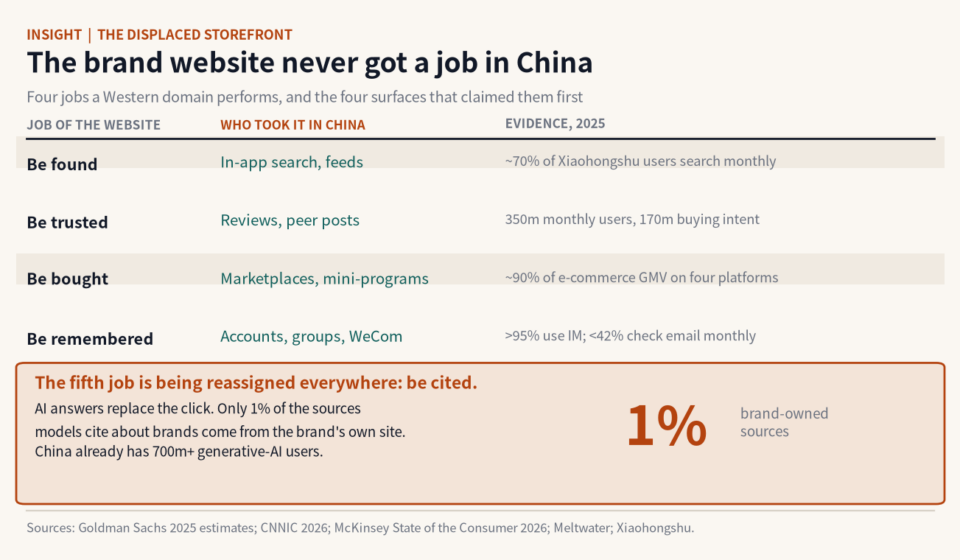
Finding. Search in China sits inside the app, not above it. Around 70% of Xiaohongshu users search inside the platform every month. There is no neutral index to rank on, only an app’s own recommender deciding whether you exist.
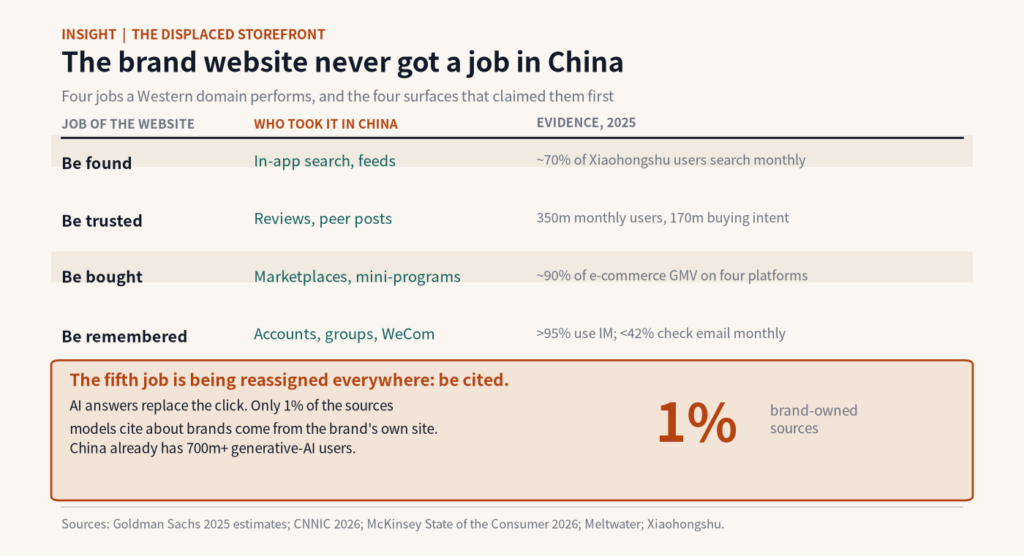
Trust. The evidence a buyer wants is another buyer’s post. Xiaohongshu alone has 350 million monthly users, and roughly 170 million of them are looking to buy something in any given month. A brand page cannot outrank a person whose review the reader can match to her own life.
Buying. Close to 90% of e-commerce GMV runs through four platforms. The transaction happens where the content was consumed, one tap from the scroll. Checkout on an external domain is a detour, and detours leak.
Remembering. Post-purchase reach is a messaging problem, and messaging means WeChat: 1.42 billion monthly users, over 95% instant-messaging penetration against fewer than 42% of internet users checking email in a given month. The reminder lives in a chat thread, not an inbox.
Four jobs, four apps, no vacancy. That is the mechanism.
Now the part that should worry everyone outside China. A fifth job is being reassigned right now, in every market at once: being cited. Buyers increasingly ask a model instead of opening ten pages, and the model answers from what it can retrieve — forums, marketplaces, reviews, video, press. McKinsey’s analysis of roughly 2.6 million citations across 25 consumer-goods brands found that only about 1% of the sources models cite come from the brand’s own website.
China is not the exception here. It is the early instance. The country has more than 700 million generative-AI users as of mid-2026, and its buyers learned to skip the open web a decade before anyone else had to.
The strategic consequence is uncomfortable for anyone whose China plan still reads drive traffic to the domain. Traffic assumes residence: you go somewhere and stay a while. Retrieval assumes nothing of the kind. A system decides, in milliseconds, whether you are worth quoting, then moves on. Those are different disciplines. One is media buying. The other is being legible: structured facts, consistent claims, third-party corroboration, prices in public.
So the lesson is not that China is strange. It is that a storefront is now a surface you appear on, not a place you own. Build for retrieval and the domain becomes an asset again, the canonical record a machine quotes when a buyer asks. Build for residence and you will spend the next five years buying traffic to a page nobody cites.