Douyin’s Ad Engine Is Raising the Bar — and the Bill — for Every Brand Selling Through Short Video
For years, one playbook worked on Douyin: find a winning video format, clone it, pour money into Qianchuan, and let the algorithm hunt for buyers. That playbook is being systematically dismantled.
In late 2026, ByteDance’s Douyin e-commerce arm tightened a set of rules that together amount to a quality reset for short-video commerce. Low-effort content — slideshows, subtitle walls, blurry clips — is being down-ranked. AI-generated material must be labelled. Creator product recommendations are increasingly treated as commercial advertising under Chinese law. And the ad engine itself, Qianchuan, is making it more expensive to buy your way out of bad content.
The message to brands is blunt: the era of using paid traffic to compensate for weak content is ending.
What Qianchuan actually is
The first thing to untangle is the terminology. Qianchuan is not simply Douyin ads. It is the e-commerce ad engine inside Ocean Engine, ByteDance’s broader advertising platform. Where brand products optimise for exposure and content, Qianchuan optimises for transactions — it is built to drive sales to a Douyin shop and into livestream rooms.
The defining feature is how it bids. Rather than buying clicks or impressions and hoping for conversion, advertisers set a target return — spend one yuan, get three back — and the algorithm decides who sees the ad, when, and against which of the brand’s videos. The system is efficient and unforgiving: if your content and livestream cannot close a sale on their own, paid spend just loses money faster.
Qianchuan’s main product has shifted toward whole-domain promotion, which optimises for a store’s total gross merchandise value — paid plus organic combined — rather than just the sales the ad can claim. That design choice matters. It means the platform now rewards brands whose organic videos already earn watch time, and punishes accounts trying to buy their way in from a cold start.
The new content rules
The rule changes reinforce that logic. Douyin’s updated system gives overall completion more weight than short-term retention, and elevates saves, repeat visits and loyal-fan engagement as signals of content value. A video that attracts a big initial audience but fails to hold viewers may not graduate to higher traffic pools.
Compliance has become part of distribution. Virtual digital humans must be real-name registered. Low-quality AI content produced in bulk may be identified and down-ranked. Off-platform diversion — pushing users to WeChat or other apps through videos, livestreams or private messages — is treated as high-risk, especially in categories such as finance, part-time work and AI courses. Creator content that sells through reviews or experience-sharing with a purchase link must be clearly labelled as advertising.
For international brands, the practical implication is that compliance decisions — content review, AI disclosure, creator contracts, lead-generation paths — must be made before publishing, not after. A compliance problem can suppress distribution, commissions and account access, not just the individual post.
The economics: costs up, ROI down
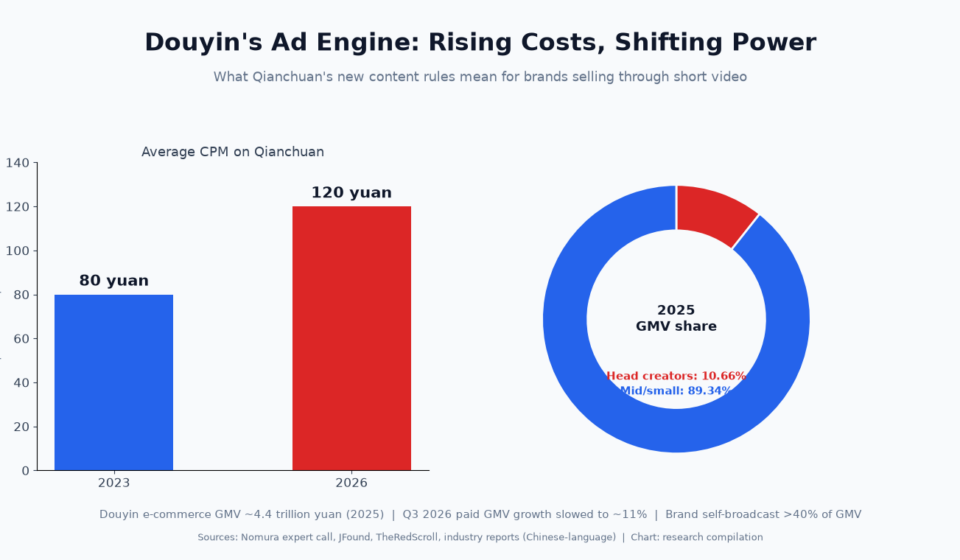
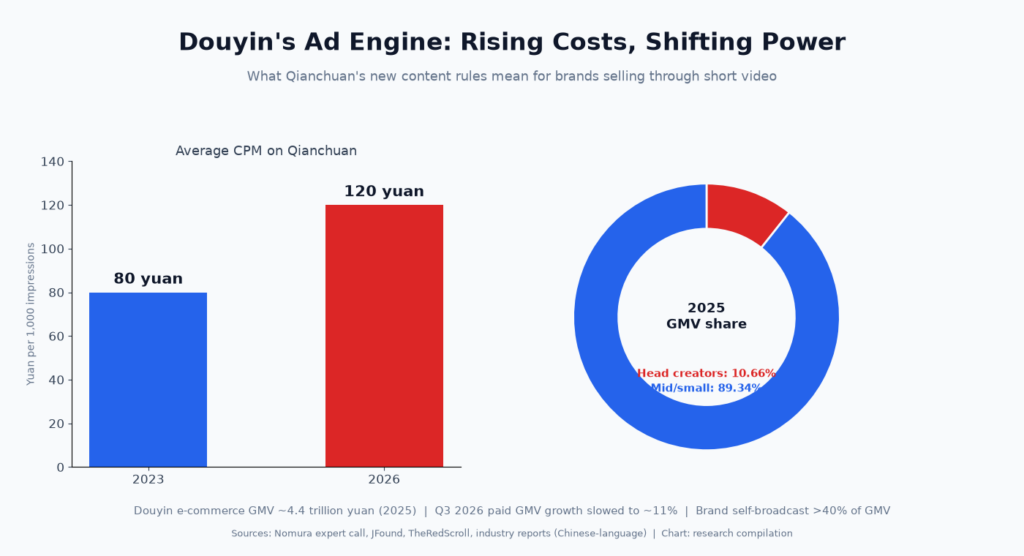
The rule changes are landing at an awkward moment for merchants. Qianchuan’s average CPM has climbed from around 80 yuan in 2023 to roughly 120 yuan in 2026 — a 50% increase. Brands that once saw a 1:3 return on ad spend now report something closer to 1:1.5 for the same budget.
Growth is also slowing. Douyin e-commerce’s gross merchandise value reached roughly 4.4 trillion yuan in 2025, making it the largest content-commerce platform in China. But a Nomura expert call in October 2026 noted that Q3 paid GMV growth had slowed to about 11%, with the full-year target trimmed toward 5 trillion yuan. The era of explosive growth is giving way to a more mature, margin-conscious phase.
That combination — rising costs, cooling growth, stricter quality rules — is squeezing exactly the brands that built their Douyin strategy on cheap traffic and cloned creative.
The creator landscape is shifting
The platform’s creator economy has been quietly de-concentrating. In 2025, head creators accounted for just 10.66% of e-commerce GMV, while mid-tier and small creators accounted for 89.34%. Brand self-broadcast, meanwhile, has grown to more than 40% of GMV, becoming a mainstream operating model rather than a supplement.
This matters because it changes where a brand should invest. Betting everything on one superstar livestreamer is increasingly risky and expensive. Building a stable self-broadcast operation, supported by a broad bench of mid-tier creators, is the more durable path — and it is the path the platform’s rules are now pushing merchants toward.
What it means for global brands
For overseas brands entering or scaling on Douyin, the lessons are concrete.
First, fix the store before scaling the spend. If a warm, free visitor will not buy, a cold, paid one certainly will not. Prove the close rate, then amplify.
Second, build a deep shelf of short videos. Qianchuan tests many creatives to find a winner; give it three and it has nothing to optimise. Winners emerge from volume.
Third, shoot real footage. Product demonstrations, tutorials, comparisons and scenario-based explanations now outperform polished but shallow advertisements. Slideshows and subtitle walls are actively penalised.
Fourth, plan a seven-day content and livestream rhythm rather than planning only around a launch day. The platform’s evaluation increasingly looks at sustained performance, not a single session.
Finally, treat compliance as part of the media plan. AI labelling, creator contracts and legal review are not back-office chores; they are distribution decisions.
The bigger picture
Douyin is following a trajectory familiar from Western platforms. YouTube and Meta spent the 2010s shifting from any content that drives clicks to quality content that earns retention. Douyin is doing the same thing, but inside an integrated commerce engine — which means the penalties hit revenue directly, not just reach.
The underlying logic is a move from traffic arbitrage to content quality. In a market where attention was cheap and abundant, cloning worked. In a market where attention is expensive and users are saturated, only content that genuinely holds attention — and converts — survives.
What to watch
Three signals will show whether the reset sticks: whether average CPMs keep climbing through the 2026 Double 11 and 2027 campaigns; whether brand self-broadcast continues to gain share at the expense of head-creator livestreams; and whether the platform introduces further quality thresholds that raise the cost of entry for small merchants.
A note on sourcing
This analysis draws on operational guides from English-language practitioners and on Chinese-language industry reporting and platform rule notices. Dedicated English-language investigative coverage of Qianchuan’s specific rule changes is limited, so figures such as the CPM increase and Q3 growth should be read as industry estimates rather than audited statistics.
The bottom line
The brands that win on Douyin in 2027 will not be the ones with the biggest ad budget. They will be the ones that can produce authentic, watchable content at the cadence the algorithm now demands — and that treat compliance and operations as part of the product, not an afterthought.