China’s Pre-Sale Culture: How Deposits and Waitlists Shape Demand
Ten yuan. About a dollar forty. For twelve years, that was the entry ticket to a Chinese pre-sale: small enough to be an impulse, large enough to be a decision.
You put the ten down on a coat that won’t ship for three weeks. The brand counts your ten, adds it to eighty thousand others, and calls its factory in Guangdong with a number it no longer has to guess at. You come back on the twenty-first to pay the balance, because if you don’t, the ten is gone.
That is yushou — the Chinese pre-sale. Not a discount scheme with a waiting period attached. A demand-measurement instrument that happens to be paid for by the customer.
Then, in the fall of 2026, JD deleted it from Double 11. No deposit, no balance, no wait: goods on the shelf, courier at the door. Tmall kept pre-sale but quietly defused it, swapping the pile of deposit coupons that used to require ten separate red packets collected in the app for a single card that waives the deposit outright.
So the mechanic that defined a decade of Chinese e-commerce is being retired just as retailers elsewhere are getting comfortable with the pre-order. That contradiction is the story. And how it splits — what dies, what survives, and where — is a better guide to demand than any festival playbook.
What a pre-sale actually is
A pre-sale is a purchase split into two payments separated by a promise.
You pay a deposit (dingjin) on a date the platform announces. You pay the balance (weikuan) a week or two later, inside a window that closes fast. Between the two dates, nothing exists yet: not the inventory allocation, sometimes not even the production run.
The size of the deposit varies — ten yuan on a coat, a hundred on a handset — but the design is fixed. In Tmall’s 2024 Double 11 cycle, the deposit window opened on October 14 and balances fell due from October 21, when the first sale window opened. Miss the balance and the deposit is forfeited. Pay the balance, then change your mind, and the deposit returns with the refund.
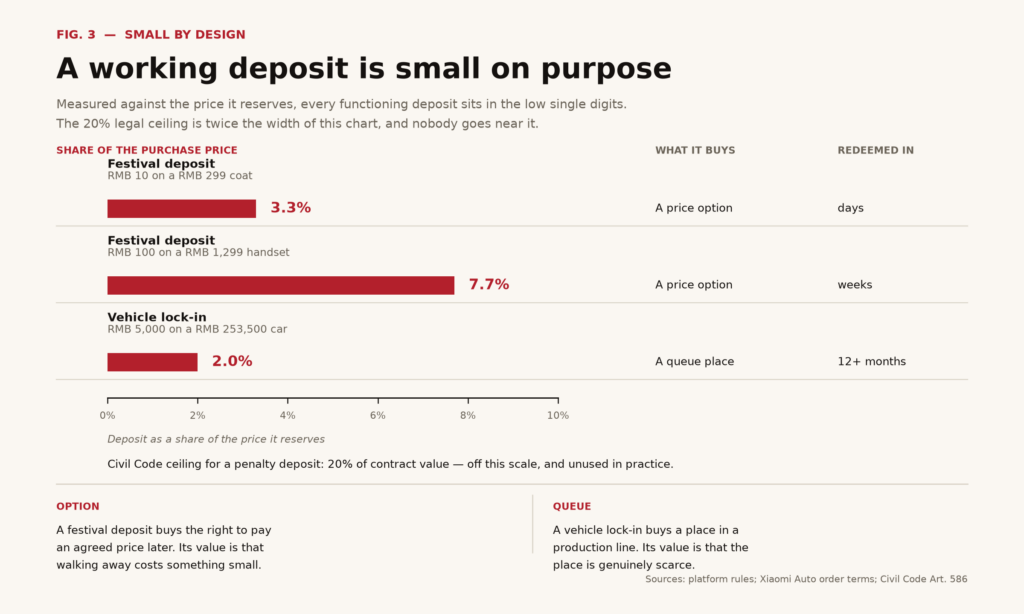
That asymmetry is not a trick. It is the Civil Code. A dingjin is capped at 20% of the contract value and carries a penalty rule: if the buyer walks, the deposit stays with the seller; if the seller walks, it comes back doubled. Spell it with a different character and the same sound names something else entirely: an advance payment, refundable, no penalty. Chinese platforms use the penalized version deliberately, then make you check a box that says so.
Which is why the smallest number in the transaction carries the most legal weight. Ten yuan is not a payment. It is a signature with a price tag.
The mechanic came from property, not from e-commerce
Here is the part Western marketers usually miss. China did not invent the deposit for shopping. It imported it from housing.
In 1994, the Urban Real Estate Administration Law established the pre-sale permit: a developer could sell apartments that did not exist yet, provided construction spending had reached a quarter of total project investment, the permits were in place, and a completion date was fixed. The model came from Hong Kong, where it was called selling flowers on the drawing board. It financed a country that needed to build cities faster than it could save for them. Over three decades, urban living space per person in China rose from under 15 square meters in the early 1990s to more than 40 by the end of 2023.
The first Double 11 pre-sale is generally dated to Tmall in 2012 — not to finance anything, but to survive the traffic. A window spread server load, spread warehouse pressure, and told merchants how much stock to commit. Twelve years later, the mechanic had become the default shape of every major promotion in the country.
Now look at what happened to both markets in the same eighteen months.
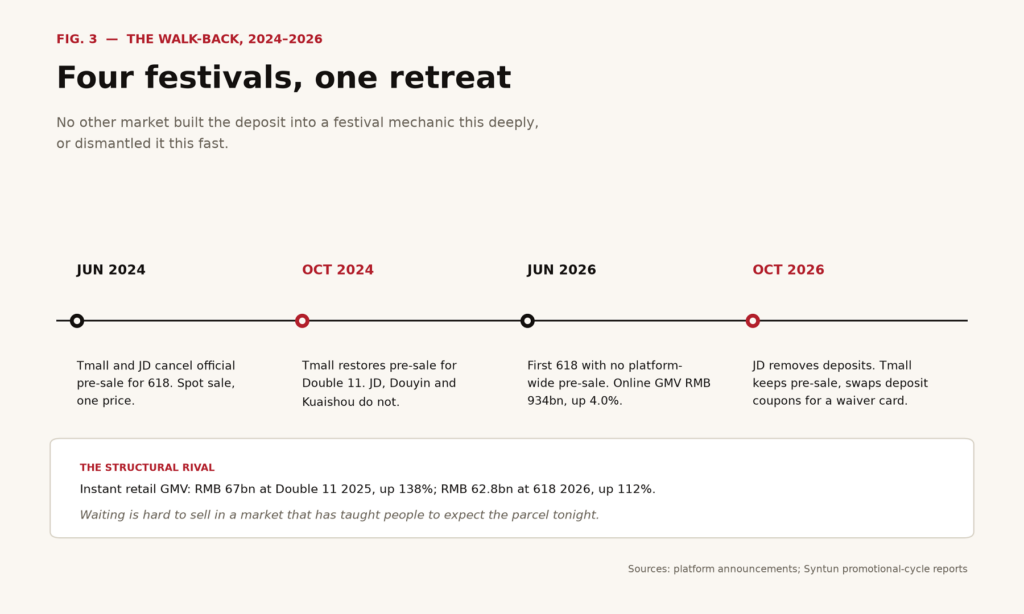
In June 2024, Tmall and JD both canceled official pre-sale for 618 and sold spot stock instead. Four months later, Tmall brought it back for Double 11; JD, Douyin and Kuaishou did not. A Tmall executive explained the reversal in terms that had nothing to do with technology: merchants said pre-sale mattered to their business, and that second-half order values were bigger. A 1,299-yuan coat and a 6,000-yuan handset take longer to decide on than a T-shirt. The deposit bought the platform time inside the customer’s decision.
By 2026 the argument had flipped twice more. June’s 618 was the first midsummer festival with no platform-wide pre-sale at all. And in October, JD went further: spot sale from October 12, no deposits, thirty-day price protection, service-category orders up 130% year on year in its first week. Tmall, pulling the opposite way, opened pre-sale on October 15 and threw in the waiver card.
Two platforms, one festival, opposite bets. That isn’t confusion. That is a market discovering that the deposit was never one thing.
The five jobs a deposit does at once
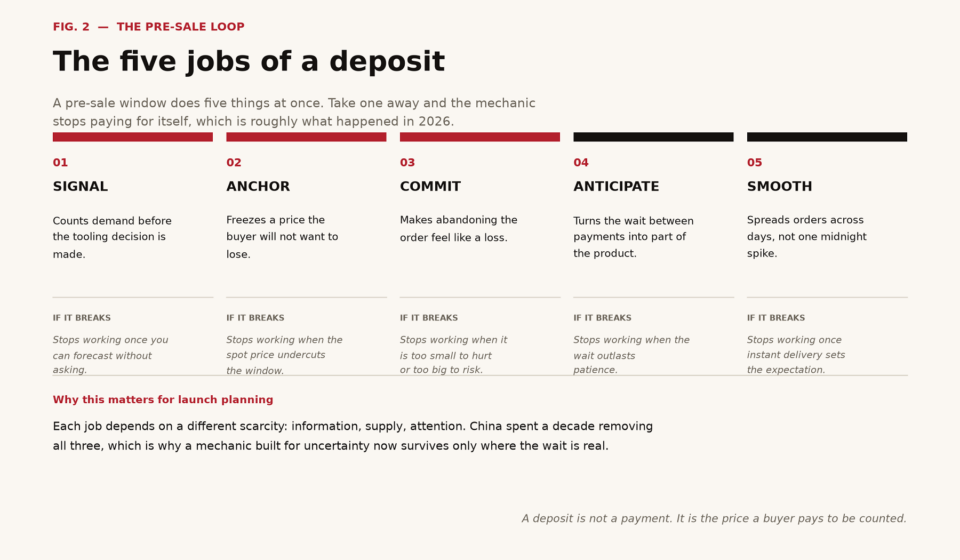
Strip away the festival language and a pre-sale window turns out to be doing five jobs.
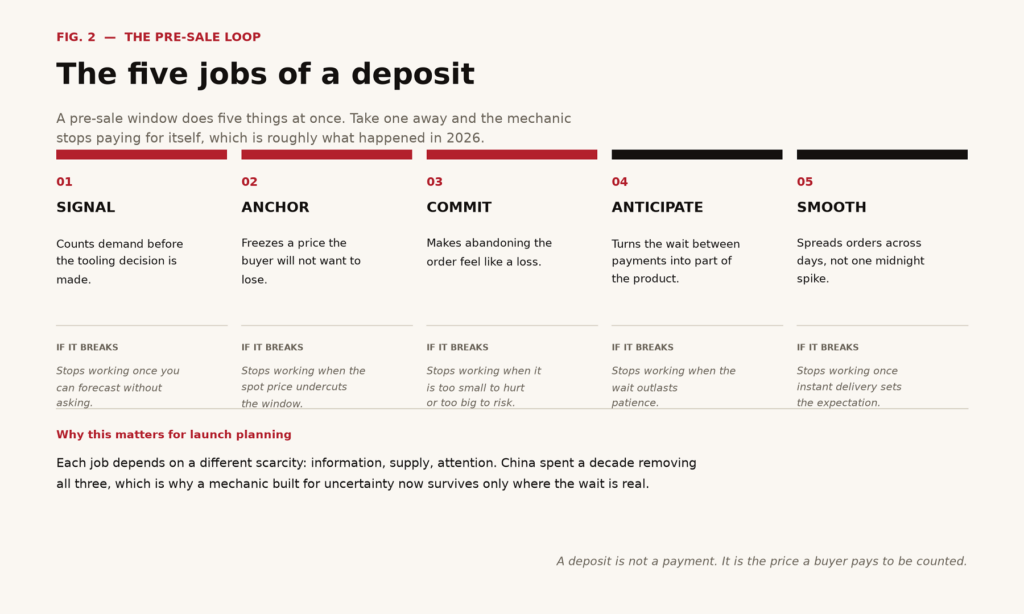
It counts demand before the tooling decision. A factory that commits to 200,000 units on a hunch is gambling. One that commits after 200,000 deposits is reading. This is the job the mechanic was invented for, and the only one that produces a number rather than a feeling.
It anchors a price. The window freezes a promotional price, and a frozen price is a loss waiting to happen if you walk away. This works right up until the spot price undercuts it — which, in 2026, is exactly what China’s consumer association warned shoppers to check.
It manufactures commitment. A forfeitable deposit converts browsing into a sunk cost. Not a large one. That is the point. Arkes and Blumer showed in 1985 that people honor sunk costs even when the rational move is to walk, and the effect doesn’t require a large sum; it requires the loss to be legible.
It sells the wait. Anticipation is not dead time. It is consumption. Kumar, Killingsworth and Gilovich found that waiting for an experiential purchase can generate more happiness than the purchase itself. A pre-sale window is a machine for manufacturing that interval on purpose.
It smooths the load. Orders spread across days instead of landing in one midnight spike. The 2026 reporting on Chinese platforms says it plainly: remove pre-sale and inventory pressure moves forward, with instant fulfillment becoming the constraint instead.
Five jobs, one payment. That efficiency is why the mechanic spread. It is also why it became fragile: each job depends on a different kind of scarcity, and China spent a decade destroying all three.
Where the scarcity went
Pre-sale economics only work when somebody is short of something.
Short of information: brands didn’t know demand, so they paid customers — in discounts, in priority, in a locked price — to tell them. Short of supply: factories needed lead time, warehouses needed notice. Short of attention: a countdown creates urgency that a permanent discount cannot.
By 2026, two of the three had been eaten.
Information went first. Platforms now run demand forecasting on transaction data at a granularity no deposit survey could match, and AI has moved from recommendation into the transaction itself. When Alibaba wired its Qwen assistant into Taobao in May 2026 and JD put its own agent in front of shoppers, the shopping assistant became a forecaster with a wallet. If you can predict the number, why pay for a signal?
Supply went second, and it went loudly. Instant retail — thirty-minute delivery of a phone charger or a lipstick — reached 67 billion yuan of GMV at Double 11 in 2025, up 138%, and 62.8 billion at 618 in 2026, up 112%. Community group buying, the older order-today-collect-tomorrow format, fell 39.6% in the same 618 period. The market didn’t just get faster. It redefined waiting as a defect.
Attention went last, and it went sideways. The urgency a deposit used to supply can now be bought from a livestream, a limited drop, or an AI assistant mentioning that three are left. Scarcity became a media product rather than a payment mechanic.
The one place the wait is still real
Then there is the exception that proves the rule: cars.
On June 26, 2025, Xiaomi opened orders for the YU7, a 253,500-yuan electric SUV. Within three minutes, 200,000 orders had been placed with a 5,000-yuan deposit. Within an hour, 289,000. Within eighteen hours, 240,000 had locked their orders — the step that makes the money non-refundable and the specification final. The standard version then quoted a delivery estimate of 53 to 56 weeks.
Read that again. A year of waiting, paid for in advance, by nearly a quarter of a million buyers, for a car most of them had never driven.
The deposit here does something the e-commerce deposit never did: it prices a queue. Xiaomi’s order book became a secondary market, with listings appearing within hours and rival dealers offering to reimburse the 5,000 yuan for anyone willing to defect. When your competitor is paying your customers’ forfeited deposits, you know the mechanic is working.
But notice why it works. The scarcity is physical. Factories cannot be conjured, battery lines cannot be doubled in a quarter, and the wait is a genuine constraint rather than a manufactured one. A deposit converts that constraint into a queue, and a queue into a status object.
Where supply is genuinely tight, the deposit is still the cleanest instrument anyone has invented. Where supply is loose, it is a tax on your own conversion rate.
What the numbers will and will not tell you
Here is where most writing on this subject overreaches, so let us be careful.
Syntun, the third-party monitor behind the most-cited festival totals, put Double 11 2025 at 1.695 trillion yuan of online GMV, up 14.2%, with comprehensive e-commerce at 1.619 trillion (+12.3%) and instant retail at 67 billion (+138.4%). For 618 2026 it reported 934 billion yuan, up 4.0%, with comprehensive e-commerce at 863.6 billion (+0.9%) and instant retail at 62.8 billion (+112.3%).
The temptation is to draw a line: pre-sale removed, growth collapsed. Don’t. Syntun itself flags that the 2025 Double 11 cycle ran from October 7 to November 11, against October 14 to November 11 in 2024 — a longer window, so the year-on-year comparison isn’t clean. The 618 comparison has its own problem: 2026’s festival was the first without pre-sale, but also the first with a nationwide trade-in subsidy program in full flow, and the first that Chinese media billed as an AI 618.
Neither platform publishes what share of festival GMV moves through pre-sale. Every number you have read about it is an inference.
What the data can support is narrower and more useful: the festivals got longer, the growth got thinner, and dropping pre-sale did not visibly cost either platform the market. Tmall still led the first phase of 618 2026 with 48.4% of platform GMV; JD held 17.7%.
That is the real finding. The deposit was never load-bearing for the sale. It was load-bearing for the forecast.
The bill always arrives
There is a reason platforms are willing to give this up, and it is not only forecasting. Deposits are the line item most likely to end up in a complaint, and occasionally in court.
The pattern is consistent enough to be a genre. A shopper pays a deposit during the window, then discovers the spot price is lower than the balance price, and is told the two promotions were different. Or forgets the balance date and loses the money. Or pays the balance, then tries to cancel, and finds the refund excludes the deposit.
In October 2026, the China Consumers Association, the China Market Supervision and Management Society and the China Article Numbering Center issued a joint Double 11 advisory that read like a warning label: check the pre-sale price against the spot price before assuming pre-sale is cheaper; understand that a deposit is a guarantee and usually non-refundable; and do not treat a locked-in discount as free.
The courts have largely backed the platforms, provided the disclosure was real. In one case that has circulated through Chinese court accounts, a shopper placed 54 pre-sale orders across four accounts, paid 5,640 yuan in deposits, missed every balance payment and sued for the money back. The court refused. The clause had been displayed prominently; the buyer had to check a box accepting that the deposit was not refundable if the balance went unpaid and was refundable if the balance was paid and the order later canceled; and the same agreement required the seller to return double if the seller defaulted. A clause that binds both sides is not an unfair term.
So the legal position is coherent: the deposit is enforceable, and the platform’s obligation is disclosure. What that leaves is a marketing problem, not a legal one. A mechanic customers experience as a trap stops producing goodwill, and goodwill is the thing a discount is supposed to buy.
The regulatory floor under all of this
Three layers hold the mechanic up, and they are worth knowing if you plan to run a pre-sale in China.
The Civil Code supplies the deposit itself: the 20% ceiling, the forfeiture rule, the double-return rule. Everything else is commentary.
The Consumer Rights Protection Law Implementation Regulations, in force since July 2024, tightened the obligations attached to taking money before you deliver. Article 22 requires a written contract for prepaid arrangements — content, price, refund method, liability — and obliges the operator to stop collecting if it hits serious financial risk. That article targets prepaid cards and memberships rather than festival deposits, and the distinction matters: regulators have not merged the two, and treating a 10-yuan festival deposit as a prepaid subscription would be a misreading.
The third layer is the most instructive, because it is the one being dismantled. On August 28, 2026, the Ministry of Housing and Urban-Rural Development, the Ministry of Natural Resources, and the financial regulator issued a notice that keeps pre-sale legal but demotes it: new land is to favor completed-home sales, any retained pre-sale requires the building’s main structure to be topped out, buyer funds go into full escrow, and mortgages are not released until completion is filed. The share of new homes sold as completed stock had already risen from 13.9% in 2022 to 32.4% in 2025.
China is not banning the pre-sale. It is unbundling it: you may still sell the future, but you may no longer spend the customer’s money while building it.
What survives, and where to use it
Once you separate the five jobs, the strategic picture gets simple. Pre-sale survives wherever the scarcity is real and the wait is informative.
Configurable high-ticket goods. Cars, custom furniture, made-to-order appliances. The deposit is a specification commitment and the queue is a factory schedule. This is where the mechanic is strongest and least contested.
Genuine limited editions. Drops, collaborations, numbered runs. Here the deposit is a raffle ticket with a price, and the waitlist is the point.
Live-commerce launches. A single-brand launch inside a livestream still runs on so-called deposit inflation, because the audience is already inside a countdown. The window is hours, not weeks.
Anything you cannot forecast. A first-time category entrant, a new price tier, an untested SKU in an untested city. Paying customers a small discount for a demand reading still beats a write-off.
It fails, predictably, in three situations: when your supply is loose enough to serve demand on the spot; when your forecasting is good enough that the deposit is redundant; and when your customer has learned that the pre-sale price is not the lowest price. The last one is not a forecasting problem. It is a trust problem, and no discount fixes it.
What to do differently
If you run launches in China, or import the mechanic anywhere else, five rules survive contact with the evidence.
Price the signal, not the discount. The deposit should be small enough to be impulsive and large enough to read as a loss. Ten yuan on a 299-yuan item works. A hundred yuan on the same item does not make the signal ten times stronger; it just lengthens the refund queue.
Never fake the queue. The EV case works because the wait is physical. A waitlist invented to manufacture scarcity is the fastest way to convert a deposit into a complaint, and Chinese shoppers now have a consumer association advisory telling them exactly how to spot one.
Sell the interval. If you are going to make people wait, the wait has to produce something: a making-of series, a configurator, a shipping countdown that updates. Anticipation is a media product. Treat the window as inventory.
Make the refund rule one screen long. Not because the law requires brevity, but because the deposit’s power comes from clarity. Every ambiguous clause converts commitment into resentment.
Retire the mechanic once you have bought the certainty. The moment your forecast is better than your deposit survey, the pre-sale is taxing your own conversion. JD’s 2026 decision was not a retreat from marketing. It was an admission that the forecast had won.
The lesson hiding in a ten-yuan payment
China’s pre-sale culture was never really about deposits. It was about a country that had to build ahead of demand — housing in 1994, warehouses in 2012, electric cars in 2025 — and needed a financial instrument that made a stranger’s intention legible.
The deposit did that better than any survey and cheaper than any advertisement. It converted interest into a number, and a number into a production plan. For a decade, that was worth more than the discount it cost.
Then the forecasts got good, the warehouses got close, and the customers got tired of arithmetic. What is left is a narrower, sharper tool: a way to price a queue when the queue is real. That is not a decline. It is a promotion, from gimmick to instrument.
Which leaves one question worth asking about your own funnel. If you removed the deposit tomorrow, what would you actually lose: the sale, or the forecast?