Six Vendors, One Customer: The Hidden Cost of Importing a Chinese Tactic
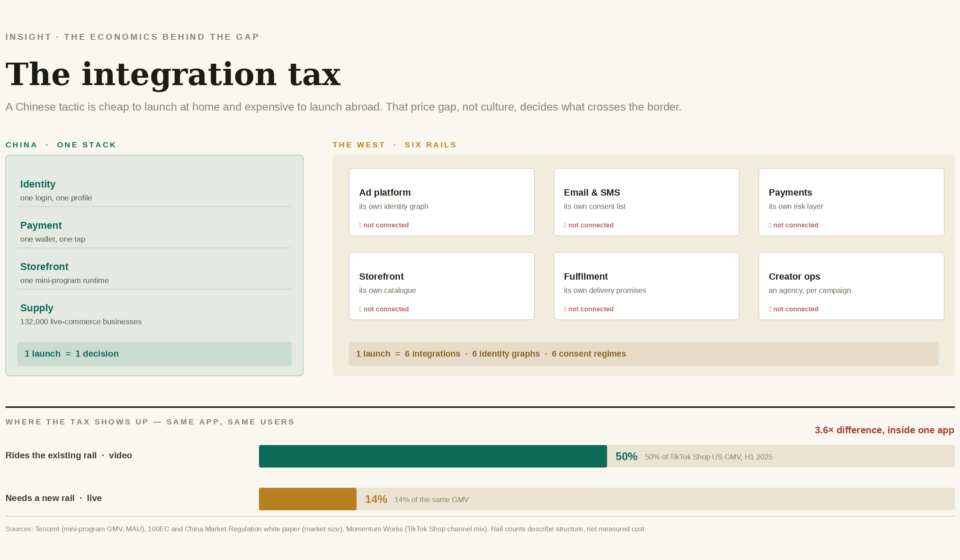
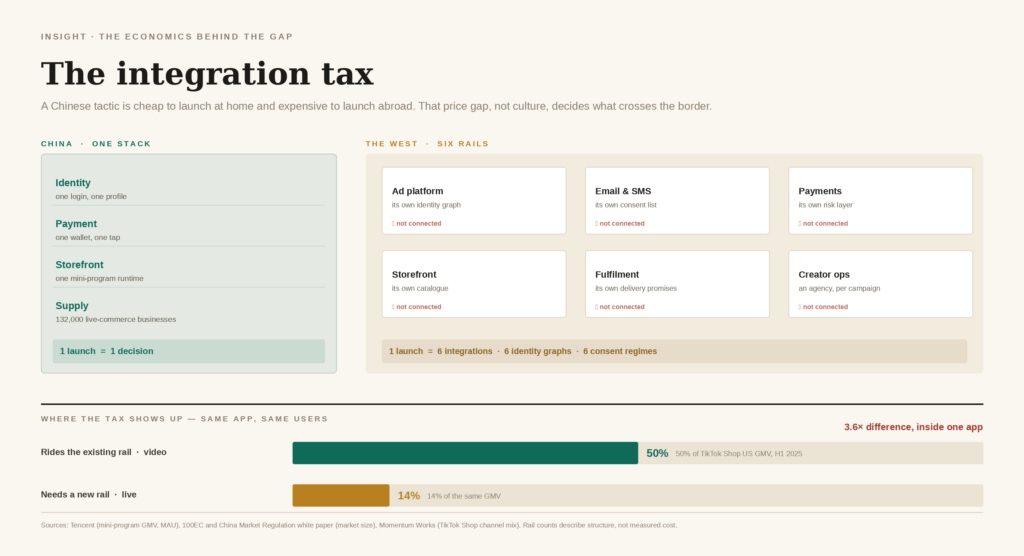
Inside one app, in one country, in the same six months, video sold 50% of TikTok Shop’s US GMV and live sold 14%.
Same users. Same checkout. Same algorithm. A 3.6× gap.
If Chinese tactics failed abroad because Western consumers are culturally different, those two numbers should look alike. They don’t. Which suggests the thing killing the import isn’t taste. It’s price.
The bill arrives before the revenue
Call it the integration tax.
A Chinese tactic launches into a stack that is already fused: one login, one wallet, one storefront runtime, one logistics layer. Adding a mechanic is a product decision, not a procurement project. A brand can test live commerce, a membership tier and a referral loop in the same quarter, on the same customer record, without signing anything.
In the West, the same launch crosses four to six vendors. The ad platform holds one identity graph, the ESP another, the payment provider a third, the storefront a fourth. Each has its own consent regime, its own attribution logic, its own reporting cycle. Nothing is shared except the customer, who is counted six times.
So the West doesn’t reject a tactic. It taxes it — and the tax is charged up front, before the first sale.
Why the tax decides the winners
Once you see the tax, the whole portability ranking stops looking cultural and starts looking financial.
Video commerce travels because it rides rails that already exist. The feed exists. The checkout exists. The only new thing is a tag on a product.
Live commerce stalls because it needs a rail that doesn’t: hosts, studio operations, scheduling, real-time inventory, refund norms. In China that rail is rentable — 132,000 live-commerce businesses exist to be hired. In most Western markets it’s an agency with a waiting list, which means per-session cost stays high until volume arrives, and volume waits on cost.
Private domain never arrives at all, because it needs five rails at once.
The second tax nobody budgets for
There is a labour version of the same problem.
China’s density is not only consumer demand — it is operator supply. 660 million livestream shoppers only exist because hundreds of thousands of people know how to run a live room. That labour market is what makes a tactic feel cheap: you can hire the skill instead of building it.
Import the format without the labour market and you are not running a channel. You are running a training programme.
What this predicts
Three things follow, and all three are testable inside 18 months.
Tactics that ride existing rails keep crossing: short video, AI-generated creative, AI-priced offers.
Tactics that need a new rail cross only when someone builds the rail as a business — which is exactly what Whatnot did for collectors, reaching roughly US$8 billion of GMV by selling the venue rather than the discount.
Tactics that need several rails keep failing, and the post-mortems keep blaming culture, because culture is the only variable anyone can name without opening the invoice.
The agentic shift is the interesting exception. Shopping agents, machine-readable catalogues and API-level checkout are being built natively in both markets, which means rail cost may be symmetric for the first time. That is a stronger reason to watch China’s AI commerce than any tactic it has already shipped.
The border is a price list
China’s advantage was never that its marketers were smarter. It was that experiments cost less, so more of them happened.
Copy the tactic and you inherit the cost. Copy the cadence and you inherit the compounding.