The Brand Day Playbook: Turning a Date Into a Revenue Asset in China
China built more than a hundred shopping festivals in under two decades. Then it ran out of the one raw material a festival cannot be manufactured without: scarcity. The brands still growing have stopped renting attention and started printing their own calendar.
1. The loudest silence in Chinese e-commerce
On November 11, 2026, Tmall expected a million brands and seventy million products to pass through its checkout. Sixty thousand of them were overseas merchants taking part for the first time. Alo, the American yoga label that had opened its Tmall store only in August, was there. Apple was taking pre-orders for a foldable phone. Alibaba stacked coupons worth up to 28 percent off and handed its 88VIP members tens of billions of yuan’ worth of them.
What the company did not do was tell anyone how much it sold.
Neither did JD.com. Neither did Pinduoduo. For the first time in its eighteen editions, the biggest shopping event on earth ran without a headline number attached to it. The platforms had quietly stopped publishing gross merchandise value years earlier, and by 2026 the ritual of the midnight scoreboard was simply gone. Even 818, the August festival Suning invented to break up the second half of the year, passed without a press conference.
You could read that silence as bad news. Sales are flat, the story goes, so the numbers went into a drawer.
You could also read it as the most honest thing Chinese e-commerce has said in a decade. Because something else was happening that same fortnight, and it was not quiet at all.
Sanrio ran its third Tmall Super Brand Day in late August. More than fifty licensee brands launched sixty-seven new products on the same day. A fur charm sold out in six seconds. A co-branded plush line cleared nearly two million yuan. Across the whole campaign, Sanrio-branded merchandise sold 139 percent more than the year before, and the flagship store’s traffic rose 95 percent.
Two events. One with a million brands and no number, one with fifty brands and a very specific number. That contrast is the whole story of Chinese marketing right now, and it explains why the most sophisticated brands in the market have stopped asking how to win the platform’s festival and started asking how to own a date of their own.
2. A holiday is a piece of infrastructure
Start with the origin story, because it is stranger than the legend.
In 2009, Alibaba was looking for a reason to make Taobao profitable. The date it picked, 11 November, had nothing to do with commerce. It was a campus joke from the 1990s about the four solitary 1s in the date, a day for single people to buy themselves a gift. Twenty-seven brands signed up. The whole thing moved 52 million yuan.
The insight buried inside that stunt is the one the industry has been mining ever since: a festival does not need to be ancient. It needs to be emotionally legible. Give people a pretext to feel something, wire a checkout to the feeling, and you have created demand that did not exist on the 10th of the month.
Six years later, Tmall did it again, but smaller and sharper. On August 12, 2015, the platform ran its first Super Brand Day — a single brand, a single day, and every lever Alibaba could pull behind it. The company’s own description was almost cheeky in its clarity: it was a miniature version of 11.11, built for one brand at a time. Tmall would pick ten to twenty brands a month, put one on the homepage each day, and let it keep the whole stage.
By 2020 the program had run more than five hundred of these days. H&M took its first in September 2018. Marriott became the first hotel group to do one in July 2018, and used it to sell a black card rather than a room. The early benchmarks became folklore inside agencies: Dyson moving seventy times its normal daily volume, Maserati selling a hundred cars in eighteen seconds, Oreo outselling its own Double 12 by six times.
None of that was magic. It was the arithmetic of a temporarily uncompetitive shelf.
3. Then China built a hundred more
Here is where the story turns. The template worked so well that everyone copied it, and then everyone copied everyone.
A team at Renmin University’s journalism school audited every promotion Taobao and Tmall announced on their own social channels between November 2020 and November 2021. They found at least thirty-three shopping festivals and thirty-eight “super category days.” Count the days those campaigns covered, including pre-sales, and you get 247. Two-thirds of the year was, officially, a festival.
That was five years ago. By 2026 the count had not gone down.
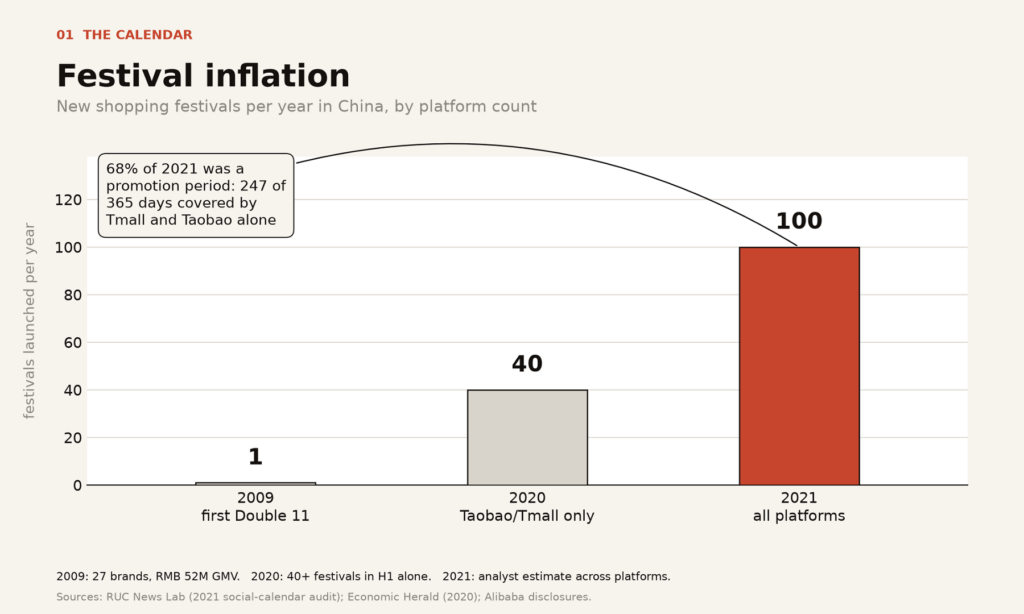
The economics of that are not complicated, and they are not kind. A shopping festival is a scarcity machine. Its entire yield comes from concentrating a year of intent into twenty-four hours, which is why the discount feels worth the hassle of doing the math. Print more festivals and you debase the currency. When a platform runs a subsidy every month, when a livestream host promises 11.11 prices on a Tuesday in March, the festival stops being an event and becomes a channel.
Chinese marketers have a phrase for the result: node inflation. The same word you would use for money.
The evidence is now in the consumer data, not just in the vibes. Accenture surveyed five thousand consumers across first- to fifth-tier cities in August 2025. Sixty-eight percent said they felt indifferent to most marketing campaigns, or actively resistant. Twenty-two percent said marketing made them less likely to buy. Fifty-five percent now compare brands constantly even when they have a favorite, up thirteen points in four years. Meanwhile, 37 percent already use AI to help them shop.
That is a brutal set of numbers for anyone whose growth plan depends on shouting louder during a designated week.
4. What a brand day actually is
Strip away the platform jargon and a brand day is a simple trade: a brand buys exclusivity of attention for a fixed window, and pays for it with an exclusive offer.
Not impressions. Not reach. The absence of competitors.
That distinction matters, because it explains why the format survived the stagnation of the mega-festival. On 11.11 you are one of a million merchants in a single feed, and your discount is instantly benchmarked against the store next door. On your own brand day you are the only thing in the feed, and your price is framed by a story instead of a comparison table.
Three formats have emerged, and they are not interchangeable.
The single-brand platform day. Tmall’s Super Brand Day, JD’s equivalent, Douyin Mall’s Super Brand Day. The platform supplies the traffic, the placement, the subsidy, and the data; the brand supplies the exclusive product and the creative. Tmall’s version is the oldest and most institutionalized. JD has pushed it further into the physical world, wiring brand days into roughly thirty thousand stores — JD MALL, city flagship stores, appliance specialists — so the same promotion runs online and in stores at once.
The IP umbrella day. One licensor, many licensees, one shared date. Sanrio’s Tmall day is the cleanest example: Alifish, Alibaba’s licensing arm, convenes thirty to fifty partner brands around a single narrative, and everyone sells into the same surge of fan attention. The brand here is not a company but a character.
The self-made day. A brand picks its own date and runs it on its own channels: an anniversary, a founder’s birthday, a homophone. Max Mara’s seventy-fifth anniversary campaign, staged as a Douyin brand day in the run-up to Lunar New Year, launched seventy-five new products, seven of them exclusive to the platform. This is the format with the lowest platform dependency and the highest ceiling.
One more thing has changed since 2015. A brand day is no longer a day. It is a multi-week arc, usually two to three weeks, with a twenty-four-hour core: a pre-sale window, a runway of creator content, one peak, then a tail. Sanrio’s 2024 pre-sale ran from August 17 to 27, with the main event on the 28th. The twenty-four hours are where the revenue lands; the three weeks around it are where the revenue is manufactured.
5. Why the math works — and where it doesn’t
Four arguments get made for brand days. Three of them hold up.
Concentrated demand. A brand day pulls forward a quarter’s worth of purchase intent into a single window. Done well, the spike is not a spike at all but a compression. This is the most-cited benefit and the most dangerous one, because it is also the definition of cannibalization. We will come back to that.
Attention without a bidding war. In a mega-festival, the cost of attention rises exactly when everyone needs it. On a brand day, the platform has already allocated the slot, which means the traffic is bought at a fixed price rather than in an auction against your category. The savings are not in media rates. They are in the fact that you are not bidding.
A forecastable spike. This is the underrated one. In a market growing 1.1 percent, the scarcest resource inside a brand team is not budget. It is certainty — something you can plan inventory, cash flow, warehouse shifts, and creator contracts around. A recurring brand day hands you a revenue line you can forecast a year ahead. Tmall’s leading brands now take more than half their GMV from members, and 88VIP alone reached roughly 64 million people by mid-2026. A date plus a membership base is about as close to a scheduled annuity as consumer marketing gets.
Brand equity. The weakest of the four, at least as usually argued. A brand day does build equity, but not because consumers admire your campaign. It builds equity because anticipation is a form of memory. If people know your day is coming, you occupy a slot in their year that a competitor cannot buy.
6. The playbook, seven moves
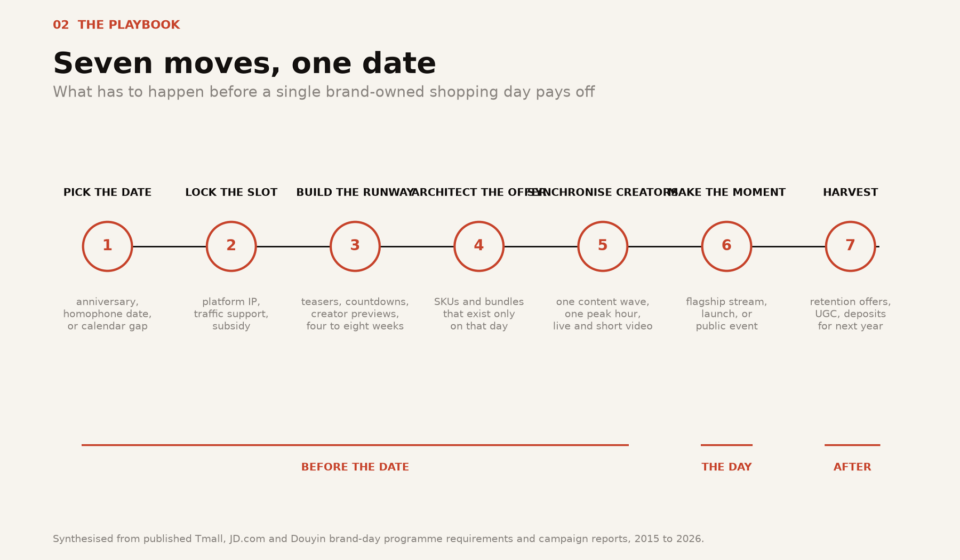
Everything below is assembled from how Tmall, JD, Douyin, and the brands on them actually run these programs. It is not a theory of brand days. It is the operating sequence.
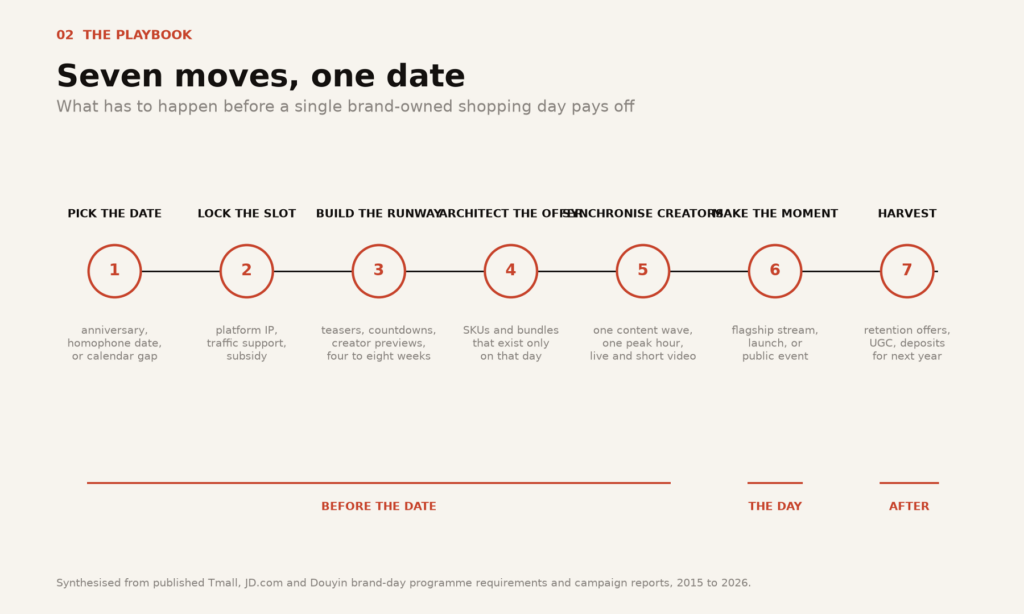
Move one: pick the date like a strategist, not a marketer. Three sources of legitimacy. An anniversary — Max Mara’s seventy-fifth, Hello Kitty’s fiftieth, which Sanrio wrapped its entire first Tmall day around. A homophone — 5.20 sounds like I love you in Mandarin, which is why May 20 became a de facto gifting festival without any platform inventing it. Or a gap — a stretch of the calendar where no platform has planted a flag, which is how 818 and 12.12 came to exist in the first place.
The test is simple. Can a customer explain the date to a friend in one sentence? If not, you have bought a slot, not built a holiday.
Move two: lock the slot, and understand what you are really buying. Slots are deliberately scarce, and the scarcity is the product. Tmall runs ten to twenty single-brand days a month, one at a time. Douyin allocated roughly fifty single-brand Super Brand Day slots for the whole 11.11 season in 2026, against about eighty-five slots for its new-product program. When supply is that tight, the negotiation is not about price. It is about what exclusive inventory you will put on the table, because that is what the platform needs to justify giving you the stage.
Move three: build the runway. Nothing about a brand day is spontaneous. Sanrio’s pre-sale opened eleven days early, with fan-community content, influencer seeding, and a coordinated countdown. The rule of thumb practitioners use is four to eight weeks of teasers, with the last ten days doing the heavy lifting.
Move four: architect the offer so it cannot be compared. This is where most brand days fail. If your offer is “twenty percent off,” you have built a discount, and the customer will check whether the store next door did the same. If your offer is a product that only exists on that date, comparison becomes impossible. Marriott sold a limited black card with privileges you could not buy elsewhere. Tmall pushed more than two thousand platform-exclusive items into 11.11 in 2026 precisely to make price comparison harder. Sanrio launched sixty-seven debuts in a single day.
Move five: synchronize the creators into one wave. Not a drip. A wave. The failure mode is two weeks of scattered reviews that peaks on a random Thursday. The successful pattern is a coordinated burst timed so that short-video seeding, live commerce, and search intent all crest on the same afternoon. Douyin’s own program documentation now requires brands to put talent into their own livestream rooms, which tells you where the platform thinks the conversion happens.
Move six: manufacture a media moment inside the day. A flagship stream, a launch, a physical event, a stunt. Sanrio turned a three-thousand-square-meter stretch of Shanghai’s University Road into an “Ita-Street” and drew more than three hundred thousand visits; a year later a Hangzhou pop-up logged close to three million check-ins. MAC built a four-hour live “makeover tournament” with sixteen of its own artists and thirty-six looks, peaking at thirty thousand concurrent viewers and roughly two minutes of average dwell time. None of that sells product directly. All of it gives the algorithm and the audience a reason to show up on the day.
Move seven: harvest, or waste the asset. The day after is where compounding happens: retention offers to first-time buyers, structured UGC collection, and a deposit of anticipation for next year. Sanrio’s three-year arc is the textbook case. Thirty licensees and twenty million yuan of co-branded GMV in 2024. Fifty brands and fifty percent growth in 2025. Fifty brands, sixty-seven debuts, and thirty-five million yuan in 2026. Each session is designed to make the next one bigger, which is only possible if the harvest is planned before the spike.
7. What the evidence actually supports
Let us be careful here, because the case-study literature on brand days is mostly written by the people selling them.
The strongest numbers come from JD’s full-channel program in the first half of 2026, where the figures are large enough and specific enough to be meaningful. Midea’s brand day cleared 3.1 billion yuan. Haier’s did 2.8 billion. Gree’s did 930 million. Hisense ran a ninety-six-hour version and grew full-channel sales by 212 percent year on year. TCL’s November 1 event grew single-day GMV by 198 percent, put thirty-two thousand Mini-LED televisions into homes, and pulled six hundred million impressions.
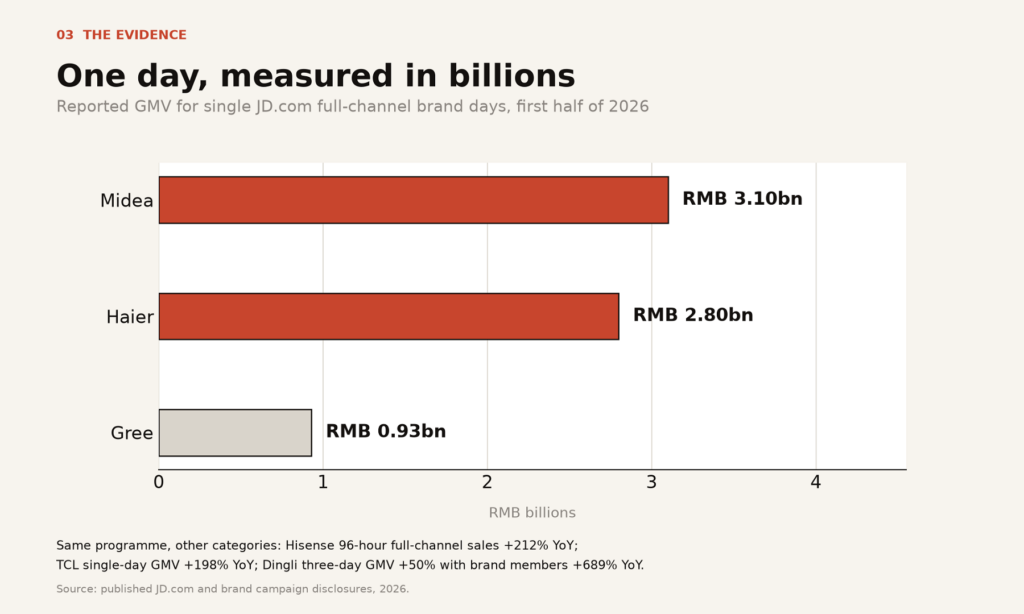
Smaller categories show the same shape. Dingli, a stationery brand, grew 29 percent on day one and nearly 50 percent across three days, with brand membership up 689 percent — a reminder that the membership gain often outlasts the sales gain.
On the content platforms, the numbers are relative rather than absolute, which makes them harder to police but no less instructive. Douyin’s Mall ran Super Brand Days with more than eight hundred brands between 2021 and 2025. In March 2025, fourteen Chinese brands used the program to set store-livestream records, with more than 180 million impressions across the campaign. Bosideng used a brand day plus a celebrity stream to break twelve and a half million yuan in a single day.
The Tmall archive supplies the older benchmarks, and they are worth keeping in perspective. Dyson’s seventy-fold day, Oreo’s six-times-Double-12, Maserati’s eighteen-second sellout — these were real, and they were also the product of a market with far less competition for the same slot. Tmall’s own pitch to brands in the program’s early years was that eighty percent of participants hit their second-highest sales peak of the year. That is a good number. It is not a transformative one. It says: your second-best day, reliably, on a date you choose.
Which is, frankly, the honest promise. A brand day does not create demand out of nothing. It concentrates demand you already had, and it buys you the conditions to convert it at a better rate.
8. The parts that do not make the case study
Cannibalization is the default outcome, not the exception. If your brand day is a discount event, the revenue it produces is revenue you would have booked in the following three weeks anyway. The spike is real and the increment is not. The only reliable test is a holdout: compare the four weeks after the event against the same four weeks a year earlier, and see whether the daily average actually moved. Most brands never run that test, because the answer is uncomfortable.
Slots are scarce, and scarcity is leverage. Tmall runs a single brand day at a time. Douyin held back roughly fifty for the whole of 11.11. If you are not one of the brands the platform wants, you are not getting a slot, and no amount of creative brilliance changes that. The self-made format exists precisely because platform slots are rationed.
Execution risk lands on the warehouse, not the campaign. A five-fold spike in a single day breaks things: stock positions, returns processing, installation scheduling, customer service. In appliances, fulfillment is where brand days quietly lose money, because delivery-and-installation capacity is subcontracted to local service partners who cannot triple their workforce for a weekend. The brands that run these well treat the operation as the campaign.
Fatigue applies to you too. A brand day is not immune to the disease it was invented to cure. Run one every quarter and it becomes a promotion. Run it once a year and it stays an event. The frequency discipline is the whole game, and it is the first thing to break when a quarter looks short.
Single-day percentages are a trap. A 198 percent lift on a low base is not a 198 percent business. If a brand day is worth 1.5 percent of annual revenue on a normal day, tripling it adds three percentage points to the year. That is a good outcome. It is not a strategy on its own, and any deck that presents the percentage without the baseline is selling you something.
9. Why the format survived 2026
The macro backdrop is not friendly to festivals. Retail sales grew 1.1 percent in the first nine months of 2026. Online sales of goods grew 3.8 percent, and the broader measure including services grew 4.4 percent. McKinsey’s China consumer work puts expected consumption growth at around 2.3 percent against household income expectations of 1.4 percent. None of that is a collapse. All of it is a ceiling.
In a market like that, the fight moves from share of voice to share of calendar. And a calendar appointment has one property that an advertisement does not: the customer opted in.
That is the mechanism worth understanding. Accenture’s finding that two-thirds of consumers are indifferent or hostile to marketing is not a statement about advertising being dead. It is a statement about interruption being dead. A brand day is not an interruption. It is a scheduled arrival that the customer has been told about in advance, often by other customers, and that they chose to wait for. The same person who scrolls past six ads will set a reminder for a drop.
There is a second, quieter reason. As platforms stopped publishing GMV, they also stopped promising growth. What they began offering instead was capability: AI tools, member programs, logistics, and exclusivity arrangements. Alibaba put its Qwen model into the shopping stack across 2025 and 2026, launched an AI shopping assistant in May 2026, and used the 2026 festival to sell AI credits as a consumer product for the first time. The platform’s pitch is no longer “we will bring you a crowd.” It is “we will give you the instruments to convert the crowd you already have.”
A brand day is one of those instruments. It is also the one the platform cannot fully control, which is exactly why brands like it.
10. Where this goes next
The AI-operated brand day. The operating cost of a brand day is coordination: offers, creatives, creator briefs, inventory, live schedules. That is precisely the kind of work that generative tools are good at. Expect the eight-week runway to compress, and expect the personalization layer — different offers for different cohorts inside the same date — to become standard. Alibaba already runs large-language models inside search and recommendation; the next step is a brand day that assembles itself.
The same-day, multi-platform brand day. Brands have started running the same date across Tmall, JD, and Douyin with different exclusive products on each. It is operationally ugly and strategically sound: it stops any single platform from owning your holiday, and it captures the different shopping modes each platform serves.
The private-domain brand day. The most interesting version, and the least dependent. A brand runs its own date on its mini-program or app, with its own members, no slot to negotiate. The constraint is reach; the advantage is that the data, the relationship, and the margin all stay in-house. Chinese brands already run sophisticated private-domain operations through WeChat; turning one of those into an annual, branded date is a small step.
The date as a measurable asset. This is the shift that will separate serious operators from the rest. Once a brand day has run three times, it stops being a campaign and becomes a line item with a growth rate, a payback period, and a retention curve. You can put it in the plan the way you put a product line in the plan.
11. Two calendars, one P&L
Here is the frame that makes the decision easier. A mega-festival and a brand day look similar on a media plan and behave completely differently on a P&L.
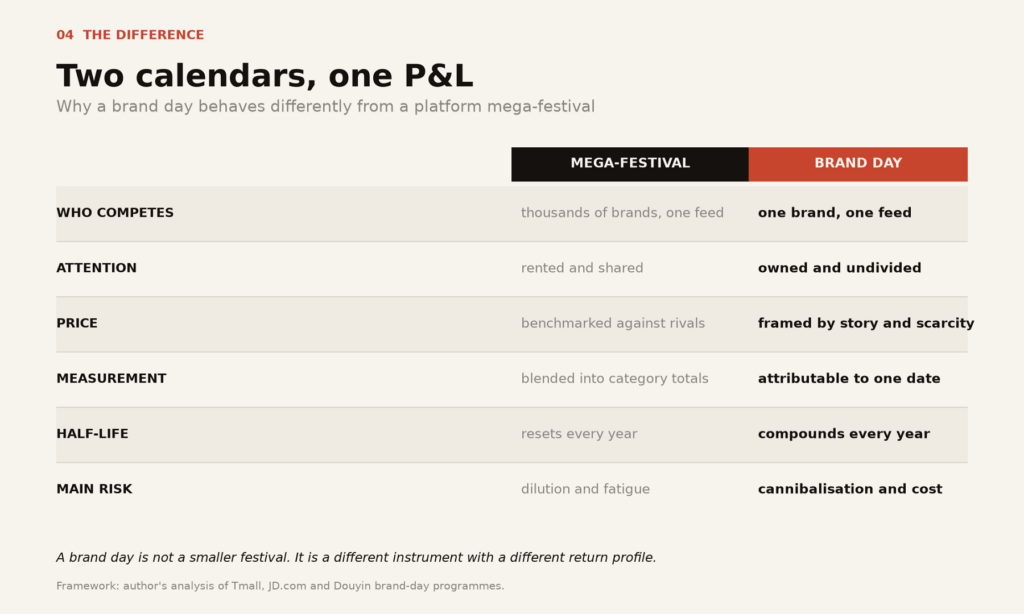
The mega-festival gives you reach you could not buy, at a price set by an auction, in a feed you share with a million rivals. Its half-life is one year: the scoreboard resets, and next November you start again from zero.
The brand day gives you a smaller audience, at a negotiated price, in a feed where you are the only thing in it. Its half-life is longer, because the date itself accrues meaning. Sanrio’s third session was bigger than its first not because the offer was better but because the audience had learned to expect it.
Most brands need both. The mistake is treating them as the same instrument with different budgets.
A quick diagnostic. Six questions. Can a customer name your date without prompting? Do you have an offer that cannot be price-compared? Is the slot secured at least a quarter ahead? Can your fulfillment survive a five-fold day? Do you have a holdout test for incrementality? And would you be comfortable running it only once a year?
Four yeses is a program. Fewer than three is a promotion with a logo on it.
The last piece of media you can own
There is a line in Tmall’s own description of the Super Brand Day that has aged well: it was built to be “a smaller version of 11.11 for a single brand.” Small, in that sentence, was the point. The program’s entire value came from shrinking the festival until one brand could hold it.
Eleven years later, the industry has learned the hard way that you cannot keep enlarging a festival without diluting it. The calendar is finite. Attention is finite. Discounts, once permanent, stop being events. What is left is the thing brands can actually control: a date, a story, and an audience that has agreed to show up.
That is not a campaign. It is an asset, and it compounds in a way that paid media never does. The brands that understand this have stopped asking their platform for a bigger slice of November and started asking which day of the year they can make their own.
The calendar, it turns out, was never given to anyone. It was always up for grabs.
Frequently asked questions
What exactly is a brand day, and how is it different from a normal promotion?
A brand day is a fixed, recurring date on which a single brand (or a single licensed character) takes over the attention of a platform or of its own channels, supported by products that exist only on that day. A promotion discounts existing stock inside a shared feed. A brand day removes the competition from the feed and replaces price comparison with a story.
Do brand days only work for big brands with platform deals?
No, but the mechanics differ. Platform slots are rationed — Tmall runs a single brand day at a time, and Douyin allocated roughly fifty single-brand slots for the whole 11.11 season in 2026 — so mid-sized brands usually start with the self-made format: an anniversary or a homophone date run on their own channels, with paid media aimed at it. The self-made version has a lower ceiling and a much higher ownership stake.
How much revenue should a brand day actually produce?
Less than the case studies imply, and more than a normal campaign. The realistic target is your second-highest sales day of the year, delivered on a date you control. Tmall’s early pitch to brands was that eighty percent of participants reached exactly that. If a brand day produces a 200 percent lift on a low base, check what share of annual revenue that base represents before celebrating.
How do you tell incremental sales from pulled-forward sales?
Run a holdout. Compare the four weeks after the event with the same four weeks a year earlier, and check whether the daily average moved. If the spike is followed by a trough of roughly the same size, you bought a timing shift, not growth. Brands that skip this test usually discover the answer later, in a quarterly number they cannot explain.
Can this work outside China?
The format travels; the infrastructure does not. What makes Chinese brand days work is the combination of a platform willing to hand over its homepage for a day, a livestream and short-video layer that can be synchronized to the hour, and a consumer culture where waiting for a date is normal. Western markets have the first two in weaker form and largely lack the third. The transferable part is the discipline: pick one date, protect it, make the offer incomparable, and run it every year until the date means something.