Why China’s Pre-Sale Stalled: The Guarantee That Only Ran One Way
The numbers tell you when the deposit stopped working. They don’t tell you why. The usual answer — AI got better at forecasting — is true but incomplete. Forecasting explains why brands stopped needing the signal. It doesn’t explain why shoppers stopped trusting the deal.
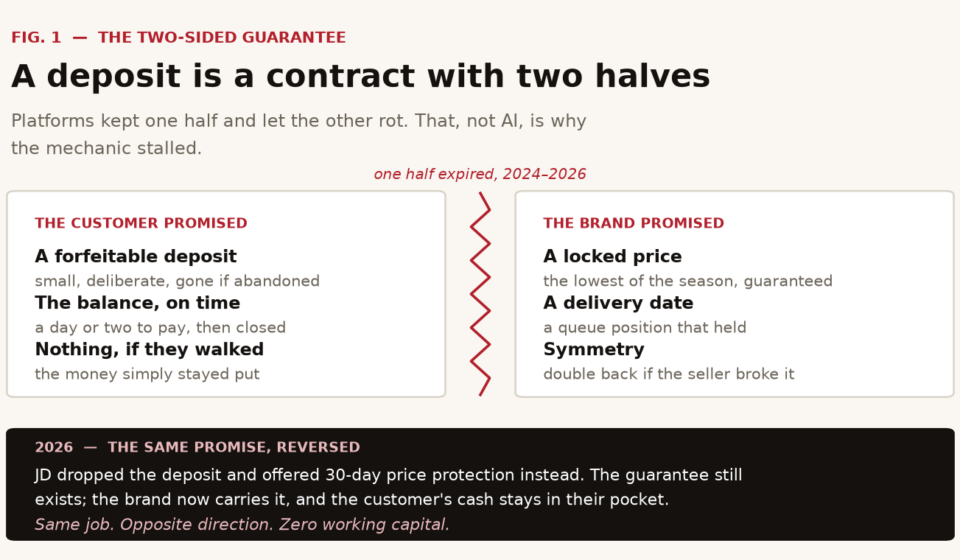
Here’s the mechanism nobody writes down. A pre-sale is not a sale. It’s a swap of guarantees. The customer hands over certainty: a forfeitable deposit, and a balance due inside a window that closes in a day or two. In return, the brand hands over a different kind of certainty: the lowest price of the season, locked.
For a decade, both halves held. Then the second half quietly stopped being true.
By 2024 the pre-sale price had stopped being the floor. Coupons stacked on platform discounts, store vouchers stacked on coupons, trade-in subsidies landed mid-cycle. A shopper who paid a deposit in mid-October could watch the balance price come out above the spot price three weeks later — and be told the two promotions were different. China’s consumer authorities were still warning shoppers about exactly this in October 2026: check the pre-sale price against the spot price, because pre-sale is not automatically cheaper.
The moment that happened, the deposit stopped being a guarantee and became a fee.
That distinction is the whole story. A guarantee is symmetric: both sides carry risk, and the penalty rule in the Civil Code enforces the symmetry. A fee is one-directional: the customer carries all of it, and pays up front for a promise the seller no longer has to keep. You can run a fee for one season. You cannot run it for a decade, because customers do arithmetic and the arithmetic is public.
Which is why the 2026 fixes are so revealing. JD didn’t only delete the deposit; it replaced the brand’s half of the bargain with a stronger version of the same promise — thirty days of price protection, and at 618 a double-the-difference pledge if a competitor undercut it. Tmall kept pre-sale but swapped its coupon maze for flat official markdowns and a card that waives the deposit. Neither platform restored the old contract. Both rebuilt the half that had broken.
Look at what those two moves cost: nothing today, everything if the forecast is wrong. Price protection is a written bet on your own pricing power, and it is affordable precisely because the forecasting got good. The same capability that made the deposit redundant also made its replacement possible. That’s the part most commentary misses: AI didn’t kill the deposit. It made the honest version of the promise cheap enough to offer.
So the transferable lesson is not “run fewer pre-sales”. It’s this. Every commitment mechanic hands the customer a promise and takes one in return. Audit both sides of yours. If your half has quietly expired — the discount is no longer the lowest, the delivery date is a guess, the scarcity is decoration — the deposit gets reclassified, by your own customers, as a fee. And a fee, unlike a guarantee, only gets paid once.