Why China’s KOC Market Grows While Nobody Believes It
Somewhere in a Shanghai agency, slide 14 of a quarterly review reads something like this: 120 notes delivered, CPE down 18%, 4.1 million impressions. Nobody in the room asks the only question that matters — did anyone believe them?
That question is not on the slide because nobody in the chain is paid to answer it.
China’s KOC economy gets described as a persuasion market that happens to be cheap. Look at the payment terms and it is the reverse: a measurement market that happens to involve persuasion. Every participant is compensated on a countable input, and the inputs have quietly become the product.
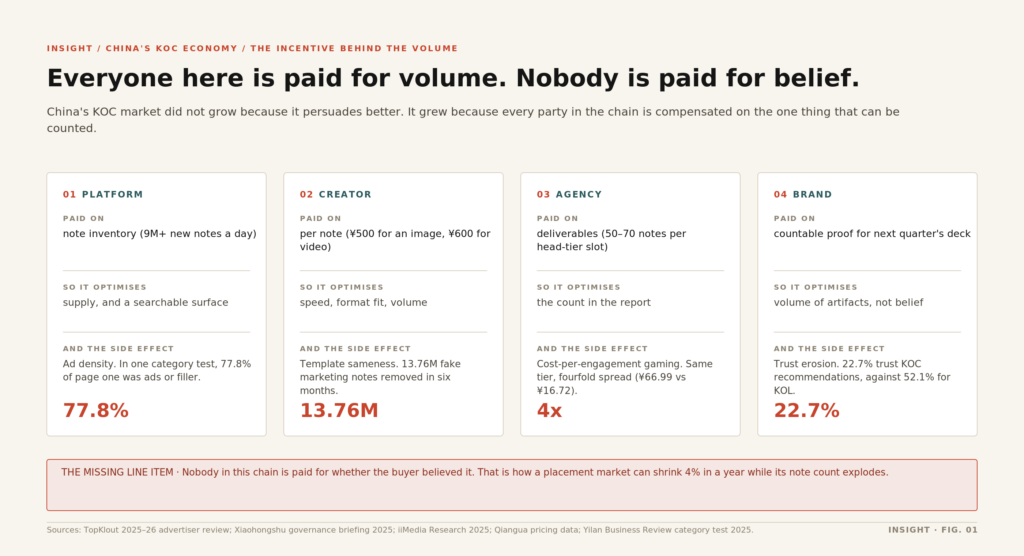
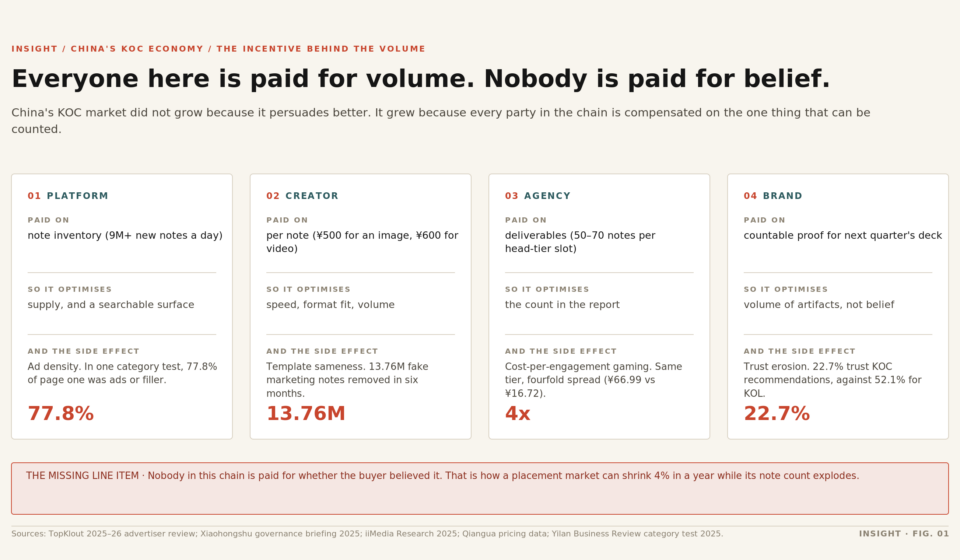
Follow the money down the chain. The platform earns on inventory, and inventory is counted in notes published per day — nine million of them. The creator earns per note, roughly ¥500 for an image and ¥600 for video, which rewards speed and format fit far more than accuracy. The agency earns on deliverables, and one head-tier slot turns into fifty to seventy tail posts, so its margin lives in the count. The brand marketer earns internal credit for proof: a number that survives a review meeting with a CFO who has never opened Xiaohongshu.
Four rational incentives, one predictable output. The chain produces the artifact that gets reported, not the belief that gets measured.
You can see the distortion in the price sheet. Inside a single tier and niche, two maternal creators with nearly identical followings — 294,300 and 290,700 — ran cost per engagement of ¥66.99 and ¥16.72. A fourfold spread within one price band means buyers are not pricing persuasion. They are pricing output, and paying by the piece.
The trust numbers have not stopped anyone. KOC recommendations are trusted by 22.7% of Xiaohongshu users; KOL recommendations by 52.1%. And still ¥84 billion moved through content placements last year, with 86.8% of deals going to mid and tail creators. When a market spends that much on a format that polls badly, it is buying something other than credibility.
Here is the uncomfortable part: this is not stupidity. It is legibility. A note can be counted, screenshotted and defended in a performance review. A shift in belief cannot. Given a choice between a metric that is defensible and a metric that is true, organisations pick defensible almost every time. KOC did not exploit that preference. It was built on it.
An account manager once described the briefs she actually receives: one hundred notes by the 30th. Not “make people want this”. The second brief has no delivery date, so it never gets commissioned.
The exit is not to buy fewer notes. It is to make belief countable: branded-search lift, share of first-page answers across twenty priority queries, 90-day content contribution, and a fee line — even 10% — tied to those numbers. Until something un-countable gets a deadline, the chain will keep producing exactly what it is paid for.
The ¥500 note was never the expensive part. Three hundred of them, bought to avoid one hard conversation, is.