The Economics Behind China’s Dealership Bloodbath: Why the Building Outlives the Brand
New cars now carry a −25.5% gross margin. The building was never the brand’s to lose.
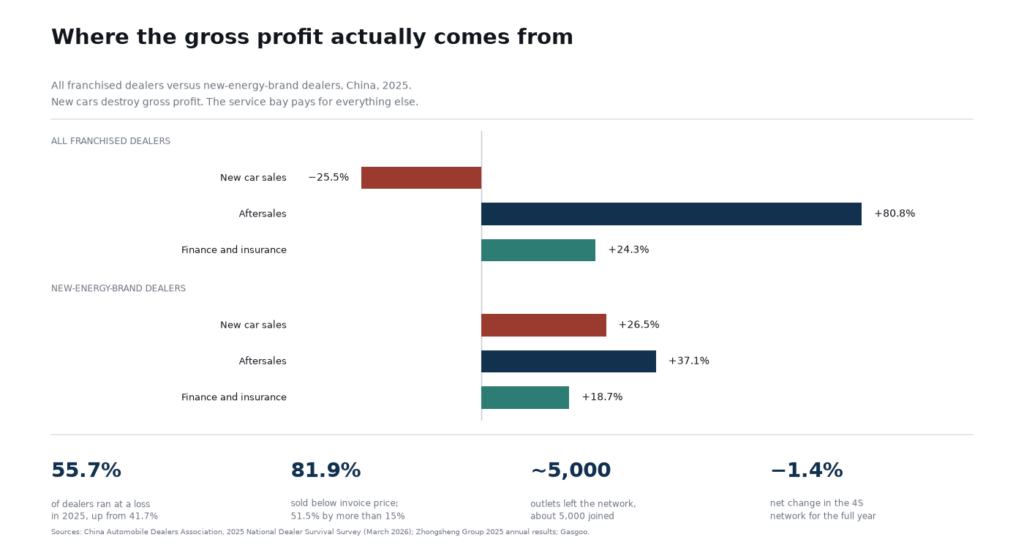
Something strange happened to China’s car retail network in 2025. Roughly 5,000 franchised stores left it. Roughly 5,000 joined it. At the end of the year the network stood at 32,432 outlets, down 1.4%.
A market that sheds and replaces a seventh of its retail capacity in twelve months, while barely changing size, is not collapsing. It is swapping. And once you look at the gross-profit line, the reason stops being mysterious.
Per the China Automobile Dealers Association’s 2025 survival survey, new-car sales contributed −25.5% of dealers’ gross profit. Aftersales contributed 80.8%. Finance and insurance added 24.3%. Read that again. The department the brand is named after is a cost of customer acquisition, and the workshop behind it is the business.
That single fact reorganizes everything else.
It explains why dealers keep selling below invoice. With 81.9% of stores in price inversion, and 51.5% inverted by more than 15%, the dealer is not trying to earn on the car. It is buying a customer who will come back for parts, service and the next vehicle. The discount is a marketing budget with a VIN attached to it.
It explains why the loss became intolerable in 2025 specifically. The two subsidies funding that budget both contracted. Manufacturer rebates, which plug the gap between invoice and transaction price, averaged more than 70 days to clear — and at one premium brand ran past 180, the only one of 40 mainstream brands in that position, partly payable as credit against the next order rather than cash. Then, from June 2025, regulators steered five-year car-loan commissions down from roughly 15% to 5%. Commission income at Zhongsheng, China’s largest dealer group, fell 38.7%.
It explains what actually closed: a franchise, not a building. When the badge stopped paying, the operator kept the asset and changed the sign. Zhongsheng converted about 48 luxury-brand stores to Huawei’s HarmonyOS Intelligent Mobility network. Between November 2024 and mid-2025 it shut 37 outlets and opened 57, ending at 439 against 436 at the end of 2024 — net flat, with a different brand mix. Its AITO stores earned roughly 27,000 yuan of gross profit per car in 2025, against an average loss of about 20,000 yuan on each luxury-badged unit.
A service bay does not care whose logo hangs on the fascia. It cares whether the customer comes back at 20,000 kilometers.
So the bloodbath is better described as a transfer. The storefront survived because it was never really the brand’s asset. It belonged to whoever owned the customer, the workshop and the lease. In 2025, that turned out to be either a different company or the same one — with a different name over the door.