Weibo Grew 0% Last Year. It Still Decides What China Talks About.
Every year someone declares Weibo dead. The obituary usually follows a template: put its user number next to Douyin’s, mention that the teenagers decamped to Xiaohongshu, and close with a line about how China’s original microblog has become a museum exhibit.
The numbers refuse to cooperate.
Weibo closed 2025 with US$1.76 billion in net revenue, flat year on year, a 26% operating margin, US$449 million in net income attributable to shareholders, and US$2.4 billion in cash and short-term investments. By June 2026 it was reporting 561 million monthly active users and 254 million daily active users. Nothing in that set is growing. Nothing in it is crumbling either.
What those figures describe is a platform that stopped trying to be everywhere and got very good at one job: telling China what just happened, and handing everyone else the frame for talking about it.
That is worth more than an engagement chart suggests.
What Weibo actually is
Weibo launched in 2009 out of Sina and won the first Chinese microblog war against Tencent, Sohu and NetEase. The format was borrowed and then localized: short posts, follows that do not have to be mutual, reposts that turn a single sentence into a live conversation, and a ranked list at the top of the app that tells you what is catching fire.
Seventeen years on, the mechanics have barely moved. You could call that stubbornness. You could also call it a moat.
The company lists on Nasdaq as WB and in Hong Kong as 9898. That matters for a practical reason: it files quarterly, so arguments about Weibo can be settled with numbers instead of impressions.
561 million users, moving sideways
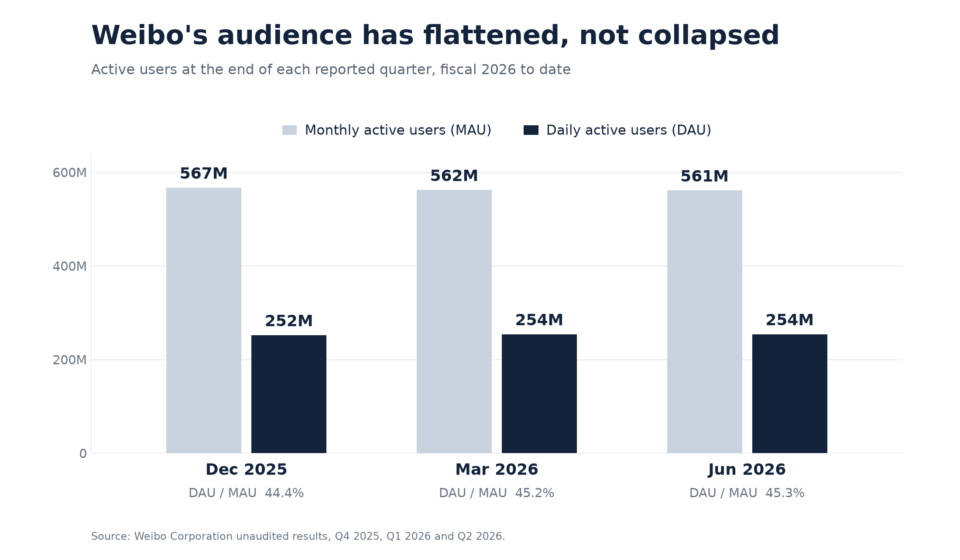
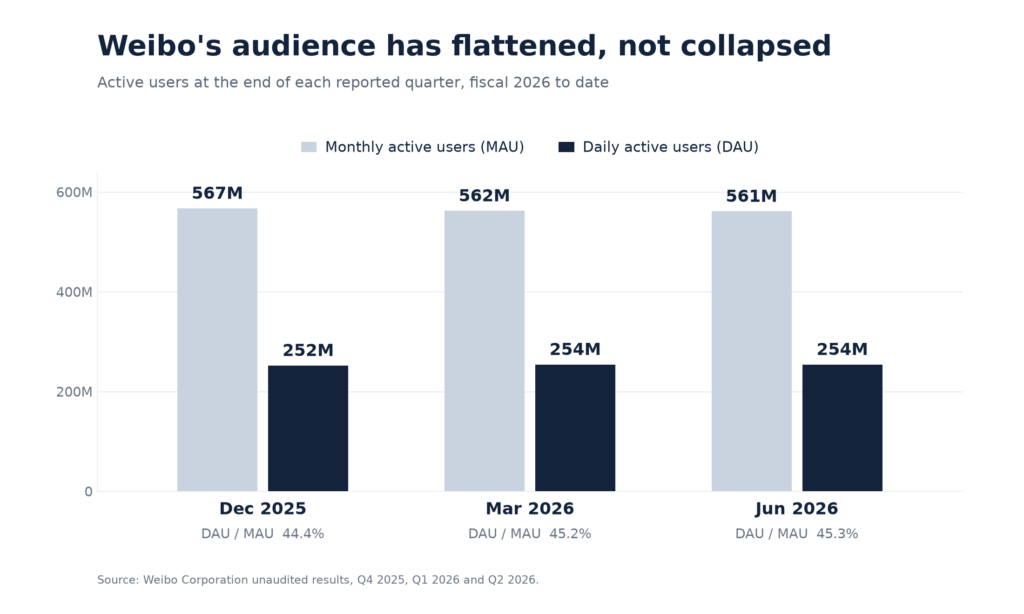
Line up the last three reported quarters. December 2025: 567 million monthly users, 252 million daily. March 2026: 562 million and 254 million. June 2026: 561 million and 254 million.
Monthly users drifted down by six million across two quarters. Daily users rose by two million. The ratio between the two, the share of monthly users who show up on any given day, climbed from 44.4% to 45.3%.
Read those three lines together and the story is not decline. It is pruning. Weibo is shedding the casual accounts that once inflated its headline number while holding on to people who open the app out of habit, often several times a day.
For a brand, the consequence is a change in the unit economics of attention. A shrinking monthly base with a rising daily ratio is a worse place to buy reach and a better place to buy attention at a specific moment.
Reach is not relevance
China had 1.125 billion internet users at the end of 2025, with penetration at 80.1%, according to a CNNIC statistical report published in February 2026. Weibo’s 254 million daily users are roughly 22.6% of that base.
So about one in four and a half people online in China opens Weibo on a given day. Its 561 million monthly users reach almost half the country’s internet population.
Half a country is not a niche. It is also not dominance, and pretending otherwise produces two opposite mistakes: writing Weibo off as legacy, or funding it as if it were a mass-reach channel.
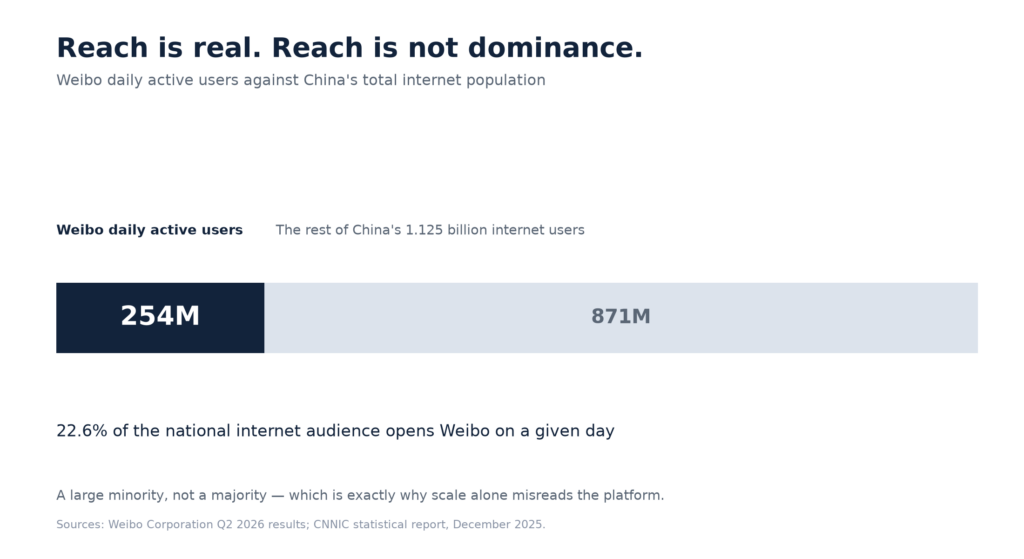
The useful way to hold both facts at once: Weibo is a large minority channel with a disproportionate say in what the majority discusses next.
The real product is the hot search list
Ask a China PR lead what they actually watch and it is rarely a brand account’s follower count. It is the hot search list.
The list ranks the most-discussed topics of the moment and refreshes continuously. It sits at the top of the app. Editors read it. Government communications offices read it. Agency account managers read it. Reporters read it, then write the pieces everyone else reads. By the time a subject feels mainstream, it has usually spent hours on that list.
Nobody outside the company can tell you the exact weighting behind it, and anyone who claims otherwise is selling something. What is observable is the shape: a topic needs volume and velocity, it needs accounts with reach to pick it up, and it has to survive an editorial layer that can promote, demote or annotate. That is why a paid push without real conversation tends to spike and disappear, while a small story with the right amplifiers can sit on the list all day.
This is second-order influence, and it is easy to undervalue because it never appears in a media plan. A campaign that lands on the list does not just reach the people who see it. It hands a frame to every other platform in the country. Douyin creators cut videos about it. Xiaohongshu users post about it. WeChat public-account writers explain it. The topic escapes the app and becomes the weather.
Which is why “how many people did we reach on Weibo?” is often the less interesting question. “What did Weibo put at the top of the page today?” is the better one.
The state regulates the hot search list. Sit with that.
Want proof that a surface sets agendas? Check whether the government bothers to govern it.
China’s algorithm rules are unusually specific here. The Provisions on the Administration of Algorithmic Recommendations for Internet Information Services, issued by the Cyberspace Administration of China together with the industry, public security and market regulation authorities, took effect on March 1, 2022.
Two articles matter for anyone working on Weibo.
Article 11 requires recommendation services to give prominent placement to content consistent with mainstream values in exactly the slots that shape attention: the home screen’s first view, hot search, curated selections, ranking lists and pop-up windows. Hot search is named as a priority surface, not a side feature.
Article 14 goes further. It prohibits using algorithms to register or trade accounts, to manufacture fake likes, comments and reposts, and to suppress information, over-recommend, manipulate rankings or search ordering, or control hot search and curated selections in order to intervene in public opinion or dodge supervision.
Read the two together and three things fall out. Hot search moves public opinion. Fake engagement is serious enough to legislate against. And the list is a regulated artifact, not a pure scoreboard.
That last point is the one Western teams miss most often. Weibo’s hot search is not Twitter’s trending. It is a governed surface with algorithmic, editorial and commercial layers stacked on top of each other. Treat it as an untouchable readout of what the internet really thinks and you will draw bad conclusions and fund worse plans.
One more thing worth saying plainly: buying your way onto the list is not growth hacking. It is the precise behavior Article 14 exists to stop, and the consequences do not end with the platform.
Why “Chinese Twitter” is the wrong mental model
The comparison is a convenient door. Walk through it and you end up in the wrong room.
Where the analogy holds
Short text. Reposts. An asymmetric follow graph. Verified accounts that signal who is official, the blue badge for organizations being the one most foreign brands chase. Real-time public argument that can turn on a dime. All of it is genuinely Twitter-shaped, which is why the shorthand survives.
Where it breaks
Three differences do most of the damage.
First, curation. Twitter’s trending is an emergent, messy signal. Weibo’s hot search is a managed one, subject to the rules above and to platform-level editorial judgment. That does not make it fake. It makes it a different kind of object: a curated national agenda rather than an emergent one.
Second, what lives inside the app. Weibo stopped being text-only years ago. Video, livestream, commerce hooks and celebrity fan ecosystems all sit inside the same product. Twitter, and later X, never became a video destination or a shopping layer the way Weibo did.
Third, who shows up. Government agencies, state media, local police bureaus, universities and major brands all run official Weibo accounts and use them as a primary channel for public statements. There is no Western equivalent at that scale or that level of formality. When a Chinese institution needs to say something in public, a Weibo post is often the first entry in the record.
A US$1.76 billion business learning to stand still
Revenue for 2025 landed at US$1.76 billion, statistically indistinguishable from 2024. Advertising and marketing contributed US$1.50 billion, about 85% of the total. Value-added services added US$255.6 million. Operating income reached US$464.8 million at a 26% margin, and non-GAAP operating margin came in at 30%. The company also declared an annual dividend of US$150 million, or US$0.61 per ADS.
A business that grows zero percent, prints a 26% operating margin and returns cash is not in crisis. It is in a mature phase, running a cash machine.
The 2026 quarters are more uneven than the annual summary. Revenue rose 6% to US$421.3 million in the first quarter on a 9% advertising jump. In the second quarter revenue grew 2% to US$453.8 million, but advertising slipped 1% while value-added services jumped 19% to US$72.9 million, part of which Weibo attributed to one-off ticket revenue from offline events.
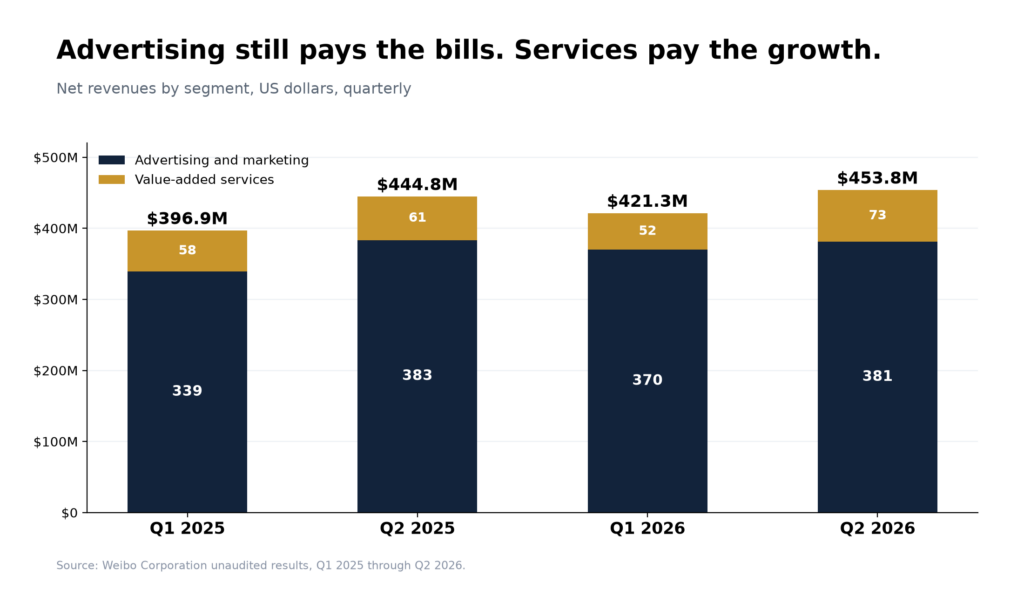
Two forces sit behind the advertising softness, and both look structural rather than cyclical. Demand from handset makers and online game companies has been sliding. Internet services and automobile advertisers partly offset that, helped by a stronger renminbi.
The Alibaba line nobody expected
Weibo breaks out advertising revenue from Alibaba separately, a leftover from the strategic relationship that began around the 2014 IPO. That line has become the most interesting number in the report.
In the second quarter of 2026, Alibaba’s spending on Weibo rose 10% to US$39.2 million. Everyone else’s fell 2% to US$341.8 million. Across the whole of 2025, non-Alibaba advertising was down 4%.
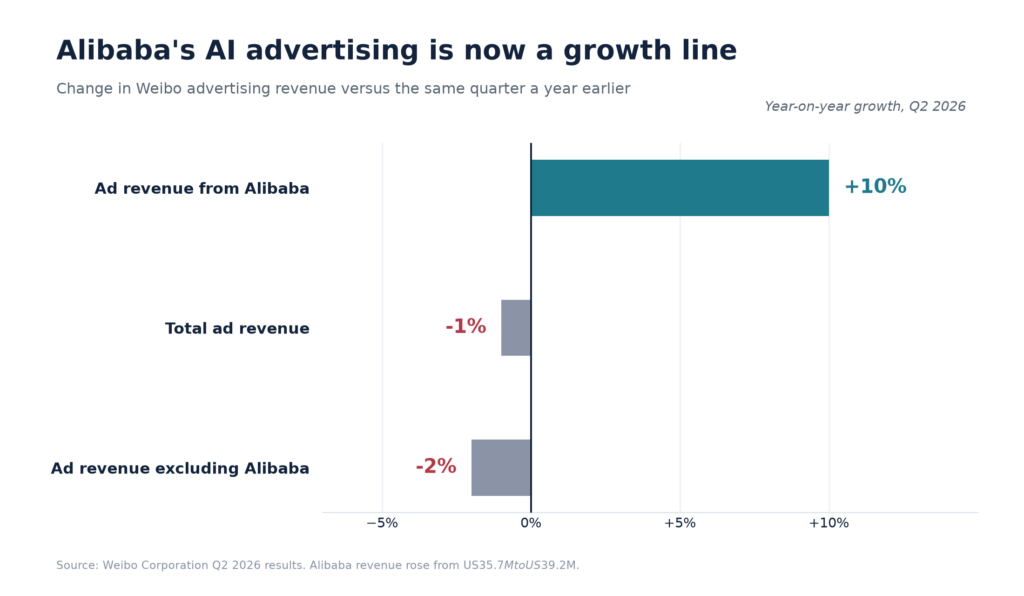
Weibo’s own explanation is that Alibaba raised demand partly to promote its AI applications. Sit with that. The most reliable growth line in Weibo’s advertising business at the moment is a Chinese technology giant buying attention for an AI product, on a platform that pundits keep burying.
It is a small number, roughly one-tenth of quarterly ad revenue. It is also a signal about where AI marketing money is going: not only into performance channels, but into the surfaces that still generate a public conversation.
Where Weibo still earns its keep: crisis and reputation
Nobody opens Weibo to buy toothpaste. That is not a criticism. It is a positioning.
For a global brand in China, Weibo functions as reputation infrastructure. It is where an official statement lands first, where a complaint either dies or metastasizes, and where the screenshots that circulate on every other platform get made.
Consider the asymmetry of a bad week. A brand that responds on Weibo within the first hours is participating in the story. A brand that stays quiet is not neutral. It is absent, and absence reads as guilt to an audience already primed to assume the worst. In Chinese crisis management, silence is a position, and rarely a good one.
This is also why the platform’s commercial logic differs from a performance channel. You are not buying clicks at a defined cost per acquisition. You are buying the right to be present, quickly, in the room where the argument happens.
Celebrity marketing, content marketing and the brand voice
Weibo’s management has been pointing at celebrity and content marketing as areas of momentum through 2026. That is a tell about what still works on the platform.
Short video and livestream platforms are built for products you can demonstrate: a skincare routine, an appliance, a snack. Weibo is built for things you have to discuss. A casting announcement. A brand partnership. A public apology. A founder saying something slightly unwise at a conference.
Where the platform still delivers disproportionate returns is the top of the funnel that media plans underserve: making a brand feel like a participant in the national conversation rather than a sponsor of it. That is soft, hard to measure, and frequently decisive.
The AI layer nobody is talking about
Weibo’s executives keep returning to AI on earnings calls, and not in the usual hand-wavy way. The specifics have been intelligent search, feed reordering, video supply and advertising efficiency.
Intelligent search matters more than it sounds. Weibo holds more than a decade of public reaction: the first hours of a scandal, the mood swing halfway through a product launch, the jokes that reveal what people actually think. That archive is exactly the raw material a retrieval system needs, and it does not sit on Douyin or Xiaohongshu in the same form.
Which means the interesting question for the next two years is not whether Weibo can win short video. It will not. The question is whether it can become the place where people check what China said about something, in real time and after the fact.
If it manages that, the decline narrative gets a second act.
The honest caveats
Credibility requires naming what does not work.
The growth story is over
Monthly users fell from 567 million in December 2025 to 561 million by June 2026. Advertising fell 1% in the second quarter. The platform is not returning to double-digit growth, and any plan that assumes it will is a plan built on nostalgia.
The trust problem is real
Article 14 of the algorithm provisions exists for a reason. The practices it bans, from manufactured likes to purchased reposts to manipulated rankings, are common enough in Chinese social media to require a national rule. If an agency promises a guaranteed hot search placement, you have learned something about the agency.
Attention has moved, even if influence has not
Time spent is the metric Weibo loses. Short video owns the idle hours. If your goal is dwell time or direct response, another platform will serve you better and cheaper.
The platform skews institutional
Weibo’s center of gravity is professional, media-adjacent and institution-facing. That is a strength for reputation work and a weakness for youth-culture marketing. A campaign built for Gen Z aesthetics will look like a costume here.
What to do with Weibo in 2026
Fund it as infrastructure, not as a channel
Give Weibo a standing budget the way you fund legal or investor relations: a permanent line for monitoring, rapid response and official presence, not a quarterly experiment you switch on and off. Teams that treat it as a campaign line usually arrive late.
Decide who owns it
The most common organizational failure is not a bad campaign. It is a platform nobody owns. Corporate communications wants the crisis mandate, marketing wants the reach, and the local team holds the login. Assign one owner, give that owner the monitoring budget, and make sure the person who writes the statement can actually publish it at 11 p.m. on a Sunday.
Monitor the list, not the mentions
Track hot search entries adjacent to your category, and track how fast adjacent topics move. A mention dashboard tells you what happened yesterday. The list tells you what is about to happen.
Write the crisis script before you need it
Decide in advance who speaks, on which account, in what tone, and within what window. Verified brand account, human voice, no legalese in the first post, substance in the second. Rehearse it once. The first hour is not the time to discover that nobody has access to the login.
Verify your partners
Ask for the mechanism, not the promise. Organic hot search movement is a function of genuine discussion volume and velocity. If an agency cannot explain how discussion gets generated, the offer is almost certainly a purchase, and a purchased placement carries regulatory risk as well as reputational risk.
Measure what the platform can actually prove
Use Weibo to measure sentiment shift, share of voice against named competitors, response latency during incidents, and the reach of official statements. Do not use it to prove incremental revenue. The attribution will not survive scrutiny, and pretending otherwise corrodes trust in the whole marketing budget.
What to watch next
Three things, over the next two quarters.
The quarterly release scheduled for November 17, 2026 will show whether the second quarter’s advertising dip was a blip or the start of a slide, and whether Alibaba’s AI-driven spending keeps growing.
The video question is whether Weibo’s video push improves retention, or simply slows the drift.
And the AI search question is whether intelligent search becomes a genuine destination behavior, with people opening Weibo specifically to check what happened, or stays a feature nobody names.
The takeaway
Weibo is no longer the place where China spends the most time. It is still where China finds out, argues, and decides how to feel.
For a global brand, that gap between attention and influence is the entire point. You can skip Weibo and still sell products. Skip it during a bad week, and you have handed the narrative to whoever is willing to speak first.
Frequently asked questions
How many users does Weibo have in 2026?
561 million monthly active users and 254 million daily active users as of June 2026. Monthly users have declined slightly from 567 million at the end of 2025, while daily users have held steady at 254 million.
Is Weibo still relevant, or has Douyin replaced it?
Both are true in different registers. Douyin owns time spent. Weibo owns agenda-setting: breaking news, public argument, and the topics the rest of the internet then discusses. For reputation and crisis work, Weibo remains the reference platform.
Is Weibo just China’s version of Twitter?
Only structurally. The post-and-repost mechanics are similar. The differences are decisive: a curated and regulated hot search list, deep integration of video and commerce, and a formal institutional presence from government and state media with no Western equivalent.
Can a brand buy its way onto the Weibo hot search list?
Purchasing placements or manipulating rankings is prohibited under China’s algorithm recommendation rules, which took effect in March 2022 and explicitly bar controlling hot search to intervene in public opinion. Agencies promising guaranteed placements are describing a regulated, high-risk practice.
How should a global brand budget for Weibo?
As standing reputation infrastructure rather than a campaign channel: continuous monitoring, a rehearsed crisis protocol, a verified official account, and a modest always-on presence. Judge it on sentiment, share of voice and response speed, not on attributed revenue.