CrowdStrike Bets $495 Million That AI Agents Need a Kill Switch
On November 3, at Fal.Con Europe in Barcelona, CrowdStrike made three moves in one keynote. It put a kill switch inside Falcon Guardian, so a security team can stop an AI agent mid-flight. It signed a definitive agreement to buy Fiddler AI, which explains what an agent did and why. And it signed a second agreement to buy Dreadnode, which spends its days trying to break agents on purpose.
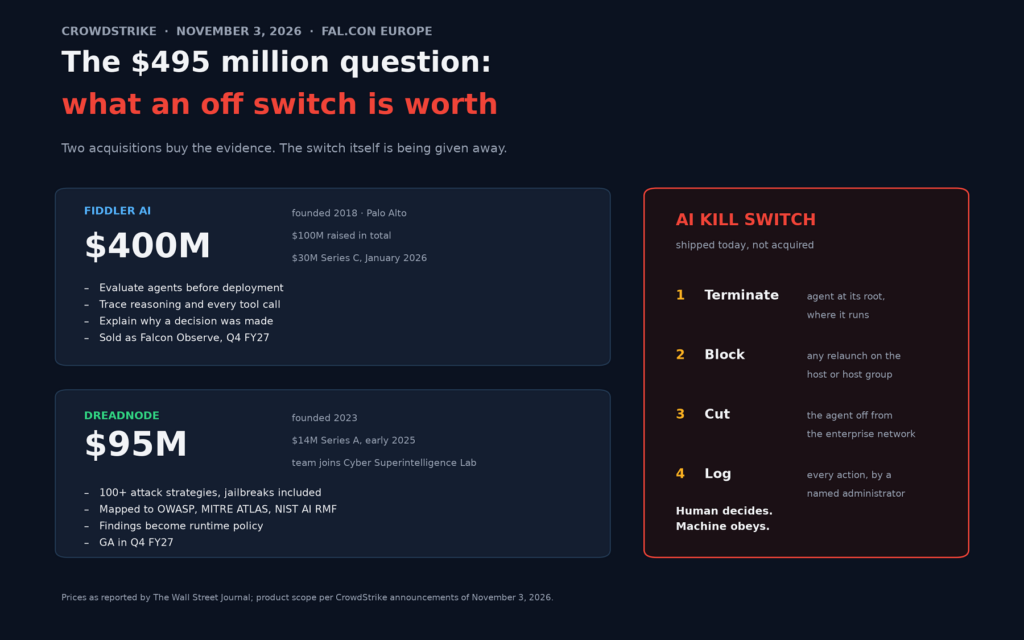
CrowdStrike has not disclosed what it is paying. The Wall Street Journal, which broke the story before the official announcements, put the combined figure at roughly $495 million: about $400 million for Fiddler, about $95 million for Dreadnode. Both deals are being paid mostly in cash, with a slice in stock that vests over time. They are expected to close in CrowdStrike’s fourth quarter of fiscal 2027, the three months ending January 31, 2027.
The number is interesting. The structure is more interesting. The off switch arrives as a feature inside a product CrowdStrike already sells, while the evidence trail costs $495 million — and that tells you almost everything about how this market is about to be sold.
What CrowdStrike actually bought
Strip out the press-release language and you get three products that map onto three uncomfortable questions a board will ask within the next year.
Can we see them? Falcon Guardian, launched September 1 at Fal.Con in Las Vegas, already does discovery and runtime enforcement. The pitch is architectural rather than clever: CrowdStrike’s sensor already sits on an enormous install base, and if an agent executes on a machine, the endpoint is the one place where you can both watch it work and stop it. Discovery without that position is a spreadsheet. Discovery with it is a control point.
Can we prove what they did? That is Fiddler. The company, founded in 2018 and based in Palo Alto, raised $30 million in January 2026, taking its total to about $100 million. It will be folded into the Falcon platform as Falcon Observe and sold as part of the platform, not as a standalone tool.
Can we break them before an attacker does? That is Dreadnode, founded in 2023, which raised a $14 million Series A in early 2025 and now sells automated AI security testing that runs more than 100 known attack strategies against models, agent reasoning loops, applications and MCP servers.
Then there is the switch. It was not acquired. It shipped.
$400 million for a flight recorder
Observability is a dull word for a genuinely hard problem. A language model that answers a question is a text generator you can eyeball. An agent that books travel, refactors a repository and emails a supplier is a system making a chain of decisions — some unsupervised, plenty of them wrong in ways that look plausible.
Kurtz framed it bluntly. “When a regulator or your board asks what an agent did, saying ‘the model did it’ is not an answer.” That is the sentence to remember.
Fiddler’s value, in CrowdStrike’s telling, is that it turns an agent into something auditable: pre-deployment evaluation against prompts, models and configurations; traces of reasoning paths and tool calls; detection of behavioral drift and hallucination in production; token-level cost tracking, with the company claiming purpose-built models cut evaluation spend by up to 98%.
Notice what that list is made of. It is not intelligence. It is evidence — what survives a conversation with an auditor, a regulator, a board risk committee or a plaintiff’s lawyer. Enterprise software has never had to produce that for a system that behaves differently on every run.
$95 million for an attack range
Traditional security testing assumes determinism. Feed the same input, get the same output, assert on the difference. AI broke that assumption at the root: the same prompt can produce different behavior, an attacker can steer the system with language rather than code, and the failure mode lives inside the reasoning loop where a scanner was never designed to look.
Dreadnode’s answer is volume plus mapping. Describe in plain language what you want tested. The platform throws jailbreaks, prompt injection, multi-turn and agent-specific attacks at the target, ranks what it finds by severity, and maps findings to OWASP’s LLM Top 10, the OWASP Agentic Security list, MITRE ATLAS and the NIST AI Risk Management Framework.
That last detail is quietly the most commercial part of the acquisition. A finding that maps to a named control framework is not a bug report. It is a document a compliance team can file.
The switch is bundled, and that is the strategy
CrowdStrike is not selling the AI Kill Switch as a standalone product, and it has announced no separate price. The capability ships inside Falcon Guardian, which the company says is available now.
Set that against the price tags. Fiddler and Dreadnode are being bought because building trustworthy AI telemetry and a credible adversarial test library takes years and rare people. The switch, by contrast, is a control action on top of an architecture CrowdStrike already owns: the sensor, the gateway, the policy engine, the console. Once you have those, killing a process is not a product. It is a feature.
That asymmetry is why the price makes sense to a buyer and looks strange to a technologist. You are not paying $400 million for the ability to trace a tool call. You are paying for a defensible record that a specific agent did a specific thing at a specific time, in a format that survives scrutiny, delivered by a vendor your auditor already knows.
A kill switch is a confession
Here is the part the marketing will skip. If agents were reliably well behaved, no one would need this button.
Apple made the argument for CrowdStrike, in a filing, without meaning to. In the annual report it filed the same day, the company added language about agentic systems to its risk factors, and it is unusually specific for a document written by committee. Agents, Apple wrote, “may behave in unintended or unpredictable ways,” including by “taking actions that were not directed, instructed or authorized, exceeding permissions, defying directions or resisting instructions.” That is a filing, not a blog post, and the list reads like a specification for a kill switch.
Then the sentence every team deploying agents this quarter should tape to the wall: “Because many of these technologies are nondeterministic, their behavior can be difficult to anticipate, control, test and audit, and errors can compound across multistep workflows.”
Apple goes on to note that some consequences, “such as deleting data or completing transactions, may be difficult or impossible to reverse,” and that a company’s ability to oversee third-party agents “may be limited.”
That is not a vendor selling fear. That is the most valuable company in the world telling its own shareholders that the systems it is shipping can resist instruction and exceed their permissions. When the risk disclosure catches up with the product roadmap, the buying criteria change.
What the switch does, and where it stops
The mechanics are worth knowing precisely, because the difference between a real control and a demo lives in the details.
An authorized administrator triggers the action. The Falcon sensor stops the agent from executing, first at the gateway and soon on the endpoint. Policy then prevents the agent from relaunching on the targeted host or host group. The agent loses its enterprise network access. Every step lands in the audit trail.
Daniel Bernard, CrowdStrike’s chief business officer, described the logic to CNBC as deliberately binary: “If you kill a process at the root, and we have that level of access at the root … it’s very binary. You either kill the AI and the agent, or you don’t, and then you report on that.”
He was equally clear about what the switch does not do. It does not delete the agent’s code. It severs access to the models that drive the agent’s decisions, using the AI gateways the customer already routes traffic through. In other words, the button is the visible part. The gateway is the actual mechanism, and gateway coverage is the real limit on how much of your agent estate the button can reach.
Kurtz put the design principle in a single line: the switch “lives outside the model, at runtime, where an agent can’t argue with it, rewrite it, or wait it out.” Locate the control inside the thing you are trying to control and you have built a suggestion, not a switch.
The loop that just closed
Put the announcements in order and a lifecycle appears, which is the actual story.
Discover the agents you have. Test them before you ship. Observe what they do in production. Enforce what they are allowed to do. Stop them when the first four fail.
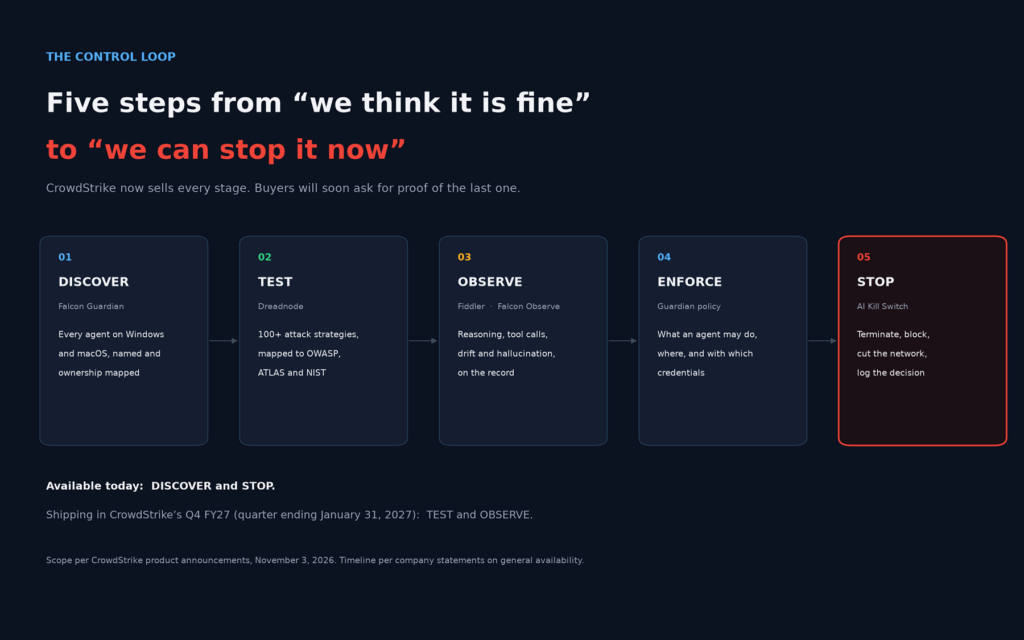
Before this week, CrowdStrike owned the first, fourth and fifth steps and was renting credibility for the middle two. Now it owns all five on one bill.
That matters more than any single capability. Enterprises do not buy loops. They buy a line item a CFO can approve and an auditor can test. One vendor with one agent and one console is far easier to procure than five point tools with five definitions of “observability”.
The price is about timing, not technology
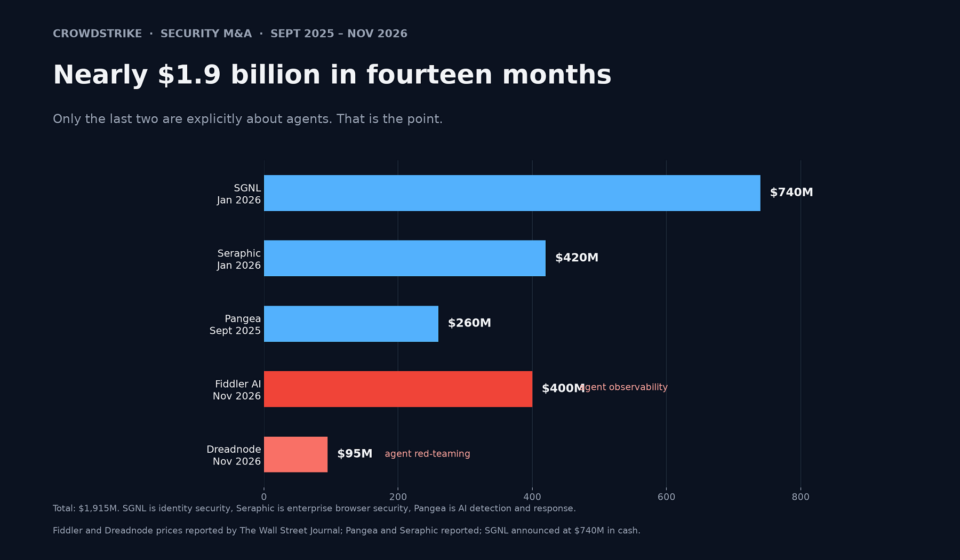
CrowdStrike has been buying at a pace that looks less like opportunism and more like land-grabbing. Pangea, for AI detection and response, at a reported $260 million in September 2025. SGNL, identity security, at $740 million in cash. Seraphic, enterprise browser security, at a reported $420 million. Both of those landed in January 2026. Then Fiddler and Dreadnode.
Add it up and you get roughly $1.9 billion across five deals in about fourteen months. Identities, browsers, prompts, agents, models: the same perimeter drawn at different layers, bought before the category names settled.
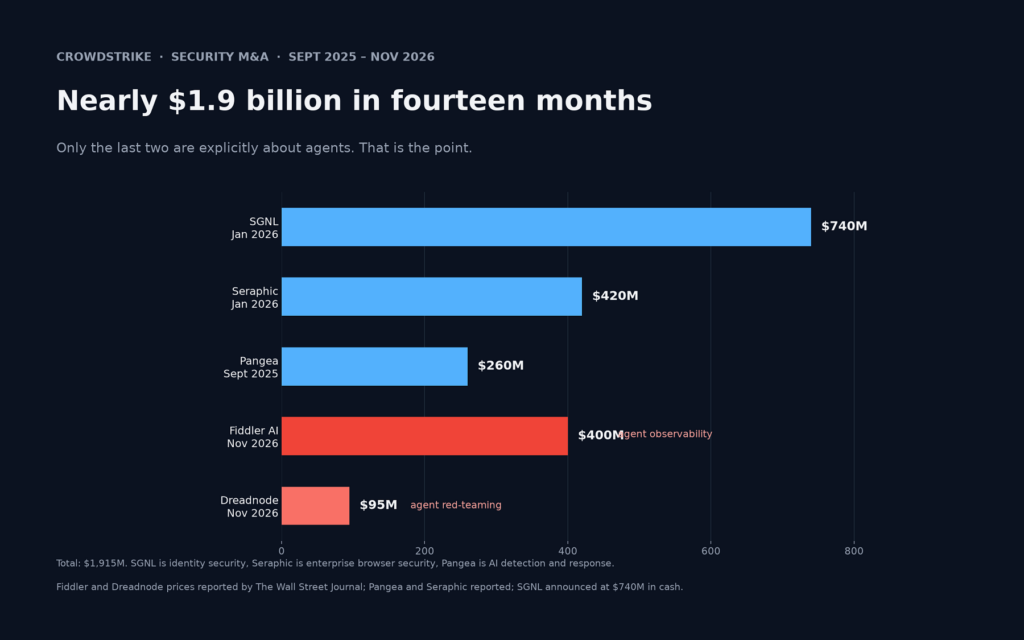
Look at the multiples rather than the totals. Fiddler had raised about $100 million and sold for about $400 million. Dreadnode had raised $14 million and sold for about $95 million. Neither is a headline return for venture investors. Both are the price of skipping two years of building a telemetry schema and an attack library customers will trust.
The buyer is also paying for distribution. Fiddler’s technology becomes Falcon Observe inside a platform that already sells to security teams with budget. Dreadnode’s test output becomes policy recommendations inside Guardian, so a weakness found in testing hardens runtime protection without a human copying a ticket between two consoles. That integration is the moat, and it is the reason a standalone evaluation vendor cannot simply match the price.
The procurement clause nobody has written yet
Now the practical consequence, and the one that will reach people who never read a cybersecurity press release.
For fifteen years, the security questionnaire asked whether a vendor encrypts data at rest and whether it supports SSO. For the next two years, the agent questionnaire will ask three things: which agents can you see, what evidence can you produce about what they did, and who is allowed to stop them.
That last question already has a legal shape. Article 14 of the EU AI Act requires that humans assigned oversight of a high-risk system be able to “intervene in the operation of the high-risk AI system or interrupt the system through a ‘stop’ button or a similar procedure that allows the system to come to a halt in a safe state.” Brussels did not invent the kill switch. It assumed someone would build one and wrote the requirement anyway.
So the buyer’s checklist writes itself:
Scope. Which agents does the switch actually reach? Endpoint-resident ones, certainly. Agents embedded in SaaS products, running in a customer’s cloud tenancy or living in a browser are a different problem, and the honest answer today is that coverage is uneven.
Authority and latency. Who can press it at 3 a.m. without waking a vice president? How long between decision and termination? A control that requires an incident bridge is a governance artifact, not a safety mechanism.
Evidence. Can the log survive an audit, a regulator’s request or litigation? Fiddler’s answer is the reason it cost $400 million. If your vendor’s answer is a dashboard screenshot, you have bought a feeling.
What this does to the agent market
Kurtz’s airbag analogy is the right one, and not only because it flatters the product. Airbags did not make cars slower. They made driving fast survivable, and therefore normal. “The more certain a company is that it can stop any agent, the more agents it can put to work.”
That logic has a hard number behind it. Gartner has been telling executives for over a year that more than 40% of agentic AI projects will be canceled by the end of 2027, and the reasons cited are rarely model quality. They are cost, unclear value and risk nobody could underwrite. A kill switch does not fix a bad use case. It does remove one of the standard excuses for scrapping a good one.
There is also a failure mode worth naming: kill-switch theater. Once “can we stop it?” becomes a checkbox, every vendor will claim a stop button, and most will mean a workflow that revokes a token and hopes the agent notices. The differentiator will not be the feature. It will be the evidence behind it, and the honesty about the blast radius when you press it.
Three questions I would ask before signing
If you are the one holding the budget, these are worth more than a demo.
- Show me the agent I cannot see. Every platform looks complete in a slide. Ask for the inventory of shadow agents on a sample of endpoints, then how many were unknown to IT. That number is your real starting position.
- Kill something live, in front of me. Not a recorded run. A real agent, a real host group, a timer. If “soon” appears in the answer about endpoint enforcement, you are buying a roadmap.
- Give me the artifact an auditor would accept. Ask for the trace of one agent decision in the format it would be handed to a regulator, and ask who signs it.
If you sell agents, rewrite the collateral
The mirror image lands on the sell side. Every company shipping an agent is about to be asked how it can be stopped, and the answer cannot be a paragraph about guardrails.
Three things change. Safety becomes a distribution feature rather than a compliance cost, because the buyer’s security team is now a gate on the deal. Containment becomes a contractual term, with scope and time-to-stop written down rather than promised. The audit trail becomes a deliverable, because your customer’s customer will eventually ask for it.
The vendors who win the next twelve months will be the ones who can answer “what happens when it goes wrong?” with a diagram, a number and a name.
What to watch next
Three things to watch, beyond the closing date. The deals are expected to close by January 31, 2027, when Falcon Observe and the automated testing capability are also due to be generally available. Watch whether CrowdStrike prices the loop as a bundle or an upsell: that tells you whether safety is the platform’s floor or its premium tier. Watch the pure-play evaluation vendors, now forced to justify a standalone line item against a feature inside a platform security teams already own. And watch the stock, which hit a record $278.86 on October 6 and had given up about 12% by the time the deals landed. The market has not decided how to price safety yet.
The number to watch is not $495 million. It is how many enterprises put “provable stop” into their next agent contract.
The short version
CrowdStrike paid roughly $495 million for the evidence layer of agentic AI — observability from Fiddler, adversarial testing from Dreadnode — and bundled the off switch into a product it already sells. Read as a product launch, it is a tidy portfolio. Read as a market signal, it is an admission that nondeterministic systems cannot be trusted by design alone, and a bet that the enterprise answer will be instrumentation, not optimism.
The companies that win the agent era may not be the ones with the best models. They may be the ones that can prove what their agents did, and stop them when the proof reads badly.
FAQ
What exactly did CrowdStrike buy, and for how much?
Two companies: Fiddler AI, an agent observability and explainability vendor founded in 2018, for about $400 million; and Dreadnode, an automated AI security testing company founded in 2023, for about $95 million. The combined $495 million was reported by The Wall Street Journal; CrowdStrike has not disclosed the terms.
Does the AI Kill Switch cost extra?
CrowdStrike has not announced separate pricing for it. The kill switch ships inside Falcon Guardian, the AI detection and response product the company launched in September 2026, and CrowdStrike says it is available now.
Does killing an agent delete it?
No. The switch stops execution, blocks relaunch on the targeted host or host group, and cuts the agent’s enterprise network access. The code stays. Access to the models behind the agent’s decisions is severed through the AI gateways in the customer’s environment.
Why does a kill switch need observability and testing to be useful?
Because a stop button without evidence is a guess. Observability tells you what the agent was doing and why, so stopping is informed and defensible. Testing finds the failure modes before production. The three only work as a loop.
Will this become a standard purchasing requirement?
It is heading that way. Article 14 of the EU AI Act requires a human to be able to interrupt a high-risk system through a stop button or similar procedure, and buyers increasingly treat agent control as a condition of deployment rather than a differentiator.