The 4.8% Problem: Why Chinese Brands Suddenly Care About Their English Copy
The economics behind Chinese brands’ sudden obsession with foreign-language copy
Ask a Chinese cross-border brand why it started spending on copy this year and you’ll rarely get a satisfying answer. “We wanted to improve the brand.” “Competition got tougher.” Both true. Both beside the point.
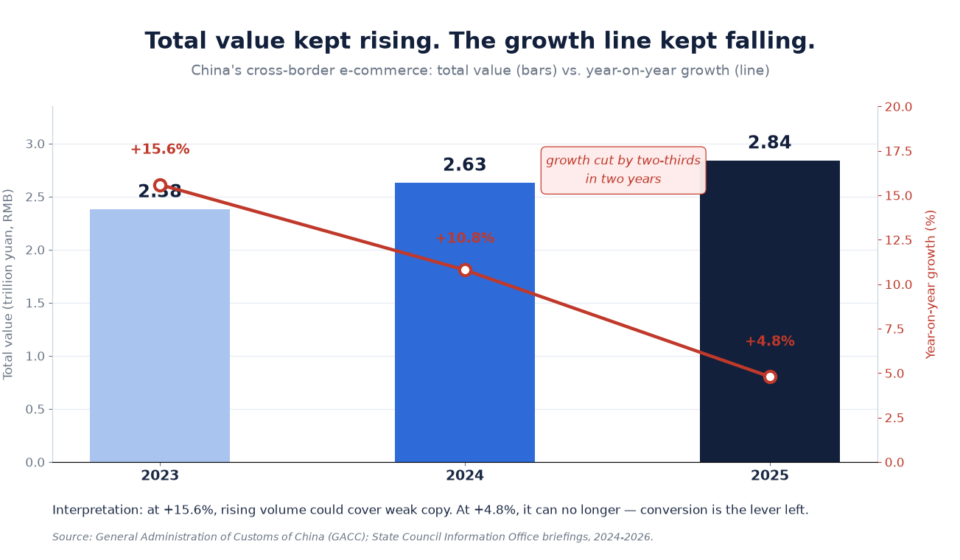
The real reason is an arithmetic one, and it’s sitting in the customs data. China’s cross-border e-commerce grew 15.6% in 2023, 10.8% in 2024, and 4.8% in 2025. Total value kept rising, from 2.38 trillion yuan to 2.84, but the tailwind that had carried the category forward lost most of its force in two years.
Here’s why that changes the conversation about copy specifically.
When a market expands at 15%, volume substitutes for quality. A listing converts at 1% instead of 3%? Traffic still arrives, orders still stack, revenue still climbs. Mediocre language is a leak in a boat that keeps moving, and nobody notices leaks at that speed. Weak localization survived for a decade not because sellers didn’t care, but because it never had to pay.
At 4.8%, that tolerance disappears. The leak no longer hides inside growth. It starts eating into it.
And conversion is the one lever that doesn’t require spending more. Bidding up paid traffic in a decelerating market means bidding against everyone for a shrinking pool. Cutting price compresses margins that are already thin. But moving a listing from 1% to 3% doubles revenue on an audience you’ve already paid for. No other lever has that shape.
Conversion is mostly a language problem. A 2011 European Commission survey found 42% of EU internet users never bought online in a language other than their own. CSA Research’s 2020 survey of 8,709 consumers in 29 countries put a similar figure at 40% — those who said they would never purchase from a website in another language. When volume was cheap, that 40% stayed a rounding error. At 4.8%, sellers are doing the math.
The cost side flipped too, and this is the part nobody talks about out loud. Localization has always been priced per word, which means a brand carrying 10,000 SKUs into ten markets was paying twice for scale: once for every listing, once for every language. That is why almost nobody localized the whole catalog. Most stopped at a curated top slice and left everything beneath it in machine-translated mediocrity, because the full version was never on the table.
AI generation inverted that curve. The fixed cost is now the voice prompt library and the human review layer, set once. After that, the marginal listing costs close to nothing.
That produces a paradox at the center of this shift: the exact moment growth slowed is the moment full-catalog localization got cheap enough to run. Affordability and urgency arrived together, and the adoption was fast. By October 2024, Alibaba reported its translation tool had served more than 500,000 merchants and translated over 100 million product listings. Volume stopped being an excuse for quality and became a requirement for it.
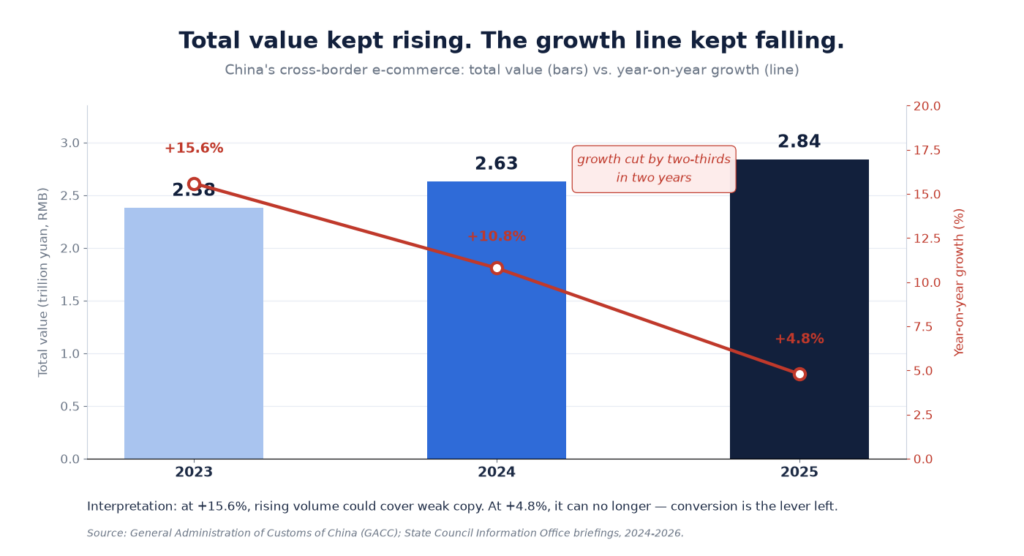
Set the two lines against each other and you can see what many operators in this market have quietly concluded: growth was never doing the selling. It was hiding how badly they wrote.