Why Loyal Customers Pay More: The Elasticity Illusion Behind Personalized Coupons
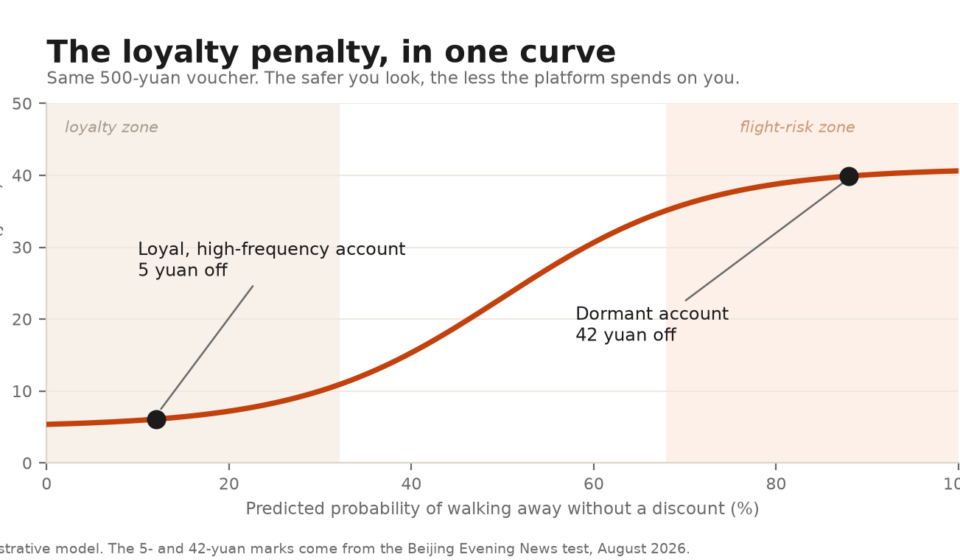
Two friends open the same 500-yuan restaurant voucher. One account sees five yuan off. The other sees forty-two. The one that has ordered from that app every week for three years is the one getting five.
The lazy explanation is greed. The real one is duller and harder to fix: the model cannot tell the difference between loving you and being unable to leave.
Picture what the pricing model actually sees. It does not see affection. It sees behaviour — open rates, repeat-purchase intervals, cart abandonment, whether you compare three listings before buying. Two shoppers can produce identical behaviour for opposite reasons. One adores the platform. The other simply finds switching annoying. To a model trained to predict response, those look the same, and both get filed under “will buy anyway.”
So the discount goes where the uncertainty is. Not to the customer who is most valuable, but to the customer most likely to disappear without one. A coupon is not a reward for history. It is an option premium — a small payment for the right to keep a sale you might otherwise lose.
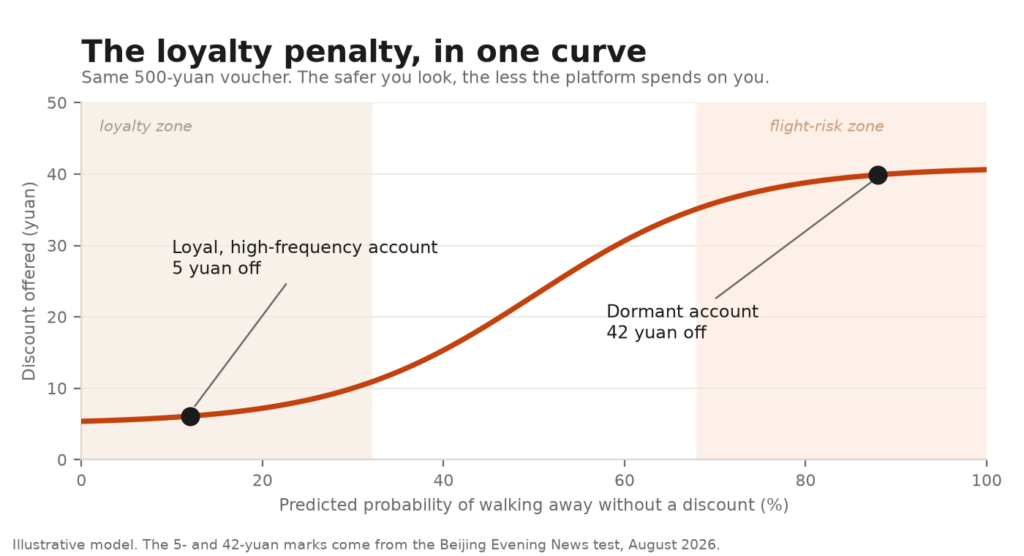
Once you see it this way, the loyalty penalty stops looking like malice and starts looking like arithmetic. A discount spent on a shopper who was going to buy anyway is pure waste. A discount spent on a shopper about to leave is an investment. The model is doing precisely what it was told: maximize margin per session. Nobody wrote a rule that says punish loyalty. Loyalty simply happens to be the cheapest thing to stop paying for.
There is a second-order cost, and it is the part most growth teams underestimate. If exit risk is what gets paid, users learn to manufacture exit risk. A dormant account, privacy mode, a second phone number, a spare account kept deliberately cold — none of that is a clever hack. It is the rational response to an incentive you published through your own pricing.
That is the reflexivity that makes these systems so hard to hold still. The better the model reads behaviour, the more behaviour becomes a negotiation.
April 2026 sharpened the question without answering it. The platform price rules prohibit pricing on willingness to pay when the consumer is unaware. Loyalty is not the same thing as willingness to pay — but a model that infers one from the other is now doing something a regulator may want explained.
The uncomfortable takeaway for anyone running this stack: if your personalization works better the less your customer understands it, you have not built a relationship. You have built a toll booth, and you are charging the people who cannot take the exit ramp.