The “AI-Generated” Watermark That Wasn’t Supposed to Be Seen
It lasted about two seconds.
In a bamboo-scene transition shot in the hit drama 《嫁金钗》 (Jia Jin Chai), sharp-eyed viewers spotted something odd: a mirror-flipped “AI生成” (AI-generated) watermark — the label an AI tool leaves on its output.
The director said he didn’t know about it. The production company didn’t immediately respond. And suddenly, a tiny artifact in a TV drama opened a much bigger question: when AI footage shows up in professional content, who’s responsible for the label — and is hiding it a crime?
What Happened
Let’s start with the facts, because the story is easily sensationalized.
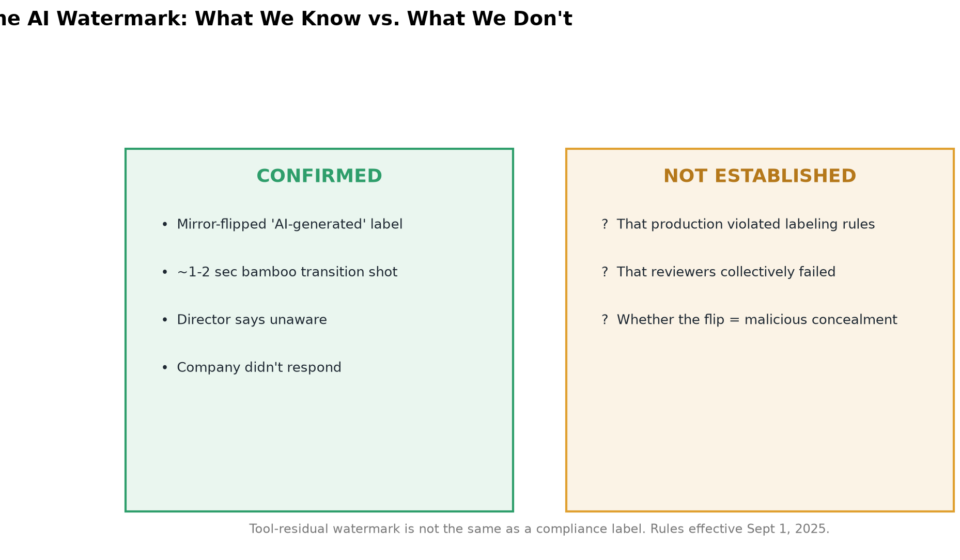
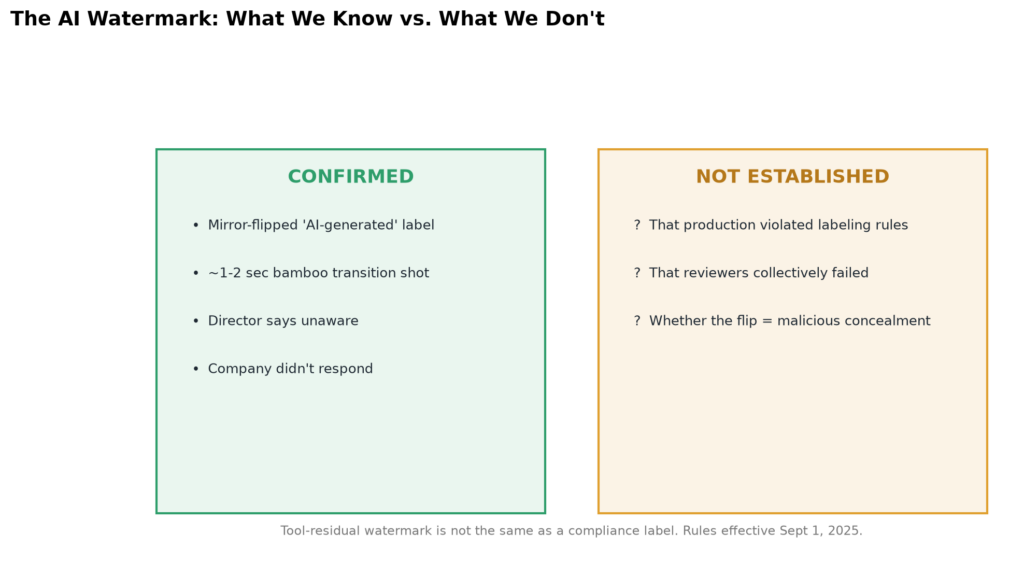
Viewers found what appeared to be a mirror-flipped “AI生成” label in a bamboo transition shot in 《嫁金钗》. The shot lasted roughly one to two seconds, according to reporting from The Paper (澎湃新闻). The mirror-flip made the text appear backwards — which is how viewers noticed it.
Director Yang Long said he was unaware of the label and suggested reporters ask the production company. The production company had not responded at the time of the report.
That’s what’s confirmed. Everything else — whether it was an accident, whether it was deliberate, whether it violates regulations — remains unresolved.
The Key Legal Distinction
Here’s where precision matters enormously, and where much of the coverage went wrong.
There are two different things: a tool-residual watermark and a legally required compliance label.
A tool-residual watermark is the label an AI tool automatically embeds in its output. A compliance label is the AI-content identification required by regulation. They’re related, but not the same.
China’s 《人工智能生成合成内容标识办法》 — the AI-generated content labeling measures — took effect on September 1, 2025. It requires both explicit and implicit labeling of AI-generated content, and it prohibits malicious deletion, tampering, or concealment of those labels.
So the legal question isn’t “was there a watermark?” It’s “does the mirror-flip constitute malicious concealment?” And that question hasn’t been answered.
What We Can’t Conclude
It’s important to be explicit about the limits of what’s known.
We can’t assert that the production violated AI labeling rules — that’s a legal determination that hasn’t been made.
We can’t assert that reviewers collectively failed — that’s not established either.
And the director’s “I didn’t know” is a claim, not an established fact. He may be telling the truth; he may not. Without a fuller investigation, we don’t know.
The Broader Compliance Picture
Step back, and this incident reflects a real gap in how AI content is produced.
AI-generated footage is increasingly used in professional video production — transitions, backgrounds, effects. But production teams may not always know when AI tools embed watermarks. The tool might add a label automatically; the editor might not notice it in a fast workflow.
And the labeling obligation falls on the content publisher, not just the tool user. So a production company using AI footage is responsible for ensuring it’s properly labeled — even if an individual editor missed it.
That’s the compliance gap: tools add labels, but humans are responsible for them, and humans make mistakes.
What This Means for Content Creators and Marketers
If you use AI-generated video or footage, here’s the practical read.
First, understand the watermark situation. Know whether your AI tools embed labels, and check for them before publishing.
Second, know the labeling rules. In China specifically, the September 2025 measures require explicit and implicit identification of AI-generated content, and prohibit concealing those labels.
Third, verify provenance. For brand content, confirm the source of any AI-generated assets before publishing. A hidden watermark is a compliance risk and a reputational one.
The Bigger AI Content Moment
This incident is part of a larger pattern this week.
The robot news anchor (see our B1 coverage) and Beijing’s micro-drama regulation (see our B2 coverage) are all part of the same story: AI content is moving from “can we make it” to “who’s responsible for it.”
A robot anchor reading vetted content is one thing. An AI-generated drama scene with a hidden watermark is another. Both raise the same question: when AI makes the content, who stands behind it?
For content creators and marketers, the answer will define credibility — and compliance — in the AI era.
What to Watch Next
Three signals will show how this develops.
Watch whether the production company responds and clarifies how the watermark appeared. That would resolve the “accident vs. deliberate” question.
Watch whether regulators issue guidance on tool-residual watermarks specifically. Clarity on whether a mirrored tool label counts as “concealment” would set a precedent.
And watch whether other productions face similar scrutiny. If AI-watermark incidents become a pattern, the compliance bar for AI content will rise.
The Bottom Line
The 《嫁金钗》 watermark incident is a small artifact with a big implication: as AI-generated content enters professional production, the question of labeling and responsibility becomes unavoidable.
We don’t yet know whether this was an accident or a deliberate concealment. But that uncertainty is itself the story — because it shows how thin the line is between “forgot to remove” and “hid it on purpose.”
In the AI content era, that line is where credibility lives.