Airbnb’s AI Travel Agent Is Coming — and It Wants to Own the Whole Trip
The most valuable moment in travel isn’t the booking. It’s the dreaming.
The hours spent searching “where should I go” and “what should I do there” currently belong to Google, TikTok, and a dozen comparison sites. Airbnb just announced it wants that moment back.
In its Q3 2026 shareholder letter, the company revealed plans to launch an AI travel agent in the first half of 2027 — one that doesn’t just answer questions but assembles maps, photos, itineraries, and bookings in real time.
It’s a battle for the travel entry point. And AI is the weapon.
What Airbnb Announced
Let’s start with the specifics, because the product is more ambitious than a chatbot.
Airbnb says it plans to begin rolling out an AI travel agent in the first half of 2027. The product isn’t a Q&A bot. It dynamically assembles maps, photos, comparisons, calendars, and itineraries in real time, and helps users plan, book, and resolve some in-trip issues.
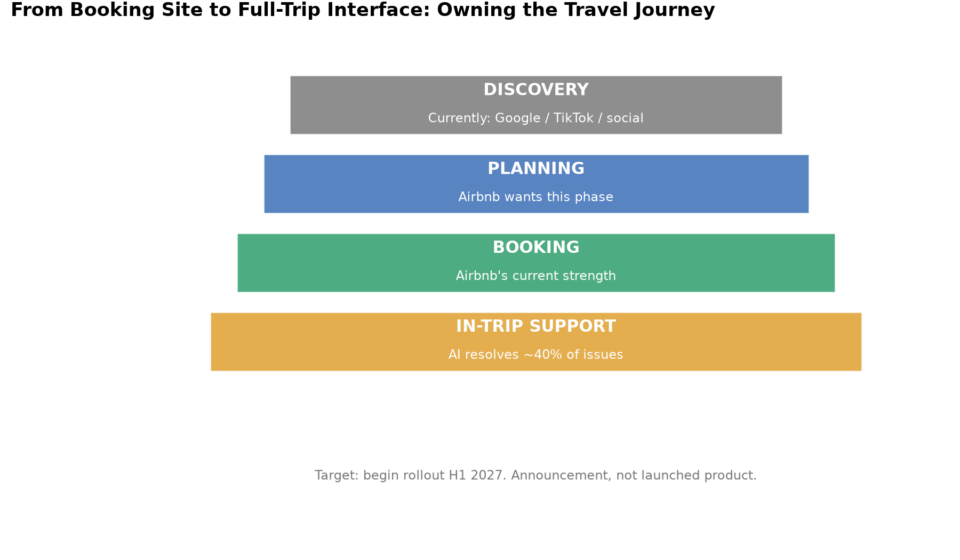
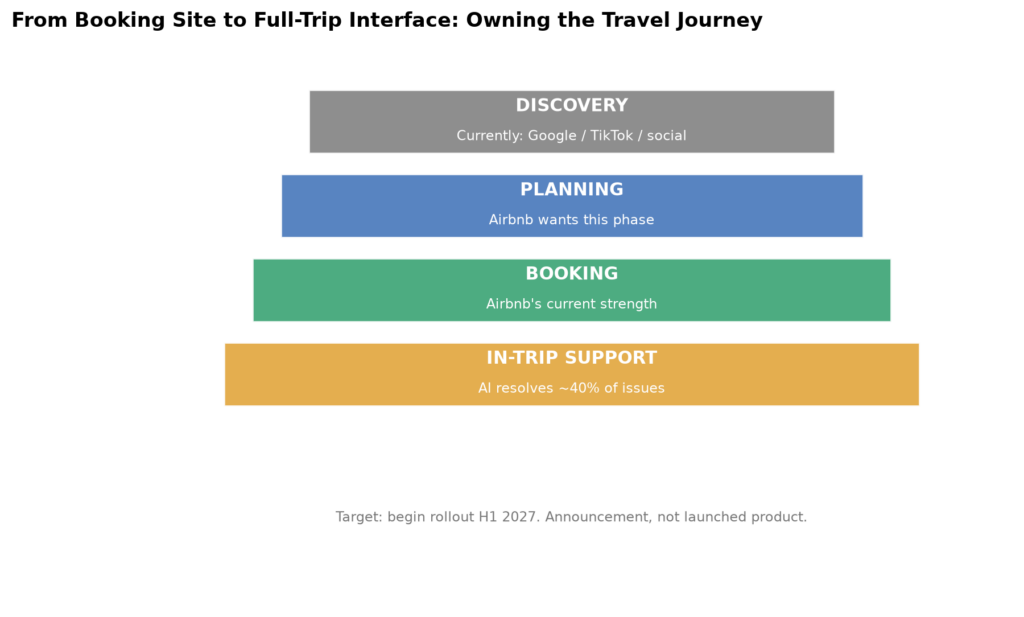
That’s a meaningfully different product from what most travel companies have shipped. It’s not about answering “what’s a good restaurant near my hotel.” It’s about composing the entire trip — discovery, planning, booking, and support — into a single interface.
The Supporting Data
Airbnb also shared some numbers that explain why it’s confident.
In Q3 2026, about 40% of customer support issues were resolved without human agents — up from roughly one-third in Q2. Support cost per booking fell more than 17% year-over-year.
Those are Airbnb-disclosed metrics. They don’t prove the new travel agent will work, but they do show that AI is already delivering efficiency internally. That’s the foundation the company is building on.
The Strategy: Owning the Discovery Phase
Here’s the strategic logic, and it’s important.
Airbnb is fundamentally a lodgings marketplace. It makes money when people book accommodation. But the decision to book starts much earlier — in the dreaming and planning phase, which currently happens on Google, social media, and competing travel platforms.
If Airbnb can capture that phase with an AI agent, it moves from “a place to stay” to “the interface for the whole trip.” That’s a much bigger and more defensible position.
It also threatens competitors. Google’s travel search, Booking.com, Expedia, and even general AI assistants (Claude, ChatGPT) are all competing for the same entry point. The company that owns trip planning owns the customer relationship.
What It Means for Travel Brands
If AI agents mediate travel planning, the rules of travel marketing change.
Brands will need to be “AI-quotable” — discoverable and recommendable by AI systems. That means structured data, strong reviews, consistent brand signals, and content that AI models can accurately cite.
There’s also a platform-power risk. An OTA’s AI agent may favor its own inventory — a new form of gatekeeping that could disadvantage independent hotels and experiences.
For airlines, hotels, and activity providers, the question becomes: how do you get recommended by an AI agent that may have its own incentives?
The Caveat: Announcement ≠ Product
It’s important not to overstate what’s happened.
This is a forward-looking plan, not a launched product. It’s not yet available in any market. The H1 2027 timeline is a target, not a guarantee.
So treat this as strategic intent, not a verified commercial result. The marketing analysis — that AI will reshape travel discovery — is sound. But the specific product’s effectiveness is unproven.
The Bigger Competitive Picture
Step back, and this is part of a larger trend: AI agents are becoming the interface for commerce.
Amazon has its Rufus shopping assistant. Google is integrating AI into search. OpenAI is exploring agentic commerce. Travel is one of the first high-value categories where the “agent as interface” model is being tested at scale.
If Airbnb succeeds, expect every major OTA to follow. If it struggles, the “AI travel agent” hype may cool — at least until the technology improves.
What to Watch Next
Three signals will show how this develops.
Watch the H1 2027 launch. Whether Airbnb hits the timeline — and how the product actually works — will be the first real test.
Watch whether competitors (Booking, Expedia, Google) launch similar agents. If they do, the travel entry-point war is fully underway.
And watch for the “AI-quotability” shift. If travel brands start optimizing for AI recommendation rather than search ranking, that’s a sign the agent era has truly arrived.
The Bottom Line
Airbnb’s AI travel agent is a bet that the future of travel isn’t just booking — it’s planning. By building an agent that assembles the whole trip, Airbnb is trying to move from a lodgings marketplace to a full-trip interface.
The product isn’t here yet. The timeline is a target. But the strategic direction is clear: in the agent era, whoever owns the planning phase owns the customer.
And travel is just the first battlefield.