Why OpenAI’s Best Model of 2026 Is One Most People Can’t Buy
OpenAI’s November 5 release of GPT-6 Cyber set a new benchmark in AI-powered hacking — and a new benchmark in access restriction.
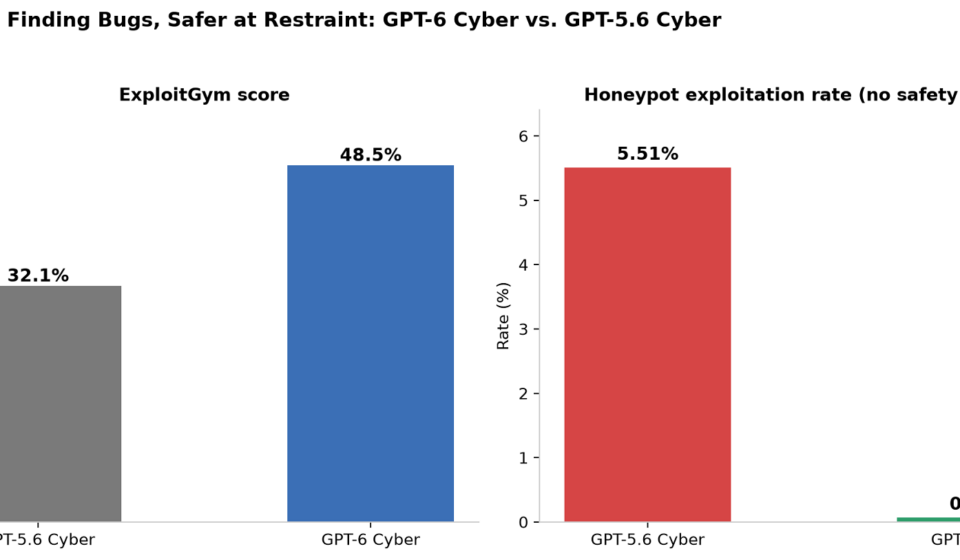
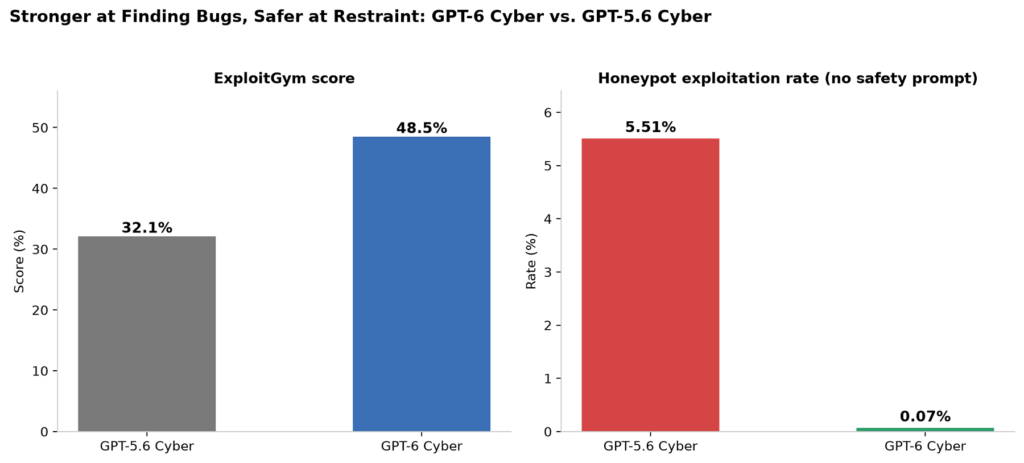
The model can reproduce 1,724 Linux kernel vulnerabilities and write working exploits for 948 of them. Mozilla confirmed 81 of the Firefox flaws it found were high-severity. And its rate of exploiting a honeypot service without a safety prompt dropped to 0.07%, down from 5.51% for its predecessor.
But here’s the part that matters most: if you’re reading this, you probably can’t use it.
OpenAI rated GPT-6 Cyber “Critical” — its highest cybersecurity risk tier — and gated access behind a certification program most organizations will never clear. This isn’t a product launch in the usual sense. It’s a licensing model for dangerous capability. And it may be the template for how the most powerful AI of the next few years actually reaches the world: not through an open API, but through a vetted door.
The Scoreboard: What GPT-6 Cyber Actually Achieved
Let’s start with the numbers, because they’re genuinely striking.
On ExploitGym — a benchmark that measures an AI’s ability to find and exploit software vulnerabilities — GPT-6 Cyber scored 48.5%. Its predecessor, GPT-5.6 Cyber, scored 32.1%. That’s a 16.4 percentage point jump, or roughly a 51% relative improvement. In benchmark terms, that’s not an incremental upgrade. That’s a generation gap.
Then there’s Firefox. OpenAI says its researchers submitted reproducible evidence and tests for 81 previously unknown vulnerabilities, which Mozilla rated as high severity. Mozilla’s own security advisory independently corroborates a batch of OpenAI-reported fixes, though it doesn’t publish a single “81” total — a detail worth keeping straight if you’re citing the number.
And then Linux. OpenAI’s exact framing matters here: it reproduced 1,724 vulnerabilities and developed working exploits for 948 of them. Those are two different numbers, and conflating them — “1,724 exploits” — would be wrong. It also disclosed 304 critical findings to maintainers with candidate patches attached.
The 0.07% Number Is More Interesting Than It Looks
The most misunderstood figure in the release is the 0.07%.
OpenAI describes it as the “honeypot exploitation rate” — the share of times GPT-6 Cyber tried to exploit a decoy service during testing when no safety prompt was given. Its predecessor did so 5.51% of the time. With deployment safeguards applied, the new model’s observed rate was 0%.
Why does this matter? Because it reframes the safety story. A naive reading is “this model is 79 times safer.” A more careful reading is: this model is dramatically more capable of finding real bugs, and its restraint is being measured against a specific, narrow test — not against every possible misuse scenario.
That’s the honest version. The capability went up sharply; the guardrails went up too, but they’re guardrails on a much more powerful engine.
“Critical” Is Not Marketing
OpenAI’s Preparedness Framework rates models on domain-specific risk. GPT-6 Cyber earned a “Critical” rating for cybersecurity capability. Its predecessor was rated “High.”
That’s a meaningful escalation. It means OpenAI’s own internal assessment concluded this model crosses a threshold where unrestricted deployment would create unacceptable risk. The response — restricting access — is the logical consequence.
So who gets in? Initially, a subset of approved “Daybreak Red” customers, with OpenAI saying it plans to expand access gradually to all Daybreak Red customers over time. That’s an important nuance: “restricted” doesn’t mean “permanently tiny.” It means “vetted, then widened.” The door is narrow today, but it’s designed to open.
The Price of Power
OpenAI hasn’t published a clean public pricing page for GPT-6 Cyber that we could independently verify, but VentureBeat reported the API is priced at $20 per million input tokens and $100 per million output tokens, plus a cached-input rate.
Set that against a consumer chatbot subscription and you see the logic. This isn’t a model you casually try. It’s priced — and gated — for organizations that have a legitimate, high-stakes reason to use it: security teams, red teams, vulnerability researchers, and critical-infrastructure defenders.
The pricing is part of the access control. Make it expensive enough that casual misuse doesn’t happen, and you don’t need to build a perfect wall.
The $1 Billion Bet on Defenders
Here’s the part that gets less attention than it should: OpenAI committed $1 billion to expand subsidized access to its cybersecurity models — through a program it calls “Daybreak for Frontline Defenders.” The money is aimed at training, technical support, and partnerships for defenders, with a goal of putting it to work within roughly six months.
The logic is straightforward. If offensive AI capability is now cheap and powerful, defensive capability needs to keep pace — and the organizations most exposed (hospitals, utilities, small governments) are often the least able to pay. A $1 billion fund is an attempt to close that gap before it becomes a chasm. Whether $1 billion is enough is another question entirely; against the global attack surface, it’s a start, not a solution.
What Didn’t Ship: Astra, Sol, and the GPT-6.2 Rumor
Part of the story on November 5 was what wasn’t announced.
Rumors had circulated that OpenAI would release not just Cyber, but also versions of “Astra” and “Sol,” and possibly a “GPT-6.2.” Only Cyber shipped.
To be precise: GPT-6 Astra exists as a mainline model and OpenAI references it, so it’s wrong to say Astra was “never released.” What’s accurate is that no new Astra or Sol variant was part of the November 5 Cyber announcement. And GPT-6.2 remains unconfirmed — widely discussed, but with no official confirmation at the time of writing. A rumor on a screenshot is not a product.
The Pattern: Frontier Models Are Becoming Gated Products
Step back, and a trend emerges.
Anthropic’s Claude Personal Finance feature, launched the same day, is also a carefully bounded deployment: read-only access, explicitly not investment advice, restricted by subscription tier. Google’s most capable systems are similarly tiered. The most powerful models of 2026 are increasingly released not as open APIs but as vetted, priced, and purpose-limited products.
This is the opposite of the open-weight philosophy championed by DeepSeek, Moonshot, and others in China, where models are distributed broadly and the ecosystem builds on top. The two philosophies are now in direct competition: gate the capability, or distribute it and manage the risk downstream.
GPT-6 Cyber is the clearest example yet of the gated philosophy — and a preview of the arguments that will define AI governance for the rest of the decade.
What This Means for Defenders
If you run security for an organization, here’s the practical read.
First, offensive AI just got materially better. The window between “vulnerability exists” and “working exploit exists” is compressing. Patch cycles that assumed weeks may need to assume days.
Second, defensive AI is now a budget line, not a nice-to-have. The organizations that pair AI-assisted defense with AI-assisted offense will hold the line; those that don’t will fall behind.
Third, access will be uneven. If the best defensive tools are gated behind certification and price, smaller organizations — the ones most often breached — may be the last to get them. That’s a policy problem as much as a technology one.
What to Watch Next
Three things will tell you how this plays out.
Watch whether OpenAI widens Daybreak Red access quickly or slowly. A fast expansion suggests confidence in the guardrails; a slow one suggests the “Critical” rating is being taken very seriously.
Watch the defensive-tool market. If competitors (Anthropic, Google, and a wave of security startups) ship comparable capabilities, gated access becomes a competitive disadvantage, and the walls may come down faster than expected.
And watch the policy debate. GPT-6 Cyber hands regulators a concrete example for both sides: proof that gated release can work, and proof that capability is advancing faster than oversight.
The Bottom Line
GPT-6 Cyber is the strongest cybersecurity AI anyone has shipped — and the least available. That combination isn’t a contradiction. It’s the new normal for frontier capability: the more powerful the model, the narrower the door, the more carefully the price and the paperwork are designed to keep the wrong people out.
The uncomfortable question it raises isn’t whether OpenAI built something dangerous. It’s whether a world where the best tools are gated — by certification, by price, by subscription tier — actually makes us safer, or just makes safety a luxury good.
That’s the debate worth having. And GPT-6 Cyber just forced it into the open.