Tencent’s Hunyuan Hy4 Demand Surge Forced a 10x Inference Expansion
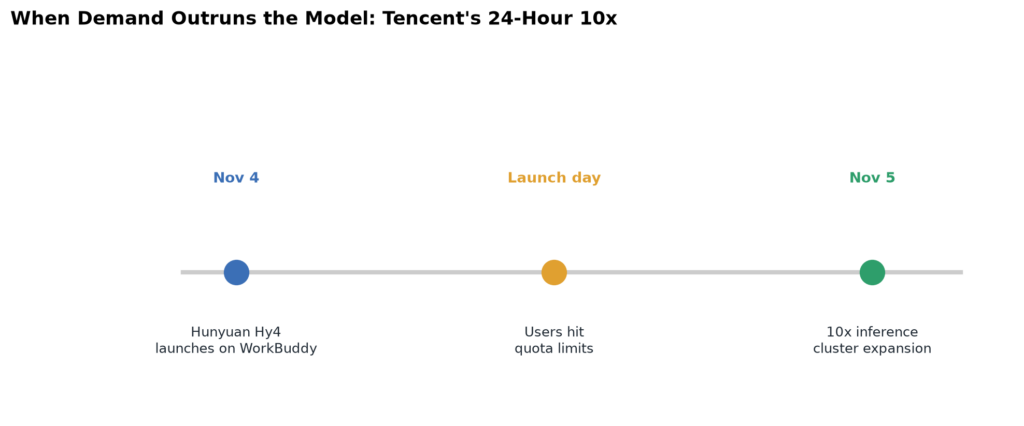
Tencent launched Hunyuan Hy4, its latest large language model, on November 4. By November 5, it was already expanding the inference cluster behind it by a factor of ten.
That’s the kind of overnight switch that tells you something real is happening. Most AI headlines are about training runs and benchmark scores. This one is about something less glamorous and more telling: when demand actually arrives, the bottleneck isn’t the model. It’s the infrastructure serving it.
Tencent just gave us a live demonstration of China’s AI demand curve. And it’s steeper than anyone planned for.
What Happened
The sequence is straightforward but revealing.
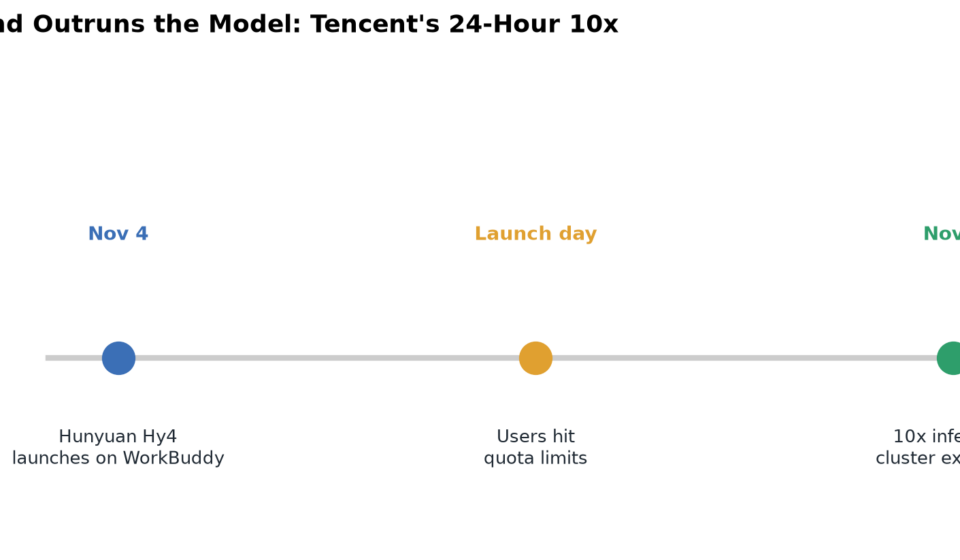
Hunyuan Hy4, Tencent’s newest LLM, launched on November 4 inside WorkBuddy, the company’s enterprise AI workspace platform. Almost immediately, demand outstripped capacity. Users began hitting quota limits on launch day.
By November 5, Tencent had announced a 10x expansion of the WorkBuddy inference cluster. It also raised the free usage quota and said it would dynamically reallocate resources to meet demand.
A 10x capacity expansion within 24 hours of launch isn’t a marketing flourish. It’s an emergency response to demand that exceeded forecasts. And it’s a signal that Chinese enterprise AI adoption is moving faster than infrastructure provisioning.
The Demand Signal
Why does a quota crunch matter? Because it’s hard to fake.
Companies don’t rush to 10x their compute clusters because of a nice press release. They do it because real users are hitting real limits and real revenue is at stake. The launch-day quota exhaustion is the clearest evidence yet that demand for enterprise AI in China is genuinely strong — not a pilot-program curiosity, but production-scale usage.
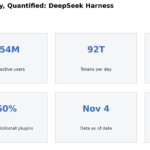
This fits a broader pattern. The same week, DeepSeek disclosed 154 million daily users and 92 trillion tokens per day on its Harness platform (see our A5 coverage). Taken together, the two data points paint a picture: China’s AI usage is scaling fast, and the constraint is shifting from model quality to serving capacity.
Inference Infrastructure: The New Bottleneck
For most of the AI boom, the story was about training. Who has the biggest clusters? Who can train the largest model? That’s where the headlines and the capex went.
But training is a one-time (or periodic) cost. Inference — serving the model to users — is a continuous, scaling cost. And as AI moves from demo to daily use, inference becomes the dominant infrastructure challenge.
Tencent’s 10x expansion is a case study in that shift. The model was built. The demand showed up. And the bottleneck was serving it reliably at scale.
This is where the next phase of AI competition will be decided. Not in who has the best benchmark score, but in who can serve the most users, at the most reliability, at the lowest cost.
Tencent’s Position
WorkBuddy is Tencent’s enterprise AI assistant and workspace platform. It’s the company’s vehicle for selling AI into businesses — a market where reliability and integration matter more than raw capability.
Hunyuan Hy4’s rapid adoption strengthens Tencent’s position in that market, particularly against Alibaba Cloud and Huawei Cloud, its main competitors in China’s enterprise AI space. The 10x expansion is a capital commitment that signals Tencent is serious about winning enterprise AI, not just participating in it.
There’s also a strategic angle: by investing in inference capacity, Tencent is betting that the enterprise AI market will keep growing. That’s a bet on the future of business software, not just on one model.
Why This Matters Beyond Tencent
The 10x expansion is a microcosm of a larger trend: China’s AI infrastructure is being stress-tested by demand.
There are two ways to read this. The optimistic reading: demand is so strong that infrastructure can’t keep up, which is a good problem to have — it means the market is real. The cautious reading: if capacity can’t scale fast enough, user experience suffers, adoption slows, and the AI boom hits a ceiling.
Which reading is right depends on how quickly Chinese cloud providers can expand inference capacity. If Tencent, Alibaba, and Huawei can build fast enough, the demand surge becomes a growth engine. If they can’t, it becomes a bottleneck.
The Broader AI Infrastructure Race
Step back, and the Tencent story connects to a global pattern.
In the US, the AI infrastructure debate is increasingly about power — data centers, grids, and the political permission to build (see our S1, S5, S6 coverage). In China, the debate is increasingly about inference capacity — serving models at scale to a massive user base.
Both are infrastructure problems. Both are growing faster than planned. And both suggest that the next phase of the AI race won’t be won by the company with the best model, but by the one with the best infrastructure.
What to Watch Next
Three signals will clarify how this plays out.
Watch Tencent’s inference capacity over the next quarter. If the 10x expansion holds and demand keeps growing, that’s a strong signal of sustained enterprise adoption.
Watch whether competitors (Alibaba, Huawei) announce similar expansions. If they do, the enterprise AI infrastructure race is fully underway.
And watch utilization rates. High utilization means demand is real; idle capacity would suggest the surge was a launch-day spike, not a durable trend.
The Bottom Line
Tencent’s 10x inference expansion, one day after launch, is a small story with a big implication. It shows that in China, the AI bottleneck has shifted from model development to infrastructure delivery.
The model is no longer the hard part. Serving it — reliably, at scale, to millions of users — is. And on that measure, the AI race is just getting started.