154 Million Daily Users, 35,000 Plugins: DeepSeek’s Harness Is Bigger Than You Think
How big is China’s AI agent economy? DeepSeek finally gave us a number.
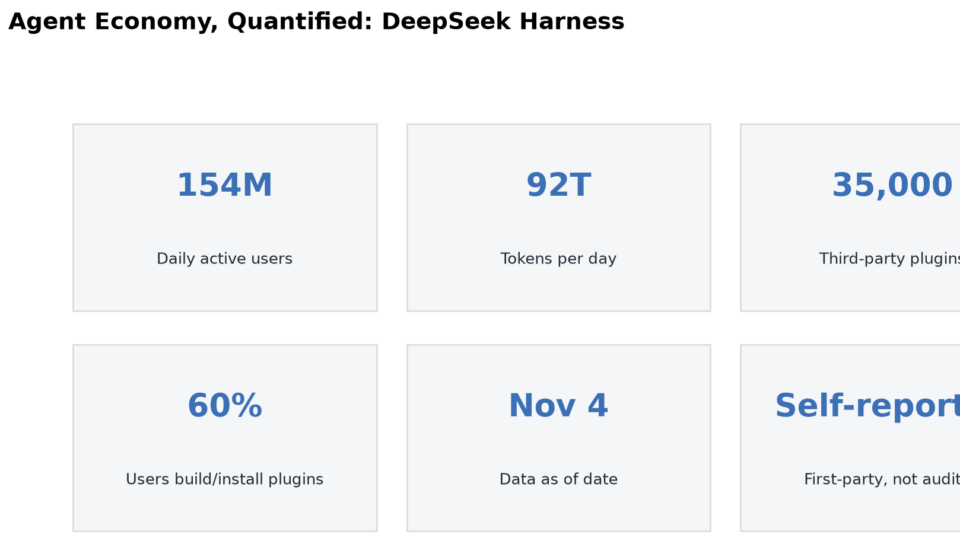
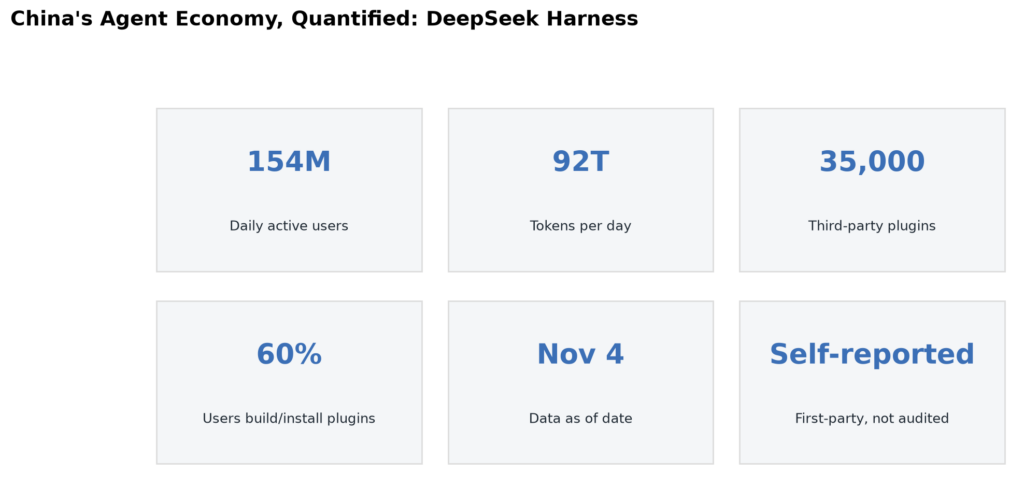
As of November 4, the company said its Harness platform — the agent-runtime infrastructure that lets developers build and run AI agents on DeepSeek’s models — had reached 154 million daily active users (counting official-API users) and was consuming roughly 92 trillion tokens per day.
That’s not a typo. Ninety-two trillion tokens, every 24 hours.
The platform also counts about 35,000 third-party plugins, with roughly 60% of active users having built or installed at least one. In other words, DeepSeek’s Harness has quietly become something that looks less like a model and more like a marketplace.
The Numbers, Decoded
Let’s start with the figures and what they mean.
154 million daily active users is a consumer-scale number. For context, that’s larger than most major AI chat products outside China. And it’s measured on official-API usage only — meaning it captures developers and enterprises building on DeepSeek’s models, not casual web visitors.
92 trillion tokens per day is an infrastructure-scale number. Every token represents a unit of compute. At that volume, you’re not looking at a demo platform; you’re looking at an industrial-grade inference operation.
35,000 third-party plugins and 60% user engagement suggest a genuine developer flywheel. Plugins are what turn a model into a platform — they’re how users extend functionality without waiting for the core team to build everything. A high plugin-adoption rate is a strong signal of ecosystem health.
One important caveat: these are self-disclosed, first-party metrics. They haven’t been independently audited. That doesn’t make them false, but it does mean they should be read as DeepSeek’s own accounting, not a third-party measurement.
What “Harness” Actually Is
Here’s where a lot of coverage gets fuzzy, so let’s be precise.
Harness is DeepSeek’s agent-runtime infrastructure. Think of it as the layer between a model and an application: it handles the scheduling, memory, tool orchestration, and coordination that agents need to actually do things in the real world.
It’s roughly analogous to OpenAI’s agent and plugin infrastructure — except it’s built on open-weight models. That’s the key difference. DeepSeek’s models can be downloaded, modified, and deployed by anyone. Harness is the managed layer that makes them easier to run at scale.
The comparison to cloud computing is apt. If DeepSeek’s models are the raw compute, Harness is the managed service on top — the thing that turns capability into a product.
The Token Economics
92 trillion tokens per day has an obvious implication: enormous inference infrastructure.
Running that volume requires a vast fleet of accelerators, optimized serving systems, and the power and cooling to support them. DeepSeek has been building this out quietly, and the token number is the clearest public evidence of scale.
But the economics differ fundamentally from the closed-model companies. Where OpenAI charges subscription premiums and per-token fees at high margins, DeepSeek has leaned into a different model: cheap inference, massive adoption, ecosystem lock-in. The bet is that volume and ecosystem matter more than per-token margin.
It’s a bet that looks increasingly shrewd. If you can serve 154 million daily users at 92 trillion tokens per day, you’ve built something that’s very hard to displace — regardless of whose model scores higher on a benchmark.
The Plugin Ecosystem: The Real Moat
Here’s the part that deserves more attention than the raw user numbers: the plugins.
35,000 third-party plugins is a lot. And 60% user engagement with plugins suggests that the ecosystem is genuinely active, not just a long tail of abandoned experiments. Plugins are how platforms create switching costs — once a user has built workflows around a set of tools, leaving becomes expensive.
The contrast with Western platforms is instructive. OpenAI and Anthropic have kept tighter control over their plugin and MCP ecosystems, prioritizing quality and safety. DeepSeek has taken a more open approach, which tends to proliferate faster but comes with more quality-control challenges.
Which approach wins is an open question. But the numbers suggest that, in China at least, the open approach is generating real adoption.
The Broader Picture: China’s AI Infrastructure Story
There’s a narrative that AI will be dominated by a handful of closed US labs. DeepSeek’s numbers challenge that.
If 154 million daily users and 92 trillion tokens per day are even roughly accurate, China has built an AI inference operation at a scale that rivals the largest Western platforms. That’s not a model-capability story; it’s an infrastructure story.
And it fits a pattern. The same week, Tencent announced a 10x expansion of its inference cluster after demand surged (see our A6 coverage). Chinese enterprises are moving from pilot to production adoption of AI, and the infrastructure is straining to keep up.
What This Means for Developers and Enterprises
If you’re building with AI, here’s the practical read.
First, open-weight models at massive scale are now a viable alternative to closed APIs for many workloads. Cost, control, and customization favor the open approach.
Second, the plugin ecosystem is where the value is shifting. Building on a platform with 35,000 plugins means you don’t have to reinvent everything.
Third, data sovereignty and regulatory context matter. For enterprises operating in China or with Chinese partners, DeepSeek’s ecosystem may be the most practical path.
What to Watch Next
Three signals will clarify how this develops.
Watch whether DeepSeek publishes audited or third-party-verified metrics. Self-disclosed numbers are a starting point, not a proof.
Watch the plugin quality, not just the quantity. 35,000 plugins is impressive; 35,000 useful plugins would be transformative.
And watch whether the open-weight approach spreads beyond China. If Western enterprises start adopting DeepSeek-scale open ecosystems, the competitive landscape for AI platforms changes dramatically.
The Bottom Line
DeepSeek’s Harness numbers — 154 million daily users, 92 trillion tokens per day, 35,000 plugins — are a reminder that the AI race isn’t only about who has the best model. It’s also about who can serve the most users, at the most scale, with the most vibrant ecosystem.
On that measure, China’s AI infrastructure story is bigger than most Western coverage suggests. And DeepSeek just made it public.