Micron’s $4.5 Billion Taiwan Pause Is About Labor, Not the Memory Cycle
When Bloomberg reported on November 5 that Micron had paused work on its $4.5 billion Taoyuan, Taiwan fab, the market’s first instinct was to read it as a demand signal — a vote of no confidence in the memory supercycle.
The actual story is more mundane, and more human: a labor dispute over employee compensation.
That distinction matters enormously. A labor-driven pause is a tactical setback, not a strategic retreat. Investors reading “Micron freezes fab = memory cycle top” are drawing the wrong conclusion — and in a market already jittery about AI capex, getting this one wrong could be expensive.
The Facts: What Bloomberg Actually Reported
Let’s start with what’s solid.
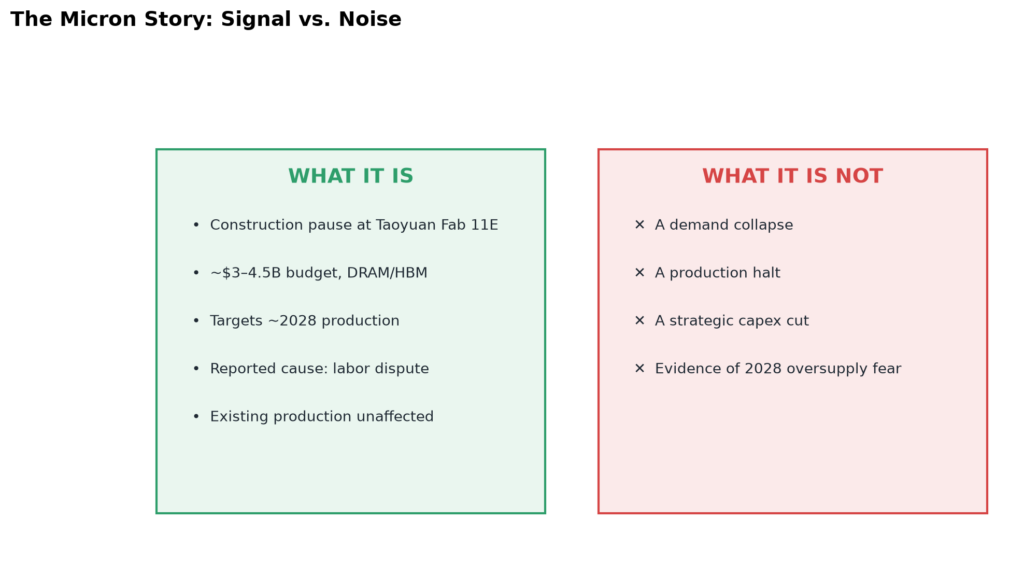
Bloomberg reported on November 5 that Micron paused or significantly slowed construction of its Taoyuan Fab 11E in Taiwan. The project’s budget is approximately $3 to $4.5 billion (the headline used $4.5 billion). It was planned to produce DRAM and HBM memory, targeting roughly 2028 production.
The reported cause is a labor dispute — specifically, over Taiwanese employee compensation and union negotiations. Reuters, citing the Bloomberg report, noted that Micron said its existing Taiwan operations remain normal.
That last detail is important: this is about a future-capacity project, not a current production line. Micron isn’t shutting down fabs that are already operating. It’s slowing the construction of a new one.
What This Is Not
Given how quickly the story moved, it’s worth being explicit about what the report does not support.
It does not support the claim that Micron is pausing because it fears 2028 memory oversupply. That causal story circulated widely, but it isn’t what the reporting says. The reported driver is labor relations, not demand forecasting.
It does not support the claim that Micron’s production has halted. Existing Taiwan fabs continue to operate.
And it isn’t fully confirmed by Micron itself. The pause is based on people familiar with the matter; Micron has not issued a complete official statement confirming all the details. That’s a meaningful caveat for anyone treating this as a hard fact.
The Labor Context
Why would a labor dispute stop a $4.5 billion fab? It’s a question worth answering, because it illuminates a real risk in semiconductor expansion.
Taiwan’s semiconductor industry faces a tight labor market and rising wage expectations. Skilled construction and equipment-installation workers are in high demand, and union negotiations can become consequential. If a compensation dispute stalls site work, the timeline slips — and for a project targeting 2028, even a few months matters.
This isn’t unique to Micron. As chipmakers race to build capacity, they’re competing for the same limited pool of specialized labor. Labor relations are becoming a genuine execution risk in the industry, not just a human-resources footnote.
Why the Misreading Matters
Here’s why getting this right is more than an exercise in pedantry.
Memory — particularly HBM, the high-bandwidth memory that powers AI accelerators — is one of the hottest segments in the entire technology sector. A false “demand top” signal can move the whole complex. If investors read Micron’s pause as a sign that memory demand is peaking, they might sell — and that selling could become self-fulfilling in the short term.
The correction is simple: Micron’s HBM remains in high demand, sold out through much of the cycle. The pause affects future capacity, not current supply. The distinction between “project pause” and “capex cut” is the distinction between a scheduling hiccup and a strategic shift.
The Broader Memory Picture
To be fair to the skeptics, there are legitimate questions about the memory cycle. Memory has always been cyclical, and the HBM boom won’t last forever. At some point, supply will catch up with demand, and prices will normalize.
But that’s a 2028-and-beyond conversation. What happened on November 5 was a construction delay at one fab, driven by a labor dispute. Reading it as a verdict on the cycle is a category error.
The real memory story in 2026 is one of constrained supply and surging demand — driven by AI training and inference. Nothing in the Micron report changes that.
What This Means for the HBM Supply Chain
If you’re watching the AI supply chain, here’s the practical read.
Micron’s Taoyuan project was part of the industry’s plan to expand HBM capacity for the 2028 timeframe. A pause delays that capacity addition, which — if it persists — could tighten HBM supply further out. That would be bullish for memory prices, not bearish.
So the irony is that the “demand is peaking” interpretation may be exactly backwards. A delayed capacity expansion, in a market where demand is still growing, tightens supply. That’s the opposite of a demand signal.
What to Watch Next
Three things will clarify the real impact.
Watch whether Micron confirms the pause and provides a restart timeline. Without that, the labor-dispute explanation remains a report, not an established fact.
Watch Taiwan labor negotiations across the semiconductor sector. If compensation disputes become a pattern, capacity expansion timelines across the industry could slip.
And watch Micron’s next earnings call for capex guidance. If the company maintains its HBM expansion plans, the pause is a hiccup. If it cuts capex, that’s a genuine signal.
The Bottom Line
Micron’s Taoyuan pause is a labor story dressed up as a demand story. The reporting points to compensation disputes and union negotiations, not fears of memory oversupply. Existing production is unaffected. The affected project targets 2028.
In a market already primed to read bad news into every headline about AI infrastructure, that distinction is worth holding onto. The memory supercycle isn’t ending because one fab’s construction slowed down. It’s just running into the same thing every industry runs into eventually: the human side of building things.