The Great Rotation: Why China Tech Rallied While US AI Crashed
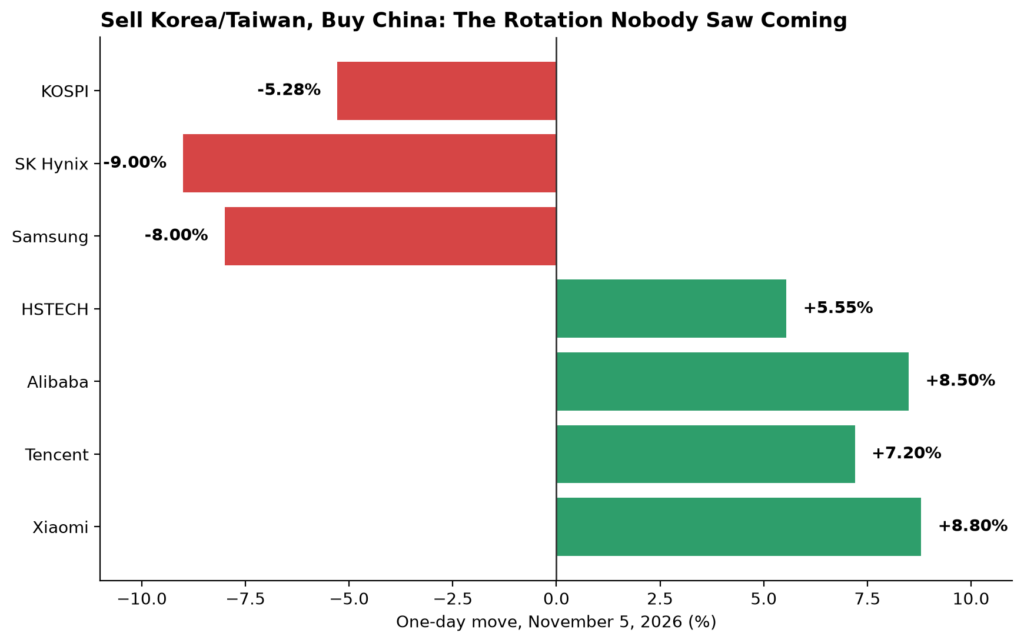
On the same day US AI stocks lost $2.5 trillion, Hong Kong’s Hang Seng Tech Index surged 5.55% — its best day since the February 2025 DeepSeek rally.
Alibaba climbed 8.5%. Tencent added 7.2%. Xiaomi jumped nearly 9%. Meituan rose 6.8%.
This wasn’t a coincidental bounce. It was one of the largest rotations the market has seen in years — and it tells you something important about how global capital is now thinking about AI exposure.
The trade was simple: if the US is going to slow its AI buildout, then China’s internet platforms — trading at 13 times forward earnings, their cheapest since 2024 — look like a value hiding in plain sight.
The Numbers: China’s Day in the Sun
Let’s start with the scoreboard, because the scale was remarkable.
The Hang Seng Index rose 3.67%, or 877 points — its best single day since February 2025. The Hang Seng Tech Index did even better, climbing 5.55%.
The individual moves were dramatic. Alibaba gained more than 8%. Tencent added 7%. Xiaomi surged nearly 9%. Meituan, the food delivery giant, rose almost 7%. Even BeiGene, a biotech, hit a 52-week high.
Meanwhile, mainland China’s CSI 300 rose a more modest 2.3% on Wednesday and 0.3% on Thursday, held back by losses in banks, coal, and energy. PetroChina fell nearly 8% as crude prices dropped.
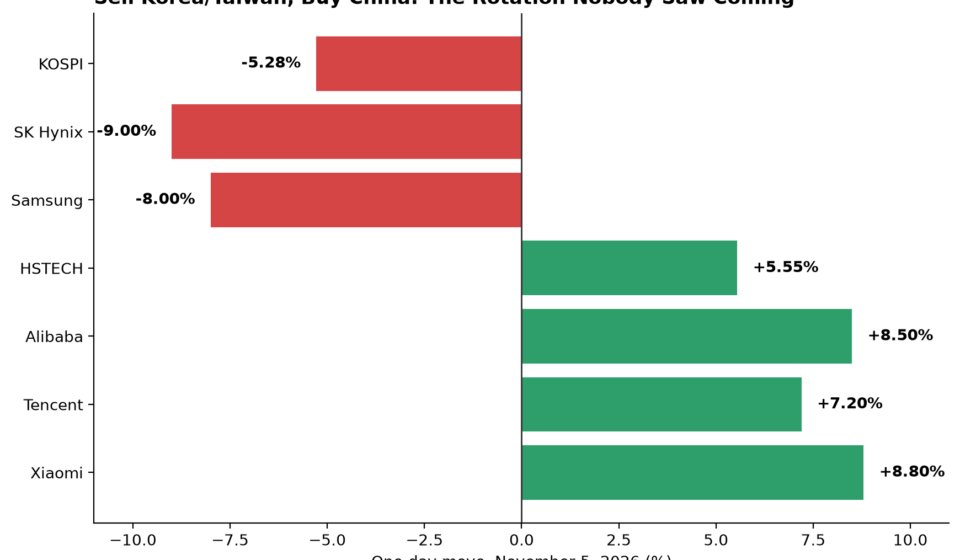
The contrast with the rest of Asia was stark. Korea’s KOSPI fell 5.28%. SK Hynix dropped over 9%. Samsung fell nearly 8%. The AI hardware supply chain in North Asia took a beating while China’s internet platforms soared.
Three Rotations at Once
The best framework for understanding what happened comes from Bloomberg Intelligence’s Marvin Chen, who described three simultaneous rotations.
The first was regional: money moving out of Korea and Taiwan — the heart of the AI hardware supply chain — and into China and Hong Kong.
The second was stylistic: money moving from growth into value. China, as Chen put it, had been “stuck at trough valuations this year while the rest of the world rallied.”
The third was thematic: money moving away from “tech hardware and pure AI plays” into more diversified businesses — internet platforms that generate cash from advertising, e-commerce, and cloud services rather than from selling GPUs.
Three rotations, one day. That’s not a coincidence. That’s a regime shift.
The Setup Was Almost Too Perfect
Here’s where the mechanics get interesting and the story gets a little less romantic.
Going into the week, Hong Kong had been one of the most heavily shorted markets in the world. Short selling reached 32% of turnover on Tuesday — the highest in over three years. The Hang Seng Tech was trading at 13 times forward earnings, its cheapest since 2024. Hedging costs were at their lowest since July.
In other words, the market was positioned for more pain. So when the US midterm results came in and triggered a rotation out of US AI hardware, the resulting squeeze was violent.
Lotus Asset Management’s Hao Hong called it “one of the biggest short squeezes in recent years.” When heavily shorted stocks suddenly find buyers, the covering rally can be ferocious — and that’s a big part of what happened.
So yes, some of this was mechanical. But the underlying thesis is real, and it’s worth taking seriously.
Why China? The Anti-AI-Capex Thesis
The deeper argument for Chinese tech isn’t that China’s economy suddenly got better. It’s that Chinese internet platforms are exposed to the opposite side of the AI trade.
Think about it. Tencent, Alibaba, and Meituan don’t need to pour 30% of revenue into data centers. They generate strong free cash flow from domestic consumption, advertising, and cloud services. They’re not betting the balance sheet on a decade-long infrastructure buildout with uncertain returns.
So when the market starts worrying about AI capex — about whether the billions spent on data centers will ever pay off — Chinese internet stocks look attractive by comparison. They’re the “boring” side of the AI trade: less upside, but far less capex risk.
There’s also policy support. Beijing has been stepping up efforts to restore investor confidence, with buyback facilities, ETF inflows, and other stabilization measures providing a floor under the market.
The Caveats: This Is a Rotation, Not a Decoupling
It’s important to be precise here, because the “China decoupling” narrative can mislead.
What happened this week was a rotation driven by relative valuations and positioning — not a fundamental re-rating of China’s economic outlook. The rally was fueled by short covering and value-seeking, not by a sudden surge in Chinese growth.
Several risks remain. US-China tech tensions haven’t gone away; a Democratic Congress could actually increase oversight of export licenses. Chinese hardware exporters dependent on US AI capex could face pressure even as internet platforms rally. And mainland investors actually sold $2.7 billion of Hong Kong stocks on Thursday — profit-taking after the Tuesday buying wave.
So treat this as what it is: a powerful rotation, not a permanent regime change. The question is whether it lasts.
The Historical Edge — and Its Limits
There’s one more data point worth noting. Since 2000, the Hang Seng has been higher one month after a 3.5%-plus day about 62% of the time, compared with 53% for any given day. So history suggests the rally has a decent chance of extending for a few weeks.
But the edge disappears by three months, when it’s back to roughly even odds. In other words, the short-term momentum favors continuation, but the medium-term picture is much less certain.
What to Watch Next
Three signals will tell you whether this rotation has legs.
Watch mainland flows. If Chinese onshore investors keep buying Hong Kong stocks through the trading links, the rally has domestic support. If they keep selling, it’s a foreign-driven trade that could reverse quickly.
Watch US-China policy. Any escalation in tech restrictions — particularly around export controls — could undercut the “safe haven” thesis for Chinese tech.
And watch earnings. The rotation was driven by valuation, not fundamentals. If Chinese internet companies deliver strong earnings, the value case strengthens. If they disappoint, the rally loses its anchor.
The Bottom Line
On a day when US AI hardware lost hundreds of billions, China’s internet stocks had their best session in nine months. That’s not because China suddenly solved its economic problems. It’s because global investors found a way to stay in the market while reducing their exposure to the one thing that just got repriced: AI capital expenditure.
The rotation may be short-lived. It may be the start of something bigger. But either way, it revealed something important: in the AI era, “exposure to AI” doesn’t have to mean “exposure to AI hardware.” And that realization could reshape how capital flows for a long time to come.