Amazon’s Nuclear Gambit: A $5 Billion Campus Powered by the Reactor Next Door
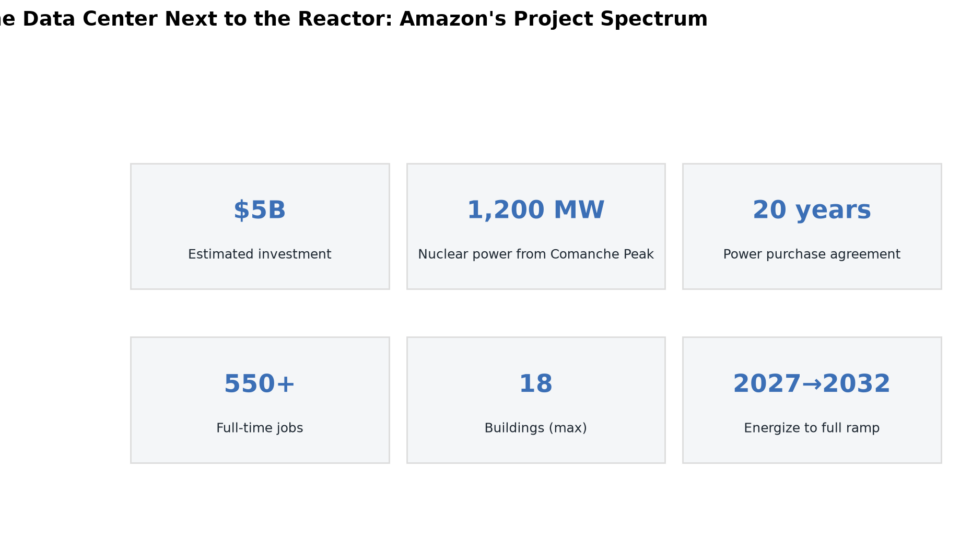
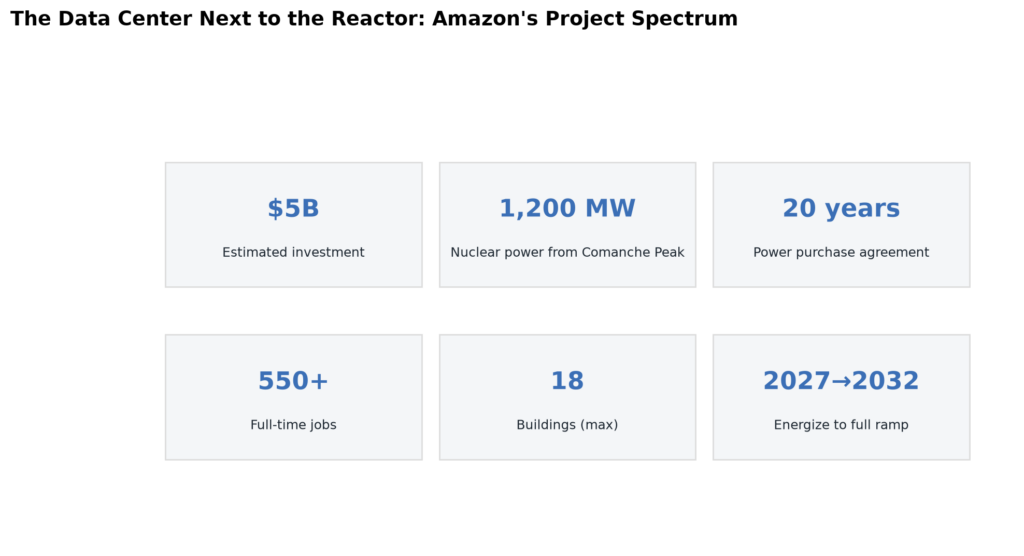
Days after Texas voters helped deliver a Democratic sweep with an anti-data-center mandate, Amazon announced a data center campus that will draw up to 1,200 megawatts of carbon-free power from the Comanche Peak nuclear plant next door — under a 20-year contract.
The ~$5 billion “Project Spectrum” near Glen Rose will support at least 550 full-time jobs, with energization targeted for 2027 and full ramp-up by 2032.
While Nscale’s IPO wobbles and neoclouds scramble for grid connections (see our S5 coverage), Amazon is doing something simpler: building next to a reactor that’s already there.
The Project: What Project Spectrum Is
Let’s start with the basics.
Project Spectrum is Amazon’s planned data center campus in an unincorporated area of Somervell County, near Glen Rose, Texas. It sits on about 435 acres of land owned by Vistra Corp., directly adjacent to the existing Comanche Peak Nuclear Power Plant.
The investment is estimated at roughly $5 billion, based on tax abatement filings and reporting from DatacenterDynamics. The campus could include up to 18 buildings, designed to handle Amazon’s cloud services and artificial intelligence workloads.
It’s expected to support at least 550 full-time positions, with wages well above the county average. Construction will generate thousands of additional jobs during the build-out phase.
The Power: 1,200 MW of Nuclear, Dedicated
Here’s the heart of the story — and the reason it matters.
Project Spectrum is tied to a 20-year power purchase agreement with Vistra for up to 1,200 megawatts from Comanche Peak. That’s a large block of carbon-free, baseload power — the kind of steady, around-the-clock output that data centers crave and that intermittent renewables can’t provide on their own.
The power flows to the campus through dedicated transmission lines to an on-site substation. Amazon is a direct off-taker, paying the full cost of the energy that supports its operations. That structure protects other ratepayers from bearing the cost of Amazon’s power needs — a critical point in a political environment where electricity bills have become a flashpoint (see our S1 coverage).
There’s also a net metering agreement, which tracks power flowing in and out and bills on the balance. And Amazon plans backup generation at the site.
The PPA was first disclosed in September 2025, and Amazon was confirmed as the buyer in February 2026.
Water: An Industrial Reservoir, Not Drinking Supply
Water is the other front in the data center backlash. Amazon’s approach here is worth examining.
The campus draws cooling water from the Comanche Creek industrial reservoir — a dedicated industrial reservoir that serves the adjacent nuclear plant. Because of its salinity, this water isn’t suitable as a drinking source. Amazon draws it under existing surface water rights owned by Vistra and leased to Amazon, not from local groundwater or the community drinking water supply.
Amazon says no new water rights will be sought, and projected water use will be under 2% of the existing rights Vistra holds for the location. For domestic needs like restrooms, water comes from the Somervell County Water District.
The company also plans to invest about $3.75 million in a water-efficiency project with Arable, deploying AWS-hosted irrigation technology to help farmers across the Brazos River Basin reduce groundwater withdrawals. Once fully implemented, it’s expected to replenish more than 330 million gallons per year.
The Community and Political Context
The timing here is impossible to ignore.
Project Spectrum’s local approvals came through in February 2026 — before the midterm backlash that saw 40 of 41 data center ballot measures rejected nationally (see our S1 and S6 coverage). So Amazon isn’t building in defiance of voters; it secured its approvals before the political weather turned.
But the model still matters. By pairing a data center with adjacent nuclear power and a dedicated transmission line, Amazon sidesteps much of the grid interconnection complexity that’s slowing other projects. And by paying 100% of its power costs and drawing from an industrial reservoir, it preempts the two biggest community complaints: electricity bills and water.
The tax package includes $2.5 million at groundbreaking and $300,000 annually per completed building — up to $5.4 million a year if all 18 buildings are built.
Why Nuclear, Why Now
The choice of nuclear is strategic, not incidental.
Nuclear provides baseload power — steady output regardless of weather or time of day. For AI workloads that run 24/7, that’s ideal. And by pulling power through dedicated lines from a plant next door, Amazon avoids the grid interconnection queue that has become a major bottleneck for data centers across the country.
This is the same “own your power” playbook that Google is executing in Wyoming (see our S6 coverage) — but with a different energy source. Google is using new natural gas fuel cells plus carbon capture; Amazon is using existing nuclear plus dedicated transmission. Both pay 100% of their power costs. Both sidestep the political and grid constraints that are slowing competitors.
Expect more hyperscaler-nuclear pairings in the years ahead. As data center power demand collides with grid constraints and political resistance, co-locating with existing generation becomes an increasingly attractive — and increasingly necessary — strategy.
What This Means for the AI Infrastructure Race
Step back, and Project Spectrum illustrates a broader shift.
The first phase of the AI infrastructure buildout was about speed: who could build the biggest campus fastest. The second phase — the one we’re now in — is about permission: who can secure power, water, and community acceptance.
Amazon’s answer is to build next to a nuclear reactor, pay its own way, and use an industrial reservoir. It’s expensive, but it clears the permission bar. And in a post-midterm environment, clearing that bar is what separates projects that get built from projects that stall.
What to Watch Next
Three signals will tell you how this plays out.
Watch the construction timeline. Energization targeted for 2027 and full ramp-up by 2032 is ambitious; delays would signal execution challenges.
Watch whether other hyperscalers announce similar nuclear co-location deals. If they do, the “build next to the reactor” model becomes the new standard.
And watch the regulatory environment around dedicated transmission and net metering. These arrangements draw scrutiny from grid operators, and how regulators treat them will shape whether the model scales.
The Bottom Line
Amazon’s Project Spectrum is a $5 billion bet that the future of AI infrastructure isn’t about who builds the biggest data center — it’s about who can secure the most reliable, politically acceptable power.
By building next to a nuclear plant, drawing from an industrial reservoir, and paying 100% of its costs, Amazon has constructed a template for the post-backlash era. It’s expensive. It’s complicated. But it works.
And in a year when the market lost $2.5 trillion partly because permission stopped being free (see our S1 coverage), that template may be the most valuable thing Amazon built.