Insight Figure — The mechanism behind the shrinking shelf
Every merchandising team that buys a ranking model expects the same thing: more of the catalog will finally get its chance. More SKUs surfaced, more long-tail products discovered, more of the inventory that humans never had time to hand-curate.
Then the months pass, and the shelf gets smaller.
Not literally. The same number of products sit in the catalog. But the share of them that receives meaningful impressions keeps contracting, and the top twenty products start absorbing a share of attention that nobody planned for. The team that bought the model to expand discovery ends up with a store that is better at exploiting the products it already sells and worse at finding the ones it doesn’t.
This is the part nobody puts in the vendor deck, because it is not a failure of the model. It is what the model was always going to do.
The only teacher a ranker has
A ranking model learns from engagement. Someone sees a product, someone clicks, someone buys, and that sequence becomes training signal. Repeat a few billion times and you have a system that can predict, with unnerving accuracy, what a shopper will respond to.
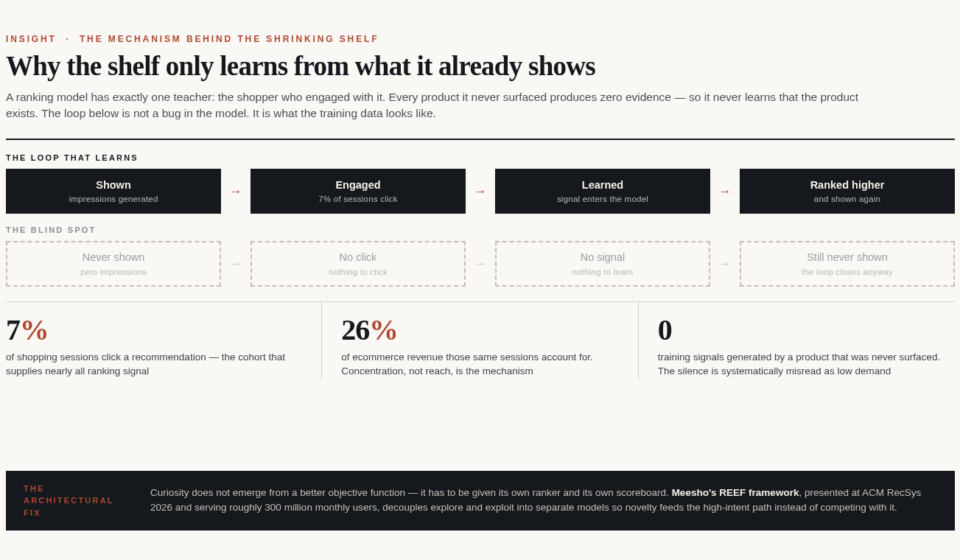
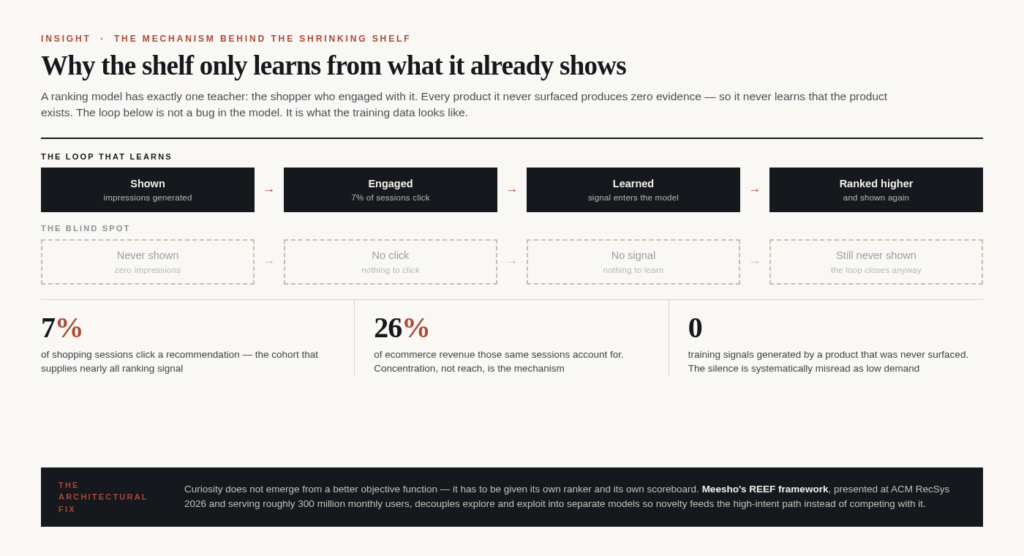
Now look at where that signal comes from. It comes from products that were shown. A product that never appears in a slot generates exactly zero impressions, zero clicks, zero purchases, and therefore zero training data. From the model’s perspective, that product is indistinguishable from a product nobody wants.
Update the model on that evidence and it will conclude, correctly given its inputs, that the unshown product is a poor bet. So it shows it less. Which produces fewer impressions, which produces less evidence, which confirms the conclusion.
The loop closes. And it closes in the direction of the products that were already winning when you installed the system.
Why the numbers make it worse
The concentration figures that make recommendation engines look impressive are the same figures that make this mechanism look inevitable.
In a Salesforce analysis of roughly 150 million shopping sessions, visits where a shopper clicked a recommendation accounted for just 7 percent of traffic — but 26 percent of revenue. Seven percent of sessions are doing a quarter of the commercial work.
Set aside the revenue for a moment and look at what that 7 percent means structurally. Only a small fraction of sessions produce the click events that feed the model. So the model’s entire picture of your catalog is built from an unusually engaged, unusually decisive slice of your audience — the shoppers who already knew roughly what they wanted.
The browsers. The gift-hunters. The people who came to wander and left without clicking anything. They generate almost no signal at all. Their taste never enters the model, which means the store never learns to serve them.
The silence is the data
This is the part that takes a minute to land. In a standard supervised setup, missing data is an inconvenience. In a ranking system, missing data is a judgment.
A product with no impressions is not neutral. It sits in the training set with a zero, and the model treats that zero as a fact about the product’s appeal rather than a fact about the system’s decisions. The silence gets read as low demand.
Which is why the failure mode is so hard to spot on a dashboard. Conversion rate looks healthy or better. Revenue per session climbs. The model is doing exactly what you asked. The only metric heading the wrong direction is diversity of exposure — and almost nobody puts that on a weekly report.
The incentives point the same way
Even a perfectly aware team will struggle, because the incentive structure rewards the loop.
Ranking teams are measured on conversion, revenue per session, and engagement. Every one of those metrics improves when the model concentrates on proven winners. Exploration, by contrast, is a cost: it deliberately shows shoppers things they are less likely to buy, and it makes this quarter’s numbers slightly worse in exchange for a benefit that shows up in a future quarter, attributable to nobody.
So the model narrows, and the organization approves, because the narrowing shows up as improvement.
Curiosity has to be engineered, not wished for
The encouraging news is that this is now treated as an engineering discipline rather than a philosophical complaint — and the fix is architectural, not motivational.
You cannot solve it by tweaking the objective function. Mix exploration into a single model and the two goals interfere: the model has one parameter space, and the signals pull against each other. Recent production research makes the case explicitly. Meesho’s REEF framework, presented at ACM RecSys 2026 and serving roughly 300 million monthly active users, decouples explore and exploit into separate rankers so that novelty discovery feeds back into the high-intent pathway instead of competing with it inside the same weights.
That is the structural insight. Exploration works when it has its own model, its own objective, and its own scoreboard. Bolted onto the exploit ranker as a percentage of traffic, it gets optimized away within two quarters.
What this means if you run a store
Three practical consequences, none of them expensive.
Measure exposure diversity before you measure lift. Track what share of your active catalog received at least one impression last month. If it is shrinking while revenue grows, you have bought efficiency and sold discovery.
Give exploration a number that survives review. Not a philosophy — a target. Share of impressions allocated to products below a sales threshold, with a floor that cannot be traded away during a bad week.
Watch new-product velocity, not just conversion. A healthy shelf teaches the model something new every week. A narrowing shelf has stopped learning, and the first symptom is that new arrivals take longer and longer to find traction.
The invisible marketer is not making a mistake. It is doing precisely what the evidence tells it to do — and the evidence, by construction, only ever comes from what it already chose to show.
The question is whether anyone is measuring the part of the catalog it has quietly stopped choosing.