The Marketer You Never See: How AI Quietly Runs the Store
The most effective marketer in modern e-commerce has never written a line of copy. It has never pitched a client, never requested a budget increase, and never appeared on an org chart. It sits inside the merchandising stack, and on any given afternoon it makes more commercially consequential decisions than the entire campaign team upstairs.
Here is the uncomfortable part. Most brands cannot name it, cannot measure it, and cannot explain what it did last quarter.
The marketer nobody hired
Think about what actually happens when someone lands on a product category page. They see a shelf. The shelf has an order. That order was not chosen by a human being this morning — it was computed, for that visitor, in the time it took the page to render.
Now multiply that by search results, recommendation rails, bundle suggestions, promotional slots and, increasingly, the price shown at checkout. Every one of those is a marketing decision. Every one of them is being made by a system that reports to nobody in the marketing department.
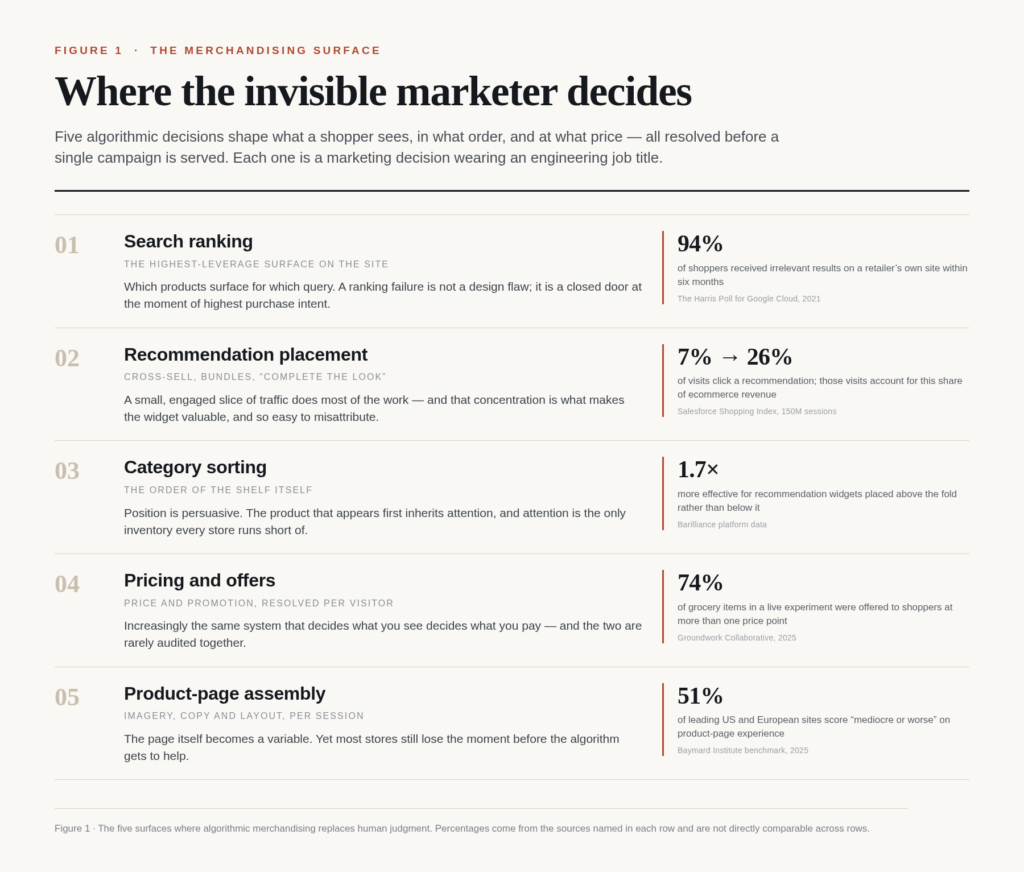
That is the invisible marketer: the algorithmic layer that optimizes the presentation of products rather than the promotion of them. Search ranking, sorting, recommendation placement, cross-sell, dynamic pricing, page assembly. It does not run campaigns. It runs the store.
Why this is a marketing problem wearing an engineering job title
Ask a CMO where conversion is won and you will hear about creative, offer, audience, landing page. Ask the same question of the data and the answer keeps pointing somewhere else.
McKinsey’s personalization work is the cleanest place to start, because it separates the effect from the hype. Done properly, personalization lifts revenue by 5 to 15 percent, cuts acquisition costs by as much as half, and improves marketing-spend efficiency by 10 to 30 percent. Those are not small operational savings. They are the same order of magnitude as the returns brands fight over in media planning — except they arrive without a media budget.
Then there is the search number, which should genuinely unsettle anyone who owns a P&L. Research commissioned by Google Cloud and fielded by The Harris Poll put the annual cost of search abandonment in the United States above $333 billion. That is revenue lost because a shopper typed something into a retailer’s own search box and the site failed to return it. In the same study, 94 percent of shoppers said they had received irrelevant results on a retailer’s site within the previous six months, and 85 percent said a bad search changed how they viewed the brand.
Worth being precise about the provenance: this is 2021 data, and it was commissioned by a vendor selling search remediation. The direction has held up in every study since, but treat the absolute figure as an order of magnitude, not an audited number.
Still — a broken search box is now a bigger line item than most brands’ paid social budgets. Yet almost no marketing team has a standing review of it.
Search ranking: the closed door at the highest-intent moment
Search is where purchase intent is at its peak and where failure is at its most silent.
A shopper who types “linen shirt, relaxed fit, under $80” has told you precisely what they want. If your ranking model returns a polyester blend at $140 because that SKU carries better margin, you have not merely missed a sale. You have taught that shopper that your store does not understand them, and according to the Google Cloud research, more than half will abandon the entire cart and go elsewhere if even one item proves unfindable.
The leverage is absurd when you stack it against other channels. No ad auction gives you a self-declared, fully specified intent signal for free. Search ranking does, thousands of times an hour. It is the cheapest high-intent inventory in commerce, and it is usually owned by a platform team with no marketing representation in the room.
Recommendations: the concentration paradox
Here is a number that should reshape how you think about the recommendation rail. In a Salesforce analysis of roughly 150 million shopping sessions, visits where a shopper clicked a recommendation made up just 7 percent of traffic. Those visits accounted for 26 percent of revenue and 24 percent of orders.
Seven percent of the traffic. A quarter of the money.
That concentration is both the opportunity and the trap. The opportunity is obvious: a small, engaged cohort is doing enormous work, so improving their experience compounds fast. The trap is attribution. Barilliance’s platform data puts the ceiling at 31 percent of site revenue, with an average of 12 percent — but as several analysts have pointed out, most of that credit comes from an accounting rule. Any order containing a clicked recommended item gets attributed to the widget, including orders the shopper would have placed anyway.
The most quoted number in this entire field is also the weakest. McKinsey’s estimate that recommendations drive 35 percent of Amazon’s purchases dates from 2013. It gets recycled in nearly every vendor deck, and it describes a catalog depth, purchase history and traffic volume that no other retailer can reproduce.
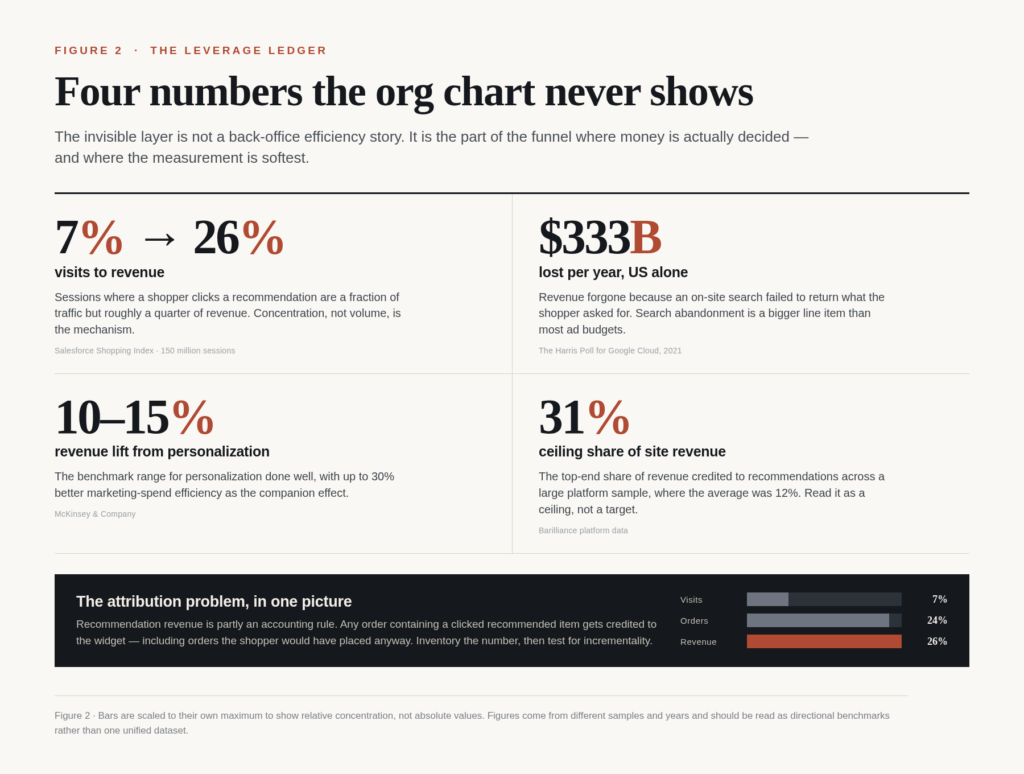
So the honest test is not “what share of revenue do recommendations touch.” It is “what revenue would not have happened without them.” That requires a holdout group, sixty days of baseline, and the willingness to discover that some of your lift was cannibalization. Very few teams run that test, which is precisely why the numbers stay inflated.
Sorting: position is persuasion
Category-page order looks like an engineering detail. It is not. It is the retail equivalent of shelf position, and shelf position has been understood as a commercial instrument since the first supermarket.
The mechanics are unglamorous but decisive. Recommendation widgets placed above the fold perform 1.7 times better than the same widgets placed below it, according to Barilliance. That ratio is not about the widget. It is about attention — the only inventory every store runs permanently short of.
Which raises a question most merchandising teams never ask out loud: what is the objective function for the sort? Revenue per session? Units? Gross margin? Conversion rate? New-customer acquisition? Each produces a visibly different shelf, and none of them are neutral.
Pricing: the decision nobody audited
Then there is the surface where merchandising stops being a presentation choice and becomes a consumer-protection question.
In 2025, Groundwork Collaborative, working with Consumer Reports and More Perfect Union, ran live price tests with 437 shoppers across four cities. Nearly three quarters of grocery items — 74 percent — were offered to shoppers at more than one price point. Prices for the identical item in the identical store varied by up to 23 percent between shoppers, and basket totals varied by about 7 percent on average. The researchers estimated the practice could cost a household up to $1,200 a year.
The Federal Trade Commission subsequently opened an investigation into the pricing tool involved. Instacart has said its experiments were short-term and randomized, not based on individual traits, and the study itself found no evidence of pricing keyed to income, ZIP code or shopping history. That distinction matters and should be stated clearly.
But the strategic lesson survives the legal nuance. The system that decides what you see and the system that decides what you pay are converging into one system. And almost no brand audits those two decisions together, because one sits with the merchandising team and the other with the pricing team, and they meet roughly never.
Assembling the page, one visitor at a time
The last surface is the one most visibly changing. Product pages are moving from static templates to dynamically assembled objects — imagery, copy blocks, review modules and layout composed per session.
Yet the foundation is often missing. Baymard Institute’s 2025 benchmark found that 51 percent of leading US and European e-commerce sites score mediocre or worse on product-page experience, and not one site achieved a perfect score. Before an algorithm can personalize a page, the page has to work.
There is a countervailing finding worth carrying into any personalization roadmap: a June 2026 Baymard survey of more than 2,200 US shoppers found that 60 percent said knowing a product photo was AI-generated lowered their confidence to buy, with 17 percent saying they would not buy at all. Shoppers accept AI earlier in the journey — 63 percent would rather use a chatbot than a person to compare features — and reject it at the moment of proof. Personalization has a credibility ceiling, and it sits right where the product image is.
Why the machine genuinely wins
It would be lazy to frame this as automation replacing craft. The structural advantage is real and worth naming precisely.
It operates continuously. Human merchandising runs on a weekly or monthly cadence. An algorithmic layer updates on live behavior, which means it responds to a trend while the trend is happening rather than in the following planning cycle.
It evaluates a space humans cannot hold. A category manager cannot reason across thousands of SKUs multiplied by thousands of query contexts. A ranking model does this as routine.
It personalizes at resolution one. Every visitor sees a store computed for them. No human operation, at any headcount, could achieve that.
It replaces intuition with measurement. Whether that is an improvement depends entirely on the objective you hand it — which is the whole argument of this piece.
The filter bubble, and the price of being understood too well
Now the honest critique.
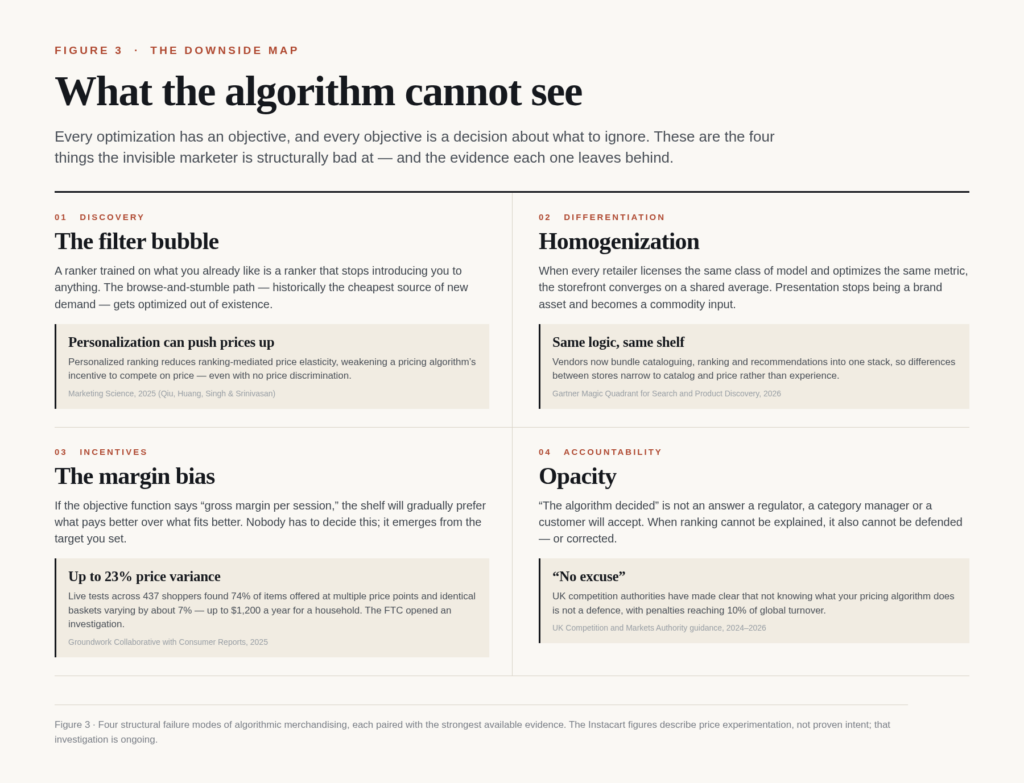
A ranker trained on what you already like is a ranker that gradually stops introducing you to anything else. The browse-and-stumble path — historically the cheapest source of genuinely new demand — gets optimized out of existence. You end up with a store that is superbly efficient at serving demand you already had and structurally incapable of creating demand you did not.
And the consequences run further than discovery. Research published in Marketing Science in 2025 found something counterintuitive: personalized ranking systems, which order products by descending consumer utility, can actually encourage pricing algorithms to charge higher prices. The mechanism is that personalization reduces ranking-mediated price elasticity — when the ranker has already surfaced the best fit, the shopper searches less, and the algorithm’s incentive to compete on price weakens. Notably, this happens without any price discrimination at all.
That is a serious finding. It means the consumer-welfare case for personalization is not automatically positive, even when nobody is profiling anyone.
Homogenization: when everyone optimizes the same target
If your competitor licenses the same class of model, trains it on the same signals and optimizes the same metric, your storefront converges on theirs.
This is already visible in the vendor landscape. Gartner’s 2026 Magic Quadrant for Search and Product Discovery describes platforms bundling cataloguing, visual merchandising, conditional slotting, ranking and recommendations into a single stack — Google’s entry alone draws on a shopping graph of roughly 40 billion products. When the intelligence layer is a purchased input rather than a proprietary asset, differentiation narrows to catalog and price.
Presentation stops being a brand asset. It becomes a commodity line item.
The margin bias, and why nobody has to decide it
This is the most quietly corrosive failure mode, because it requires no malfeasance at all.
Set the objective to gross margin per session and the shelf will drift, over months, toward what pays better rather than what fits better. No meeting is held. No one signs off. The model simply learns the target you gave it.
Which is why the audit question is not “is our AI biased?” — an unanswerable framing. The answerable question is: what is the objective function, and would we defend it to a customer?
Opacity is now a legal exposure, not just a cultural one
“The algorithm decided” used to be an internal inconvenience. It is becoming a compliance problem.
The UK Competition and Markets Authority has been unusually direct. Its position is that not knowing what your pricing algorithm is doing is no excuse — end users and suppliers alike must understand how the tools work. The authority has identified four categories of algorithmic collusion risk, including hub-and-spoke arrangements where competitors use a shared algorithm or data hub to exchange sensitive information indirectly, and it has confirmed that businesses bear full responsibility for the consumer-facing conduct of their AI agents. Penalties reach 10 percent of global turnover.
Read that again in a merchandising context. If your ranking and pricing logic cannot be explained to a regulator, an internal audit or a journalist, you are carrying risk that never appears on a marketing dashboard.
Where this is heading: the agentic layer
Gartner’s Hype Cycle for Digital Commerce 2026 places AI agents for commerce operations as a transformational technology expected to reach mainstream adoption within two to five years, with merchandising optimization named as a primary use case. The same research introduces agentic buying, AI checkout and answer engine optimization — a world in which shoppers begin their journey inside ChatGPT, Gemini or Perplexity rather than on your homepage.
The implication for merchandising is sharp. If discovery migrates to AI assistants, then the invisible marketer stops being your internal ranking system and becomes someone else’s. Your product data either becomes legible to those agents or it does not.
The adoption data suggests most organizations are not ready. McKinsey’s 2025 State of AI survey found 88 percent of organizations using AI in at least one function, 62 percent experimenting with agents, and 23 percent scaling an agent at all — with no more than 10 percent scaling agents within any single business function. Meanwhile Gartner’s own read on marketing leaders is that 29 percent claim to be in production with agents while 52 percent are still testing with customers.
Capability is arriving faster than governance. That gap is where the next round of merchandising failures will come from.
What to actually do about it
Four moves, in rough order of return.
Treat merchandising as a media channel. Give it an owner, a quarterly target and a seat in the marketing planning cycle. If search ranking and recommendation placement drive more conversion than your campaign calendar, they deserve the same scrutiny — and the same test-and-learn discipline.
Audit the objective function, not the output. Write down what the model is optimizing. Then ask whether that target would survive being published. Margin-weighted sorting is defensible if it is disclosed and bounded; it is indefensible if it is simply the default.
Layer human curation on top, deliberately. Editorial collections, seasonal stories, expert picks, merchant-selected slots. Not as nostalgia — as differentiation. When every competitor’s algorithmic baseline converges, the curated layer is the only part of the shelf that is actually yours.
Protect serendipity as a retention metric. This one is technically hard and commercially underrated. Exploration is now a first-class engineering problem, not a philosophical one: recent production research from Meesho, presented at ACM RecSys 2026 and serving roughly 300 million monthly active users, describes decoupling exploit and explore rankers so that novelty discovery feeds back into the high-intent pathway rather than competing with it. Measure discovery the way you measure conversion — because a store that stops surprising people eventually stops growing.
The takeaway
The invisible marketer is already doing more of the actual marketing than the visible one. That is not a prediction; it is the current operating reality of every serious e-commerce business.
The brands that win the next cycle will not be the ones with the most sophisticated ranking model. They will be the ones that stop treating merchandising as a back-office function and start running it like the high-leverage marketing surface it has become — with a named owner, a defensible objective, an honest attribution test, and a deliberate human layer that the algorithm cannot replicate.
The alternative is a store that is perfectly optimized for the customer you already had, and invisible to the one you have not met yet.
Frequently asked questions
What exactly counts as AI merchandising?
The algorithmic layer that decides product presentation rather than promotion: search ranking, category sorting, recommendation placement, cross-sell and bundle logic, dynamic pricing, and increasingly per-visitor product-page assembly. If it determines what a shopper sees, in what order, or at what price, it belongs in this category.
Why call it the invisible marketer instead of just merchandising technology?
Because it makes marketing decisions — which product gets shown, to whom, at what price — while sitting outside the marketing organization, outside the campaign calendar, and usually outside marketing’s measurement. The label is a provocation designed to get it onto a CMO’s agenda.
How much revenue do product recommendations really drive?
Less than the most-quoted figures suggest. Salesforce data shows recommendation-clicking visits are 7 percent of traffic but 26 percent of revenue. Barilliance puts the ceiling at 31 percent of site revenue with a 12 percent average. The famous 35 percent Amazon figure is a 2013 McKinsey estimate and should be read as directional only. All of these measure attribution, not incrementality — only a holdout test tells you what was truly incremental.
Can personalization actually hurt consumers?
Yes, and not only through price discrimination. Research in Marketing Science shows that personalized ranking can reduce ranking-mediated price elasticity, weakening a pricing algorithm’s incentive to compete on price — pushing prices up even when no individual profiling occurs. Separately, live price experiments documented by Groundwork Collaborative found identical items offered at up to 23 percent different prices across shoppers.
What is the single highest-return fix for most brands?
Fix search before you personalize anything. Search abandonment costs US retailers an estimated $333 billion a year, and 94 percent of shoppers report receiving irrelevant results on retail sites. A ranking model cannot rescue a catalog that the search layer cannot retrieve, and personalization on top of a broken search foundation simply fails more efficiently.