AI Image Ads: What Performs When Everything Looks Generated
Open your feed. Count the ads that look as if they were lit by the same invisible studio, shot against the same gradient horizon, and finished by the same hand. You will lose count around seven. That is not a coincidence, and it is not a failure of taste. It is the predictable output of a supply shock nobody modeled properly: generative AI has made competent commercial imagery fast and, in many workflows, cheap.
Here is the part the industry keeps getting wrong. The interesting question is not whether AI imagery works in advertising. It is whether anyone can tell — and what happens to the numbers when they can. On that question the evidence is unusually clear, and it points somewhere most creative teams are not looking.
Two studies, quoted against each other, both correct
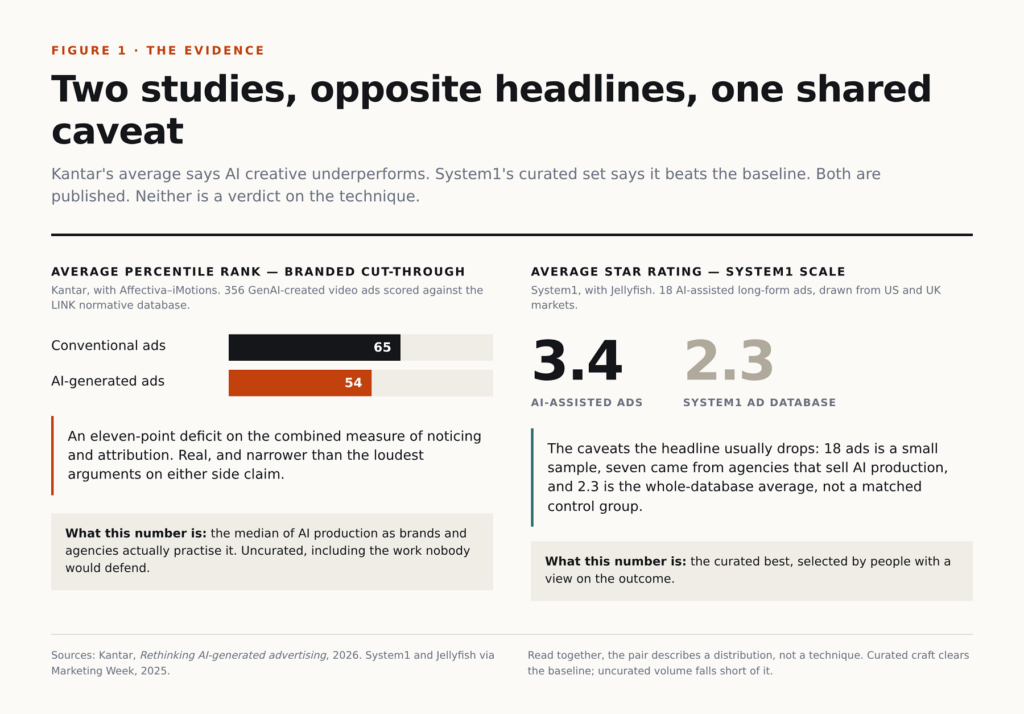
Kantar, working with the biometric firms Affectiva and iMotions, ran 356 GenAI-created video ads through its LINK testing system and scored them against the normative database of conventionally produced work. On branded cut-through — the combined measure of whether people noticed the brand and attributed the ad to it — the AI ads averaged the 54th percentile. Conventional ads averaged the 65th.
Then System1, with Jellyfish, tested 18 AI-assisted long-form ads and got an average of 3.4 stars. The average across System1’s entire database of 123,000 video ads was 2.3 stars. That is a database-wide benchmark, not a matched control group. Same technology category. Opposite headline.
Both are legitimate, and the difference lies in what went into each sample. Kantar scored whatever brands and agencies submitted: the median of AI production as it is actually practiced, including the work nobody would defend. System1 scored 18 ads chosen because someone believed in them, seven of which came from agencies that sell AI production. One sample measures the median. The other measures a curated best. And 2.3 is a whole-database average — a distinction the headlines routinely swallow.
Read separately, the findings seem to fight. Read together, they say something more useful: the technology alone does not determine performance. Execution does. And execution, in this category, has a specific and diagnosable definition.
The variable that belongs in the brief
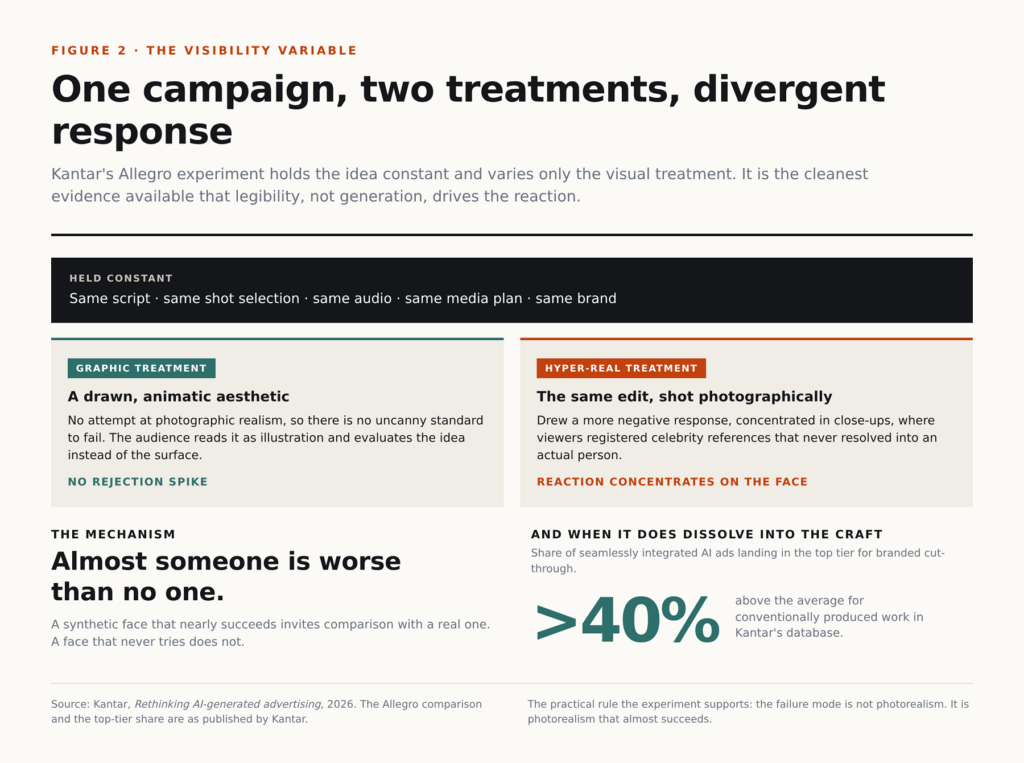
Kantar did something more useful than computing an average. It split its 356 ads around a single question: is the use of generative AI obvious to a normal viewer, or has it been absorbed into the craft?
The direction is unambiguous. Kantar reports that more than 40% of ads where AI use was seamless landed in the top tier for branded cut-through. Ads where the generation was legible went the other way.
The cleanest demonstration in the study is a controlled one. Kantar ran an experiment with Allegro, the Polish e-commerce platform, on a single campaign: same script, same shot selection, same audio, same media. One version used a drawn, animatic aesthetic. The other used hyper-realistic imagery. The hyper-real version drew a more negative response, concentrated in close-ups, where viewers registered celebrity references that never resolved into an actual person. The graphic version did not have that problem, because it never asked to be read as a photograph.
That is the whole mechanism in one paragraph. The failure mode is not photorealism. It is photorealism that almost succeeds. A synthetic face that nearly works invites comparison with a real one, and loses. A face that never tries does not enter the comparison at all.
The practitioner’s translation: if a viewer can name the tool, you have spent production budget buying a discount on your own brand. The goal is not to conceal AI — that is a separate question with its own legal answers. The goal is to reach the point where the question does not arise, because the image is doing a job only a specific, real thing could do.
Why honesty is the wrong word and specificity is the right one
Every conference panel now ends with someone saying brands need to be authentic. True and useless, because authenticity is not a production method. It is a perception, and perceptions are built from detail.
Getty Images holds a large body of consumer evidence here. Its VisualGPS platform surveyed more than 30,000 adults across 25 markets, and the resulting report, Building Trust in the Age of AI, is the reference most of the industry quotes without reading. Three findings do the real work. Almost 90% of consumers want to know whether an image was created with AI. 98% agree that authentic images and videos are pivotal to establishing trust. And synthetic depictions of nonhuman subjects are perceived as less misleading than synthetic people or synthetic products.
That last finding is the one to pin on the wall. It tells you where the trust risk concentrates: not in the abstract, but in the literal. A generated mountain range is atmosphere. A generated face is a claim. A generated product is a promise about an object the customer will later hold.
Getty’s methodology note matters as much as its findings. The report draws on perspectives gathered from 2022 into 2024, with the underlying survey waves fielded earlier. Treat the numbers as a large, well-built snapshot rather than a live reading of consumer mood in 2026, because mood on this topic has moved, and moved in one direction.
The thirty-seven-point gap
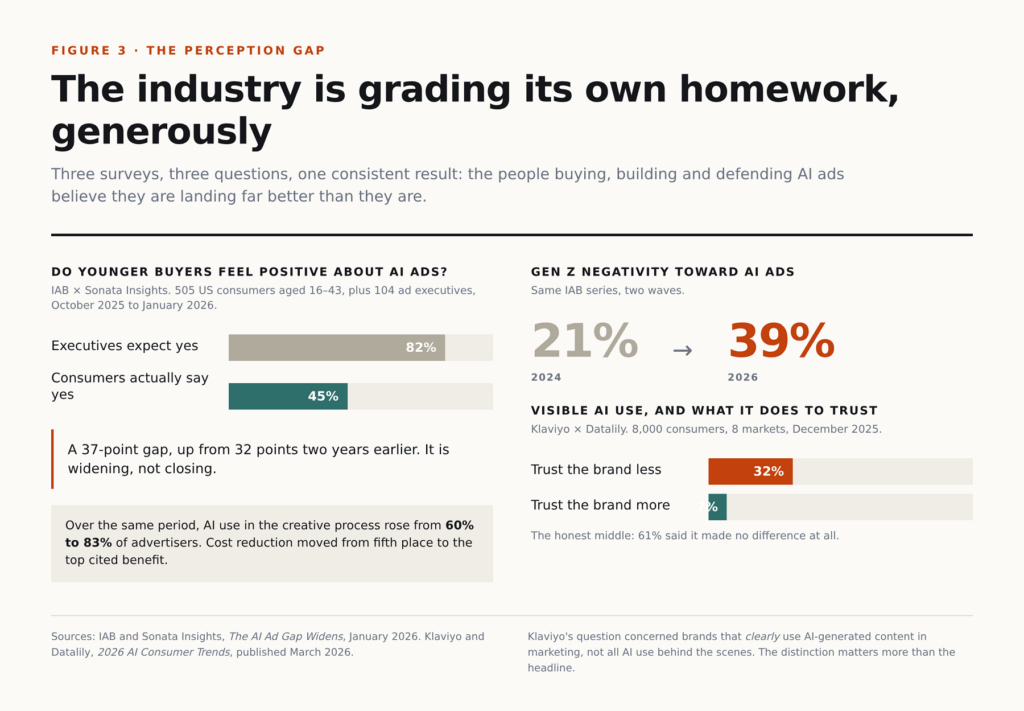
The IAB, with Sonata Insights, surveyed 505 US consumers aged 16 to 43 and 104 advertising executives between October 2025 and January 2026. The executives believed 82% of younger consumers felt positive about AI-generated ads. Among the consumers surveyed, the figure was 45%.
That is a 37-point gap, up from 32 points two years earlier. It is widening while adoption accelerates. In the same research, AI use in the creative process rose from 60% to 83% of advertisers, and cost reduction moved from fifth place to the most-cited benefit, at 64%.
The generational split does something specific and unfriendly. Gen Z negativity toward AI ads went from 21% in 2024 to 39% in 2026. Millennials sat at 20%. Thirty percent of those Gen Z respondents described brands using AI in advertising as inauthentic; 24% called it unethical.
That complicates an easy assumption. Growing up inside synthetic media does not appear to breed tolerance for it. The cohort with the most exposure is the cohort extending the least benefit of the doubt.
Klaviyo’s survey of 8,000 consumers across eight markets, fielded in December 2025, sharpens the same finding. When a brand’s use of AI is clearly visible in its marketing, 32% of consumers trust it less and 7% trust it more.
Be honest about the middle, though, because the middle is most of the market. Sixty-one percent said it made no difference. Most people genuinely do not care, and any deck claiming otherwise is selling you something. But the people who do care care enough to register — and they skew young. Whether that hardens into a durable commercial penalty as the cohort’s spending power grows is a risk to monitor, not a proven outcome. The survey measures attitude, not revenue.
The counter-movement is already priced in
Something quietly strange happened while everyone was arguing about whether AI ads work. Brands began advertising the absence of AI.
Heineken, Polaroid and Cadbury have run campaigns built around human-made craft. Apple has put made-by-humans language in closing credits. Aerie publicly committed to keeping AI-generated imagery out of its campaigns and reported engagement gains afterward. Whether those gains are causal or coincidental is genuinely unclear from public data, so treat the case as directional rather than proof. But the pattern is consistent with everything above: when the supply of a signal explodes, the signal can invert.
The failure cases cluster around one mistake. McDonald’s Netherlands published a 45-second AI-made Christmas spot on December 6, 2025, and removed it three days later, after audiences called it uncanny and hollow. It drew criticism not for technical failure but for choosing a category — family Christmas — where visible automation reads as indifference. Coca-Cola’s AI holiday work split audiences: sharp criticism from creative professionals, a warm reception from ordinary viewers, including the maximum possible 5.9-star rating in System1’s Test Your Ad panel. Which of those two audiences your brand actually answers to is a strategic question, not an aesthetic one.
Four rules that survive the data
Rule one: separate the job from the tool. Generation is good at plausibility and bad at proof. Put it where plausibility is the deliverable: conceptual backdrops, atmosphere, mood, scale, fantasy, the impossible camera move. Keep it away from anything the customer will later hold, eat, apply, or stand next to. The moment an image makes a factual claim about a physical object, you are asking a plausibility engine to do a verification job, and it will fail at exactly the rate you cannot afford.
Rule two: anchor with one real element. The strongest hybrid work shares a structure: a genuine, photographed subject inside a generated environment. The real element does the trust work; the generated element does the ambition. That structure reduces the risk of misrepresenting the product itself — but it does not automatically remove disclosure obligations, and treating it as a legal shield is a mistake.
Rule three: treat iteration speed as the actual product. Meta reported its end-to-end AI ad solutions, Advantage+ included, at an annual revenue run rate above $60 billion in Q3 2025, with nearly two million advertisers using its video-generation features by midyear. Google put Veo inside Asset Studio, turning up to three static images into videos of up to ten seconds. The value on offer is not better single images. It is testing forty concepts where you used to test five, and finding the outlier by exhausting the field rather than by guessing well. That advantage exists only if your measurement keeps pace — and most teams’ systems do not.
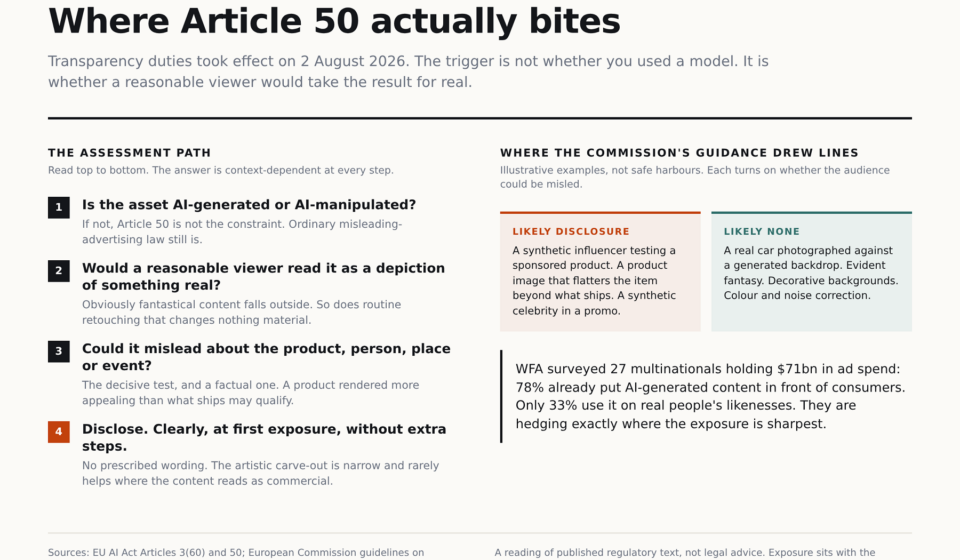
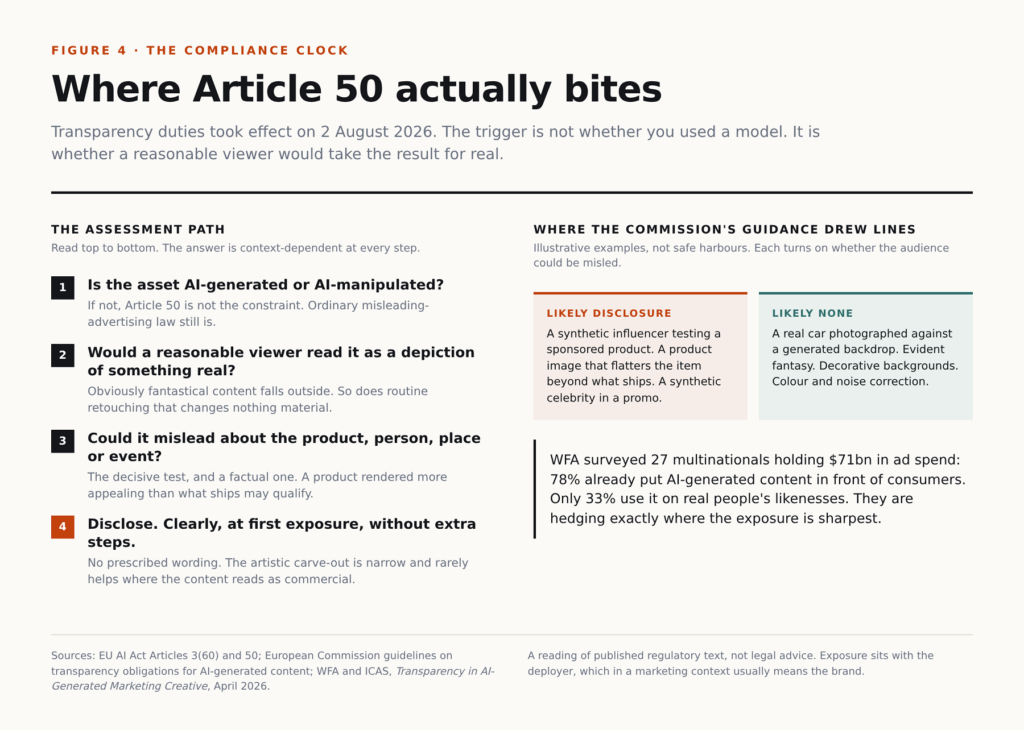
Rule four: settle your disclosure posture before legal settles it for you. The EU AI Act’s Article 50 transparency obligations took effect on August 2, 2026. They do not require labeling every AI-assisted ad. Article 50 carries several distinct duties: machine-readable marking by providers, and disclosure by deployers in specified cases, most notably deepfakes as defined in Article 3(60). Whether disclosure is required turns on content and context, not on whether a model was involved. The artistic carve-out is narrow and is unlikely to help where the work reads as commercial.
Meanwhile the World Federation of Advertisers found 78% of multinationals already putting AI-generated content in front of consumers, but only 33% using it on real people’s likenesses, and only 4% believing decorative backgrounds need disclosure at all. That is the industry making granular judgment calls in the absence of settled practice — which is defensible right up until it isn’t.
The category table nobody wants to publish
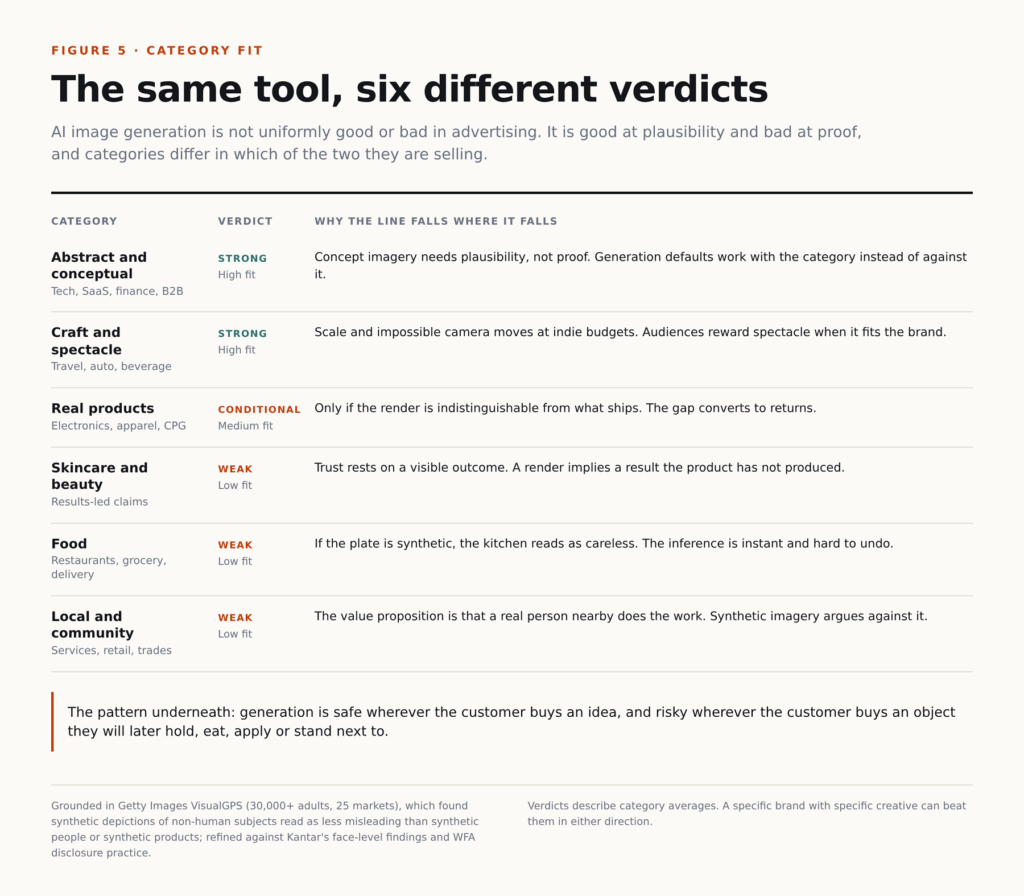
The useful question is not whether to use AI imagery. It is where. Treat the distinctions below as planning hypotheses worth testing, not as settled empirical rankings — the available studies do not establish a universal performance order by sector.
Abstract and conceptual categories — tech, SaaS, finance, B2B — tolerate generation well, because the customer is buying a proposition rather than an artifact. Craft and spectacle categories — travel, automotive, beverage — benefit disproportionately, because generation buys scale that used to be reserved for seven-figure productions. Real products are conditional: fine if the render is indistinguishable from what ships, expensive if it isn’t, because the gap can convert into returns. Skincare and beauty are weak candidates, because the entire claim is a visible result, and a render can imply an outcome the product has not produced. Food is risky for a reason that should concern any restaurant marketer: if the plate is synthetic, the kitchen may read as careless. That inference can run from image to operation in under a second, and later brand investment may not fully undo it. Local and community is weakest of all, because the value proposition often depends on the fact that a real person nearby does the work.
What to do on Monday
Audit last quarter’s creative against the visibility test, not the quality test. Pull every AI-assisted asset and ask a stranger — not a colleague — to name which ones used generation. The ones they name are the ones likely costing you percentile points. Rework or retire them.
Then measure the thing you are not measuring. If your creative review scores craft and your media report scores conversions, nothing in your system can detect an enjoyment penalty at all. Add a cheap perceptual check: run winning and losing assets through a forced-choice test against category norms, or a face-coding panel if you have budget. If part of the effect is nonconscious, self-report surveys will miss it — pair them with observational measures.
Then write the disclosure policy you will need anyway, at asset level rather than campaign level, because that is how the regulation is actually shaped. Distinguish legal disclosure from elective transparency, and do not assume that every background is exempt or every AI-assisted visual needs a public label.
And keep one honest sentence in the deck: AI made production cheaper. It did not make judgment cheaper, and judgment is what the audience is responding to.
The premium was never in the pixels
The great AI flattening is real, and it is not primarily a technology story. It is a scarcity story. When every brand can produce a beautiful product shot in seconds, beauty stops being a signal and becomes a floor. What stays scarce is the thing generation cannot manufacture: a specific place, a specific person, a specific imperfection that could only have come from having actually been there.
The brands winning this transition are not the ones with the most polished renders. They are the ones who understood early that AI is a volume instrument, and used it to buy more attempts rather than better averages — while spending the saved budget on the one input that still costs money and still moves trust, which is reality.