Why AI Copy Gets Generic at Volume: The Bottleneck Moved, and Nobody Noticed
Here is a thing I have now watched happen in four different content teams.
The first month is euphoria. Output triples. The backlog clears. Someone says the word “unlocked.”
The third month is quieter. Nobody says anything out loud, but the copy starts getting flagged in review for a reason nobody can name. It is not wrong. It is not even bad. It is just — there is nothing in it to argue with, which turns out to be the same as having nothing in it to remember.
By month six, someone in leadership asks why brand tracking is flat despite a 400% increase in published assets. And the answer is uncomfortable, because it is not a tooling problem. The tooling worked exactly as designed.
So let me try to explain the mechanism properly, because “AI copy is generic” is a description, not an explanation, and the description has been unhelpful in every meeting I have sat in.
The optimiser and the buyer are optimising different things
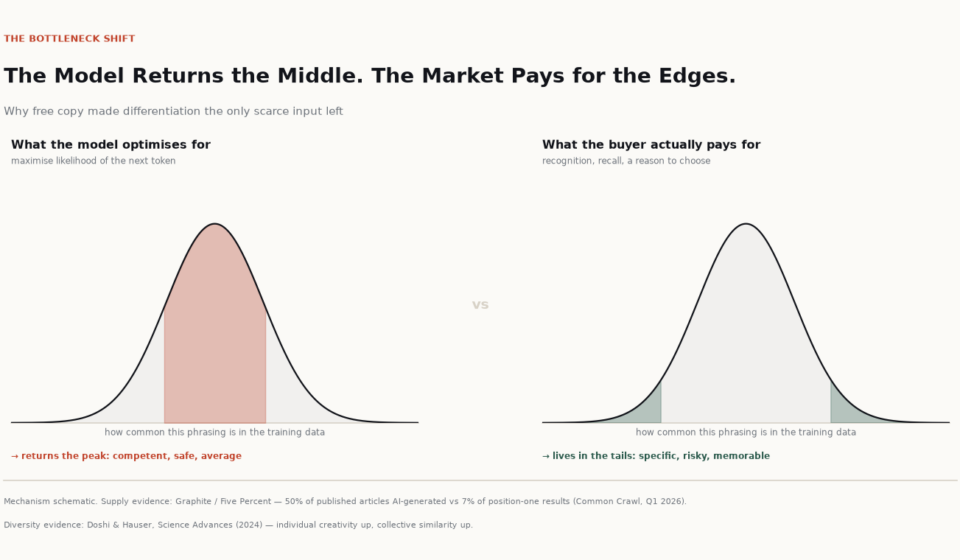
A language model is a next-token predictor. It is trained to maximise the likelihood of what comes next, which means it is trained to return the most probable continuation. The most probable continuation of any prompt is, structurally, the centre of the distribution of everything the model has read.
That is not a flaw. That is the entire product. If you asked a model to be unpredictable it would be useless.

But marketing does not buy the most probable sentence. Marketing buys the sentence that gets remembered, quoted, screenshotted, argued with. And memory lives in the tails, because the tails are where the specific sits — the odd number, the named customer, the unfashionable opinion.
So you have an optimiser pointed at the centre, feeding a market that only pays for the edges. That gap is the quality ceiling. It is not a temporary limitation of the technology. It is the technology working.
Why free supply made the bottleneck worse, not better
Standard economics says cheaper supply should be good for buyers. It has not worked that way here, and the reason is worth sitting with.
When copying cost nothing, the constraint on content stopped being production and became attention. Specifically, the attention required for a piece of copy to be noticed in a category where everyone now publishes infinitely. Attention does not scale with supply. It is fixed per reader, per day.
Which means the marginal value of the thousandth article is not just lower than the first — it is close to zero, and in brand terms possibly negative. Graphite’s data makes this visible: roughly half of newly published articles are AI-generated, but only 14% of pages ranking in Google are, and only 7% of position-one results. The supply curve went vertical. The visibility curve did not move.
The bottleneck did not disappear. It moved — from “can we produce it” to “is there any reason for this to exist.”
The part that makes it structural rather than fixable
This is where I part company with most of the advice on the subject, which says: write a better prompt.
In 2024, Doshi and Hauser ran the experiment that settles this. Writers given AI ideas produced stories that judges rated more creative, better written and more enjoyable — especially the weaker writers. But those stories were also measurably more similar to each other than stories written unaided.
Read that second half carefully. Improving the prompt improves the individual output. It does not restore the diversity, because every competitor is improving their prompt too, against the same model, trained on the same corpus, converging on the same improved answer.
This is a commons problem, and commons problems do not have private solutions. The individual move is rational and the aggregate outcome is a monoculture. You cannot prompt your way out of a coordination failure.
What this actually implies
Three things follow, and they are uncomfortable for different people.
For the model vendors: better models will raise the ceiling without removing it, because a better predictor is a better predictor of the same centre. Fine-tuning on your own corpus genuinely helps — for about eighteen months, until everyone else does it.
For search: volume strategies are already being priced at zero, both by Google’s scaled-content policy and by answer engines that cite a narrow slice of what exists. Publishing more is not a distribution strategy. It is a storage strategy.
For marketers: the scarce input is no longer words. It is the specific, verifiable, slightly risky thing only you know — and the editorial willingness to put it in the copy. That is the one input a model cannot manufacture, because manufacturing it would require knowing something the model has no access to.
Which is, if you think about it, a strangely hopeful conclusion. The thing that remains valuable is the thing that was always supposed to be valuable: knowing something your competitors do not, and being willing to say it in a way they would not.
The ceiling is where the machine stops. Everything above it is a decision.