Why AI Ads Feel Cheap Even When They Look Expensive
Every commercial image budget has two columns, and the industry has spent thirty years pretending only one of them was expensive.
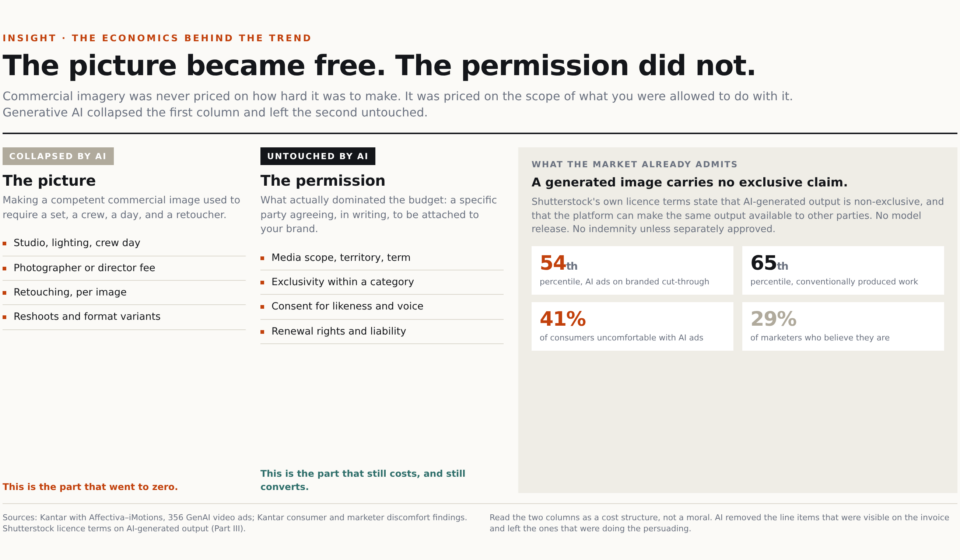
Column one is the picture: studio, crew, lighting, retouching, reshoots. Column two is the permission: a named person agreeing to be attached to your brand, for a defined term, in a defined territory, exclusively within a category, with a signature on a release.
Ask any producer which one accounted for more of the invoice, and the answer is column two. A model’s day rate is a rounding error next to usage. A photographer’s fee is visible; the license that lets you run the frame in six markets for twelve months is what gets negotiated at the end, and it is what the client is actually buying. Stock pricing makes the same point from the other direction: Getty’s rights-managed rates have always moved on media, territory, term and exclusivity, not on how hard the frame was to shoot.
Generative AI did something specific and narrow. It collapsed column one. It did not touch column two.
That is the whole mechanism behind the performance data. Kantar, testing 356 GenAI-created video ads, found that they averaged the 54th percentile in branded cut-through, compared with the 65th percentile for conventionally produced work. When the generation is seamless, more than 40% of the ads land in the top tier. When it is obvious, scores fall, branding weakens, and facial coding picks up more confusion than delight.
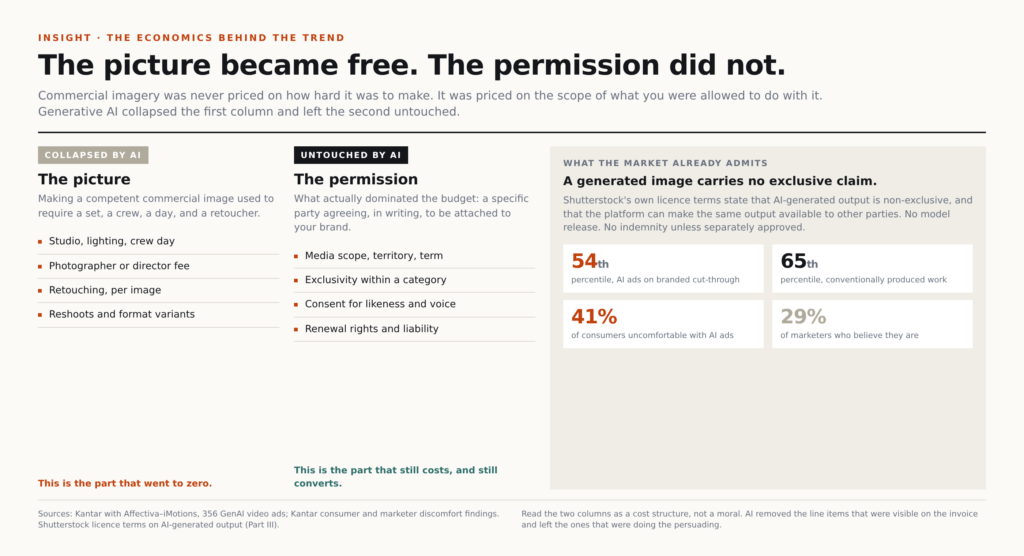
Now read that against the cost structure. What AI removed was the part of the invoice nobody was persuaded by. What remained is the part that persuades: a specific face that consented, a specific place that exists, a product that is the product. Shutterstock’s own license terms say it plainly. AI-generated output is non-exclusive, the platform can license the same output to someone else, and there is no model release, because there is no model.
So the flattering explanation, that audiences are snobs about new tools, is wrong. The unflattering one is arithmetic. An AI image is cheap because nothing and no one in it agreed to be there. That absence is not a legal footnote. It is the exact attribute viewers are reading for.
This also explains a gap the industry keeps mis-measuring. Kantar found 41% of consumers are uncomfortable with AI ads. Among marketers, the figure is 29%. Both groups are judging the same work and arriving at very different numbers, which is what happens when one side is reading the invoice and the other is watching the ad.
The strategic implication is not “use less AI.” It is “stop buying the cheap column and calling it creative.” If you cut production cost and kept nothing that carries consent — no real person, no real place, no real object — you did not save money. You deleted the asset and kept the invoice.
The brands getting this right are spending differently, not less. They generate the setting and photograph a real person. They use the model for the versioning that used to eat a week, and spend the saved budget on the one shoot day that produces something with a signature attached.
The picture was never the product. The permission was. That was true when a day on set cost five figures, and it is more true now that it costs nothing.