Why Shoppers Remember Every Increase and No Discount
The asymmetry behind the backlash against algorithmic pricing
There is a puzzle sitting inside the pricing debate, and it is rarely stated plainly. Retailers are being investigated, sued, and legislated against for raising prices algorithmically. Yet the largest dataset we have on what those algorithms actually do says they cut prices about as often as they raise them.
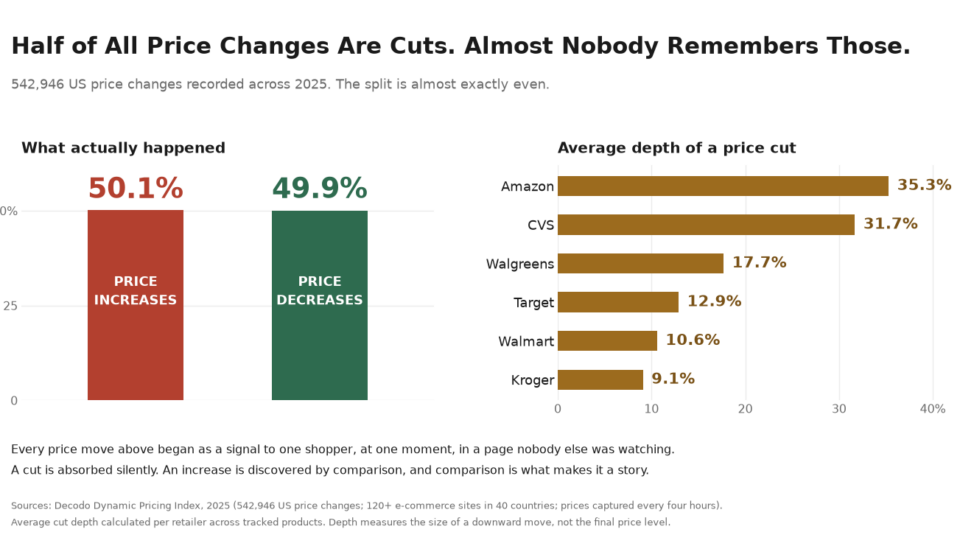
Decodo’s 2025 index logged 542,946 price changes across US e-commerce. Upward adjustments: 50.10%. Downward: 49.90%. A near-perfect split. The same year, Consumer Reports told us shoppers believe algorithmic pricing means one thing — paying more.
Both of those things are true at once. That’s the interesting part.
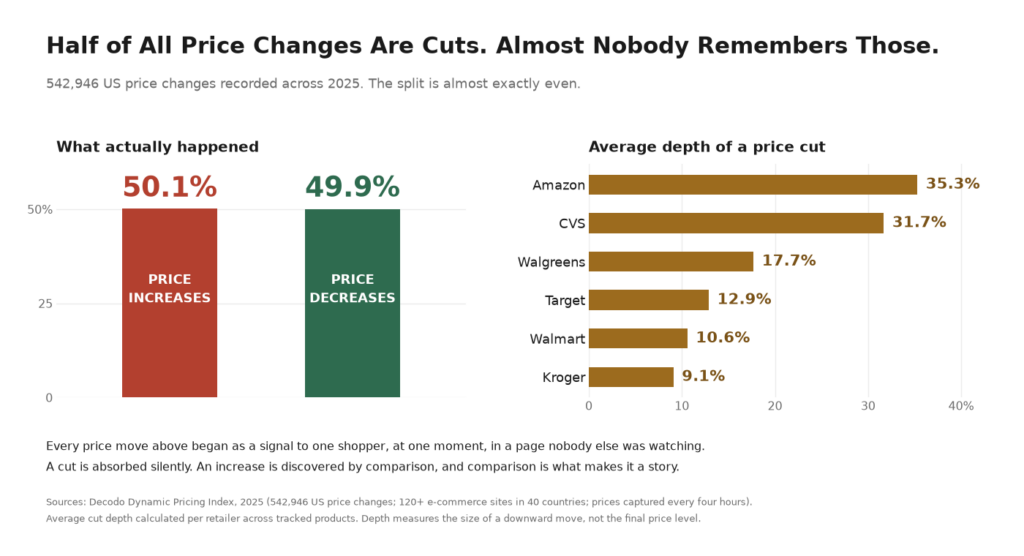
The first explanation is arithmetic, and it’s dull, so people skip it. A price cut doesn’t travel. It arrives privately, on a page you were already looking at, and if you were not looking at that page at that moment, it never reaches you at all. Amazon recorded 116,509 changes in a single year. Nobody experiences 116,509 price cuts. You experience the ones on the four products you happened to check, and you never learn about the rest.
A price increase travels differently. It doesn’t need to reach you individually; it only needs one person to compare. The moment a shopper sees a figure that doesn’t match what a friend paid, the increase stops being a data point and becomes a story with a villain in it.
So the two moves are symmetric in the database and wildly asymmetric in memory. That’s the first layer.
The second layer is what the research on reference prices found, and it’s more uncomfortable. A field experiment published in the Journal of Business Research manipulated price variation at an online retailer and reached a blunt conclusion: customers reacted strongly to price increases and not at all to reductions. The asymmetry isn’t a reporting artifact. It’s how the judgment works.
Which means the 49.9% of cuts are not just unnoticed — they are, in behavioral terms, close to inert. They don’t build the credit that would offset the next increase. A discount that nobody registers generates a sale and no goodwill.
Put those two findings together and the strategic picture inverts. Brands have been reading the backlash as evidence that consumers reject algorithmic pricing. The record suggests something narrower and more actionable: consumers reject the visible direction of algorithmic pricing, and visibility is a design choice, not a property of the algorithm.
Now the part that should make marketers uneasy. If cuts are silent and increases are social, then a firm can run a genuinely balanced pricing engine — half cuts, half raises — and still accumulate nothing but complaints, because only one half of its behavior ever becomes public. The remedy isn’t to cut more. It’s to make the cuts travel: name them, time them, tell people they happened. A discount nobody can see is a cost with no reputational return.
And there’s a harder version of the same lesson. Some of the anger may not be about price at all, but about legibility. A cut you can’t observe and an increase you can’t explain are the same experience from the outside: a number that changed for reasons you don’t have access to. The industry has spent a decade building engines that optimize the number, and almost nothing building the sentence that explains it.
The half of the ledger that generates all the headlines is not the half that generates all the value. Fix that imbalance and the backlash looks less like a verdict on the technology and more like a verdict on how quietly the good half was done.