AI Pricing: The Marketing Implications of Dynamic Pricing
The technology for one price per person is finally cheap. The permission to use it is not. What separates the brands that win on pricing from the brands that get caught doing it.
Two Phones, One Seat
She books the flight at 9:14 a.m. Her colleague books the same route, same week, four minutes later. Same row, adjacent seats. The fare differs by $61.
Neither of them knows this until they compare receipts over lunch, and by then the trip is over and the story has already been told three times. Notice what happened in that retelling. Nobody discussed load factors, fuel hedging, or the fact that seat inventory changes by the second. They discussed who got treated worse.
That is the whole problem in one anecdote. Dynamic pricing is an operations story. Personalized pricing is a story about status, and status stories travel.
It also explains why this topic produces so much bad writing. The economics are genuinely impressive, the backlash is genuinely severe, and most commentary picks a side and stops thinking. Let’s not do that.
What Actually Changed
Pricing has always operated on a ladder. Every rung earns more than the one below it, and every rung costs more trust than the one below it.
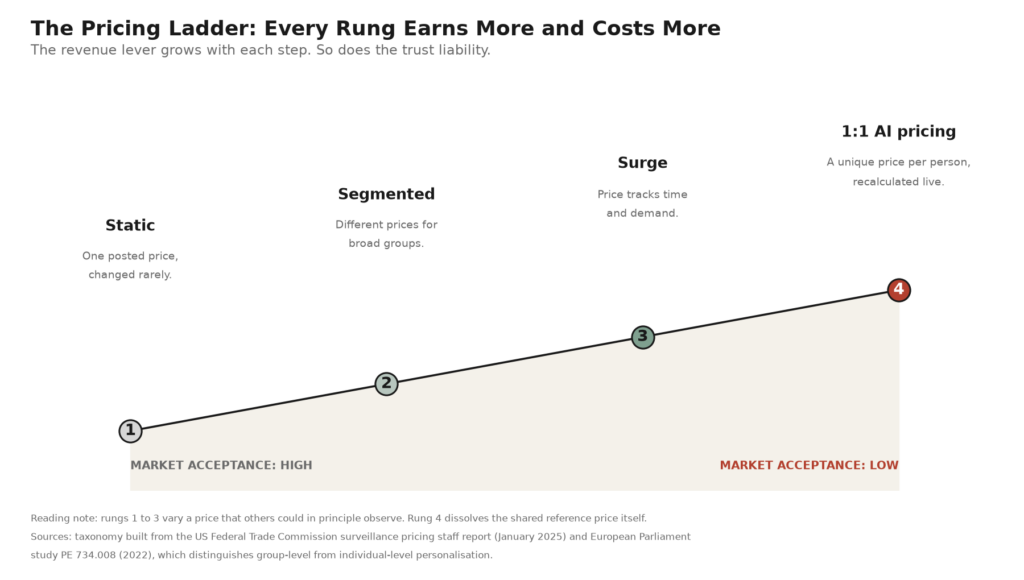
The first three rungs share a property that turns out to matter enormously: the price is knowable in principle. A student discount can be looked up. A surge multiplier is displayed on the screen. You can ask a friend what they paid and get an answer that means something.
Rung four breaks that. There is no shared reference price to compare against, because the comparison itself has been dissolved.
What made rung four practical was not a breakthrough in pricing theory — first-degree price discrimination has been in economics textbooks for a century. What changed is two unglamorous inputs. The cost of estimating an individual’s willingness to pay collapsed, and the data got granular enough to do it.
How granular? In January 2025 the US Federal Trade Commission published interim findings from its surveillance pricing study, and the details are almost comically intimate. Pricing intermediaries — the middlemen retailers hire — were found to work with at least 250 clients, drawing on inputs that range from a shopper’s precise location down to mouse movements on a webpage and the items left sitting in an abandoned cart. The report was approved 3–2, with two commissioners dissenting.
Meanwhile the tooling has gone mainstream. In Simon-Kucher’s 2025 Global Pricing Study, 72% of respondents said they use AI in pricing, though most use it for unambitious work — the single most common application, at 41%, is gathering market intelligence such as competitor prices rather than setting prices dynamically.
So: broad adoption, narrow ambition. That gap is where the marketing problem lives.
The Economics Are Not the Problem
Let’s be clear about the size of the prize, because the skeptics are wrong here.
The best evidence comes from a field experiment rather than a model. Dubé and Misra, publishing in the Journal of Political Economy in 2023, ran a randomized controlled pricing experiment, then constructed personalized prices from that data and validated them back in the field. Their findings are stark:
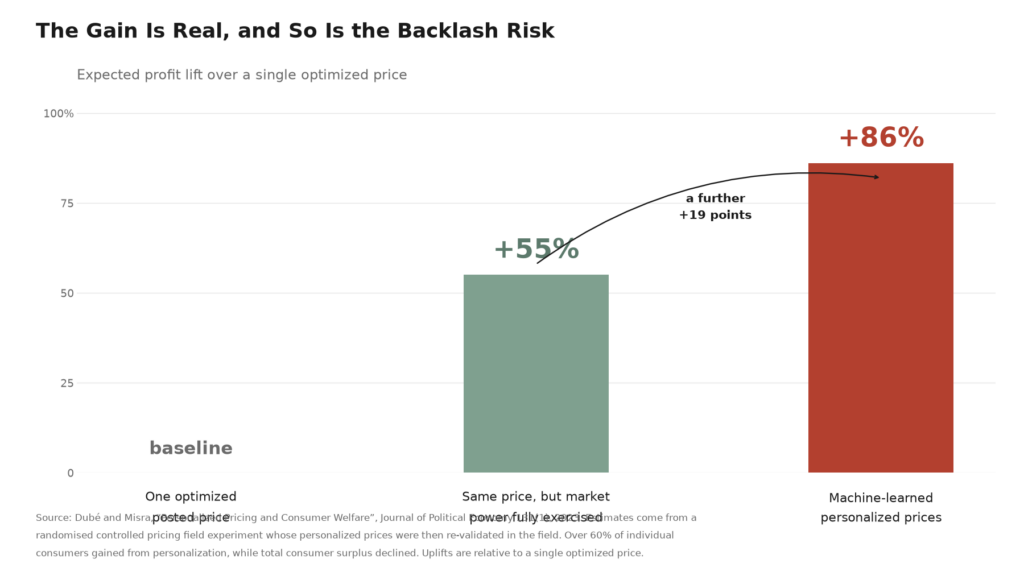
Simply pricing optimally — one price, market power fully exercised — lifts profit 55% over the baseline. Personalization adds a further 19 points on top of that, for a total of 86% above the non-optimized price.
Eighty-six percent. That is not a rounding error, and no amount of brand-safety handwringing makes it disappear.
But the same paper contains the sentence that most pricing decks leave out. Total consumer surplus declined. And more than 60% of individual consumers actually benefited from personalization — meaning the aggregate loss is concentrated in a minority who pay more, while a majority pay less.
Read that again, because it reframes the entire debate. Personalized pricing is not primarily an extraction machine. It is a redistribution machine. It moves surplus from price-insensitive buyers to price-sensitive ones, and it keeps a slice for the seller.
That’s efficient. It’s also politically unstable, because the losers know who they are and the winners don’t.
One more number, because it explains why this arrived now rather than in 2005. Benjamin Shiller’s work on first-degree price discrimination found that demographic data alone barely improved the profit a firm could extract — under one percent in his Netflix simulation. Add web-browsing behavior and the simulated gain jumped to roughly 12%.
Demographics tell you who someone is. Behavior tells you how badly they want the thing. Only the second one prices well.
Fairness Is a Comparison, Not a Level
Here is where marketing and economics stop speaking the same language.
An economist asks whether a price clears the market. A customer asks whether the price matches what the last person paid. These are different questions, and the second one has more emotional force.
The mechanism is old and well documented. People evaluate a transaction against a reference — what the price used to be, what a peer paid, what seems normal — and they treat departures from that reference as a fairness violation rather than a market outcome. This is the core of the dual entitlement principle that Kahneman, Knetsch and Thaler described in the 1980s: firms are entitled to a reference profit, customers are entitled to a reference price, and raising prices when costs haven’t moved is judged as taking, not trading.
Personalized pricing is a machine for manufacturing reference violations at scale. Every customer gets their own reference, so every customer is potentially the person who got the worse deal.
And the response is asymmetric. A discount reads as a gift. The identical mechanism running in the other direction reads as a scam. Same math, opposite verdict — because the customer isn’t evaluating the mechanism, they’re evaluating their position in it.
Which produces the counterintuitive finding that should shape every pricing decision: the risk isn’t variance. The risk is variance that gets discovered, in a direction that makes someone feel like a mark.
Three Cases From the Record
The folklore on this topic is thick, so let’s use cases where we can check the primary record.
Amazon, September 2000. The canonical story is that Amazon tested different DVD prices on different customers based on demographics, got caught, and apologized. Half of that is right. The backlash was real and severe. But Amazon’s own statement, issued on 26 September 2000, insisted the test varied discounts on a totally random basis, not demographic information, that the purpose was to measure how sales respond to lower prices, and that “in retrospect, this random testing was a mistake.”
Sit with that. Even if Amazon was telling the truth, it lost the argument. Twenty-six years later the story is still told as a targeting scandal. The lesson isn’t about whether the algorithm used demographics — it’s that once a price difference becomes visible, the company’s explanation becomes the least interesting part of the story.
Wendy’s, February 2024. On an earnings call, the CEO mentioned testing “dynamic pricing and daypart offerings.” Within days, social media had translated that into surge-priced burgers, and the chain was being compared to Uber at dinner time. The company walked it back within weeks, stating plainly that it had no plans to raise menu prices at peak demand.
The word traveled faster than the clarification, and the clarification never caught up. For a $5 purchase, the tolerance for price uncertainty is approximately zero.
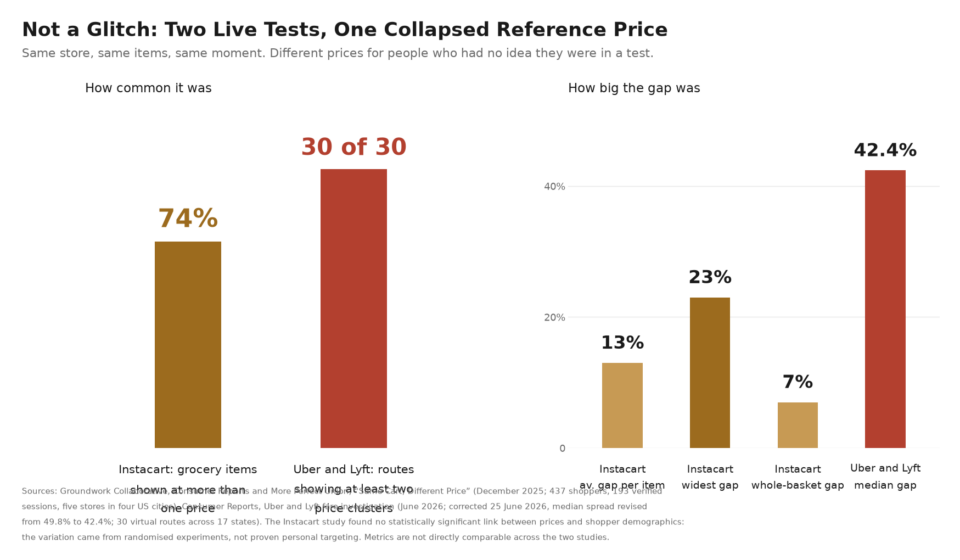
Instacart, December 2025. This one is different, because outsiders brought receipts. Groundwork Collaborative, Consumer Reports and More Perfect Union recruited 437 shoppers across four US cities to fill identical baskets at identical stores at identical moments. The findings, published as Same Cart, Different Price:
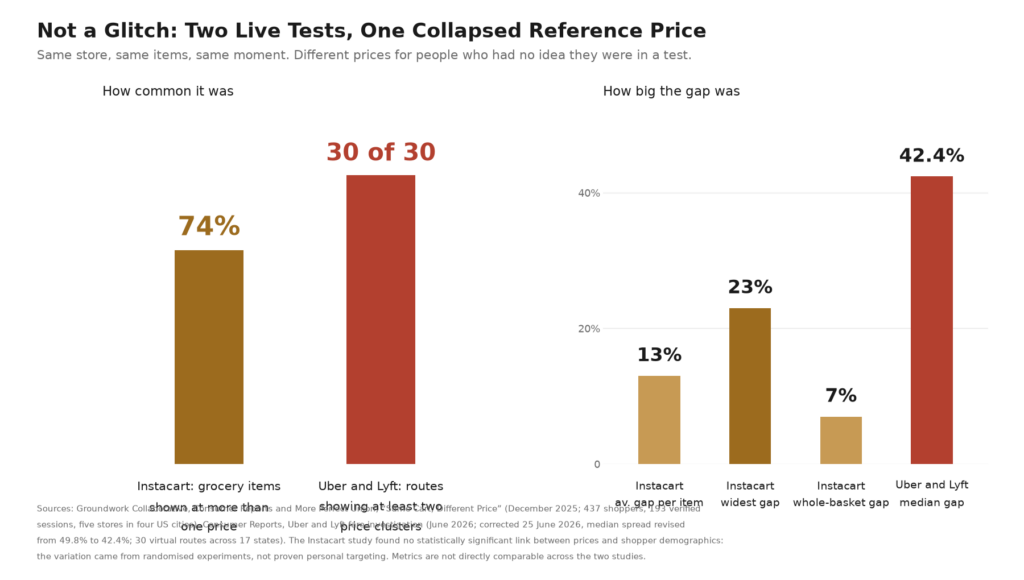
Nearly three-quarters of items appeared at more than one price. The average gap was about 13%, with individual items diverging by up to 23%. Some items carried as many as five simultaneous price points. Within weeks, New York’s attorney general had sent the company a letter demanding answers under the state’s new algorithmic pricing law, and the practice was halted under pressure from Congress, the FTC and the public.
Now the part almost nobody reported, and it matters for diagnosis: the researchers found no statistically significant relationship between price and shopper demographics. The variation came from randomized experiments — real price testing, but not proven personal targeting.
Which means the most-cited example of personalized pricing in America may not have been personalized at all. It was differential, which is enough to produce the outrage and enough to trigger the law, but it isn’t the same thing. If you’re a marketer drawing lessons from this case, get the mechanism right, or you’ll fix the wrong thing.
The Detection Problem
Why did any of this survive as long as it did? Because for most of the past decade, personalized pricing was nearly impossible to prove.
The best illustration is the European Commission’s 2018 mystery-shopping study — 160 websites across eight member states, in four sectors including airlines, hotels, televisions and sports shoes. Investigators found no evidence of systematic first-degree personalization, and where price differences did appear, the median difference was under 1.6%.
That result is usually cited as reassurance. Read it the other way. Either personalization was rare, or the method couldn’t see it — and the study’s own authors leaned toward the second explanation. A single price shown to a single visitor, observed once, carries no counterfactual inside it. You cannot detect differential pricing by looking at one price.
That’s the environment brands have been operating in: low detection, therefore low accountability, therefore rational indifference to the reputational risk.
That environment is gone, and not because pricing behavior got worse. Because measurement got better. Matched-pair shopping, volunteer panels, virtual routing — the tools that produced the Instacart and rideshare findings are cheap, repeatable, and increasingly automated.
The rideshare investigation is the template. Consumer Reports tested 30 virtual routes across 17 states and found price clustering on every single one, with a median spread of 42.4% and 12.4% of advertised discounts turning out not to be real savings. Worth noting: the publication corrected its own figures in June 2026, revising the median from 49.8% and the fictitious-discount share from 10.8%. Even the auditors are still calibrating. Treat any single number in this field as provisional.
Where It Works, and Where It Doesn’t
Industry isn’t the variable people think it is. The real variable is whether the customer can construct an explanation that doesn’t insult them
| Context | Verdict | Why |
|---|---|---|
| Airlines, hotels, rideshare | Tolerated | The reason is visible: the plane is filling up, it’s Friday night, demand moved |
| Events and ticketing | Contested | Accepted for scarcity, resented when the mechanism is hidden |
| B2B and enterprise | Routine | Negotiated pricing is the norm; the buyer has agency and a relationship |
| Grocery and CPG | Volatile | Identical product, no available explanation, high purchase frequency |
| Luxury and prestige | Hostile | Price opacity contradicts the brand’s promise of consistent access |
| Essentials: food, medicine | Legally exposed | Regulators have already moved; ethically indefensible |
The pattern: surge pricing works where demand is a shared, observable fact. Everyone at the airport can see the airport. Personalized pricing fails where the differentiator is a private fact — your browsing history, your income proxy, your device. Shared facts feel like weather. Private facts feel like being watched.
The Regulatory Floor Just Moved
For years this was a reputational question. It is now a compliance question, and the timeline is compressing fast.
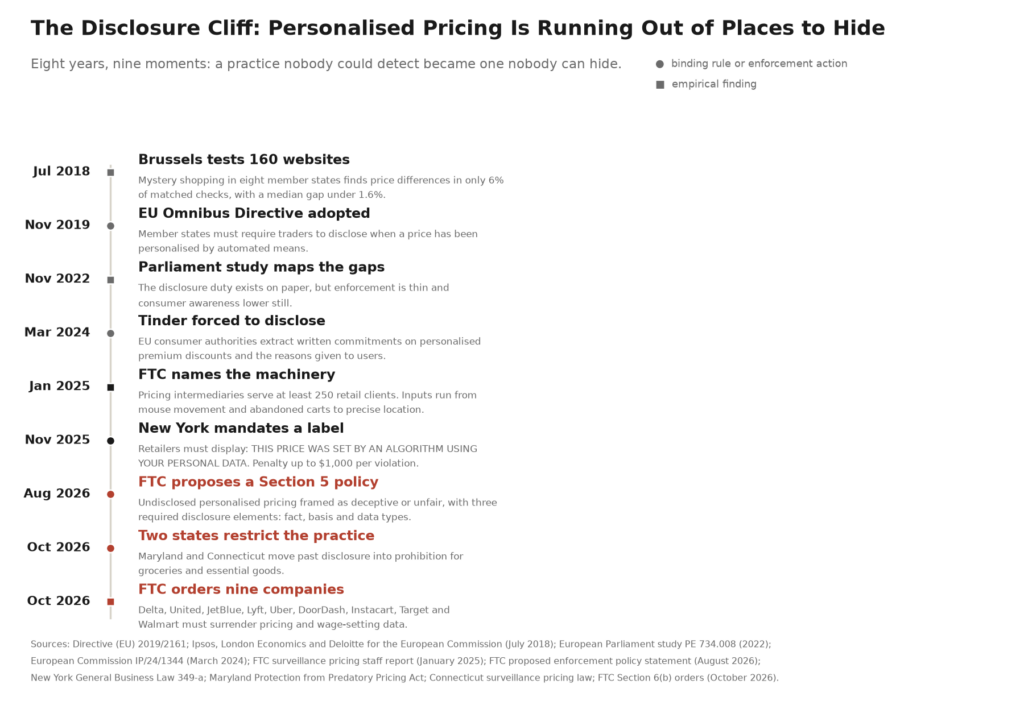
The European track started earlier and moves more slowly. The Omnibus Directive, adopted in 2019, amended the Consumer Rights Directive so that member states must require traders to tell consumers when a price has been personalized by automated decision-making. In March 2024, European consumer authorities extracted written commitments from Tinder to disclose that its premium discounts were personalized by automated means, and to explain why. A draft Digital Fairness Act is expected around 11 November 2026, though it is unlikely to be in force before late 2028.
The American track started later and moves faster, and it now has two distinct phases.
Phase one is disclosure. New York’s Algorithmic Pricing Disclosure Act took effect on 10 November 2025 and survived a First Amendment challenge to become the first statute of its kind. If a price is set by an algorithm using your personal data, the retailer must say so, in those words, on the page.
Phase two is prohibition. Maryland’s Protection from Predatory Pricing Act, signed in April 2026, took effect on 1 October 2026 and reaches groceries and third-party delivery. Connecticut enacted a parallel restriction the same month. New Jersey went further than anyone, adding a private right of action with treble damages — the first state to hand consumers a lawyer instead of a label.
Overlaid on both phases is the federal posture. On 19 August 2026 the FTC issued a proposed enforcement policy statement treating undisclosed personalized pricing as a potential violation of Section 5 of the FTC Act, identifying three required disclosure elements: that the price is personalized, the basis for personalization, and the types of data used. Then in October 2026 it issued Section 6(b) orders to nine companies — Delta, United, JetBlue, Lyft, Uber, DoorDash, Instacart, Target and Walmart — demanding information not only on consumer pricing but on wage-setting.
The FTC has been candid that Congress hasn’t given it authority to ban personalized pricing outright. It has also made clear it intends to enforce aggressively against practices lacking adequate disclosure. Read those two statements together and you get the actual regulatory thesis: not prohibition, but forced legibility.
The Disclosure Trap
Here is the assumption embedded in every disclosure regime, and it deserves scrutiny: that telling people about a pricing practice makes it acceptable.
It doesn’t. It makes it legible.
Consider what the New York label actually says to a shopper. Not “we found you a better price.” It says: this price was set by an algorithm using your personal data. That is a confession displayed at the point of sale. The disclosure satisfies the legal requirement and simultaneously supplies the emotional evidence for the fairness complaint.
Worse, the FTC’s three elements are operationally brutal. “The basis for personalization” is a reasonable request until you’re looking at a gradient-boosted model with 400 features and no single causal story. Nobody can explain that to a shopper in a tooltip.
So what will actually happen is what always happens when law meets unexplainable models: companies will simplify the models rather than attempt the explanation. Pricing will migrate toward rules a human can defend in one sentence — member rate, off-peak rate, clearance, new-customer offer.
That is a marketing constraint wearing a legal costume, and it’s the single most important near-term implication of the new rules. Compliance pressure is about to do what brand teams have been arguing for a decade: force pricing back toward explainable rules.
The Playbook: Pricing With AI Without Losing the Room
Five moves, ordered by leverage.
1. Anchor the variance to a shared fact. Time, capacity, cost, inventory age. If the reason for the difference is something both customers could observe, the difference reads as a market. If the reason lives only in your data warehouse, it reads as a judgment about them.
2. Price the relationship, not the person. A member rate is a badge. A personalized rate is a file. The first is chosen by the customer and visible to their friends. The second is assigned and invisible, which is precisely what makes it feel like surveillance rather than service.
3. Give the difference a name. “Member price” and “off-peak” are explanations. A bare, unexplained number that happens to differ from your neighbor’s is not a discount, it’s a discovery waiting to happen.
4. Publish the rule before the price. Tell customers how pricing works when nobody is angry. Wendy’s problem wasn’t dynamic pricing; it was that the first explanation arrived during a pile-on. Trust is built in the calm periods and spent in the crisis.
5. Instrument trust, not just conversion. Most pricing tests measure revenue lift and call it a win. Add complaint rate, refund rate, repurchase within 90 days, and unprompted sentiment. Dubé and Misra’s 19-point gain is a real gain — but it was measured over a horizon that may not include the customers who found out.
If you want a sixth: keep one sentence ready that a human can say on camera without flinching. If you can’t produce that sentence, you have a pricing strategy you can’t defend.
The Loyalty Loophole, and Its Limits
Notice where the market is actually heading. Not toward pricing individuals — toward pricing membership.
The consumer data points consistently in that direction. In Vypr’s research across more than 75,000 consumers, 73% viewed brands offering exclusive lower prices to loyalty members positively, and exclusive low prices were the single most preferred reward type at about 35%, ahead of points (27%) and gifts (20%). Polling funded by Chamber of Progress found 66% of New Yorkers and 68% of Canadians preferring discounts even when that means not everyone pays the same price; support for loyalty rewards ran at 72%, digital coupons at 67%, new-customer offers at 66%.
Handle those numbers with care — they come from an advocacy organization arguing against pricing bans, and advocacy polling tends to find what it’s looking for. But the direction is corroborated by the Vypr data, and it matches the intuition: consumers don’t object to differential pricing. They object to unexplained differential pricing that they suspect is about them.
Membership solves this because it converts a private variable into a public status. You know why the member paid less. You could become a member. The difference is chosen rather than assigned.
Two limits are worth naming. First, two-tier pricing creates its own loser — the non-member who now subsidizes the member’s discount, and who can see exactly what they’re missing every time they check out. You haven’t removed the comparison; you’ve just moved it to a place where it looks legitimate. Second, the data machinery doesn’t disappear when you relabel it. A membership file is still a personal-data construct. The FTC’s October 2026 orders cover wage-setting alongside consumer pricing, which tells you the scrutiny is widening rather than narrowing. Loyalty pricing buys time. It doesn’t buy immunity.
Costco is the more interesting counter-example. Costco charges different people different amounts — but it does the work through a membership fee, not the shelf price. Markups are capped at roughly 14% on branded goods and 15% on Kirkland Signature; renewal runs about 92% in the US and Canada; the $1.50 hot dog and soda have held since 1985. The product price is identical for everyone in the building, so nobody ever compares receipts and feels cheated. The differentiation is structural, disclosed, and chosen. It’s the same economic outcome as personalized pricing, arriving through a door nobody resents.
That’s the design lesson, and it’s easy to miss: the difference doesn’t have to be small. It has to be visible, chosen, and defensible.
The Risks, Stated Honestly
Four things could break a pricing strategy that looks fine on a spreadsheet.
The regulator arrives faster than the model can be explained. New York’s label requirement, Maryland’s grocery ban, New Jersey’s treble damages — these landed within twelve months of each other. If you’re operating in multiple states, you now need a pricing architecture that can be switched per jurisdiction. Most teams don’t have one.
Detection is now cheap, and it’s other people’s job. The Instacart and rideshare investigations were run by consumer organizations with volunteer panels and virtual routing. That capability is only getting easier to replicate. Any assumption of pricing invisibility should be treated as expired.
Model opacity is a legal liability, not just a communication problem. “The algorithm decided” has never worked on a customer, and it’s about to stop working on regulators too. A system you can’t explain is a system you can’t defend in a hearing.
Gaming erodes the advantage. Price-comparison bots, VPNs, incognito shopping, and now AI agents that shop on a customer’s behalf. Here’s the optimistic wrinkle: Decodo’s tracking of US e-commerce in 2025 found that roughly half of recorded price changes were decreases, which suggests much of what gets called “dynamic pricing” is discounting dressed up in algorithmic clothing. The menace is real, but the average case is softer than the headlines.
One honest caveat before the forward look. We have strong evidence on willingness-to-pay extraction and strong evidence on stated fairness objections. What we don’t have is good longitudinal data on whether a personalized-pricing scandal produces measurable, durable revenue damage. The Instacart case suggests the damage is fast and real, but it’s one case, resolved by retreat within weeks. Anyone claiming a precise trust-to-revenue conversion rate is guessing.
Where This Goes Next
Four shifts are already visible in the record.
Disclosure becomes the price of admission. Not a differentiator — a baseline. The interesting competitive question stops being whether you personalize and becomes whether you can explain it in a sentence. That single constraint will quietly reprice a lot of machine-learning investment.
Fairness becomes a positioning asset. Watch for brands advertising the absence of personalized pricing, the way food companies advertise the absence of additives. “Same price for everyone” is a claim a competitor with a sophisticated pricing engine cannot easily match, which makes it strategically valuable precisely because it’s expensive.
The winning model prices status, not identity. Membership, tenure, channel, commitment. Variables the customer can see, name, and choose. The direction of travel is away from “what do we know about you” and toward “what have you told us you want.”
Agents will dissolve the secret. This is the one that changes the math rather than the messaging. If a customer’s AI assistant requests quotes for the same basket from twelve retailers and negotiates, the individualized price stops being private — it becomes a bid in a visible auction. Pricing opacity depends on the customer not knowing; delegated shopping removes that condition by design. Whatever survives the agentic transition will be pricing that can be justified to a machine as well as a person.
The Takeaway
AI made personalized pricing cheap, and cheap things get used. But the constraint on it was never technical. It was always whether a customer, opening the receipt next to a friend, would feel served or sorted.
The 86% profit uplift is real. So is the 13% gap that ended a pricing program in weeks. Both of those numbers live in the same dataset, and the brands that treat only one of them as data are the brands that will learn the other one the hard way.
Price the relationship. Name the difference. Publish the rule before you need it. And keep one sentence ready that you’d be willing to say into a microphone — because sooner or later, that’s the only pricing policy that counts.