What Running an AI Email Program Actually Feels Like
Here is the complaint I keep hearing from people who run lifecycle programs: the AI writes fine, but everything it writes sounds like it was written by the same person. Which, in a sense, it was.
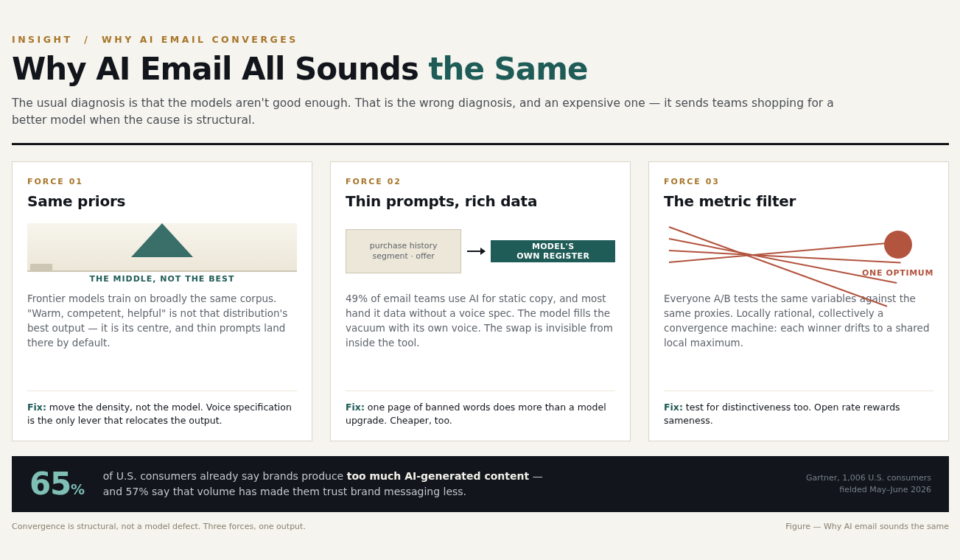
The instinct is to blame the model. Upgrade the stack, get the newer one, add a reasoning step. That instinct is expensive and mostly wrong. The sameness is not a quality defect you can buy your way out of. It comes from three structural forces that operate whether your model is excellent or mediocre, and the sooner you see them as structural, the sooner you can work around them.
Force one: the model is doing what it was trained to do
Frontier models are trained on broadly the same corpus, optimized against broadly the same human preference signals. The result is a distribution of outputs whose centre is “warm, competent, helpful.”
That centre is not mediocrity; it is genuinely good writing. But it is the middle of the distribution, not the best of it. When you give a model a thin prompt — “write a friendly re-engagement email for a customer who hasn’t ordered in 90 days” — you are asking it to sample somewhere near that centre. And the centre is the same for every brand on earth using the same class of model.
This is why the output is fluent and forgettable at once. Fluency is what the centre optimizes for. Distinctiveness is in the tails, and thin prompts do not reach the tails.
Force two: we hand over data and forget to hand over voice
Litmus reports that 49% of email teams use generative AI for static copy, while 41% use it for segmentation, behavioral prediction and journey analysis. Read that again. The single most common use of AI in email is writing the words.
Now ask what those teams actually put in the prompt. They load it with what the platform can query: segment name, purchase history, last order date, the offer. That is data about the customer. What is missing is specification of the writer — vocabulary, sentence rhythm, what this brand would never say, how it handles an apology.
A model with rich customer data and no voice specification does something very specific: it fills the voice vacuum with its own default register. The output is correctly personalized and stylistically identical to everyone else’s correctly personalized output. From inside the tool, this is invisible. The email looks tailored. It reads generic.
Force three: the feedback loop actively selects for sameness
The third force is the one nobody names, and it is the most damning, because it is rational behaviour producing a bad collective outcome.
Everyone optimizes on the same measurable proxies. Open rate, click rate, conversion. Everyone tests variations against those proxies with the same models. The variation that wins is the one that clears the proxy threshold — and warm, frictionless, agreeable copy reliably clears it. Reluctance, bluntness, a strange specific angle: these are punished by the metric long before a human reader ever sees them.
So each team, acting sensibly in isolation, walks toward a shared local maximum. Individually optimal. Collectively a convergence machine. Nobody decided to make every brand sound alike; the incentive structure did it for us.
This is the same trap that flattened brand voice across every other AI-assisted channel, and it explains why “AI content” became a genre people can identify by ear.
Which is why the fix is not a better model
If the cause were the model, the solution would be a better model, and this would be a short piece. But all three forces are structural, so the fixes have to be too.
Move the density, not the model. A voice specification is the only lever that relocates output away from the generic centre. One page: words you use, words you ban, how you open, how you refuse, how you apologize. Hand that to a mediocre model and you get something that sounds like you. Hand a rich dataset to an excellent model without it and you get something that sounds like everyone.
Starve the prompt of data the customer didn’t give you. Half of what makes AI email feel synthetic is not the register but the evidence. A model loaded with observation data will reveal observations. Restraint is a prompt-level decision, and it costs nothing.
Test for distinctiveness, not only for lift. Open rate rewards agreeableness. If distinctiveness is never on the scorecard, the optimization loop will select it out, and you will have built a perfectly tuned machine for producing the average.
None of this requires a new vendor. It requires admitting that the sameness is coming from the process around the model, not from the model itself — and that the 65% of U.S. consumers who already think brands overproduce AI content are not reacting to bad prose. They are reacting to the sound of a category converging.