AI Voice Agents for Sales: The Call Center’s Quiet Revolution
The most consequential change in outbound sales this decade did not announce itself. There was no keynote, no demo video of a robot doing something adorable. It arrived as a line item in a spreadsheet: the cost of a conversation fell by roughly ninety percent, and almost nobody outside the call center noticed.
That is how it usually goes. Text and image generation got the headlines because we could see them. Voice got the budget because we could measure it.
For a decade, the economics of a phone call quietly forbade ambition. A US-based agent, fully loaded with benefits, attrition replacement, quality assurance, supervision and real estate, costs somewhere between twenty-nine and forty-two dollars an hour. Industry benchmarks put a single handled call at two dollars seventy to five dollars sixty. Those numbers set the ceiling on how many conversations a company could afford to have. Every lead that wasn’t worth a five-dollar call simply didn’t get called.
Now run the same four-minute conversation through a voice agent at a lean 2026 rate and it lands at forty-four cents. Add a knowledge base, guardrails, PII redaction and automated quality assurance, and you are still under a dollar. The ceiling didn’t move. It vanished.
But here is the part that makes this interesting rather than merely cheap: the technology arrived at scale in the same eighteen months that regulators decided to write rules about it, and in the same period that buyers started telling researchers, politely but firmly, that they would rather not.
This is the story of a revolution that got its economics right before it got its manners.
1. What a voice agent actually is, and what it isn’t
Strip away the marketing and the stack is unglamorous. Speech-to-text turns the caller’s voice into text. A large language model decides what to say next. Text-to-speech turns that decision back into a human-sounding voice. Telephony plumbing connects the two ends. Latency now sits comfortably under half a second, which is the threshold where a conversation stops feeling like a walkie-talkie and starts feeling like a phone call.
The capability boundary is sharper than vendors admit. A voice agent is excellent at conversations with a known shape: qualification, scheduling, order status, renewal reminders, list cleaning, first-line triage. It is competent at objection handling when the objections are the five you expected. And it is genuinely bad at the thing that closes complex deals, which is reading a room you cannot see.
That distinction matters because the industry keeps blurring it. “AI SDR” is a useful label for a qualification engine. It is a misleading label for a closer.
2. The cost curve broke, and it broke fast
The numbers deserve to be seen side by side, because the ratio is the whole argument.
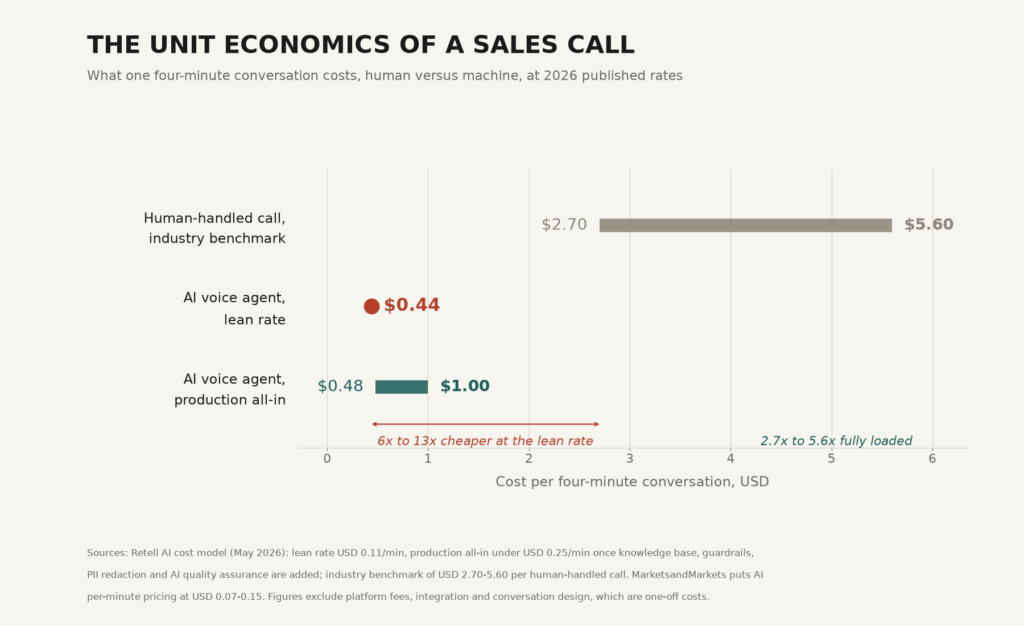
Look at the spread rather than the absolute figures. At the lean rate, AI is six to thirteen times cheaper per conversation. Fully loaded with the unglamorous production costs, it is two-point-seven to five-point-six times cheaper. Even the conservative end of that range rewrites a channel’s budget.
And note what the ratio does not include: platform fees, integration work, conversation design, the twelve weeks of tuning before the agent stops embarrassing you. Those are real costs, they are one-off rather than per-minute, and they are exactly the costs that make the first year of a deployment look worse than the business case promised.
This is where I part company with the more breathless vendor decks. Marginal cost approaching zero does not mean total cost approaching zero. It means the variable cost approaches zero while the fixed cost moves onto a different line of the P&L, where fewer people are watching it.
3. The labour market already voted
If you want to know whether a technology is being adopted, don’t read the press release. Read the employment projections.
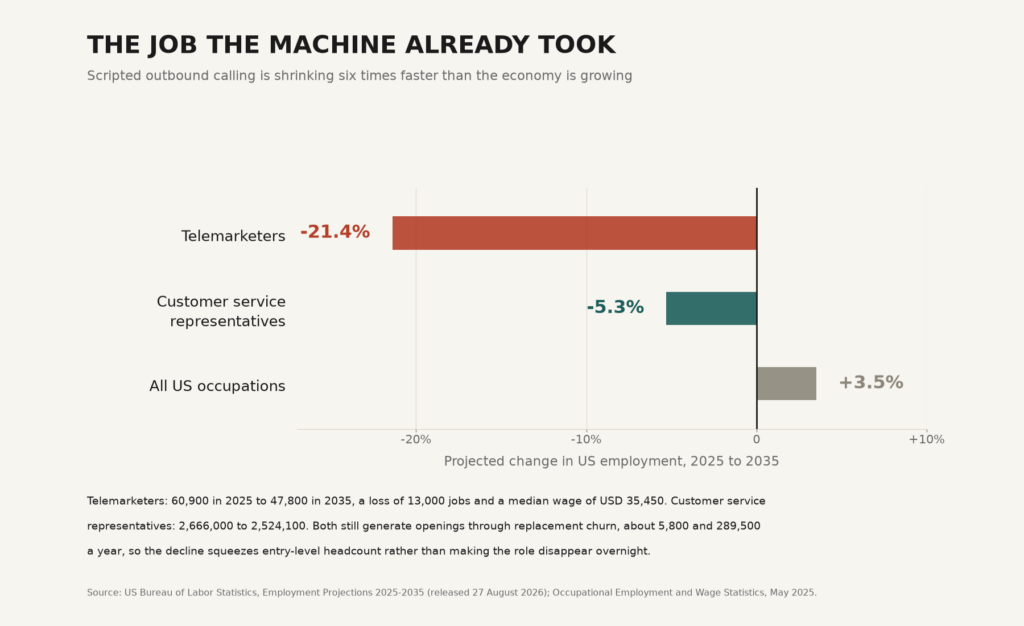
The Bureau of Labor Statistics projects telemarketer employment falling from 60,900 to 47,800 between 2025 and 2035 — a decline of 21.4 percent against total employment growth of 3.5 percent. Customer service representatives follow a gentler version of the same curve: 2,666,000 down to 2,524,100, a decline of 5.3 percent. Median pay sits at $35,450 and $44,770 respectively.
Two details keep this from being a simple story of replacement. First, both occupations still generate substantial openings each year — roughly 5,800 and 289,500 — almost entirely from churn as workers retire or move on. Second, a declining occupation is not an empty one. What is shrinking is the entry-level rung: the scripted, high-volume, low-judgement work that used to be how someone learned the job.
That is the quieter cost. We are automating the apprenticeship.
4. Where these systems genuinely win
Let me be specific, because “AI in sales” is too vague to act on.
Outbound qualification. The email-to-call handoff, the list that needs cleaning, the inbound form that needs a human voice within five minutes rather than five hours. This is the highest-volume, lowest-empathy work in the funnel, and it is precisely the work humans did badly because they resented doing it.
Inbound triage. Routing, basic eligibility, scheduling. A voice agent that answers on the first ring at eleven at night is not competing with a good human. It is competing with voicemail.
Renewal and reminder calls. Structured, predictable, and mercifully boring.
Multilingual outreach. A capability jump rather than an efficiency gain. A twenty-person team that suddenly conducts conversations in six languages is doing something it could not previously do at all.
Notice the pattern: every item on that list has a known shape. That is the test I would apply before deploying anything.
5. Where they lose, loudly
The failure modes are equally specific, and they cluster around ambiguity.
Complex B2B negotiation, where the deal turns on a concession you were not authorised to make and the other side is watching for hesitation. Emotionally loaded conversations, where the caller is not asking for information but for reassurance. Brand-critical moments, where one wrong sentence becomes a screenshot. And every edge case the model has not seen, which is where a human’s judgement earns its salary.
There is also a failure mode nobody puts on a slide: the agent that is technically correct and socially wrong. It answers the question, closes the ticket, and leaves the customer feeling handled. Resolution rate looks fine. The relationship quietly degrades.
6. The disclosure trap is not the trap you think
The outline I started from framed disclosure as a dilemma: identify yourself as AI and lose trust, or stay quiet and risk the regulator. I expected to find evidence for that trade-off. I didn’t. What I found was stranger.
The disclosure question is largely settled in law. The FCC ruled in February 2024 that AI-generated voices count as “artificial” voices under the Telephone Consumer Protection Act, which means outbound calls using them require prior express consent — and prior express written consent where the call is telemarketing. The European Union’s AI Act went further: since 2 August 2026, providers of systems designed to interact directly with people must inform users that they are dealing with AI, at the latest at the first interaction, unless that is obvious — and the Commission’s guidelines say “obvious” should be read narrowly.
So the real question is not whether to disclose. It is what disclosure costs you operationally, and whether your agent can survive being known.
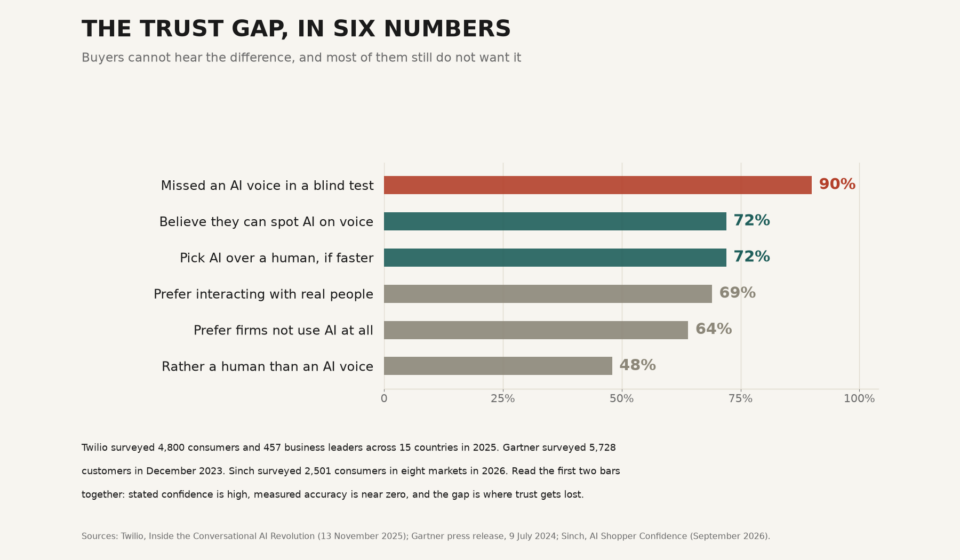
Twilio’s 2025 study of 4,800 consumers across fifteen countries offers the uncomfortable answer. Seventy-two percent said they could immediately tell when they were talking to an AI on a voice call. In a blind test, ninety percent failed to correctly identify AI-generated voice clips. People are confident and wrong.
Which means disclosure is not a technical problem you can solve by making the voice better. It is a trust decision you make before the conversation starts, and the data suggests a large share of your buyers will keep talking anyway — 78 percent said the ability to reach a human mattered, but only 15 percent had ever experienced a seamless handoff. The complaint is not about the machine. It is about the exit.
7. The uncanny valley is asymmetric
Voice is harder than image in one specific way: we forgive a human’s stumble and punish a machine’s.
A human agent who mishears a name, apologises and asks again is being human. A voice agent that does the same thing is being broken. The tolerance for error is not shared, and no amount of latency reduction fixes it, because the judgement is about intent rather than performance.
This is why the emotional intelligence arms race in voice AI is partly a category error. Getting better at sounding human raises expectations faster than it raises capability. The gap between “almost human” and “actually thoughtful” is where the discomfort lives.
8. Faster beats human, and that should worry you
Here is the finding that should reorganise your roadmap.
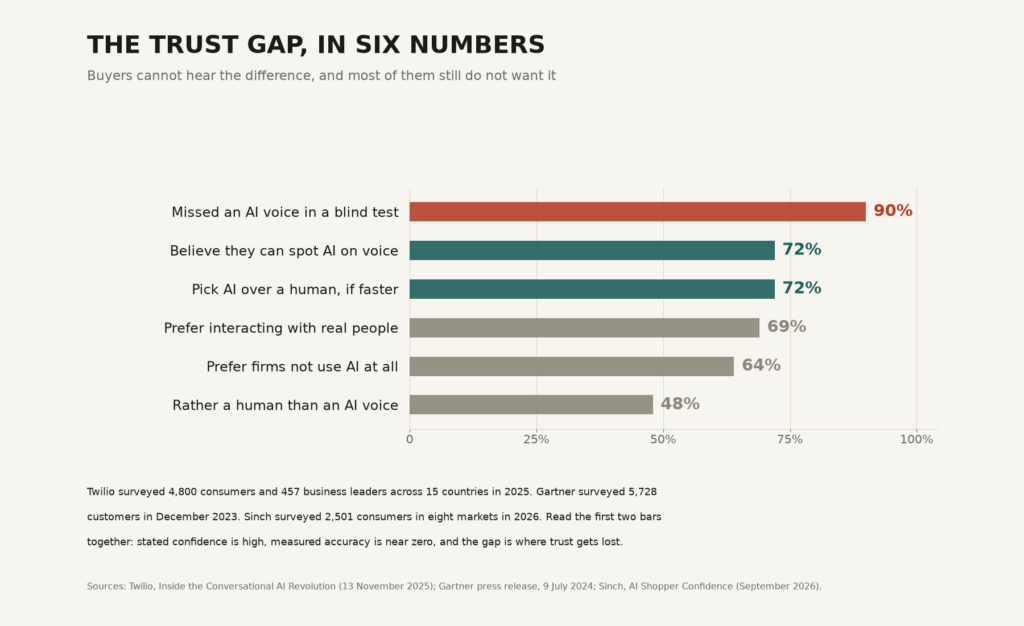
Sixty-nine percent of consumers say they prefer interacting with real people. Sixty-four percent, in Gartner’s separate survey of 5,728 customers, would prefer companies didn’t use AI in customer service at all. Yet seventy-two percent would choose an AI agent over a human if the issue was guaranteed to be resolved faster.
Read those together and the conclusion is unavoidable: loyalty is to resolution, not to the channel and not to the voice. Consumers are not asking for a human. They are asking to not be slowed down.
That reframes the entire trust problem. Your AI voice agent does not fail because it is artificial. It fails when it is slower, dumber, or harder to escape than the alternative. And it succeeds when it resolves in one pass and hands off cleanly when it can’t.
Twilio’s numbers make the handoff deficit brutal: 83 percent of business leaders believe conversational AI can replace human agents, while 78 percent of consumers say the ability to switch to a human is important. Fifteen percent have experienced that switch working well. The gap between what leaders believe and what customers experience is where the reputational risk actually sits — a thirty-one-point gap between the ninety percent of executives who think customers are satisfied and the fifty-nine percent of customers who are.
9. The handoff is the product
If I could give one piece of advice to anyone building in this category, it would be this: stop optimising the demo and start engineering the exit.
A handoff that works has three properties. The human inherits the full transcript, not a summary. The customer does not repeat themselves. And the transfer happens before frustration, triggered by signals rather than by the caller demanding it loudly enough.
Almost nobody gets all three. It is unglamorous work, it does not show up in a launch video, and it is the difference between a channel customers tolerate and one they resent.
10. The regulatory clock is running
Regulation did not arrive after the market. It arrived alongside it, which is unusual and worth understanding.
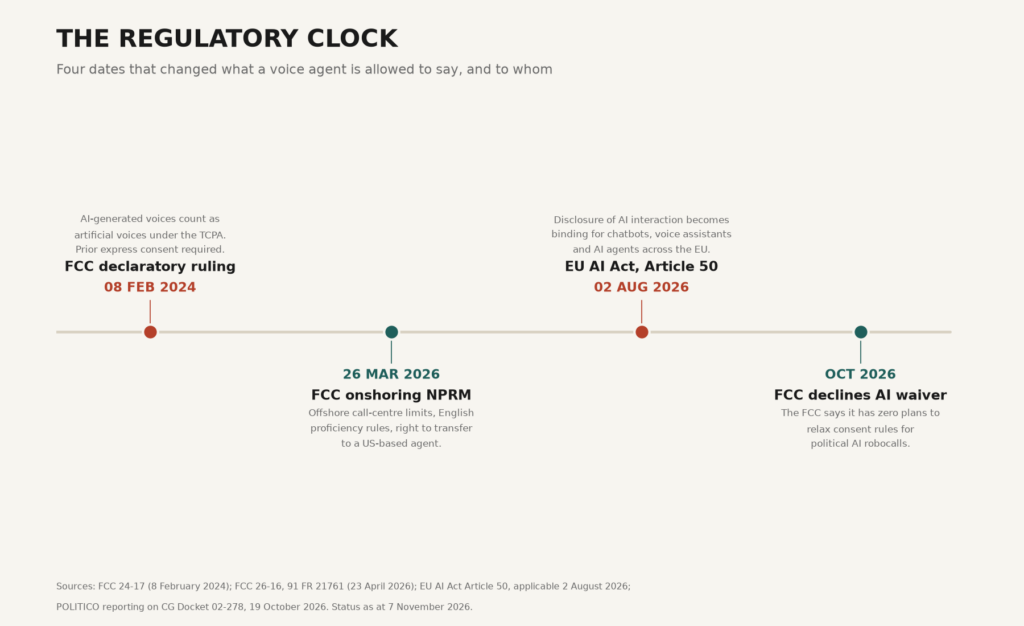
Four dates tell the story. February 2024: the FCC classified AI-generated voices as artificial voices under the TCPA, putting consent obligations on every outbound call. March 2026: the Commission proposed rules on offshore call centers, including English proficiency standards and a customer’s right to be transferred to a US-based agent. August 2026: Article 50 of the EU AI Act made AI disclosure binding at the first interaction. October 2026: the FCC said it had “zero plans” to relax consent rules for political AI robocalls, despite a petition from a conservative advocacy group.
That last one matters more than it looks. A regulator that declines an easy political carve-out is signalling that the consent regime is not up for negotiation. If you are planning an outbound AI calling programme, plan assuming consent must be provable, documented, and specific.
11. The onshoring twist nobody priced in
Here is a second-order effect that most cost models miss entirely.
The FCC’s 2026 proposal on offshore call centers — limiting the share of calls handled abroad, requiring disclosure when a call is handled outside the US, creating a right to be transferred to a domestic agent — raises the cost of the human side of the comparison. If offshore labor gets more expensive and more constrained, the AI business case improves without a single improvement in the technology.
That is a strange thing to model against. It means your ROI calculation is partly a bet on telecom policy, and the bet could move in your favour or against you depending on which side of the equation the rules land.
12. A deployment playbook that survives contact with reality
Five steps, in order, no skipping.
Draw the containment boundary by task, not by channel. List every conversation type your team handles. Mark each one known-shape or ambiguous. Deploy only on the known-shape ones first. This single exercise prevents most failed pilots.
Design the exit before the entry. Decide what triggers a handoff, what context travels with it, and what the customer hears during the transition. Test the handoff more than you test the happy path.
Disclose at the first turn, in plain language, and mean it. Article 50 requires it, the FCC requires identification on artificial-voice calls, and the “obvious” exemption is narrower than your legal team hopes. A disclosure that customers can hear and act on is cheaper than a complaint.
Price against fully loaded human cost, and be honest about the fixed side. Integration, conversation design, and ongoing tuning are real. A model that ignores them will look brilliant in month one and wrong by month nine.
Govern it like a channel, not a tool. Sample transcripts weekly. Track containment and post-containment satisfaction. An agent that closes conversations without solving problems will look efficient right up until the repeat-contact rate arrives.
13. What the 2029 forecast actually means
Gartner projects that by 2029 agentic AI will autonomously resolve 80 percent of common customer service issues without human intervention, cutting operational costs by around 30 percent. That number is now in a thousand board decks.
I would read it as a deadline rather than a forecast. Eighty percent autonomous resolution is not primarily a statement about model intelligence. It is a statement about how much of your institutional knowledge has been moved into a state a machine can safely act on — governed, current, owned, unambiguous.
Two companies can buy the identical platform in 2026 and land forty points apart, because one consolidated its knowledge and the other pointed a model at a shared drive full of contradictory PDFs. The forecast describes an organisational bottleneck wearing a technology costume.
The takeaway
AI voice agents are the rare technology whose business case is already settled and whose social licence is still being negotiated.
The economics are not close. At six to thirteen times cheaper per conversation, the question is no longer whether high-volume outbound work migrates to machines. It already has, and the employment projections show it happening in slow motion.
What remains open is everything that determines whether this works: whether the exit to a human is real, whether disclosure is honest, whether the agent is aimed at known-shape work instead of aspirational use cases, and whether anyone is watching what it says after launch.
The brands that get this right will not win by having the cheapest calls. They will win by having the only automated channel customers do not dread. That is a narrower advantage than the vendor decks promise, and a more durable one.