The Neighbor Is the Channel: How WeChat Groups Became China’s Quietest Retention Machine
The group chat that never appears in a media plan
It’s 9:40 on a Tuesday night in a city no brand team has ever put on a media plan. A woman who runs a stationery shop has just posted seven photographs to a WeChat group of 286 neighbors: strawberries, eggs, a five-kilo bag of rice, dish soap, frozen dumplings. “Orders close at eleven,” she writes. “Pickup tomorrow from four.”
By 10:50, sixty-one households have paid. Nobody has bought anything from a supplier yet. Nothing is sitting in a warehouse yet. On Thursday those same neighbors will queue at her counter for ninety seconds, complain about the strawberries, and ask whether the rice is coming back next week.
That is community group buying and it is the most misread channel in Chinese commerce. Not because it is small. Because almost everyone measures it the way they measure advertising: reach, GMV, growth. The number that actually matters is quieter. It is the share of a household’s grocery spend that arrives through a person they know.
For a decade that share has been climbing. And in the past eighteen months, the industry that owns it has been rebuilt almost from scratch.
What community group buying actually is
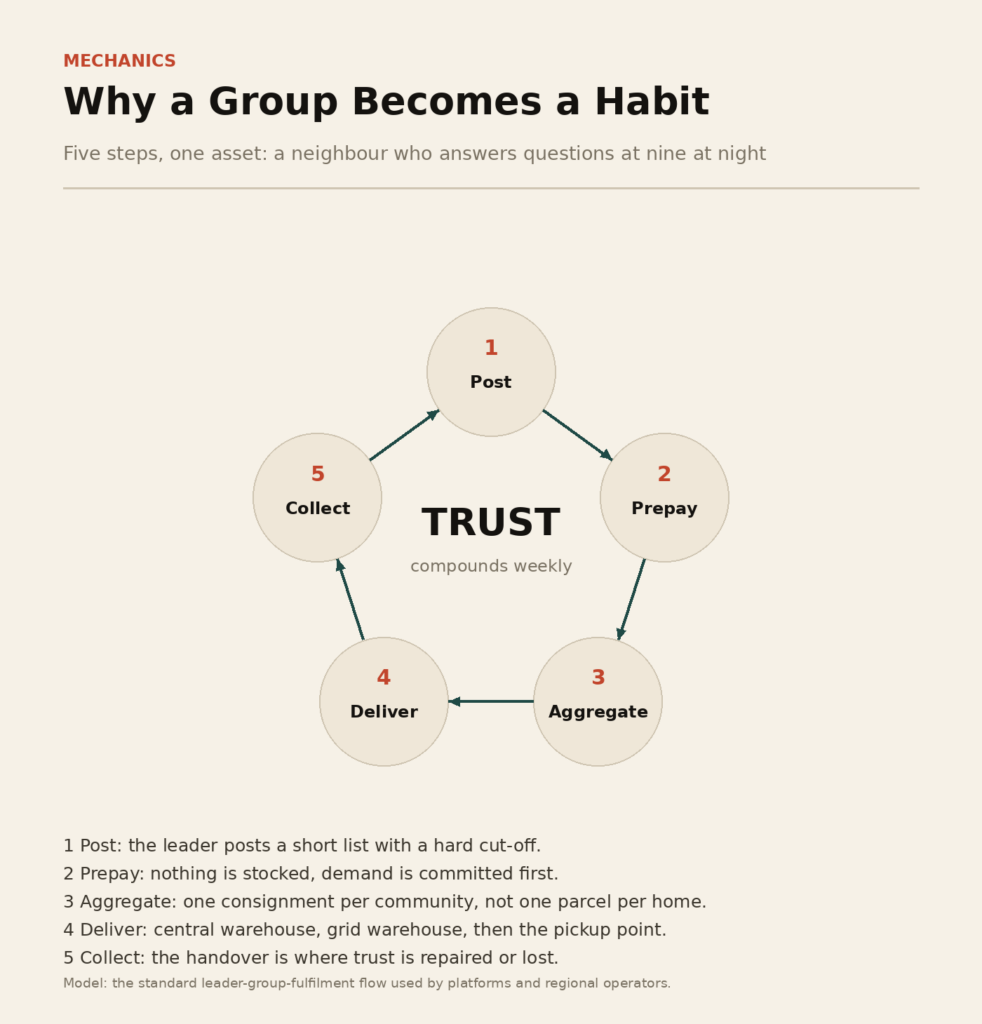
Strip away the buzzwords and the model is almost insultingly simple. A group leader — 团长 — organizes a WeChat group of neighbors. She posts a short list of products with a cut-off time. Neighbors pay in advance. The platform pools every order in the neighborhood into a single consignment, ships it overnight to a grid warehouse, and drops it at her shop, her home, or a shelf by the door. The next afternoon, people walk over and collect.
No storefront. No shelf stock. No courier per order. The customer covers the last hundred meters herself, and does not experience it as work, because she was walking past anyway.
This is not the same thing as a group discount. It is not livestream selling, and it is not the private-domain CRM brands run on WeChat. Those are marketing motions. Community group buying is a fulfillment architecture that happens to be organized socially.
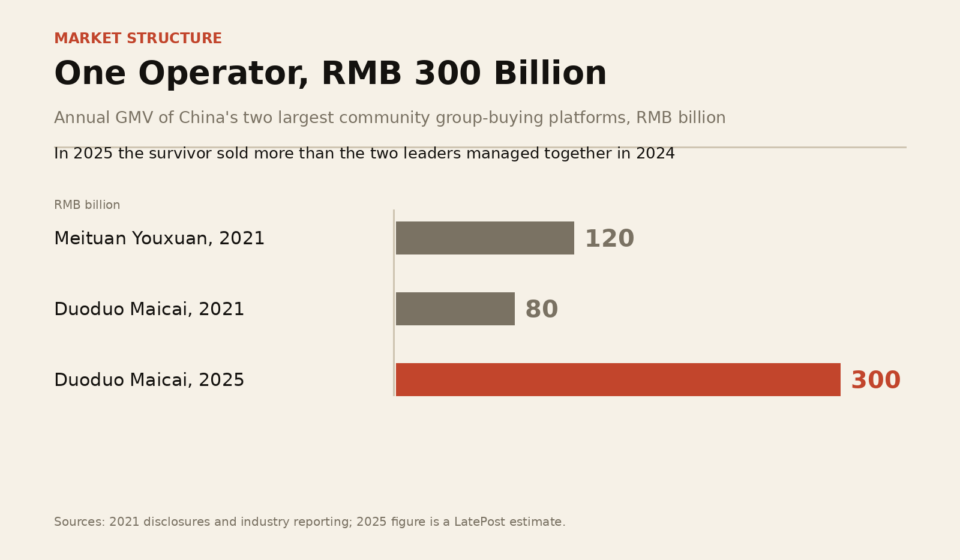
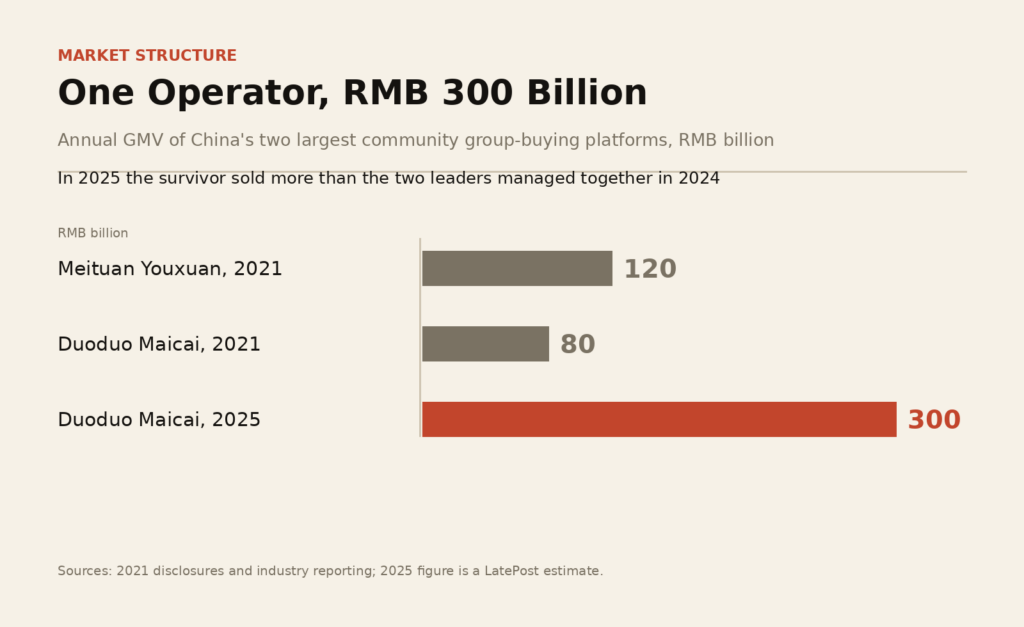
The scale arrived fast. In 2021, Meituan Youxuan did about RMB 120 billion in GMV and Duoduo Maicai about RMB 80 billion, and both were still treated as disappointments against targets their owners had set. That tells you something about the mood of the era: RMB 100 billion was a rounding error in a land grab.
How an order travels from a group chat to a doorstep
The supply chain is the part nobody photographs.
Goods move through four layers: a central warehouse that aggregates supplier volume, a shared warehouse that buffers fast-moving categories, a grid warehouse serving a cluster of neighborhoods, and finally the pickup point, usually a shop counter with a sticker on it. Each layer does one thing: it turns many small, unpredictable orders into a few large, predictable movements.
That is the whole trick. A traditional e-commerce parcel travels alone. A community group buying consignment travels as a block. Cost per order falls not because the trucks are faster but because there are fewer trucks doing more work per stop.
It also explains why the pickup point matters more than the app. The app is a menu. The pickup point is where the product is inspected, the complaint is filed, the substitution is explained, and the relationship is either repaired or quietly broken.
Who is actually buying
Not the person most brand teams picture.
China had 1.125 billion internet users at the end of 2025, a penetration rate of 80.1 percent, and WeChat alone reports about 1.44 billion monthly users — a figure that includes duplicate and overseas accounts, but still describes a surface where commerce can happen inside a chat without anyone calling it e-commerce.
The buyer is more often a household in a county-level city or an outer suburb than a young professional ordering salad at midnight. She is feeding four people, planning tomorrow’s dinner tonight, and comparing the price of eggs across three groups.
That profile is exactly why the channel matters to mass-market brands. It reaches places where modern trade is thin, where delivery fees are unaffordable, and where a neighbor’s recommendation carries more weight than a banner ad ever will.
Why this is a retention engine, not an acquisition channel
Most Chinese channel stories are acquisition stories: buy traffic, convert, repeat. Community group buying inverts that. It is nearly useless as a paid acquisition channel and unusually powerful as a retention machine, for four reasons that compound.
Frequency is the first moat
Groceries are bought several times a week, in small baskets, week after week. No campaign manufactures that cadence and no loyalty program fakes it. Once a household routes its vegetables, eggs and cleaning products through one group, the group becomes part of the weekly rhythm, the way a refrigerator is. Habit is the cheapest retention technology ever invented, and this channel runs on the thinnest-margin category in retail.
Trust sits at the last meter
A platform recommendation is an algorithm guessing. A neighbor’s recommendation is a person risking something. When the leader says the peaches are good this week, she is spending social capital, and everyone in the group knows it. That is why a recommendation in these groups so often outperforms paid media on the same product, and why one bad batch does more damage than a month of discounts.
The switching cost is social
Leaving a group is not like uninstalling an app. It means leaving a room where people talk about the building, the school run, the water pressure. The commerce is attached to a social space, and the social space is the lock-in. Platforms have spent years trying to recreate this with membership tiers. The group does it for free.
Social proof arrives in real time
In a group of 286 people, the first twenty orders are visible. Visibility creates momentum, momentum creates the cut-off scramble, and the scramble creates tomorrow’s conversation. This is not a recommendation engine. It is a recommendation room.
Together, those four mechanics produce something that behaves like a subscription without a subscription’s infrastructure: predictable frequency, low churn, near-zero acquisition cost, and a renewal that happens every time someone says “same as last week.”
The group leader: the cheapest sales force in retail
The leader is the strangest asset in Chinese retail and the least studied. She is usually a shop owner, a stay-at-home parent, or a retiree with a spare room and a good memory for names. She recruits the group, curates the list, answers questions at ten at night, handles the returns, and earns a commission on what her neighbors buy.
During the subsidy years those commissions ran somewhere around 10 to 15 percent, and they have compressed as the market consolidated — a detail worth remembering, because it explains most of the model’s fragility. The platform carries no fixed payroll for this workforce: no store to lease, no recruiter to pay, no training program to run. Thousands of micro-retailers absorb the customer-service cost of an entire grocery business and get paid only when something sells.
That is also why the leader is not a “channel partner” in the usual sense. She is a small business with her own customers, her own reputation and her own P&L. Treat her as a distribution cost and she will treat you as one of several suppliers.
The economics: why next day beats 30 minutes
Here is where the industry’s instinct has been wrong for five years.
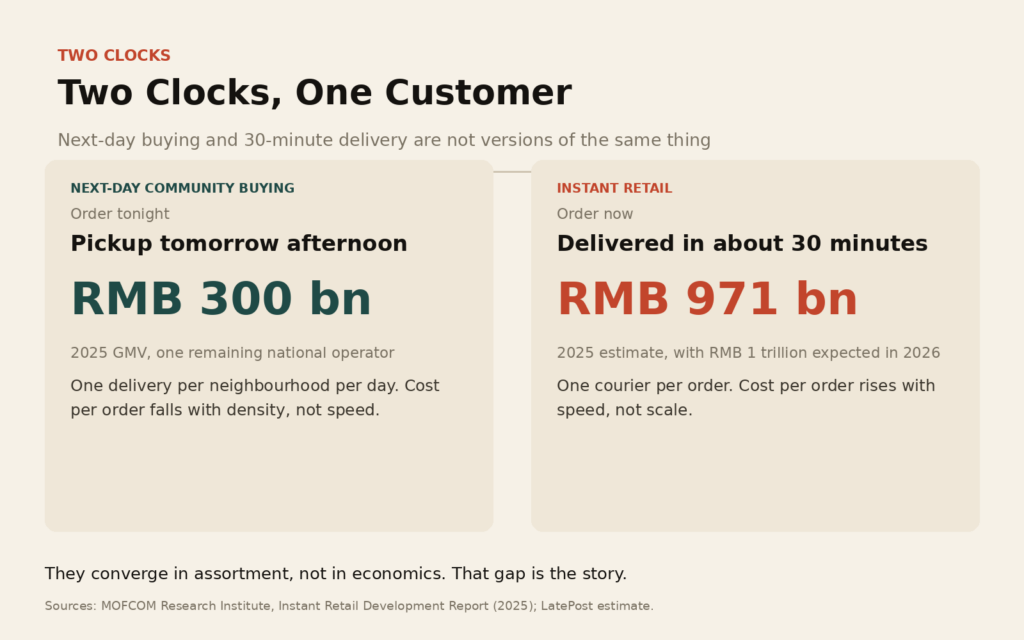
The obvious move, once you have density, is to deliver faster. Every platform tried it. But a 30-minute promise changes the unit economics completely: one courier per order instead of one consignment per neighborhood, a premium for speed, and a customer who now expects the premium to be free. Next-day delivery is not a compromise. It is the only version of this business where the arithmetic closes.
Meituan learned that the expensive way. Its February 13, 2026 profit warning guided to a net loss of RMB 23.3 billion to 24.3 billion for 2025, with core local commerce moving from a RMB 52.4 billion operating profit in 2024 to roughly a RMB 6.9 billion operating loss — the price of fighting a delivery-speed war on someone else’s terms. Even before that fight, the new-initiatives segment that housed Youxuan lost RMB 2.3 billion in the first quarter of 2025 alone.
A 30-minute promise is a service. A sixteen-hour promise is a business model. The market has now priced both.
The great unwind of 2025
Read only the headlines from 2025 and you would conclude the category died.
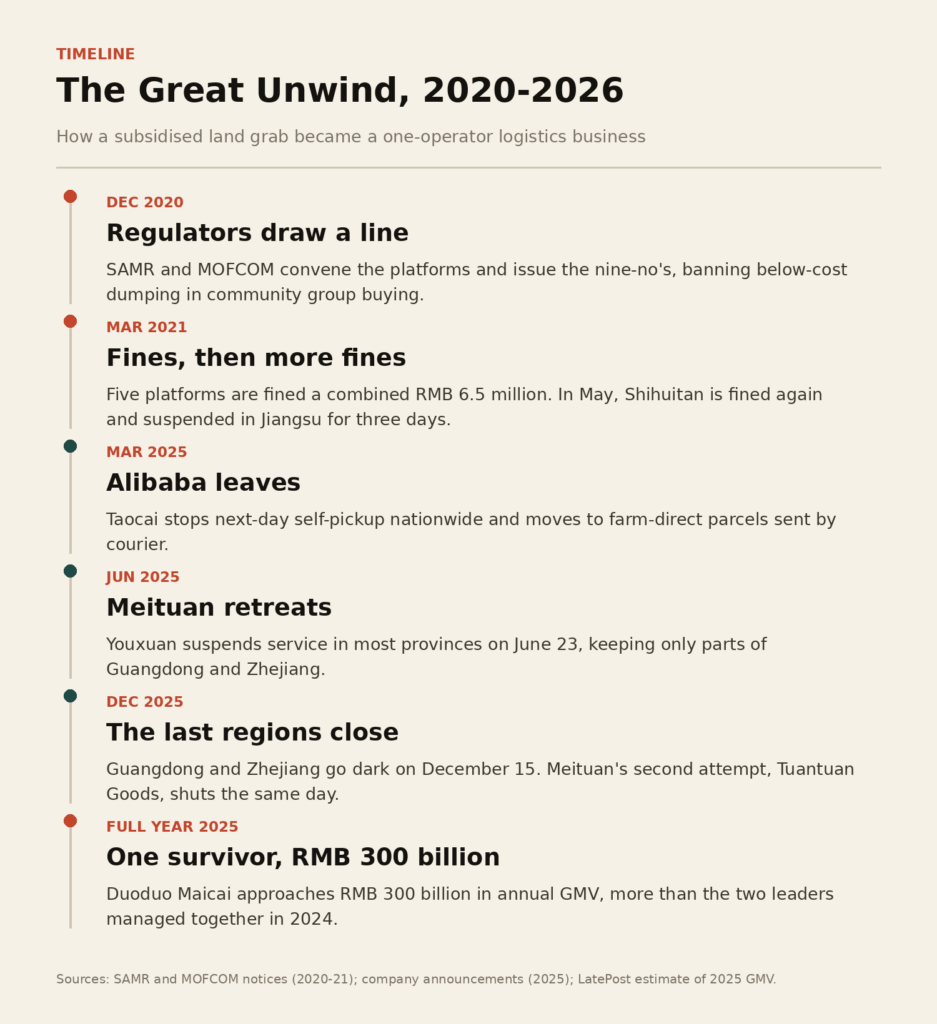
Alibaba went first. In March 2025, Taocai stopped next-day self-pickup nationwide and shifted to farm-direct parcels delivered by courier — a retreat dressed as an upgrade. Meituan followed in June, suspending Youxuan in most provinces and keeping only parts of Guangdong and Zhejiang. In December it closed those too. The same week, its second attempt at the format, Tuantuan Goods, shut down. Between them, the two best-funded platforms in Chinese retail walked away from a market they had spent years and tens of billions of RMB trying to own.
Then came the number nobody expected. Duoduo Maicai finished 2025 at roughly RMB 300 billion in GMV, according to an estimate published by LatePost — more than it and Meituan Youxuan managed together in 2024. One operator, no subsidy war, a business that finally looked like logistics rather than marketing.
The obituary was wrong, and so was the victory lap. What died in 2025 was not community group buying. It was the belief that you could buy this market with discounts and keep it with an app.
The uncomfortable truth: the moat is not yours
Here is the part platform strategists do not enjoy hearing.
When Meituan left, its customers did not stop buying groceries. Its leaders did not stop leading. They moved — to Duoduo Maicai, in a matter of weeks, with their groups intact. That is the cleanest natural experiment the category has produced, and it points somewhere inconvenient: the retention in this model belongs to the leader, not to the platform. The platform rents it, order by order.
So the “retention engine” framing needs one correction. The engine is real. The ownership is contested. A platform can own the warehouses, the suppliers and the app, and still lose the customer the moment the person running the group decides to sell someone else’s rice.
For brands, that is not bad news. It is the opportunity. You cannot buy a group chat. You can become the supplier the leader trusts, recommends and reorders — and you can build that relationship directly, instead of renting it from a platform that will happily offer the same shelf to your competitor.
Where the model actually went
Three places the model went next.
Instant retail took the money and the attention. The Ministry of Commerce Research Institute puts the sector at RMB 781 billion in 2024 and about RMB 971 billion in 2025, crossing RMB 1 trillion in 2026 and reaching RMB 2 trillion by 2030. The two numbers are not directly comparable — one is a single operator’s GMV, the other a whole-sector retail estimate — but the direction is not in doubt. And instant retail comes with a larger bill: three platforms, one courier per order, and a subsidy war that has already cost one of them a full year of profit.
Regional operators took the trust. Players such as Changsha-based Zhihua Zhiguo run smaller, denser networks — roughly RMB 710 million in GMV in 2024, with the leader count up about 10 percent — and they look less like tech companies than like very good local wholesalers with a social layer.
Private-domain tools took the leader. Kuaituantuan, Pinduoduo’s WeChat group-buying tool, was estimated at around RMB 150 billion in GMV in 2022, with five to six million leaders. It sells no groceries of its own. It sells the operating system for people who do.
The survivor, meanwhile, is drifting toward all three. Duoduo Maicai has been testing home delivery in Shanghai and converting parts of its pickup network into parcel stations with lockers — the next-day model growing a delivery arm, because the customer it just inherited also shops at eleven at night.
Why the West keeps failing to copy it
Every few years a Western company tries to port this model and quietly gives up. The post-mortems usually blame logistics. The real gap is structural.
Instacart-style delivery sends a courier into a supermarket on demand: convenient, expensive per order, and aimed at households that can pay for convenience. Community-supported agriculture prepays for a weekly box: aggregated demand, but no daily frequency and no organizer. Nextdoor has the social graph and no commerce. Each one has two of the three ingredients: frequency, aggregation, and a paid organizer.
The missing piece is almost always the paid neighbor — someone whose income depends on being right about the peaches. Add her, and the economics flip: no store, no courier per order, no customer acquisition cost, and a person who absorbs the complaints.
There is a second, quieter reason. In China the group, the catalog and the payment all live on one surface. Elsewhere the group chat is in one app, the payment in another, and the catalog behind a link that half the group will never tap. Three frictions, three places to lose the order.
What global brands should do about it
If you sell food, beverage, household or personal care into China, this channel deserves a line in the plan that is not “other.” Four moves that work.
Buy the leader, not the impression. A budget allocated per active leader — samples, incentives, training, exclusive packs — will outperform the same money spent on a platform’s display inventory, because it buys the recommendation rather than the slot.
Design for tomorrow, not for now. Pack sizes, shelf life, case counts and packaging all have to survive a night in a grid warehouse and a morning on a shop counter. A product built for same-day delivery often fails that test; a product built for a two-day parcel usually passes.
Make the leader’s job smaller. Her binding constraint is time. Product cards she can forward in one tap, three sentences she can paste, a returns rule she can explain without calling anyone — that is what channel enablement means here, and almost no brand does it well.
Measure by group, not by campaign. A group is a cohort. If you cannot tell whether the group that bought in March is still buying in September, you are running a promotion, not a channel.
One warning: do not buy GMV. The platforms that tried to manufacture demand with subsidies are the ones that left. This channel rewards patience and assortment discipline, and punishes anyone treating it as a performance-marketing line item.
The risks nobody puts in the pitch deck
Concentration. With one national operator left, and regional players too small to balance it, brands face classic channel risk: a single point of negotiation, a single set of terms, a single algorithm deciding whether your SKU survives.
Leader churn. Leaders are not employees. They multi-home, they switch when commissions move, and they take their groups with them. Any retention forecast that assumes loyalty to your brand rather than to her income is fiction.
Quality fragility. Fresh produce is unforgiving. One bad batch in one group can undo a year of recommendations, and the person absorbing that anger is the leader, not you.
Thin margins. Low baskets, low prices, high handling. The survivors are logistics companies that happen to sell vegetables, and they win on cost per consignment, not on brand love.
Regulation. The rulebook was written early and has not been repealed. In December 2020 the market regulator and the commerce ministry issued the “nine no’s,” banning below-cost dumping. In March 2021 five platforms were fined a combined RMB 6.5 million. In May, Shihuitan was fined again and suspended in Jiangsu for three days. Price wars in adjacent categories have drawn the same scrutiny since. The model is legal and mainstream now, but it operates with a visible ceiling on how it may compete.
What happens next
Three things, in order of confidence.
First, convergence at the edges. The survivor is already adding delivery; the instant-retail platforms are already adding next-day bulk. Within two years the customer will not know, or care, which one she is using, and the fight will move to who owns the replenishment list.
Second, the brand-owned group. The logic is too obvious to ignore: if the relationship is portable, why rent it? Expect more brands to run leader programs directly through tools such as Kuaituantuan, with the platform reduced to a fulfillment vendor.
Third, AI as a back-office tool rather than a front-line one. Forecasting demand per grid warehouse, drafting the nightly product list, flagging the neighbor who stopped ordering — all of that is already feasible. What AI cannot do is be the person someone trusts with the strawberries. The human layer is the product.
A field guide: telling a real community engine from a coupon in a group chat
Five questions, in the order I would ask them.
Does the leader actually live there? If she cannot name the building, it is a distribution point, not a community.
Is the assortment built for tomorrow? If the list is full of items that need refrigeration within four hours, the model will fail quietly, one refund at a time.
Does the basket clear the cost of handling? If the average order is smaller than the labor of sorting it, growth makes the loss bigger.
Is anyone measuring the group, not the order? Retention shows up as repeat participation by cohort. If the dashboard only shows GMV, nobody is watching the thing that matters.
Does the leader earn more than a coupon? Commission compression is the earliest warning signal in the channel. When her income stops being worth her evening, the group starts to die — long before the platform notices.
The lesson worth stealing
Community group buying is not a Chinese curiosity, and it is not a discount channel that got out of hand. It is a demonstration of something most Western retention playbooks miss: the strongest lock-in is not a points balance or a push notification. It is a person your customer sees on the stairs.
The 2025 shakeout did not disprove that. It proved it more sharply than any growth chart could. Two of the best-capitalized companies in the country built the warehouses, bought the customers, and still handed the relationship to someone else, because the relationship was never theirs to buy.
So the lesson for anyone selling into China — or anywhere trust still travels by word of mouth — is not “build a group chat.” It is harder than that. Find the people who already have one. Make them look good. Pay them properly. Then get out of the way.
The most powerful retention tool in Chinese retail is not an app. It is a neighbor with a good memory and 286 people who believe her.