The KOC Economy: Why Micro-Influencers Beat Celebrities in China
The pitch has not changed in a decade. A slide opens with a face everyone recognizes, a follower count with nine digits, a fee with seven. The room nods. Someone asks about exclusivity. Someone else asks whether the talent will do a livestream.
Three months later the same room is looking at a different deck: enormous impressions, unremarkable sales, and a spike that lasts eleven days before collapsing back to baseline.
In China, a growing number of brand teams have quietly stopped taking that meeting. Not because celebrities stopped working. They still work, for the narrow job of making a brand feel large. What changed is the layer underneath. China turned the ordinary customer into infrastructure.
That is the KOC economy, and it is routinely misread by people outside it. KOC stands for key opinion consumer a term of art with no legal definition and no agreed follower cutoff. In practice it means a real customer with a small audience, often a few hundred to a few thousand followers, whose posts read like testimony rather than advertising. You will also see them called (ordinary people) in Chinese industry reports, which is closer to the truth: the defining feature is not the follower count but the fact that the account looks like a person, not a channel.
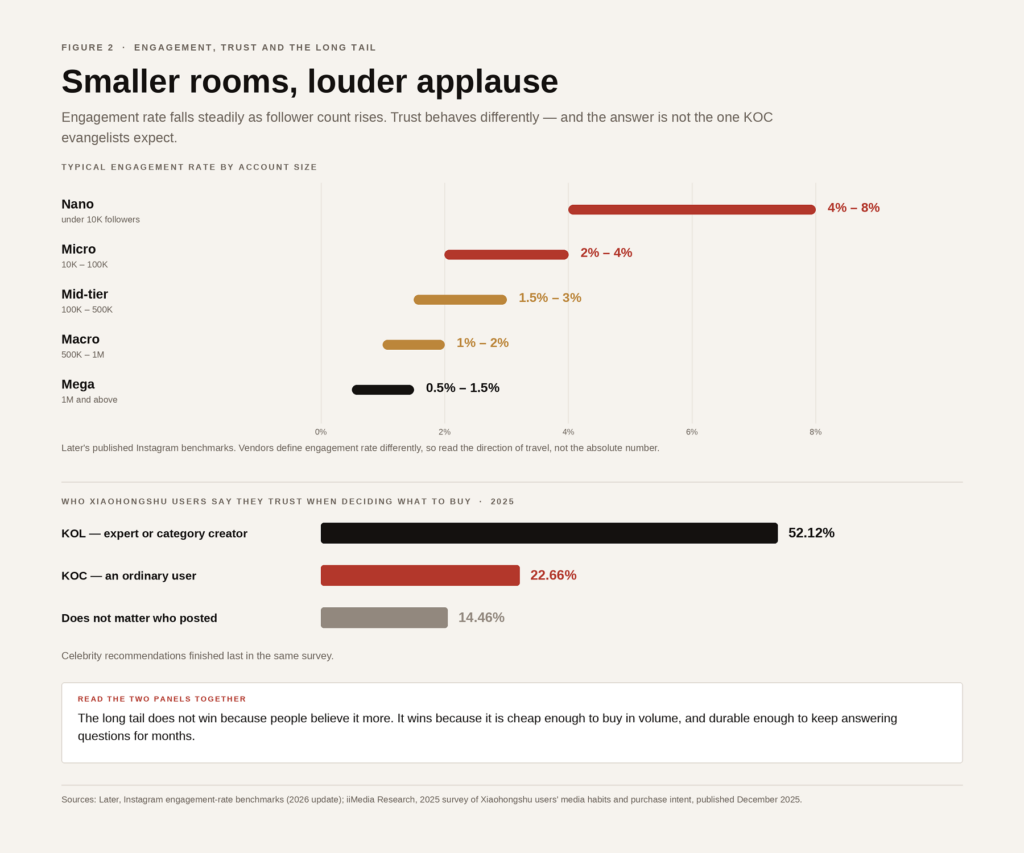
The usual explanation for their rise is that consumers trust ordinary people more than they trust stars. The Chinese survey data does not support that, at least not in the simple form. What the data supports is stranger and more useful: KOCs win because they can be bought in bulk, they persist, and they are cheap enough that a brand can afford to be wrong about most of them.
Three words that get used as if they were interchangeable
Celebrity, KOL and KOC are not points on one line. They are three different products with three different failure modes.
| Tier | Who they are | Reach | Typical cost | What buyers actually get |
|---|---|---|---|---|
| Celebrity | Actors, singers, idols | Tens of millions | Highest, often seven figures | Status transfer. The brand looks bigger than it is |
| Head KOL | Top creators and livestream hosts | Millions | Very high | Mass reach plus a conversion event on a fixed date |
| Mid-tier KOL | Category specialists | Tens of thousands to low millions | Moderate | Category authority and credible comparison content |
| KOC | Ordinary customers | Hundreds to low thousands | A product sample, a small fee, or a commission | Volume of specific, searchable, first-person evidence |
The middle of that table is where most Western budgets land, because it is the easiest place to defend in a planning meeting. The bottom is where the volume is.
One honest caveat about the numbers that follow: no Chinese regulator or research house publishes a “KOC market”. What they publish are tiers — head, mid, tail. Tail-tier creator data is the closest thing to a KOC proxy that exists, and it is the number I use here. Where I say tail, I mean the tier, not the ideal.
Where the placements actually go
TopKlout, the Chinese influencer research firm, publishes an annual review of advertiser spending on creators. Its 2026 edition puts the total KOL placement market at about RMB 84 billion in 2025, down from RMB 87.3 billion the year before. The figure covers placement fees only; celebrity fees, livestream slot fees and GMV commissions sit outside it. Not a boom. A plateau, and a redistributing one.
Split that market by tier and something odd appears. Head-tier creators took 13.8 percent of all placements but 20.6 percent of all spend. Tail-tier creators took 55.4 percent of placements and 38.9 percent of spend. In 2024 the tail’s share of placements was 52.0 percent. It gained 3.4 points in a single year, while its share of spending slipped slightly.
Read that as a sentence: the work is migrating down the ladder faster than the money is.
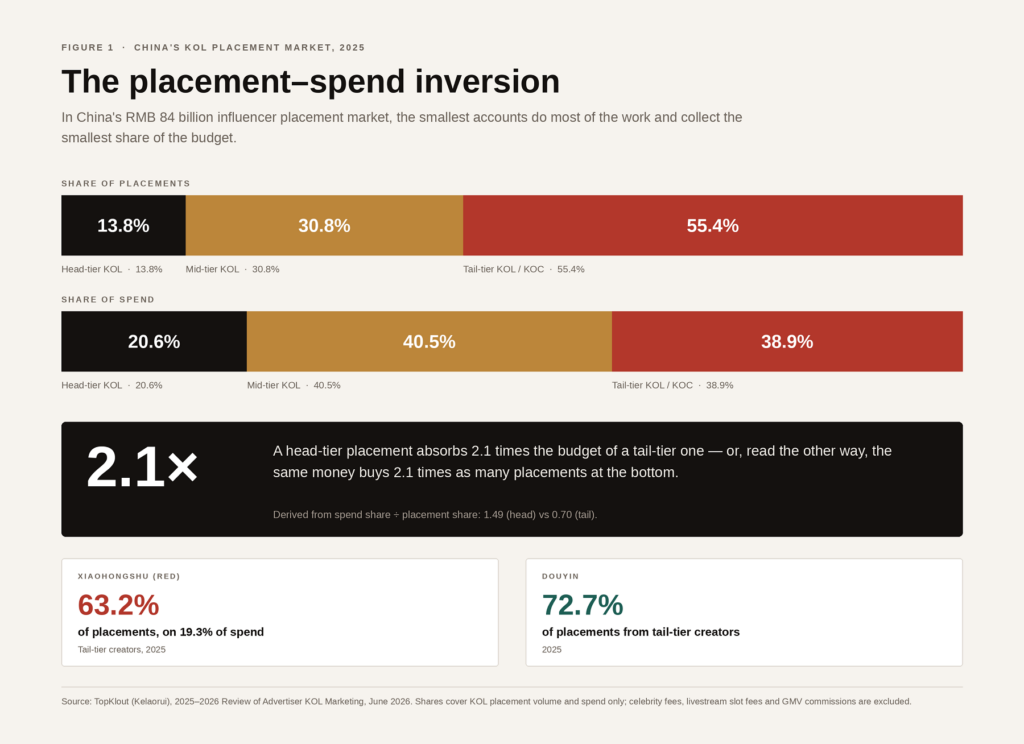
The same pattern shows up harder on individual platforms. On Xiaohongshu, the lifestyle and product-review app known abroad as RedNote, tail-tier creators accounted for 63.2 percent of placements in 2025 while absorbing 19.3 percent of spend; head-tier creators took 7.0 percent of placements and 39.1 percent of spend. On Douyin, TikTok’s Chinese sibling, tail-tier creators accounted for 72.7 percent of placements.
What a placement actually costs
Shares of spend are abstract until you divide them by shares of volume. Do that and you get a rough price index: a head-tier placement consumes about 1.49 times the average budget per placement, a tail-tier placement about 0.70. The ratio between the two is roughly 2.1.
Which means a head-tier slot absorbs about twice the money of a tail-tier one — or, flipped around, the same budget buys about twice as many placements at the bottom. On Xiaohongshu the gap is far wider: a head-tier placement there consumes roughly eighteen times the budget of a tail-tier one.
Anyone who has signed both kinds of contract will find the arithmetic unsurprising. What is surprising is how rarely it gets put on one page. Rate cards tell a simpler version of the same story: a mid-tier KOL post is quoted in the low thousands of renminbi, a KOC post in product, in commission, or in a few hundred.
The cheaper instrument is not cheaper because it is worse. It is cheaper because you can buy two hundred of them, shrug at most of the output, and still end up with a dozen pieces that keep paying for years. The celebrity post is one bet. This is a portfolio.
Why the platform is quietly on the tail’s side
None of this would work if the platforms were not built to reward it.
Xiaohongshu reports more than 350 million monthly active users. On that platform, accounts with fewer than a thousand followers produce more than 90 percent of all notes and take around half of all traffic. That is a design choice, not an accident of growth: distribution is split between a social graph and an interest graph, and the interest graph does not care how famous you are if your note answers the question somebody just typed.
And they type a lot. Roughly 88 percent of Xiaohongshu users search actively on the platform. Douyin, meanwhile, passed one billion monthly active users in March 2025, with the average user spending around 46.5 hours a month inside it.
Put those facts together and the strategic logic writes itself. A platform where search intent is high, where small accounts are subsidized with distribution, and where people arrive with a purchase question rather than an entertainment appetite is a platform that pays compound interest on specificity. A note titled “I used this for six weeks, here is what broke” keeps answering that query for two years. A celebrity video answers it never.
TopKlout’s analysts describe the shift in almost those terms, noting that content with strong scenes, concrete detail and weak sales pressure now earns more user trust than polished brand creative.
The trust paradox
Here is where the standard story falls apart, and where the interesting version begins.
iiMedia Research asked Xiaohongshu users in 2025 who they trust when they are deciding what to buy. KOLs — the professional creators — won with 52.12 percent. KOCs came second at 22.66 percent. A further 14.46 percent said the identity of the poster did not matter, only the content. Celebrity recommendations finished last.
So ordinary users are not the most trusted voice on the platform. They are a distant second, behind the professionals. Anyone selling you a “people trust people, not celebrities” narrative is skipping that line.
The global picture points the same way. Nielsen’s Global Trust in Advertising study — the 2015 edition remains the most cited — found that 83 percent of respondents trust recommendations from friends and family, and 66 percent trust opinions posted online by strangers, ahead of almost every paid format. Note what it measures: people trust people, including people they have never met, and they discount institutions and paid performers.
Marketing academia has a name for the mechanism. The persuasion knowledge model, set out by Marian Friestad and Peter Wright in 1994, holds that audiences build working theories about when someone is trying to persuade them, and adjust their reading accordingly. A celebrity endorsement is maximally legible as persuasion; the discount is applied automatically, often before the first syllable. A KOC note is ambiguous — it might be a paid placement, it might be a person with a bathroom shelf — and ambiguity is where the value lives.
Which is precisely why the next section matters, and why the next three years will be hard for anyone whose KOC strategy depends on that ambiguity surviving.
The flywheel is an operations problem
Every deck about KOC marketing has the same five boxes: seed, create, distribute, convert, recycle. Brands recruit customers, send product, collect content, let the algorithm work, convert the audience, and turn new customers into new creators.
The diagram is right. It is also why so many programs fail, because it hides what the work actually is.
Running a thousand-KOC program means sourcing a thousand people, verifying a thousand addresses, shipping a thousand parcels, briefing a thousand humans without flattening their voices into press-release English, chasing the four hundred who went quiet, labeling every post that carries a purchase link, archiving the evidence for three years, and reconciling commission payments across three platforms. It is a supply chain with opinions.
That is the real barrier to entry, and it is not creative. Global brands are good at buying one expensive thing extremely well. They are much worse at running a thousand cheap things reliably. The teams that win at KOC in China usually have an operations lead in the room, not the best mood board.
Where this fails
KOC marketing is not a universal solvent, and the category boundaries are sharper than the evangelists admit.
Luxury is the clearest case. When the product is a status signal, the status of the person holding it is the product. A thousand ordinary customers holding a handbag does not make the handbag desirable. It makes it common.
Mass-reach launches are the second. If the job is to make forty million people aware of something in two weeks, one celebrity broadcast is more efficient than a thousand small fires. KOCs compound over months. Launches do not have months.
Complex technical products are the third. Where the buyer needs to understand a specification, a mid-tier specialist with real expertise beats a hundred enthusiastic amateurs. Volume of testimony is not a substitute for competence.
And there is a fourth failure mode that gets discussed less: organized authenticity is a contradiction. The moment a KOC program is exposed as a scripted operation — templated talking points, identical photos, refunded orders — the asset that made it work evaporates, and it evaporates in public. One of the enforcement cases below began exactly there.
The bill for being honest
Chinese advertising law has spent five years closing the gap between a paid recommendation and a paid advertisement, and it has done so with unusual precision.
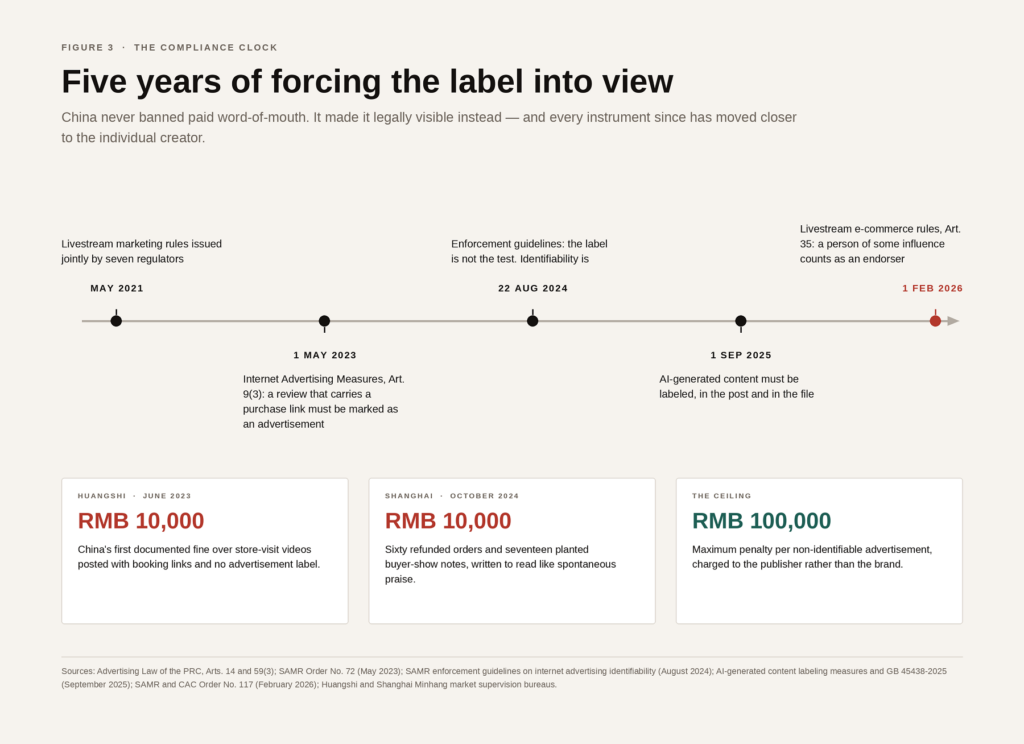
Start with the Advertising Law itself. Article 14 requires advertisements to be identifiable, so that consumers can tell an ad from anything else. Article 59(3) sets the penalty for failing that test: up to RMB 100,000, levied on the publisher of the advertisement rather than on the brand that commissioned it.
Then the Internet Advertising Measures, in force since 1 May 2023. Article 9(3) is the provision that matters. Where goods are promoted through knowledge sharing, experience sharing or product review — and a shopping link or other purchase method is attached — the publisher must conspicuously mark the content as an advertisement. That sentence describes most of the KOC economy.
In August 2024 the regulator published enforcement guidelines that closed the obvious loophole. Whether a post carries the label is not the test, the guidelines say; identifiability is. A label does not launder a post that still reads as independent advice, and a missing label does not exempt a post that is plainly promotional.
Since 1 September 2025 there has been a second label to worry about: AI-generated text, images, audio and video must be marked as such, in the post and in the underlying file metadata.
Then, on 1 February 2026, the livestream e-commerce rules took effect. Article 35 provides that where livestreamed content constitutes a commercial advertisement, the people involved carry advertiser, publisher or endorser duties — and it explicitly contemplates “a natural person with a degree of influence” recommending goods in their own name or image. That phrase was written for the person with 3,000 followers.
The fines themselves are almost beside the point, though they are real. In June 2023, Huangshi’s market regulator fined a local agency RMB 10,000 over store-visit videos that carried booking links and no advertisement label — reported at the time as the first case of its kind. In October 2024, Shanghai’s Minhang district fined a clothing company RMB 10,000 after it refunded 60 orders in exchange for buyer-show notes and planted 17 more from staff accounts.
The strategic cost is larger than the legal one. A KOC note is valuable because it does not look like an advertisement. The law now requires it to look like one. That is not a compliance detail; it is the central tension of the next three years, and there is only one honest resolution: build content that is still worth reading with a label on it.
Why global teams still buy the star
If the arithmetic is this clear, why does the celebrity line item survive every budget cycle?
Four reasons, and none of them is really about marketing.
The first is availability bias. Global brand leaders grew up in markets where celebrity endorsement is the default signal of seriousness, and where the transfer from famous face to brand equity is well documented. That intuition travels badly. It gets applied to China by people who have never scrolled a Xiaohongshu feed for an hour.
The second is incentives. Agencies earn a percentage of media and talent spend. A single celebrity deal is one contract, one invoice, one margin. A thousand KOC placements is a thousand reconciliations for a fraction of the fee. The advice to go small is often correct and almost never free.
The third is control. KOC content is uneven by design. It has bad lighting, odd grammar, and opinions the brand did not approve. Global teams are built to approve creative, not to tolerate it.
The fourth is measurement. Impressions and reach are legible to a board. “Share of search results for a specific question in four lower-tier cities, measured at 90 and 180 days” is not. When the reporting system rewards the wrong thing, the budget follows the reporting system.
What to measure instead
If you are going to run the tail, you need a different instrument panel, because the standard one will tell you the program failed.
A handful of metrics earn their keep.
Search share by question. Not brand search volume — question coverage. Take the twenty queries a real buyer types before purchase, and measure what share of results, on which platforms, is your content. This is the closest available proxy for the compounding value of a long tail.
Note survival. What percentage of the notes you paid for are still live, still indexed and still collecting saves at 90 and 180 days? Attrition is the silent killer of KOC programs, and it is almost never reported.
Save rate over like rate. A save is a purchase intent stored for later. A like is a mood. On Xiaohongshu in particular, saves track the content that actually converts.
Repeat purchase and review velocity. Did the customers who arrived through peer content come back, and did they leave reviews of their own? If they did, the flywheel is real. If they did not, you bought media with extra steps.
And one metric that did not exist three years ago: whether AI assistants cite you. China had 1.125 billion internet users at the end of 2025 and 602 million generative AI users, up 141.7 percent in a year. Those assistants assemble answers from exactly the kind of specific, first-person, long-tail content this article has been describing. The brands that own it will be the brands the models quote.
What changes in 2026
Three shifts are worth planning around.
KOC management is becoming a software category. Sourcing, briefing, shipping, compliance checks and performance tracking are being automated, which lowers the operational barrier that has protected incumbent agencies. The creative judgment stays human; the reconciliation does not.
The label is becoming a design constraint. Once every paid post must be marked, the only content that survives is content with standalone utility. Expect the winning format to look less like a review and more like a manual: what this does, what it does not do, who should not buy it.
And discovery is moving. With 602 million people using generative AI, a growing share of purchase research starts in a chat window rather than a feed. That favors content that is specific, sourced and quotable — which is, accidentally, what the best KOCs were producing all along.
The short version
China’s influencer market did not reject celebrity. It built a second market underneath it, at a scale nobody planned: RMB 84 billion in placement spend, more than half of all placements going to the smallest tier, and roughly twice the placement volume per yuan at the bottom as at the top.
The trust story is more subtle than the slogan. KOCs are not the most trusted voice — professional creators are — but they are trusted enough, cheap enough and durable enough to be bought in numbers no single endorsement can match.
The law has now removed the ambiguity that made the format work, which means the next generation of KOC programs will be judged on utility rather than on authenticity. Content that still helps when it is labeled as an advertisement is the only kind that compounds.
If you take one thing from this piece: stop casting, start manufacturing. And staff it like an operations function, because that is what it is.