Insight: Why the long tail compounds — and why the KPI system never saw it
The discovery, once you line up the numbers, is a little embarrassing for the industry: KOCs did not win a trust contest. They won an accounting error.
Here is the tell. In iiMedia Research’s 2025 survey, professional creators — KOLs across the mid and upper tiers — were the most trusted source on Xiaohongshu at 52.12 percent, with KOCs at 22.66 percent. If trust were the engine, budgets should have followed KOLs up the ladder. They did the opposite. Between 2024 and 2025, the tail’s share of placements climbed from 52.0 to 55.4 percent, a 3.4-point gain, while the head-tier share of placements rose only 0.7 points and its share of spend barely moved, from 20.5 to 20.6 percent. Money went down the ladder even as trust was concentrated higher up.
So what actually moved the budget? Three mechanics that never show up on a media plan.
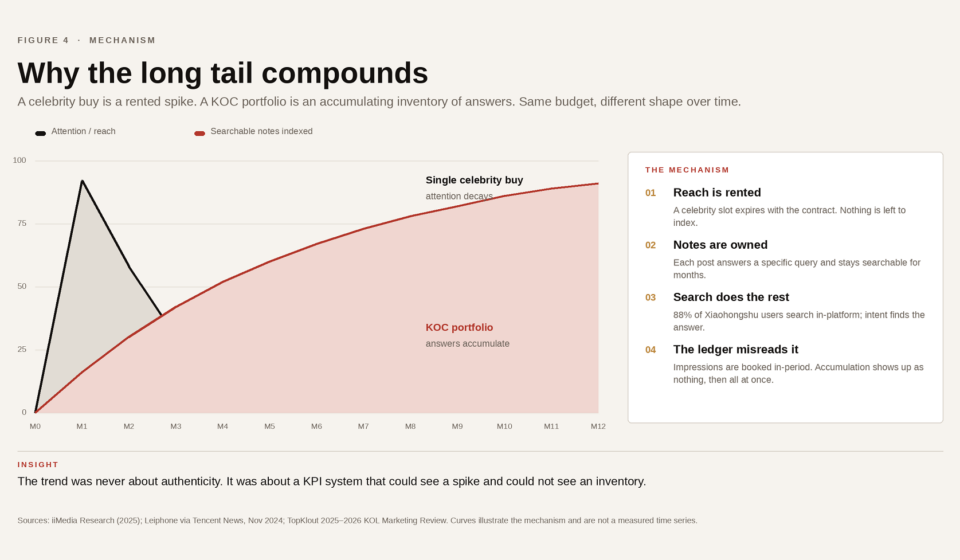
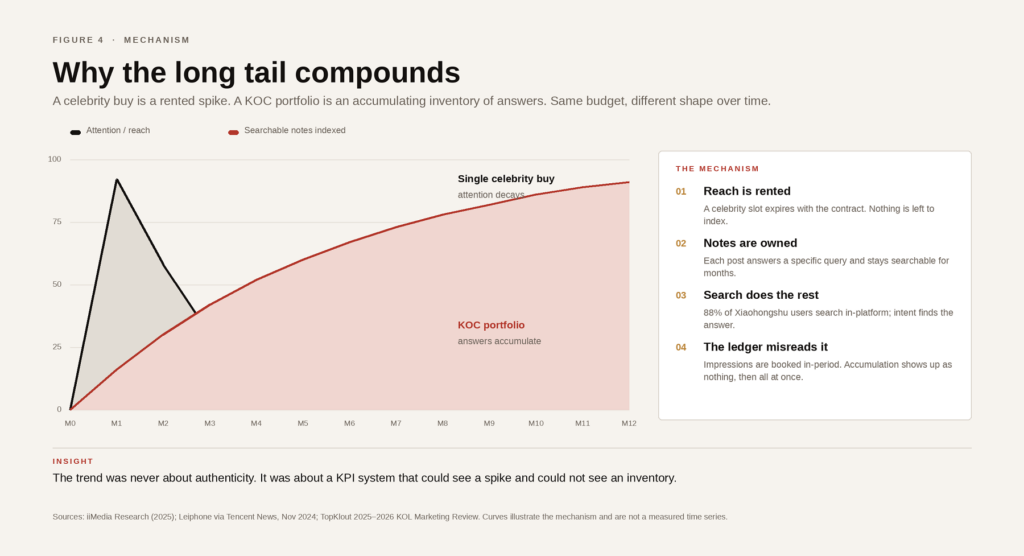
First, the unit of purchase changed. A celebrity buy rents attention for a fixed window and leaves nothing behind. A KOC note is a small, durable asset: it answers one specific question — does this fade, does this pill the fabric, is it worth it for oily skin — and keeps answering it. Industry reporting from 2024 found that accounts with fewer than a thousand followers produce more than 90 percent of notes on Xiaohongshu and that roughly 88 percent of users search in-platform. Those conditions favor content that stays findable long after a campaign ends. Celebrity reach decays. A library of indexed answers accumulates. Same spend, opposite time signature.
Second, the cost of being wrong fell. A single head-tier placement absorbs roughly twice the budget of a tail-tier one. On Xiaohongshu the gap is wider — a derived price index drawn from TopKlout’s share-of-spend and share-of-placement data puts it in the high teens, though the ratio is sensitive to rounding and no public rate card confirms it. Either way, at that price gap you stop optimizing individual units and start managing a portfolio — most notes will be mediocre, a few will be found, and the handful that get indexed pay for the rest. No single bet has to work. That is a fundamentally different risk structure, and it is the real reason small accounts got bought in bulk.
Third — and this is the part nobody puts on a slide — the measurement system is structurally blind to accumulation. Impressions and reach are booked in the period in which they occur. A celebrity spike is fully legible to a dashboard in week one. Two hundred notes that are still being found in month nine do not exist as a line item. They appear as a very small number today and a residual, unattributed lift much later. Tell a CFO one of these is a campaign and the other is drift, and you can guess which gets cut.
Which reframes “authenticity” entirely. Authenticity was never the strategy; it was the side effect of buying cheap, heterogeneous, first-person content in volume. The industry named the aesthetic and missed the machinery.
The forward implication is sharper still. As AI assistants move purchase research into a chat window — China counted 602 million generative-AI users at the end of 2025 — the content most likely to be retrieved and quoted is specific, durable, first-person text of exactly the kind the long tail produces. If the accounting error was ever going to turn into a structural advantage, this is where it happens: an index of two-year-old notes is a better input to an answer than a three-month-old impression count, which by then exists only in a deck. The brands that treated KOC as cheap media will keep buying impressions. The ones that treated it as inventory are about to own the answer.