The Trust Stack: Why a Review in China Outsells the Ad Budget
The short version. In China, a review is not feedback. It is inventory. What a brand owns in reviews — how many exist, how specific they are, how recent, how they read beside a competitor’s — moves more product than the ad budget does. This piece maps how that estate gets built, where the practice tips over into fraud, and what three years of enforcement have actually changed.
1. A review does a job an advertisement cannot
Start with the plumbing, because the scale is the precondition for everything else.
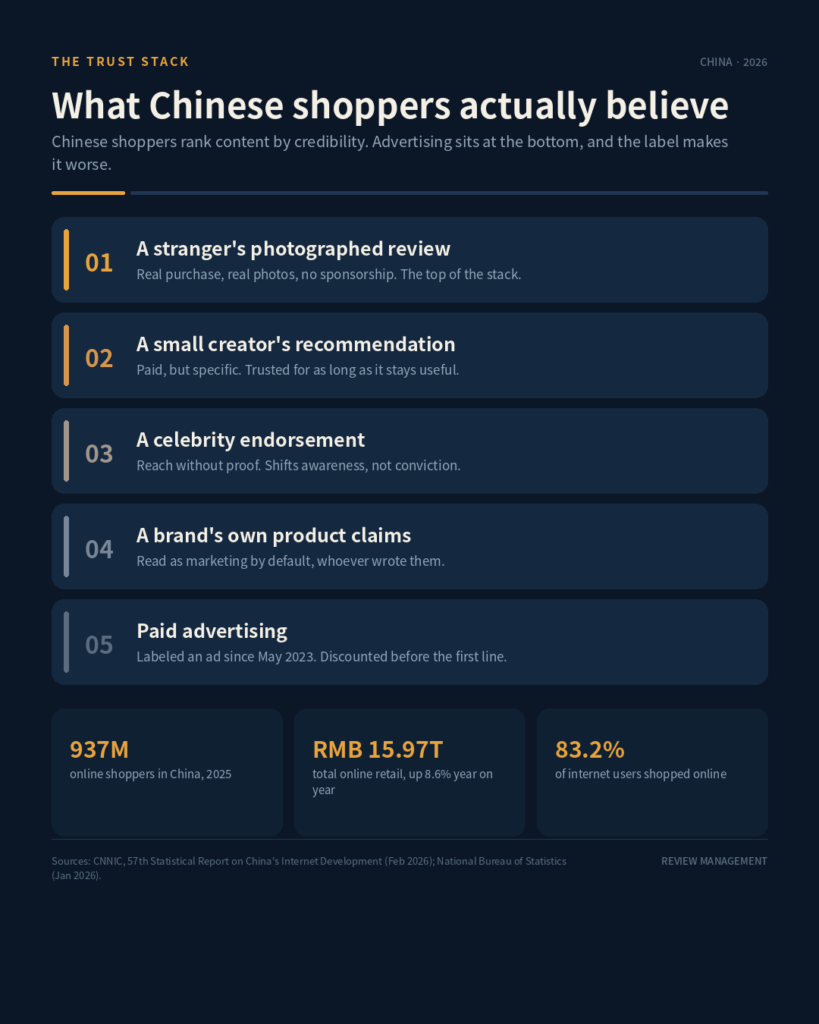
China closed 2025 with 1.125 billion internet users and 937 million online shoppers — 83.2% of the online population, according to the 57th Statistical Report on China’s Internet Development, published in February 2026. Online retail reached RMB 15.97 trillion, up 8.6% year on year. Physical goods alone accounted for RMB 13.09 trillion, which is 26.1% of all consumer retail in the country. Live commerce did RMB 6.95 trillion with 660 million users.
Those numbers explain volume. They do not explain behavior, and behavior is where the interesting part lives.
Here is the thing that trips up Western marketing teams: in China the purchase is not the moment of persuasion. It is the moment of confirmation. Persuasion already happened, days earlier, in a feed, in a search bar, in someone else’s comment thread. Xiaohongshu reports that about 70% of its monthly users search inside the app — a striking number for a platform most outsiders still file under “lifestyle blogging.” People go there to look things up before they spend.
So the review is not a post-purchase artifact. It is pre-purchase infrastructure. It sits upstream of the ad, upstream of the landing page, and it decides whether either of them gets a fair hearing.
2. Trust has a pecking order, and advertising sits at the bottom
Chinese shoppers do not weight all content equally. They rank it. The ranking is stable and, if you have spent time in the market, almost intuitive:
A stranger’s photographed experience beats a creator’s paid recommendation. A creator’s paid recommendation beats a celebrity endorsement. A celebrity endorsement beats a brand’s own advertising. The more commercial a piece of content smells, the less it is believed.
This is not a cultural quirk. It is a structural response to regulation. Since May 2023, the Measures for the Administration of Internet Advertising have required that content which promotes a product through knowledge sharing, experience sharing or product testing — and which carries a purchase link — be visibly labeled as an advertisement. The label exists to protect consumers. It also works as a sorting signal: anything wearing the label gets discounted by the reader before the first sentence lands.
Which means the most valuable thing a brand can own is not a great ad. It is a body of content that does not look bought, because it largely was not.
3. Five layers of proof
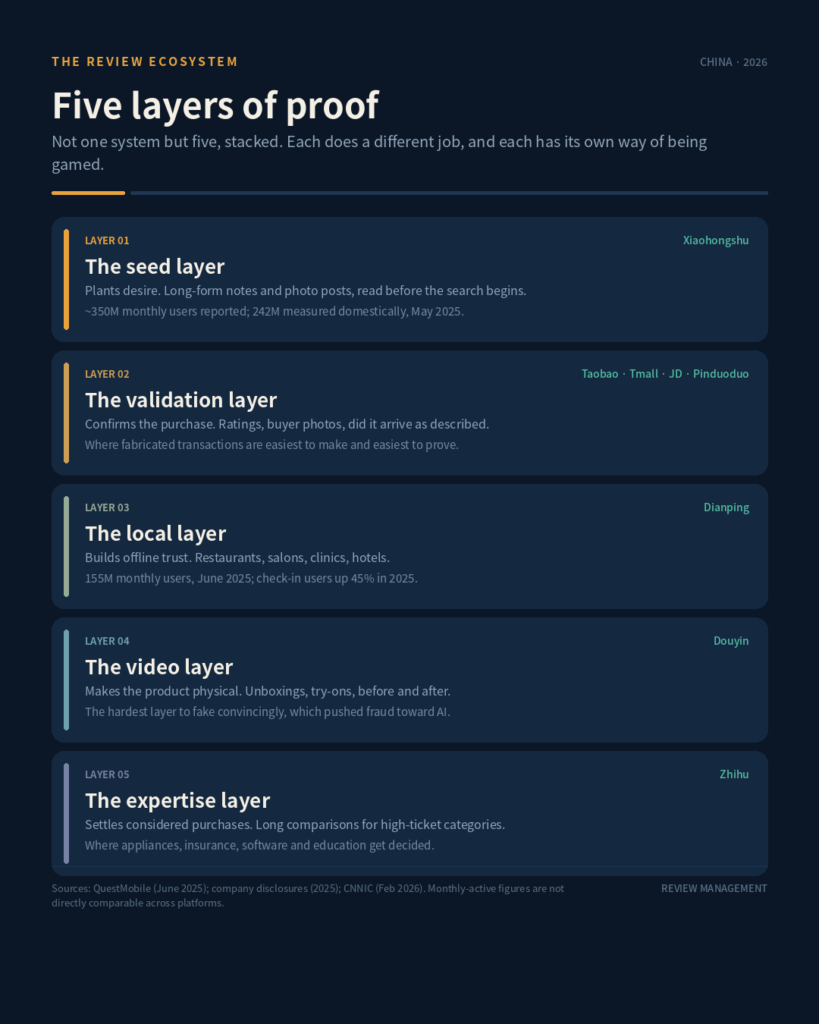
China’s review economy is not one system. It is five systems stacked on top of each other, each doing a different job in the decision.
The seed layer — Xiaohongshu. Long-form notes, photo dumps, “here is what happened when I used this for six weeks” posts. This is where desire gets planted. Xiaohongshu says it has passed 350 million monthly users; QuestMobile measured about 242 million domestic monthly actives in May 2025. The gap between those two numbers is worth sitting with, because it tells you something about how platform metrics travel. Either way, the platform’s function is unambiguous: it manufactures the want.
The validation layer — Taobao, Tmall, JD, Pinduoduo. Ratings, buyer photos, “did it arrive as described.” This is the layer where a planted want becomes a defensible purchase. It is also the layer regulators watch most closely, because it is where fake transactions are easiest to manufacture and easiest to prove.
The local layer — Dianping. Restaurants, salons, clinics, hotels. QuestMobile put Dianping at 155 million monthly actives in June 2025, against 511 million for the Meituan app. Offline trust gets built here, and it gets built by volume of reviews plus the platform’s own ranking mechanics. In 2025 the number of users posting check-ins on Dianping grew 45% year on year, and the number of review authors grew by close to 30%.
The video layer — Douyin. Unboxings, try-ons, “I bought five of these so you don’t have to.” Video converts a specification into a physical object. It is also the hardest layer to fake convincingly at scale, which is precisely why the faking moved to AI.
The expertise layer — Zhihu. Long comparisons, “which of these three should you actually buy,” answered by people who appear to know. High-consideration categories — appliances, insurance, B2B software, education — get settled here.
A brand with strength in one layer and silence in the others looks, to a Chinese shopper, like a rumor.
4. The playbook, step by step
Strip away the vocabulary and the operational discipline looks like this.
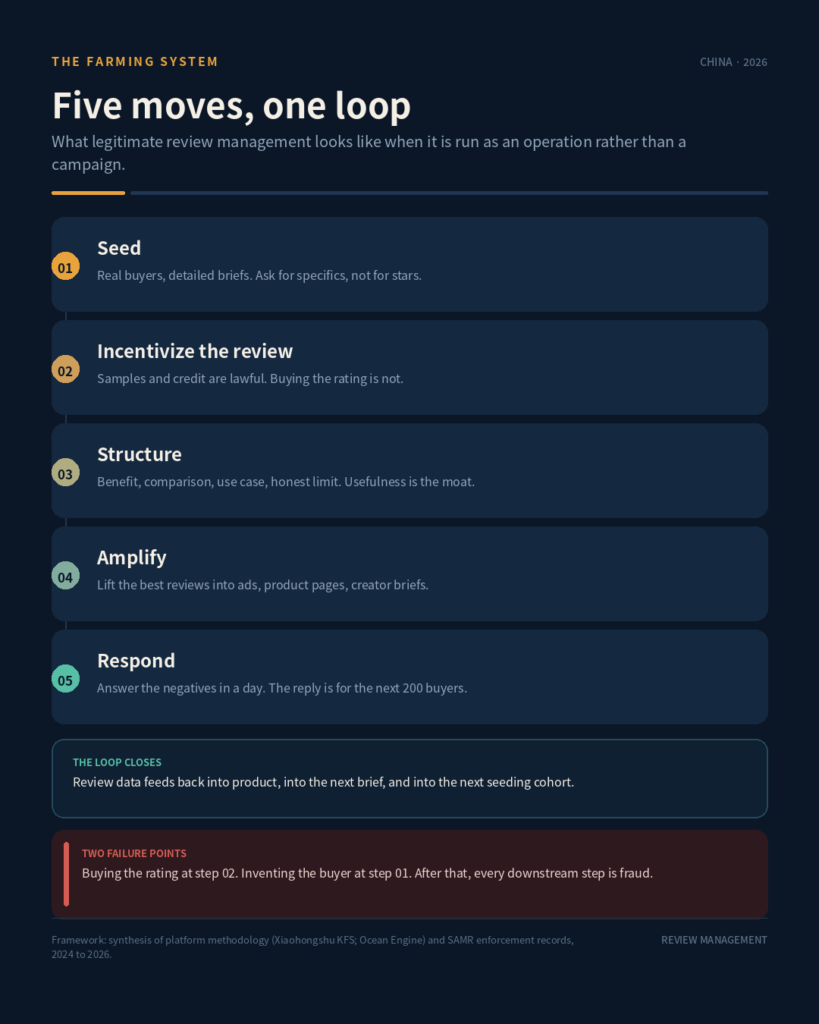
Step one: seed for specificity, not stars. The opening cohort of reviews decides what the review page becomes. Brands recruit real buyers and small creators, then ask for detail: what arrived, how it was used, what surprised them, who it is not for. A five-star review that says “good quality, fast shipping” is worth almost nothing. A four-star review that says “the strap digs in if you are over 175cm, but the buckle is the best I have used” is worth a great deal, because it reads like a person and it pre-empts the objection that would otherwise kill the sale.
Step two: incentivize the review, never the rating. Samples, coupons, points, a small credit — all normal, all legal, as long as the ask is for honesty rather than five stars. This distinction is not a matter of taste. Purchased praise is the exact behavior the regulator now goes after, and when it surfaces, the recovery cost dwarfs whatever the reviews earned.
Step three: engineer the structure. Guide reviewers to cover the four things a buyer needs: the specific benefit, the comparison to the obvious alternative, the use case it fits, and the honest limit. Do that and the review page stops being a scoreboard and starts being a decision aid. Usefulness is the moat, not volume.
Step four: amplify the winners. The review that explains the product best is an asset. Brands lift it into ad creative, into the product page, into the creator brief for the next cohort. A single well-argued review can be repurposed for eighteen months.
Step five: run a response desk. Not a complaint inbox — a desk. Reviews get read daily across five platforms; negative ones get answered within a working day by someone with authority to fix the problem; and the pattern across reviews gets fed back into product. The reply is not for the reviewer. It is for the two hundred people who will read it before they buy.
5. The platforms publish their own playbooks
One reason this discipline is so advanced in China: the platforms industrialized it and then taught it.
Xiaohongshu’s official model is KFS — KOL, Feeds, Search. Creators produce the content, the feed distributes it, and search harvests the demand the feed created. Layered on top is the “reverse funnel”: instead of chasing the broadest audience first, you find the tight core of people whose specific problem your product solves, saturate them, and let word of mouth widen the circle.
Read that model carefully and you notice it is a review-management system wearing a marketing label. The content is review-shaped. The distribution is review-shaped. The search behavior it harvests is people looking for other people’s verdicts.
Douyin runs its own version through Ocean Engine, and Meituan runs one for local merchants. The methodology is not secret. It is published, taught, and certified. Which is why the capability gap between a Chinese brand team and a Western one is rarely about ideas. It is about whether anyone on the team has ever been trained to run this.
6. Where it becomes fraud
Now the part the industry usually skips.
There is a line, and it is not subtle once you look at the enforcement record. On one side: seeding real customers, structuring their feedback, amplifying what is true. On the other: inventing the customer.
China Central Television ran an exposé in 2025 on what the trade calls “zero negative review” shops. The mechanics were mundane and industrial: recruitment on Xiaohongshu and Xianyu, code words to dodge platform filters, RMB 5 to 6 per fabricated review, forged logistics records so the parcels looked real. The same year, regulators flagged a newer variant — AI-generated buyer photos. Merchants were producing photorealistic “customer” images at near-zero marginal cost and dropping them into comment sections. Zhejiang’s consumer council said plainly that using AI to fabricate reviews crosses the honesty line that market transactions rest on.
The enforcement cases show the economics at work. In one Shenzhen case, an oral-care brand sold more than 600,000 units of a single toothpaste SKU through a Douyin store; investigators found that more than 530,000 of them were fabricated orders, about RMB 6.94 million in fake transactions against roughly 69,000 genuine units. Actual profit was RMB 346,000. In another case, an apparel operation ran 35,062 fake orders across five stores between July 2025 and March 2026, paying RMB 10 in commission per order and shipping empty parcels weighted with salt and tissue paper to satisfy courier scans. Total commission: RMB 350,620. And in Guangzhou, a consultancy published 113 ranking lists in which clients paid to appear at the top — conduct regulators treated as false advertising.
Notice what these have in common. The fake activity is cheap, the real revenue is small, and the penalty is large. That ratio is the whole story of the last three years.
7. The enforcement squeeze, in dates
If you are building a review program and you only remember one thing, remember the timeline.
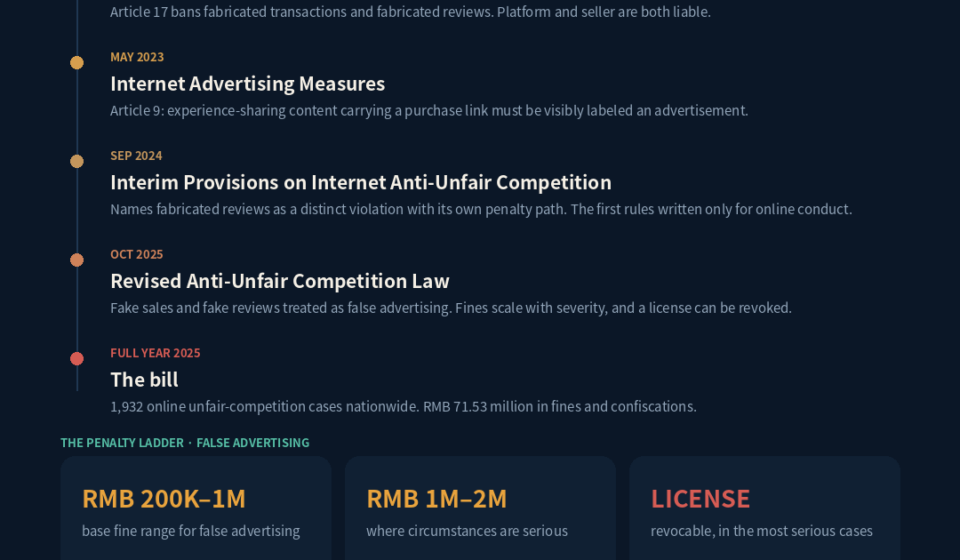
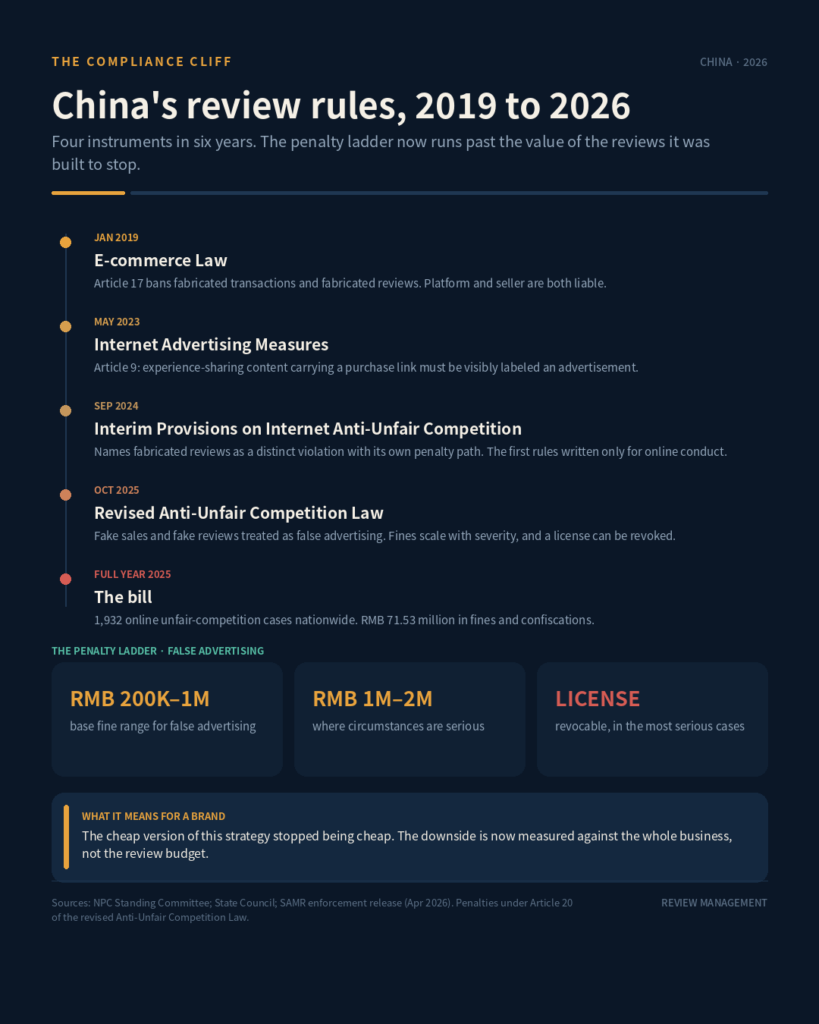
- January 2019 — E-commerce Law in force. Article 17 prohibits fabricating transactions or reviews to mislead buyers. The obligation lands on the platform as well as the seller.
- May 2023 — Internet Advertising Measures in force. Article 9 requires knowledge-sharing, experience-sharing and product-testing content with purchase links to be labeled as advertising. The “plant grass” economy becomes legally visible.
- September 2024 — Interim Provisions on Anti-Unfair Competition on the Internet in force. A regulation from the State Administration for Market Regulation (SAMR), built specifically for online conduct, it names fabricated transactions and fabricated user reviews as a distinct category with a clear penalty path.
- October 2025 — Revised Anti-Unfair Competition Law in force. Passed in June 2025, expanded from 33 to 41 articles, and it treats inflated sales figures and user reviews as false advertising. Fines run from RMB 200,000 to RMB 1 million, rise to RMB 1 to 2 million where circumstances are serious, and can reach license revocation.
- 2025 enforcement year — the numbers. Across the country, market regulators handled 1,932 online unfair-competition cases and imposed RMB 71.53 million in fines and confiscations, with fabricated reviews and paid rankings among the recurring targets.
8. The authenticity paradox
Here is the trap nobody warns you about.
The techniques that make a review page persuasive are the same techniques that make it look engineered. Ask forty buyers for detailed reviews in the same week, with the same brief, covering the same four points, and you get forty reviews that read like they were written to a template. Because they were. Shoppers in this market have seen a great many engineered review pages. They have developed an eye for the tell: too many reviews clustered in one week, too many mentioning the same feature in the same order, no negative reviews at all.
A page with 4.9 stars and zero complaints is now a warning sign, not a reassurance. A page with 4.6 stars, three savage reviews about a delivery delay in March, and a brand reply that fixed it, reads as real.
Which means the strategy cannot be “more reviews.” It has to be “more texture.” Different lengths, different use cases, different reasons for buying, arriving at an uneven rhythm, with the negative ones left standing.
9. Why global brands keep losing this
Four failure modes, in rough order of how often I see them.
They file reviews under customer service. In most Western org charts, reviews sit with CX or support — a cost center to be monitored. In China they sit with growth, because they are the top of the funnel. Same data, different budget line, completely different outcome.
They monitor the platforms they know. A global team will have dashboards for Trustpilot and Google and nothing at all for Dianping, where a restaurant’s entire local reputation lives. The blind spot is not a technology problem. It is a scope problem.
They answer in translated corporate Chinese. A defensive reply written by someone who has never read a Chinese comment thread can turn a two-line complaint about a scratched lid into a screenshot that travels. Tone is the product here.
They have no seeding capability. No KOC network, no sample logistics, no briefing template, no way to move forty real buyers through a review in three weeks. The Chinese competitor has all four, and treats them as fixed costs.
10. AI is now rewriting the review layer, in both directions
Two things are happening at once, and they pull against each other.
Platforms are using models to clean up the mess. Dianping announced in September 2025 that it would use in-house models trained on its review corpus to strip out inauthentic reviews and surface what it calls “AI plus real high scores” — a ranking built on verified visits rather than on text that could have been written by anyone. A Meituan executive has said in public that a model cannot judge a restaurant, because it never ate the meal.
Merchants are using models to make the mess. AI buyer photos, AI-written reviews with plausible imperfections, AI-generated “before and after” pairs. The marginal cost of a fake review has fallen to nearly zero, which breaks the old deterrent arithmetic: faking used to be expensive enough to be risky.
And a third force is quietly changing what a review is for. Buyers increasingly ask a model instead of scrolling a page — and the model answers from whatever review and discussion corpus it can reach. Your review estate is now training data for someone else’s recommendation. Brands that spent a decade optimizing for the platform’s ranking algorithm now have to optimize for a language model’s citation behavior, which rewards specificity, corroboration across sources, and plain statements of fact over adjectives.
11. A 90-day plan you can actually run
Days 1–30: audit. Pull every review across Xiaohongshu, the marketplaces, Dianping and Douyin for your category and your three closest competitors. Count reviews, not stars. Note recency, length, whether photos appear, and whether any negative reviews survive. You are looking for the texture gap, not the score gap.
Days 31–60: seed. Recruit 30 to 50 real buyers through your existing customer list and a small creator pool. Brief them on the four points. Ask for honesty in writing, and mean it. Expect a third of them to say something inconvenient.
Days 61–90: operate. Stand up the response desk with a named owner per platform, a one-working-day SLA on negatives, and a weekly pattern report to product. Then pick your three best reviews and put them into paid creative. The loop closes when a review starts selling.
What this actually means
Chinese brands did not get better at marketing than everyone else. They got earlier. They understood that in a market where the shopper researches for days before committing, the review is the marketing — and then they built departments around that single insight while everyone else was still building campaign calendars.
The lesson is not “buy more reviews.” That road now ends in a fine. The lesson is that trust in this market is manufactured, audited, and increasingly machine-read — and that a brand with no review operation has outsourced its reputation to strangers who owe it nothing.
Your reviews are not a reflection of your product. Increasingly, they are the product the next customer buys.