The Shelf Became a Studio: How JD.com Learned to Sell Attention
JD.com spent two decades convincing Chinese shoppers that it delivers genuine products fast. At its 2026 merchant content conference, held in Beijing on April 14, it made a different promise to merchants: put your products on camera, and we will help 100,000 of you double your sales this year.
That target is part of a larger shift. JD now runs a real content business, with creator funds, livestream programming blocks, short-video distribution and AI-generated hosts working around the clock, and it increasingly earns money from the attention that content attracts rather than from the goods themselves.
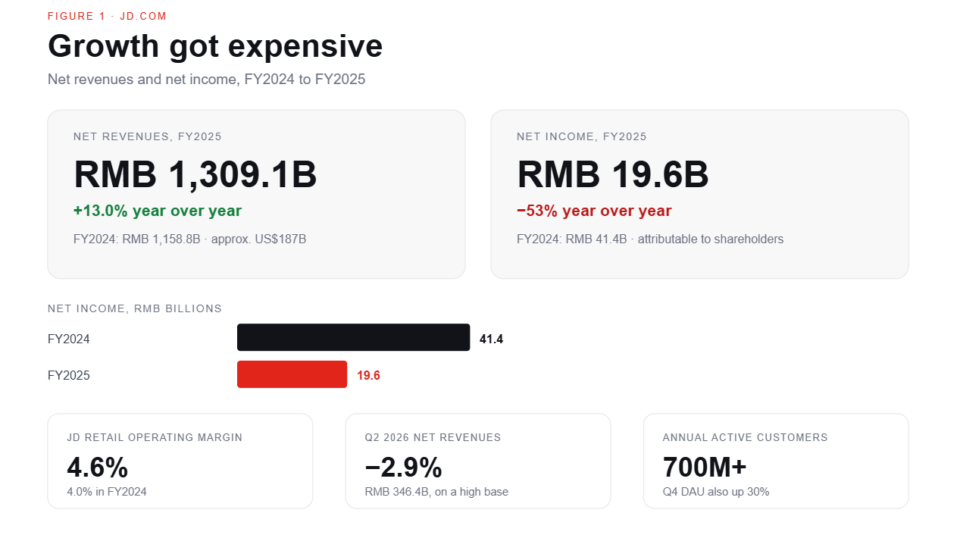
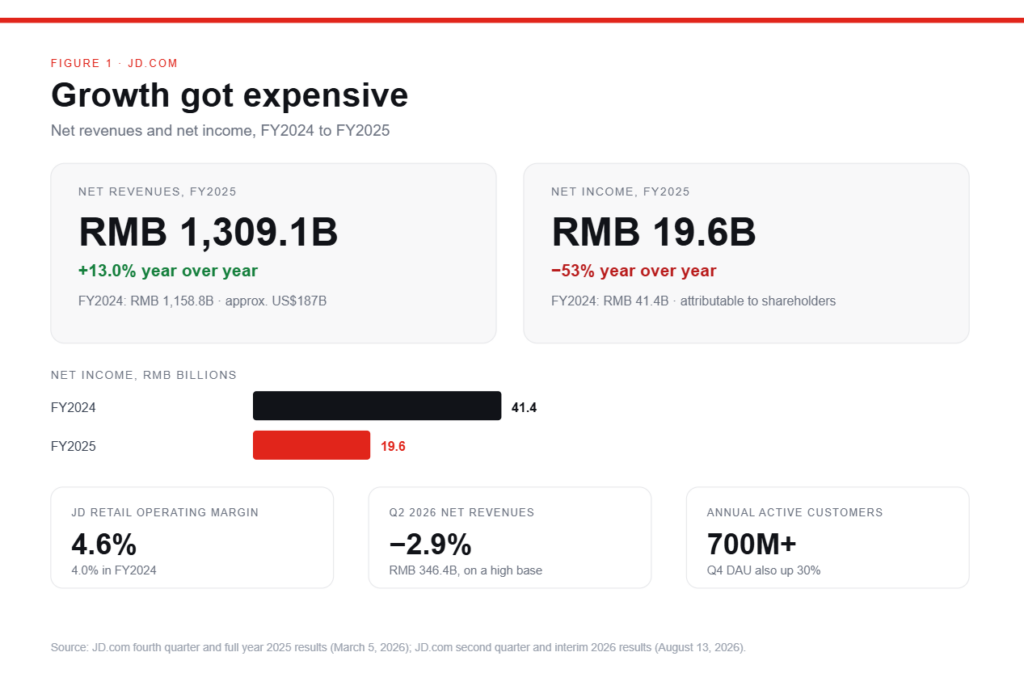
Three sentences explain why this matters. Revenue for 2025 reached RMB 1,309.1 billion, up 13 percent. Net income attributable to shareholders fell by more than half, to RMB 19.6 billion. And in the most recent quarter, revenue declined.
Growth now has to be bought. Content is one of the things it is buying growth with.
A Retailer by Revenue, a Broadcaster by Instinct
Start with what JD is.
JD.com was founded in June 1998 by Liu Qiangdong (Richard Liu), listed on Nasdaq in 2014, and later added a Hong Kong listing. It ranks 41st on the 2026 Fortune Global 500, up from 44th a year earlier, and remains the highest-ranked mainland-Chinese private company on that list. It employs more than 900,000 people across its ecosystem, and 2025 spending on compensation and benefits alone came to RMB 157.2 billion.
What separates JD from Alibaba is ownership. Tmall and Taobao connect buyers and sellers; JD buys inventory, holds it and moves it through its own logistics network. That model is heavy, expensive and hard to copy, which is exactly why JD has defended it for twenty years.
It also means JD owns the whole customer journey, from the moment someone opens the app to the moment a courier rings the bell. No marketplace has that. And once you own the journey, the question of where discovery happens stops being someone else’s business.
The Numbers That Actually Matter
The 2025 results, published on March 5, 2026, tell two stories at once.
The first is scale. Full-year net revenues reached RMB 1,309.1 billion, roughly US$187 billion, a 13 percent increase. Annual active customers passed 700 million. Daily active users in the fourth quarter grew about 30 percent year over year, and quarterly active users and purchase frequency each grew more than 30 percent. For a company this size, that is not normal.
The second story is cost. Net income attributable to ordinary shareholders dropped from RMB 41.4 billion in 2024 to RMB 19.6 billion, a fall of roughly 53 percent. On a non-GAAP basis it fell from RMB 47.8 billion to RMB 27.0 billion. The fourth quarter alone produced a net loss of RMB 2.7 billion.
Between those two stories sits the retail core, which is doing fine on its own terms. JD Retail generated RMB 51.4 billion of operating income for the year, with an operating margin of 4.6 percent, up from 4.0 percent. Read that again: the retail business got more profitable while the group got less profitable. The difference is what JD is spending to find new demand — food delivery, international expansion, and the content machinery that feeds the app.
The most recent quarter sharpens the picture. In the second quarter of 2026, revenue fell 2.9 percent to RMB 346.4 billion, dragged down by a 5.4 percent decline in product revenue against a high year-earlier base. Service revenue, which includes marketplace commissions and advertising, rose 6.8 percent. The chief financial officer put it plainly: high-margin marketplace and marketing revenues continued to outperform.
That sentence is the whole article in miniature. The goods business is flat to down. The attention business is growing.
What “Content Pivot” Actually Means Here
“Content” is a slippery word, so let’s be concrete. At JD it describes five connected layers.
Creator supply. JD pays people to make videos. In April 2024 it announced RMB 1 billion in cash incentives for creators and institutions, with weekly bonuses of up to RMB 30,000 for qualifying individuals, subsidized playback, sales commissions, and a separate RMB 5 million program for agencies that onboard influencers at scale. The stated goal at the time was 100 star creators by year end.
Programming blocks. The company now runs what it calls five livestream formats: youth-hosted shows, executive-hosted shows, on-location broadcasts, celebrity appearances and fully automated AI streams. Add nine vertical tracks spanning electronics, technology, food, fashion, lifestyle, outdoor, health, live events and AI, and you have something that looks suspiciously like a channel schedule.
AI production. JD gives merchants a free digital-human service — one it values at RMB 30,000 a year — that can stream 24 hours a day with nobody in the room. Merchants can also open a shop livestream at zero cost, and JD’s own buyers will host shows on their behalf with no commission and no slot fee.
Conversion plumbing. This is the part Western retailers keep getting wrong. Content does not sit in a separate app waiting for a handoff. A short video, a livestream, a product review and the checkout button all live in the same session, which means the distance between being persuaded and being charged is measured in taps.
Attention monetization. Once merchants depend on video for sales, they buy advertising to amplify it. That is where the margin sits, and why service revenue is outgrowing product revenue.
The Starting Gun Was 2024, Not 2026
It is tempting to read the content push as a reaction to TikTok-style commerce. It began earlier and more quietly.
JD’s own framing in 2024 leaned on a behavior statistic: according to the China Internet Audiovisual Development Research Report, 71.2 percent of surveyed users shop through short videos and livestreams, and more than 40 percent name those formats as their primary purchasing channel. In other words, the question stopped being whether Chinese consumers buy from video and became which app they open first.
That is an uncomfortable question for a company whose historical advantage was search: you type a model number, you compare, you buy. Search rewards the retailer with the best catalog and the fastest delivery. Video rewards whoever captures the idle scroll.
2026: The Doubling Plan
The April 2026 conference turned all of this into a formal merchant program built on four pillars and twelve initiatives, with one headline commitment: help 100,000 new merchants achieve 100 percent year-on-year sales growth through livestream and short video during 2026.
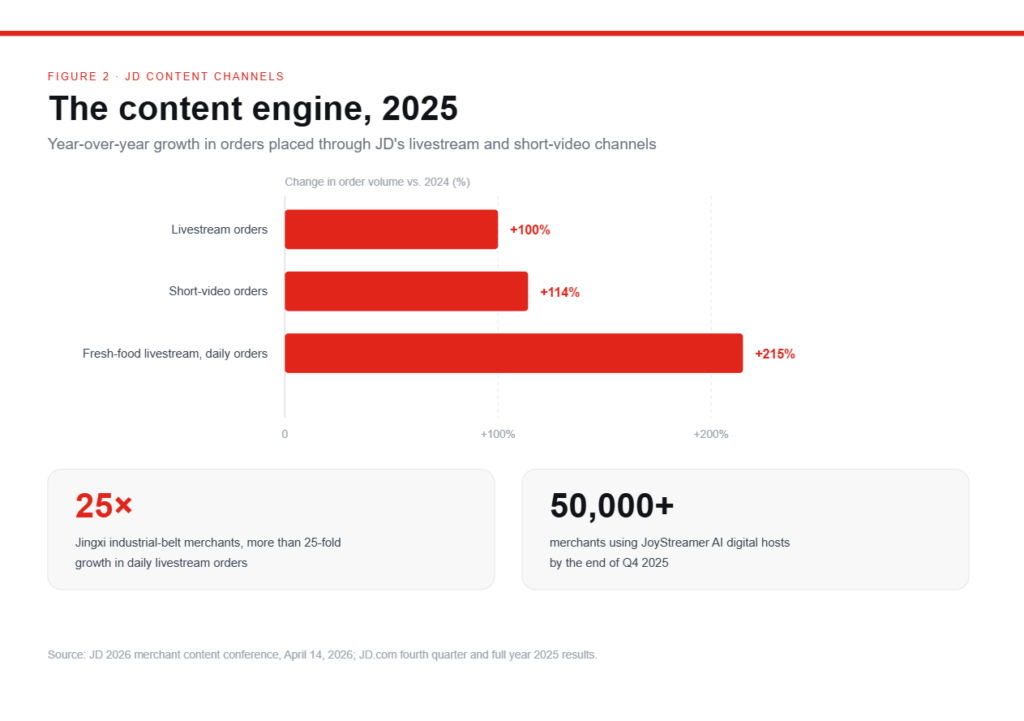
The 2025 numbers behind that promise are the strongest evidence that the pivot is real rather than rhetorical. According to figures presented at the conference, the number of merchants and creators selling through JD’s livestream business doubled year over year, and traffic doubled with them. Orders placed through JD livestreams rose more than 100 percent; orders placed through short video rose 114 percent. Daily livestream orders from fresh-food merchants rose 215 percent. Daily livestream orders from merchants on Jingxi, JD’s value-focused platform, rose more than 25-fold, with the number of daily streaming accounts and sessions each up more than fivefold.
The initiatives themselves are revealing about where the friction was. JD is pushing traffic at merchants, tying livestream and short video into the app’s main promotional channels — the subsidy program, flash sales, deal pages — and letting its advertising system pull in traffic from outside the platform. New products get an extra traffic boost of more than 50 percent if they come with a content plan. The AI toolkit is priced to remove excuses: automated clipping lifts livestream conversion by more than 40 percent, AI product selection lifts livestream transaction value by about 30 percent, AI cue cards lift viewers by about 34 percent, and planning a full show’s product lineup and script now takes eight minutes.
Eight minutes. That is not a productivity improvement. That is a change in who can afford to broadcast.
Twenty-Four Hours a Day, Nobody in the Studio
The single most underreported number in JD’s 2025 results release is this: more than 50,000 merchants were using JoyStreamer, its AI digital-human system, by the end of the fourth quarter. Fifty thousand merchants are running synthetic presenters — most of them small and mid-sized brands that could never justify a full-time host.
The surrounding AI footprint is just as large. JD’s customer service systems handled more than 4.2 billion inquiries during the 2025 Singles’ Day promotion. More than 50,000 AI agents were running inside the company’s internal workflows by year end. JoyInside, its agent for hardware, had signed more than 40 brands at that point and nearly 200 by mid-2026.
Why does this matter for a brand marketer? Because it collapses the cost of presence. A retailer used to rent shelf space. Now it rents attention, and the marginal cost of a few more hours of attention approaches zero. When the supply of shopping content becomes effectively infinite, the scarce resources flip: trust, distinctiveness, and the willingness of a real person to put their name on a recommendation.
The Moat Nobody Talks About: Buyers Who Can Sell
Every platform can hire influencers. JD has something rarer.
Its differentiated format is what the company calls merchandiser livestreaming — caixiao in Chinese, meaning procurement-and-sales — with shows hosted by JD’s own category buyers: the people who negotiate with brands, know the supply chain end to end, and can explain why one air fryer costs twice as much as another. The company’s livestream team describes this as the core advantage over rival platforms: the host understands both the product and the price.
It is a strange kind of moat, and a durable one. Douyin can manufacture reach; Xiaohongshu can manufacture taste. Neither can manufacture a buyer who has spent a decade inside a category and can answer, live, why a refrigerator’s compressor matters.
The Structural Shift That Should Change Your Budget
Here is the part most global brand teams have not caught up with.
In early 2026, a white paper on China’s livestream commerce industry was released by the Development Research Centre of the State Administration for Market Regulation together with a research group from the Chinese Academy of Social Sciences. Its findings describe a market that has quietly reorganized itself.
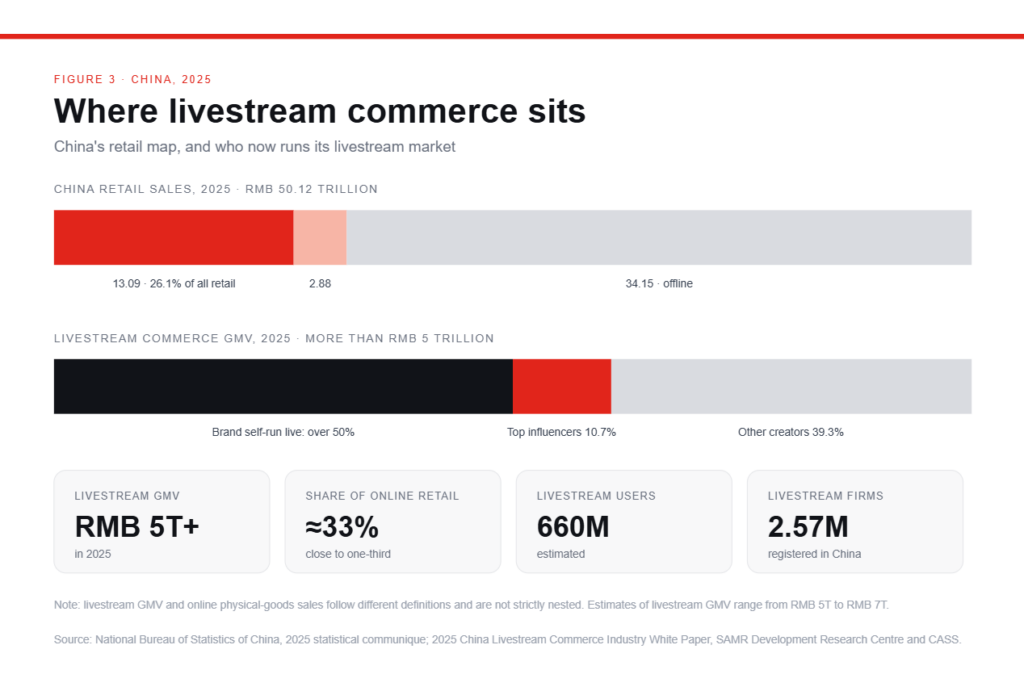
Livestream commerce generated more than RMB 5 trillion of gross merchandise value in 2025, close to one-third of China’s online retail sales, with an estimated 660 million users. The market grew more than twelvefold between 2019 and 2024. And the composition has inverted: livestreams run by brands themselves now account for more than half of livestream GMV, while the share driven by top-tier influencers has fallen to about 10.7 percent.
The implication is uncomfortable. The era when a handful of mega-hosts controlled the channel is over. The channel is now mostly run by brands, on their own accounts, with their own people or their own digital doubles, which is precisely why a retailer with 700 million customers and a merchant base measured in the millions cares so much about teaching those merchants to broadcast.
For context on the size of the pool: China’s online retail sales reached RMB 15.97 trillion in 2025, up 8.6 percent, of which online sales of physical goods reached RMB 13.09 trillion, equal to 26.1 percent of all retail sales in the country. E-commerce contributed more than a third of the year’s total retail growth. Definitions vary — some industry estimates put livestream GMV closer to RMB 6 or 7 trillion depending on what gets counted — but the direction is not in dispute.
What This Means for Global Brands
If you sell into China, or plan to, five adjustments follow.
Stop treating JD as a listing. A listing competes on price and stock. A content presence competes on being remembered. If your JD account is managed by a distributor with a spreadsheet, you are structurally locked out of the growth.
Budget for production, not just media. The merchants winning on JD are not the ones with the biggest ad budgets. They are the ones with a repeatable filming cadence: weekly shows, category-specific scripts, review-style short videos that keep working after the stream ends.
Use the digital-human tier deliberately. A synthetic host is excellent for late-night coverage, long-tail SKUs and price-and-spec explanation. It is poor at building affection. The sensible split is humans for narrative and launches, digital humans for endurance.
Design for the shorter path. On a platform where inspiration and checkout share a session, the cost of a vague value proposition is higher than on a marketplace where the customer arrives already searching. Your product page is now a landing page for a video.
Plan for disclosure. China’s regulators issued rules on livestream e-commerce supervision in December 2025, tightening responsibilities across platforms, merchants and hosts. AI presenters are part of that conversation. Assume disclosure requirements will get clearer, not looser.
The Honest Caveats
Three things could break this story.
The math. JD’s group-level profitability halved in 2025, and the second quarter of 2026 showed revenue actually shrinking. Content may be defending the franchise, but defending is expensive, and the market will keep asking when the spending stops.
The credibility problem. Content that lives on a shopping platform is commercial by definition, and viewers know it. Independent creators built audiences by being interesting first and commercial second. A retailer has to earn that order of operations, and it is not obvious that a checkout button in the corner helps.
The measurement problem. Livestream GMV figures vary by trillions depending on definitions, and GMV is a poor proxy for profit. Brands should be skeptical of channel-level ROI claims and insist on incremental analysis.
What to Watch Into 2027
Three signals will tell you whether JD’s content bet is working.
Watch the mix, not the total. If service and marketing revenue continues to outgrow product revenue while retail margins hold near 4.6 percent, the media-company thesis is compounding.
Watch whether creators stay. JD bought supply with cash in 2024. Cash-bought creators leave when the subsidy does. Retention of mid-tier creators is the real test.
Watch the AI cost curve. If eight-minute show planning becomes two minutes, and digital hosts become genuinely watchable, the number of merchants who can sustain a daily channel goes from tens of thousands to hundreds of thousands.
The Takeaway
JD did not become a media company because it wanted to. It became one because the moment of discovery moved, and a retailer that does not own discovery ends up renting it from someone else, usually at a price set by a competitor.
The 100,000-merchant target is the clearest signal yet. When China’s largest self-operated retailer starts teaching its suppliers to make television, the channel has changed shape. Brands that still treat JD as a shelf are optimizing for a store that is quietly turning into a studio.
Frequently Asked Questions
How big is JD.com?
JD.com reported RMB 1,309.1 billion (about US$187 billion) in net revenues for the 2025 financial year, a 13 percent increase, with more than 700 million annual active customers. It ranked 41st on the 2026 Fortune Global 500 and employs more than 900,000 people across its ecosystem.
What exactly is JD’s content pivot?
It is the build-out of a content layer inside JD’s shopping app: creator incentive programs, five livestream formats, short-video distribution, merchant training and AI production tools. The goal is to turn a place people go to buy into a place where they also discover.
Why would a retailer do this instead of just buying ads?
Because discovery time is being captured elsewhere. If consumers meet products on short-video platforms, the retailer loses the first impression and eventually the transaction. Owning content means owning the first impression.
How is this different from Taobao Live?
JD’s model is self-operated, so its content sits closer to inventory, pricing and fulfillment, and its signature format uses JD’s own category buyers as hosts. Taobao Live operates inside a marketplace, where the platform connects third-party sellers to audiences.
Is the strategy working?
Partly. Engagement metrics are strong: livestream orders more than doubled in 2025, short-video orders rose 114 percent, and more than 50,000 merchants use AI digital hosts. Profitability metrics are not: group net income halved in 2025, and revenue declined 2.9 percent in the second quarter of 2026.