Bilibili Is Not a Niche. It’s Where 70% of Young China Already Is.
There is a video on Bilibili that runs nearly forty minutes and consists almost entirely of one man comparing rice cookers. Comments drift across the picture while he talks, timestamped and stacked: someone marking the second the steam appears, someone else litigating induction against IH heating, a third typing 来了来了 — here we go — before anything has happened at all.
If your media plan is built on six-second views, that scene reads as a rounding error. It is not. It is the entire argument.
Bilibili is the Chinese platform Western marketers misread most consistently. For a decade the shorthand was “anime site, small, a bit odd, skip it.” Then came 2025, and the company posted the first full-year GAAP profit in its history. Not by inventing a revenue line. By holding an audience it had been accumulating since 2009 long enough for that audience to reach its spending years, and by selling advertising into it without setting the place on fire.
That is a different story from “niche community.” It is the story worth understanding before your next China planning cycle.
The Platform Western Marketers Keep Getting Wrong
Here is the problem with the shortcut. Yes, Bilibili started in 2009 as a home for anime, comics, and games fans. Yes, its mascots are cartoon televisions. And yes, the homepage on a random Tuesday carries more cosplay than you expected.
But the platform is not organized around a feed. It is organized around people. The core product is what Bilibili calls PUGV — professional user-generated video — which in practice means creators who build followings over years, and viewers who arrive for the creator rather than for whatever the algorithm served. YouTube rewards the video. Bilibili rewards the person who made it.
That single difference changes how advertising behaves on the surface of the platform. On a feed, a bad ad is swiped away and forgotten. On a creator page, a bad ad is remembered, and so is the creator who took the money.
Danmu: the mechanic the West never built
Then there is the feature with no real Western equivalent. Danmu — bullet comments — are viewer comments that fly across the video itself, synced to the moment they were typed. Ten thousand people can watch the same video at ten thousand different times and still feel like they are in a room together.
For a viewer, it is company. For a brand, it is the most honest focus group on the internet. Nobody self-censors a comment that will scroll past in four seconds. If your product placement lands, you will see it in the danmu before you see it in the sales data. If it feels like an ad, you will see that too: in public, on your client’s video, permanently.
That is the trade Bilibili has spent seventeen years making: reach in exchange for trust. It is also why the company took so long to become profitable.
The Numbers That Actually Matter
Bilibili reports in RMB and lists on Nasdaq and in Hong Kong. The latest reported quarter is Q2 2026, with third-quarter results due November 24. Here is the short version.
| Metric | Latest figure | Change |
|---|---|---|
| Daily active users | 116.5 million | +7% year on year |
| Monthly active users | 371 million | — |
| Monthly paying users | 33 million | — |
| Average daily time spent | 113 minutes | total viewing time +14% |
| Total net revenue | RMB 7.94 billion (US$1.17 billion) | +8% |
| Advertising revenue | RMB 3.13 billion (US$461.4 million) | +28% |
| Gross margin | 37.2% | 16th consecutive quarter of expansion |
| Net profit | RMB 339.1 million (US$50.0 million) | +55% |
| Adjusted net profit | RMB 703.6 million (US$103.7 million) | +25% |
| Full-year 2025 revenue | RMB 30.35 billion | +13% |
| Full-year 2025 net profit | RMB 1.19 billion (US$170.3 million) | first GAAP annual profit |
A quarter-by-quarter read, with the boring parts left in
The temptation is to draw an arrow. Resist it.
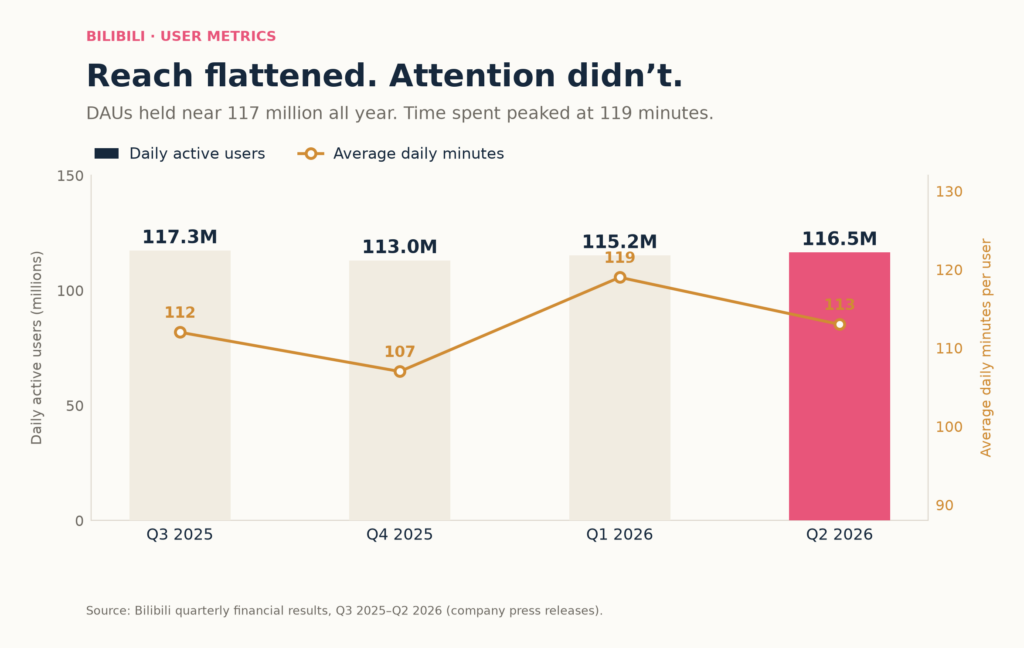
Daily active users went from 117.3 million in Q3 2025 to 113.0 million in Q4, then 115.2 million in Q1 2026 and 116.5 million in Q2. That is a plateau, not a breakout. Q4 dipped sequentially; the first half of 2026 recovered it.
What did move was attention. Average daily time spent per user went from 112 minutes to 107, jumped to 119 minutes in Q1 2026 — the highest the company has reported — and settled at 113 in Q2. Total viewing time still grew 14% year on year in that quarter, on DAU growth of 7%.
Put plainly: reach is a stock, attention is a flow. The first stopped compounding. The second did not.
Why “Niche” Is the Wrong Word
Seven in ten is not a niche
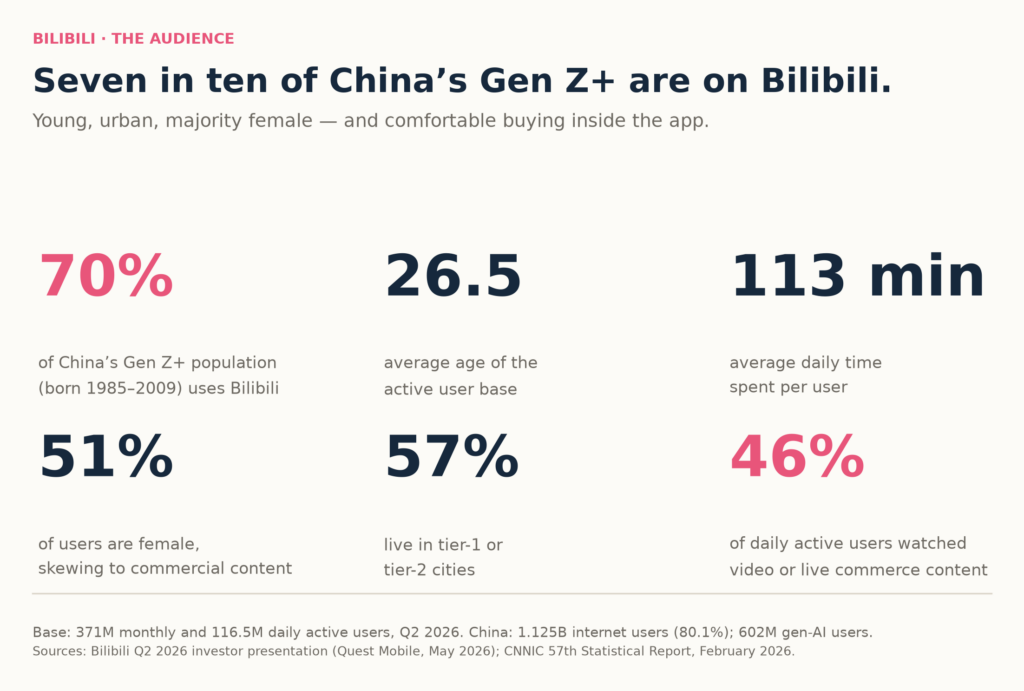
The number that should end the argument comes from Bilibili’s own investor materials, which cite Quest Mobile data from May 2026: roughly seven in ten people in China’s Gen Z+ cohort use the platform.
The label is doing quiet work, so it deserves a footnote. Gen Z+ means anyone born between 1985 and 2009. In 2026, that is everyone from about seventeen to about forty-one. It is not a youth segment. It is the prime consumption cohort of the world’s second-largest economy, and roughly 70% of it opens this app.
Seven in ten of an entire generation, in one market, on one app. That is not a niche. That is infrastructure.
The cohort aged up and stayed
Two numbers explain why this is structural rather than lucky. The average age of the active user base is 26.5. The average age of a new user is 22.6.
Read those together. Your existing users are getting older, which normally means drifting away. Here they stay, and the pipeline behind them is younger than the base. Bilibili is not chasing a demographic through a revolving door. It is running a room where the people already inside keep ordering another round.
Composition matters for planners too. 51% of users are female, and the company describes them as showing higher interest in commercial content. 57% live in tier-1 or tier-2 cities. And 46% of daily active users watched video or live-commerce content in Q2 2026, which means nearly half the daily audience arrives in a shopping mindset.
The Profitability Inflection
For most of the past decade, the standard question about Bilibili was whether the model worked at all. Full-year 2025 answered it, at least provisionally.
Revenue reached RMB 30.35 billion, up 13%. Gross profit rose 27% to RMB 11.11 billion, lifting gross margin to 36.6% from 32.7%. The company posted net profit of RMB 1.19 billion against a loss of RMB 1.36 billion a year earlier, and adjusted net profit of RMB 2.59 billion against an adjusted loss of RMB 39 million. Operating cash flow was RMB 7.15 billion. It ended the year with RMB 24.15 billion in cash, time deposits, and short-term investments.
What actually changed
Three things, and none of them were magic.
The advertising mix shifted toward higher-margin inventory. Gross margin climbed in every quarter of the year. And costs were held down while revenue grew: in Q3 2025, operating expenses fell 6% year on year even as revenue rose 5%.
Worth saying plainly, though: profitable is not the same as richly profitable. Full-year net margin was 3.9%. In Q2 2026 it was 4.3%. The gap between GAAP profit of RMB 1.19 billion and adjusted profit of RMB 2.59 billion is mostly share-based compensation — a real cost, paid in stock rather than cash, but still a claim on future dilution.
Bilibili is now a business that pays for itself. It is not yet a business with a wide cushion.
Follow the Money: Four Engines, One Rotation
Bilibili earns from four lines: value-added services (premium memberships and paid live-streaming products), advertising, mobile games, and IP derivatives.
In full-year 2025, the split was value-added services at 39.3%, advertising at 33.1%, games at 21.1%, and IP at 6.5%. By Q2 2026, advertising had moved to 39.4% and value-added services to 37.4%, with games down to 17.5% and IP at 5.7%.
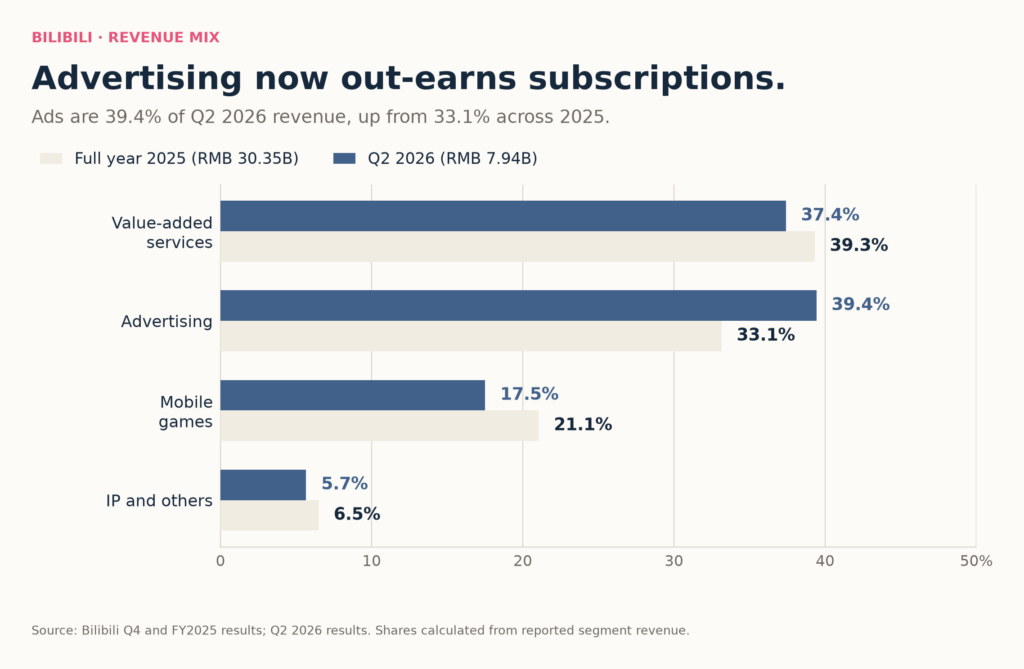
That is the rotation in one sentence: away from hit-driven games revenue, toward two recurring lines — advertising and subscriptions.
Advertising is carrying the company
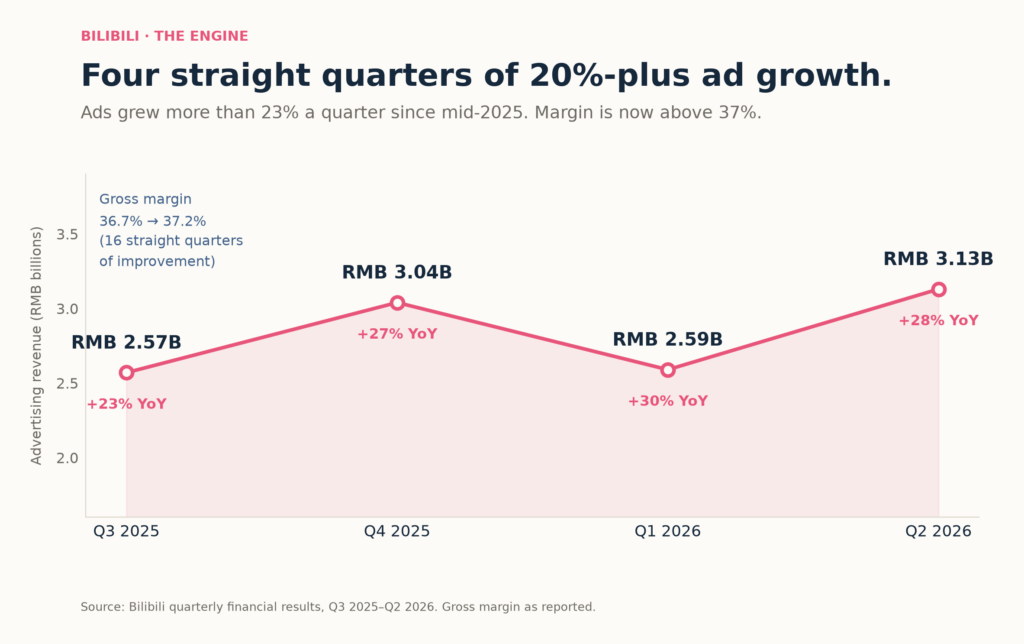
Advertising grew 23% in Q3 2025, 27% in Q4, 30% in Q1 2026, and 28% in Q2. Four consecutive quarters above 20%, on a base that was already growing. The company credits better ad products and better efficiency, which in plain language means it extracted more money from the same impressions: the least painful way to grow ad revenue.
The games line is arithmetic, not a collapse
This is where a lot of English-language coverage goes wrong. Take three recent quarters: games revenue fell 17% in Q3 2025, 14% in Q4, and 14% again in Q2 2026. The easy conclusion is that the games business is dying.
It is not. Full-year 2025 games revenue rose 14% to RMB 6.39 billion, helped by a full year of the licensed title San Guo: Mou Ding Tian Xia and the fourth-quarter launch of the in-house game Escape from Duckov. The quarterly numbers show a return to normal after an unusually large hit, not a structural decline.
The distinction matters for anyone modeling the company. A hit-driven line can look like a trend for three quarters and then not be one.
The AI Chapter Nobody Priced In
Bilibili does not talk about AI the way everyone else does. It reports it.
Revenue from AI-powered advertising tools grew 180% in 2025, and viewing hours of AI-assisted content rose roughly a hundredfold, according to Caixin’s reporting of the results. Management has flagged AI-assisted creation tools as a 2026 priority, aimed at the most expensive part of the business: making a good video.
Think about what that does to a community whose entire selling proposition is “this took effort.” Cheaper production expands supply, which is good for a platform that always needed more good mid-form video. It also thins the signal. If everyone can generate something watchable, then the thing that made Bilibili worth 113 minutes a day — the sense that a real person spent forty hours on this — becomes scarcer and more valuable at the same time.
That is the bet. Not “AI will save us,” and not “AI will kill us.” AI changes the cost of the content that justifies the ad premium, and the company is trying to land on the right side of that trade.
What This Means If You’re the Brand
Enough structure. If you have a China budget and a young-consumer target, here is what actually travels.
1. Buy the creator, not the impression
Programmatic habits imported from Meta will underperform here, and not slightly. The unit of value is a creator’s credibility with an audience that has followed them for years. Budget for fewer, longer partnerships, and give the creator room to say no to your script.
2. Mid-form is the format that survives AI
Ten-second cutdowns are now free to produce. Thirty-minute reviews are not. If your category rewards explanation — devices, beauty, education, finance, or travel — Bilibili is one of the few places where the long version still gets watched to the end.
3. Read the danmu
Before you commission a second video, download the comments from the first. You will learn more about how your product is actually understood in China from eight thousand timestamped reactions than from a quarterly brand tracker, and you will learn it in a week.
4. Re-cut the plan around tier-1 and tier-2 cities, and around women
With 57% of users in tier-1 or tier-2 cities and 51% female, the platform’s center of gravity is not “student with no money.” It is urban, increasingly affluent, and skewed toward categories where purchases get researched rather than impulse-bought.
5. Treat commerce content as a shelf, not a spot
Nearly half of daily active users watched video or live-commerce content in Q2 2026. That is not a channel for awareness at the top of the funnel. It is where people go to decide.
The Honest Caveats
Three that matter, plus a macro problem that isn’t Bilibili’s fault.
User growth has flattened, and Q4 2025 showed a sequential decline. Bilibili is no longer a user-growth story. It is a monetization story, and those get judged quarter by quarter.
Paying users have plateaued. The company reported 35 million monthly paying users in Q3 2025 and 33 million in Q2 2026, against 371 million MAU. That is roughly 9% conversion. Every incremental yuan now has to come from ad load, ad pricing, or deeper monetization of the same paying base — and ad load is exactly the lever that erodes the trust the whole model rests on.
Competition for attention is structural. Douyin and Kuaishou are not going to stop. Bilibili’s answer is depth rather than volume, and depth is a harder thing to hold when short video keeps getting better.
Then there is the ceiling: China had 1.125 billion internet users at the end of 2025, or 80.1% penetration. There is no unclaimed audience left to conquer. From here, growth is arithmetic on a saturated base.
What to Watch Next
Bilibili reports third-quarter 2026 results on November 24, which makes the next few weeks unusually informative. Four things are worth tracking.
Whether advertising growth holds above 20% for a fifth straight quarter. Whether gross margin clears 38% without a cost cut doing the work. Whether the paying-user line turns back up. And whether AI creation tools show up as more supply without a visible drop in average quality — the first real test of whether the moat is the tooling or the taste.
The Takeaway
Bilibili stopped being a niche curiosity somewhere around the time its average user turned twenty-six. What 2025 proved is narrower and more useful than the headlines suggested: a platform can spend a decade building community loyalty first and monetizing second, and still come out the other side with a profit and its audience intact.
For a brand, the practical version is simple. If China’s next decade of buyers matters to you, this is the densest concentration of them anywhere on the Chinese internet. And the only way in is through people they already trust.
FAQ
Is Bilibili profitable?
Yes, on a full-year basis since 2025. Bilibili reported net profit of RMB 1.19 billion (about US$170 million) for fiscal 2025, against a net loss of RMB 1.36 billion in 2024, and adjusted net profit of RMB 2.59 billion. Margins remain thin: 3.9% for the full year, 4.3% in Q2 2026.
How many users does Bilibili have?
371 million monthly active users and 116.5 million daily active users in Q2 2026, with 33 million monthly paying users. Users spend 113 minutes a day on the platform on average.
Is Bilibili just China’s YouTube?
No. YouTube organizes around videos and search; Bilibili organizes around creators and communities, with interest-based verticals and bullet comments overlaid on the video itself. The commercial consequence is that advertising on Bilibili behaves more like sponsorship than like programmatic placement.
Why should a Western brand care about Bilibili?
Because roughly seven in ten of China’s Gen Z+ population — people born between 1985 and 2009 — use it, the average user is 26.5, and 57% live in tier-1 or tier-2 cities. It is the highest-density access point to China’s current and next generation of urban consumers.
What is Bilibili’s biggest weakness?
User growth has flattened while paying-user conversion sits near 9%, which pushes the company toward higher ad load — the one lever that can damage the community trust its ad pricing depends on.