Kuaishou’s Down-Market Playbook: The Commerce Engine the West Overlooks
Ask ten Western brand strategists about China’s short-video duopoly, and nine will name Douyin. The tenth will mention Kuaishou, then change the subject.
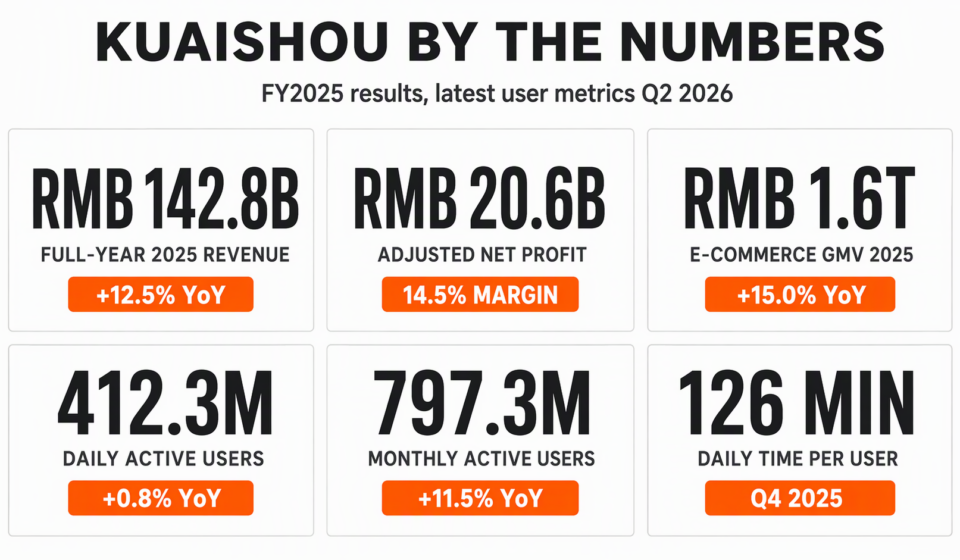
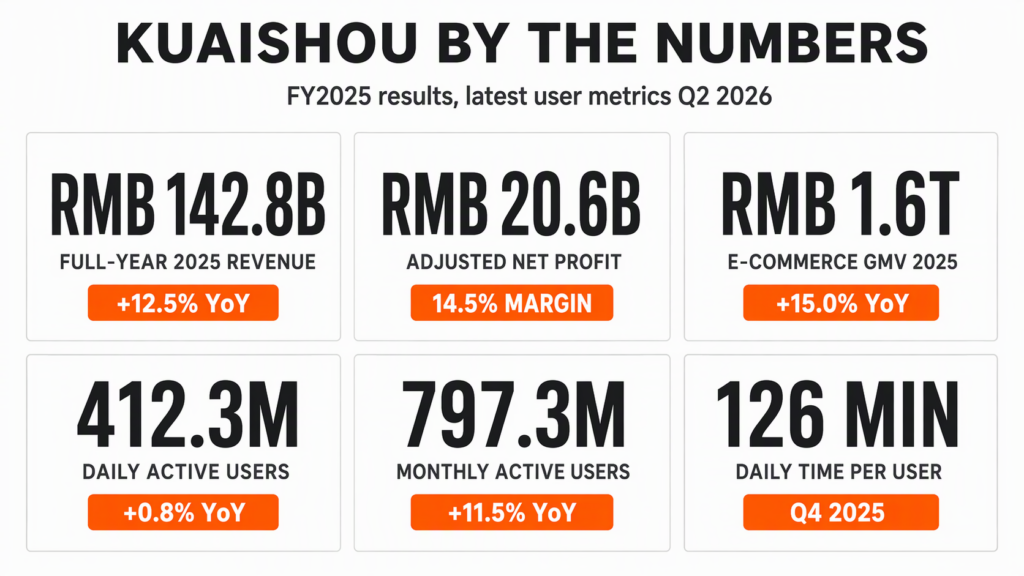
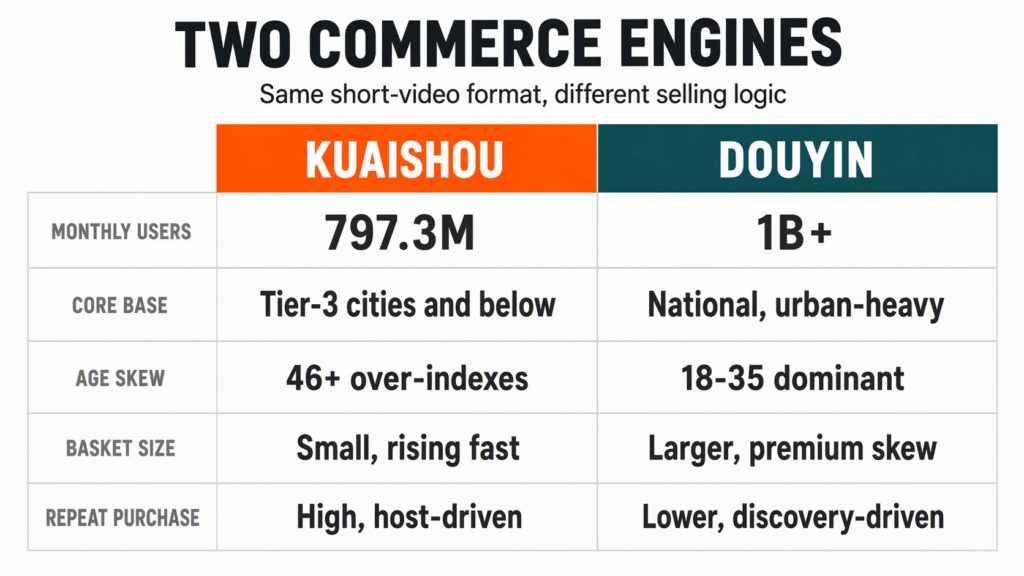
That reflex is expensive. Kuaishou isn’t a poorer copy of Douyin. It is a different machine, running a different playbook, in front of an audience Western marketing has spent a decade filing under “later”. In the second quarter of 2026, it averaged 412.3 million daily users and 797.3 million monthly users. That is not a niche. That is a country-sized audience with a buying habit the rest of the industry keeps failing to model.
So let’s do the unfashionable thing and look at how the machine actually works.
What Kuaishou Actually Is
Strip the branding away and you get three products stacked on one another: a short-video feed, a live-streaming platform, and a shop that sits inside both.
It began in 2011 as a GIF-making tool and moved into short video in 2013, which makes it the oldest of China’s big video platforms — older than Douyin, older than the playbook everyone copied. It listed in Hong Kong in February 2021 under stock code 1024, more than doubled on its first day, and was briefly valued above US$150 billion. Tencent has been a shareholder since before the listing. The China Internet Investment Fund, an entity inside the Cyberspace Administration of China’s orbit, holds a golden share — the instrument Beijing has used across its internet majors to keep a veto over certain decisions without owning the company outright.
That last detail matters more than most foreign analysts admit. Kuaishou is a commercial company operating inside a policy envelope. Its moderation choices, its community norms and its reluctance to chase certain categories are not quirks of taste. They’re structural.
The Numbers, Without the Hype
Full-year 2025: revenue of RMB 142.8 billion, up 12.5%; adjusted net profit of RMB 20.6 billion on a 14.5% margin; e-commerce GMV of RMB 1,598.1 billion, up 15%. Average daily users 410.2 million. Average monthly users 724.6 million. Average time in app: 126 minutes a day.
Then 2026 arrived and the growth rate fell off a table. Second-quarter revenue rose 1.4% to RMB 35.5 billion. Adjusted net profit dropped to RMB 3.9 billion from RMB 5.6 billion a year earlier. Gross margin slid from 55.7% to 51.6% while R&D spending climbed 34.7% to RMB 4.6 billion. Yet users kept coming: monthly actives jumped 11.5% year on year to 797.3 million, while daily actives grew 0.8%.
Hold that divergence. We’ll come back to it.
Where the Money Actually Comes From
Three lines do nearly all the work.
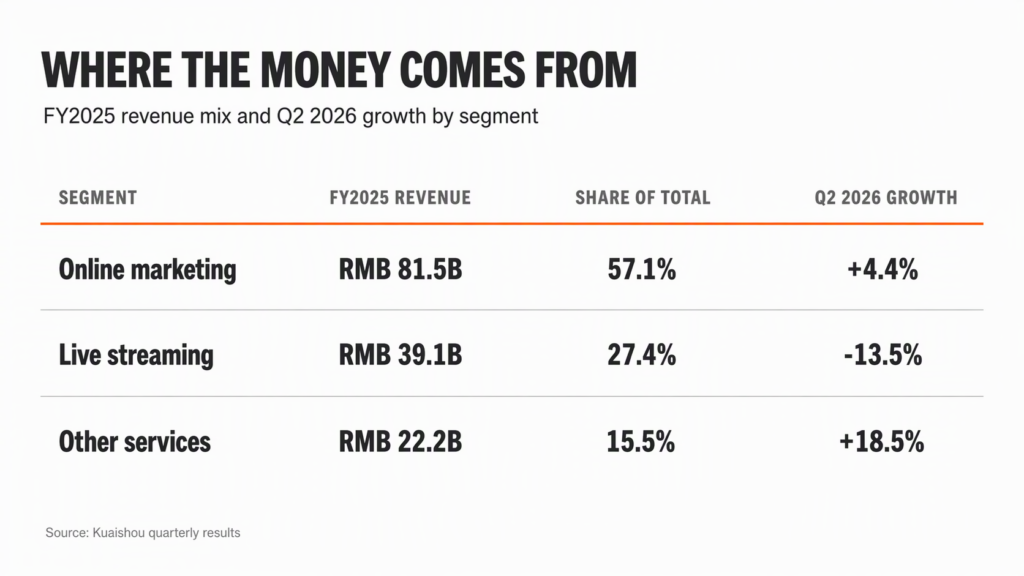
Online marketing — advertising, in plain English — brought in RMB 81.5 billion in 2025, or 57.1% of revenue. Live streaming added RMB 39.1 billion, 27.4%. Everything else, meaning e-commerce commissions plus Kling AI, contributed RMB 22.2 billion, or 15.5%.
What’s interesting is that the three lines are now moving in opposite directions. In the second quarter of 2026, advertising grew 4.4%, other services grew 18.5%, and live streaming fell 13.5%. That isn’t a wobble. It’s a two-year trend. The business that built Kuaishou’s culture — a host, a room, a stream of virtual gifts — is contracting, while the businesses that monetise attention more quietly carry the growth.
One disclosure note to carry into any boardroom: Kuaishou’s 2026 quarterly releases no longer carry a GMV line. The latest disclosed figure was RMB 521.8 billion for the fourth quarter of 2025, up 12.9%. If a deck hands you a precise 2026 GMV total, ask where it came from.
The Down-Market Bet Nobody Wanted to Make
Here’s the thing about China’s lower-tier cities. For a decade they were the part of the market that brand teams described as emerging while treating as later.
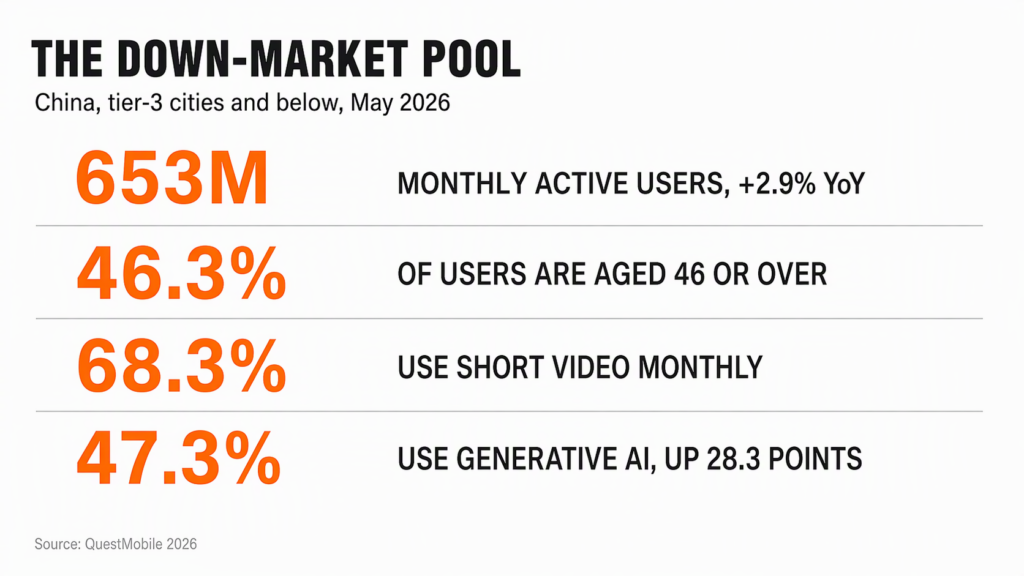
QuestMobile’s 2026 down-market study puts that pool at 653 million monthly active users in tier-3 cities and below, up 2.9% year on year. Nearly half of them — 46.3% — are over 45. Short video reaches 68.3% of them every month. Generative AI use inside that group hit 47.3%, up 28.3 percentage points in a year.
Kuaishou grew up there. Its earliest audience was provincial, rural and unglamorous: farmers, repair shops, small-town wedding singers, people filming ordinary competence. The algorithm rewarded them. Where Douyin’s feed optimises for the next-best video, Kuaishou’s distribution has long been described as flatter — more reach for ordinary accounts, less concentration on a celebrity tier. That design choice produced something a pure recommendation engine struggles to manufacture: a bond between one seller and one buyer that survives the next swipe.
A Short Detour Into What Laotie Means
Users on Kuaishou call each other laotie — roughly, old buddy. It sounds like a slogan. It behaves like a contract.
The consequence is commercial and specific. On a discovery feed, the creator is interchangeable; the algorithm decides who’s worth watching next and the viewer barely registers a name. On Kuaishou, the follow relationship carries more weight than the next impression, so a host can build a room that fills at the same hour every night with the same people. The host sits closer to a village shopkeeper than to an ad slot. People come back not because the feed served them, but because they chose to.
That’s why the company’s own language keeps returning to private domain: public traffic converts once, private relationships convert again.
Why Trust Beats Reach
Think about how you buy from a person rather than a page. You buy because you’ve watched them do the thing before. Because the last three orders arrived intact. Because when they say the pan survives dry heat, you believe them.
Kuaishou’s filings keep pointing at the same loop. In the fourth quarter of 2025 it reported repeat-purchase frequency among active e-commerce users rising year on year, along with higher revenue per paying user. In the second quarter of 2026 it reported that users with mutual follows exchanging private messages grew more than 15%. Those aren’t vanity numbers. They’re the plumbing of a repeat-buyer business: follow, purchase, group chat, store visit, purchase again, no ad in between.
Discovery commerce does the opposite. The feed finds a stranger, sparks an impulse and moves on. Both models work. They just demand different things from a brand. Discovery rewards creative volume and bidding skill. Relationship rewards patience and consistency, and punishes anyone who treats a host slot as a billboard.
Live Selling Here Is a Relationship, Not a Campaign
Which is why the operating tempo feels wrong to anyone trained on Douyin.
Kuaishou has been deliberately thickening the middle of its creator pyramid rather than only the top: support for mid-tier hosts in verticals where it has an edge, such as agriculture and anime, plus incentives to raise streaming frequency. In the first quarter of 2026, daily active streamers with more than 10,000 followers rose 10.1%, and merchant-to-host matches inside its distribution pool rose 47%.
The implication is blunt. One viral clip does very little here. Twelve sessions with the same host, the same product and the same price logic do a great deal — because the twelfth session is when the audience stops evaluating and starts reordering.
What Douyin Does Better, and Why It Doesn’t Transfer
Credit where it’s due. Douyin’s recommendation engine is sharper at cold-start discovery, its celebrity machine is bigger, and its monthly reach passed a billion in spring 2026 on QuestMobile’s count. If your goal is to make a product famous in three weeks, Douyin is the better instrument.
Kuaishou is the better instrument for a different job: making a product habitual. The two aren’t substitutes, and treating them as a ranking is where most international plans go wrong. You don’t ask which platform is bigger. You ask which behaviour you’re trying to create.
The Awkward Part: Growth Has Flattened
Let’s not pretend otherwise.
Second-quarter revenue grew 1.4%. Core commercial revenue — ads, e-commerce and Kling combined — grew 7.4%, respectable and a long way from the 17.1% the same block posted in the fourth quarter of 2025. On the second-quarter call, management described Chinese consumption as recovering only modestly, with buyers still migrating from discretionary to staple categories. Live streaming has now declined by double digits for several consecutive quarters. The AI build-out is real money: research spending up a third, gross margin down four points.
None of that invalidates the thesis. It complicates it. A platform whose advantage is loyalty will grow more slowly than one whose advantage is novelty — and it should, because loyalty compounds on a different curve.
Kling AI Is Not a Side Quest
The reflexive Western read is that Kling is Kuaishou’s answer to Sora, a shiny object bolted onto a video app. The numbers disagree.
Kling generated RMB 340 million in the fourth quarter of 2025, then passed USD 20 million in a single month in December — which the company described as an annualised run rate of USD 240 million. In the first quarter of 2026 it cleared RMB 650 million, up more than 300%, with the run rate near USD 500 million by March. In the second quarter it passed RMB 850 million, up more than 200%. Global users went from 60 million at the end of 2025 to more than 100 million by June 2026; enterprise and developer customers from 30,000 to roughly 50,000. Two commercials made with Kling took a Silver and two Bronze Lions at Cannes in 2026.
Why should a marketer care? Because the model that sells subscriptions to film studios also collapses the cost of producing the twenty ad variants a Kuaishou campaign needs. AIGC-driven short-video marketing spend on the platform grew more than 70% year on year in the second quarter. In the first half of 2026, more than 850,000 merchants used Kuaishou’s free AI tools to pick products, generate creative and answer customers.
That’s the quiet part of the story. AI is migrating from a product Kuaishou sells into a cost structure it hands to its merchants.
Why Global Brands Skip It — Three Rational Mistakes
The reasons are rational. They’re also wrong.
Mistake one: it looks unfamiliar. Douyin has a TikTok-shaped analogue. Xiaohongshu maps loosely onto Instagram. Kuaishou maps onto nothing a Western marketer has used, so it gets deprioritised in favour of whatever needs less translation.
Mistake two: the down-market discount. Teams assume tier-3 consumers can’t afford them. But revenue per paying user has been climbing, and the merchant strategy has shifted from discount supply toward brands — a T2000 brand programme launched in late 2025, with brand marketing spend up 42% year on year in the first quarter of 2026.
Mistake three: nobody to call. Far fewer agencies outside China will quote you a Kuaishou programme in English. That’s an operational excuse rather than a strategic one, but it’s the excuse that actually kills budgets.
Risks the Pitch Deck Leaves Out
A credible read has to include the ugly lines.
The share price is the loudest. Kuaishou’s market value sat at roughly US$15 billion in early November 2026, against the giddy valuation it carried as a newly listed company in 2021 — a drawdown that tells you what public markets think of the growth story rather than what users think of the app.
Regulation is structural, not episodic. The golden share means content and operational decisions sit inside an envelope that can tighten without notice.
Competition is asymmetric. Douyin’s reach is larger, its advertising and commerce scale still bigger, and its pockets deeper. Kuaishou is defending a relationship business against a distribution business.
Overseas remains unresolved. The international arm, anchored in Brazil, swung to a RMB 25 million operating loss in the second quarter of 2026 from a small profit a year earlier.
And transparency thinned exactly where analysts want it most: no quarterly GMV, and far less English-language disclosure than US-listed peers.
Four Signals Worth Watching
The gap between daily and monthly users. Monthly actives rose 11.5% while daily actives rose 0.8%. Either Kuaishou is buying lighter users through AI-optimised acquisition, or engagement is diluting. Time per user is the tell.
Whether GMV comes back. A platform confident in its commerce engine publishes the number. A platform managing a transition stops.
Kling’s margin against its capex. Run rate is easy to grow when research spending is up a third. The real question is whether AI revenue can eventually carry the margin it currently consumes.
Brand mix. If T2000 brands keep outpacing the marketplace, Kuaishou stops being a discount channel and becomes a brand channel — which changes who should be there at all.
If You’re Actually Going to Try It
A short, unsentimental playbook.
Don’t port Douyin creative. The pacing, the host style and the price framing are all wrong for this room.
Commission hosts instead of renting impressions. Pick three to five mid-tier hosts in your category, commit to a season rather than a slot, and let them demonstrate one thing repeatedly.
Measure repeat purchase and net transaction ROI, not week-one ROAS. Kuaishou has been pushing a net-GMV bidding product precisely because returns and refunds distort gross numbers.
Build for in-app search. Chinese users search inside apps rather than browsers, and Kuaishou’s generative search work now contributes measurable GMV. If your product name and category terms don’t exist in Chinese titles and captions, you’re invisible at the moment of intent.
And be honest about price. If your product only works at a premium, test small before you commit — this is a room that rewards demonstrable function over brand aura.
The Takeaway
Kuaishou is the cleanest test of a proposition Western marketing half-believes: that trust, repeated at scale, beats reach, refreshed constantly.
Growth has slowed, the stock has been punished, and the margins are being spent on a generative-video bet that may or may not pay back on schedule. And still, 797 million people open the app every month, 412 million open it every day, and a meaningful share of them buy from the same faces they’ve watched for years.
For a global brand, the question isn’t whether Kuaishou is as big as Douyin. It’s whether you can build a commerce motion that assumes nothing about virality and everything about the second purchase.
FAQ
How big is Kuaishou in 2026?
412.3 million average daily users and 797.3 million average monthly users in the second quarter of 2026, on full-year 2025 revenue of RMB 142.8 billion and e-commerce GMV of RMB 1,598.1 billion.
Is Kuaishou just a smaller Douyin?
No. Douyin concentrates attention and monetises discovery; Kuaishou flattens distribution and monetises repeated relationships. The audiences differ too: Douyin skews younger and more urban, while Kuaishou over-indexes in tier-3 cities and older cohorts.
Why did Kuaishou stop reporting quarterly GMV?
The 2026 quarterly releases carry no GMV line. The last published figure was RMB 521.8 billion for the fourth quarter of 2025, up 12.9%. Treat any 2026 GMV total as an estimate.
How does Kuaishou make money?
In 2025, 57.1% came from online marketing, 27.4% from live streaming and 15.5% from other services — mainly e-commerce commissions and Kling AI, the fastest-growing line.
What’s the biggest risk for a brand entering?
Platform-side, margin compression from AI investment, a shrinking live-streaming line and a structural regulatory envelope. Operationally, the bigger risk is running a Douyin-shaped campaign on a relationship platform and concluding the audience doesn’t buy.