Why Douyin Converts and TikTok Discovers: A Marketer’s Guide to Both Platforms
Douyin vs TikTok: The Same Codebase, Two Different Checkouts
A shopper in Chengdu watches a fifteen-second clip, taps once, and the order is confirmed inside the same app. A shopper in Chicago watches a nearly identical clip, taps once, and lands in a marketplace tab where she compares three sellers, adds to cart, and waits nine days for delivery.
Same gesture. Same company. Different machines.
So here is the question worth sitting with: why does one tap end in a payment and the other tap end in a shopping cart? Not because the creative is better. Not because Chinese users love shopping more. The difference sits underneath the video, in who owns the payment rail, who owns the delivery network, and who owns the data that connects a view to a sale.
That sentence is the whole argument: Douyin is a transaction engine that happens to publish video, and TikTok is a discovery engine that is learning to transact. Plan one short-video strategy for both markets and you will build something that fits neither.
The short answer
- Douyin monetizes attention directly. The feed, the search box, the mall tab and the ad system all point at the same ledger. By 2025, roughly half of Douyin’s e-commerce gross merchandise value came from shelf-style browsing and search rather than from live streams, on a third-party estimate.
- TikTok monetizes attention indirectly, and it is closing the gap faster than most people expected. Global TikTok Shop GMV reached US$64.3 billion in 2025, nearly double the year before, and the research firm that tracks it projects the platform will pass US$100 billion in 2026.
- The gap is not creative quality. It is distance between the video and the card details. Douyin’s is about one second. TikTok’s is about one click, one redirect, and often one different website.
- The 2026 twist: TikTok’s American commerce is becoming marketplace-led, not livestream-led. Live dropped to 8.2% of attributed US GMV in the first half of 2026. If your TikTok plan is still built around live selling, it is built around the wrong channel.
Three definitions, so the numbers make sense
Closed-loop commerce. The discovery, the checkout, the payment and the refund all happen inside one app. Douyin is closed-loop. TikTok Shop is closed-loop inside the app but open at the edges, because delivery, returns and much of the demand still travel outside it.
Shelf e-commerce. Product listings, a mall tab, search results and store pages, as opposed to content that sells. Douyin calls the combination “full-field interest e-commerce.”
GMV versus GTV. GMV counts the value of goods sold. GTV counts the value of transactions, which is how local services get measured, because a restaurant voucher is not a product.
Where the two platforms actually diverge
The checkout
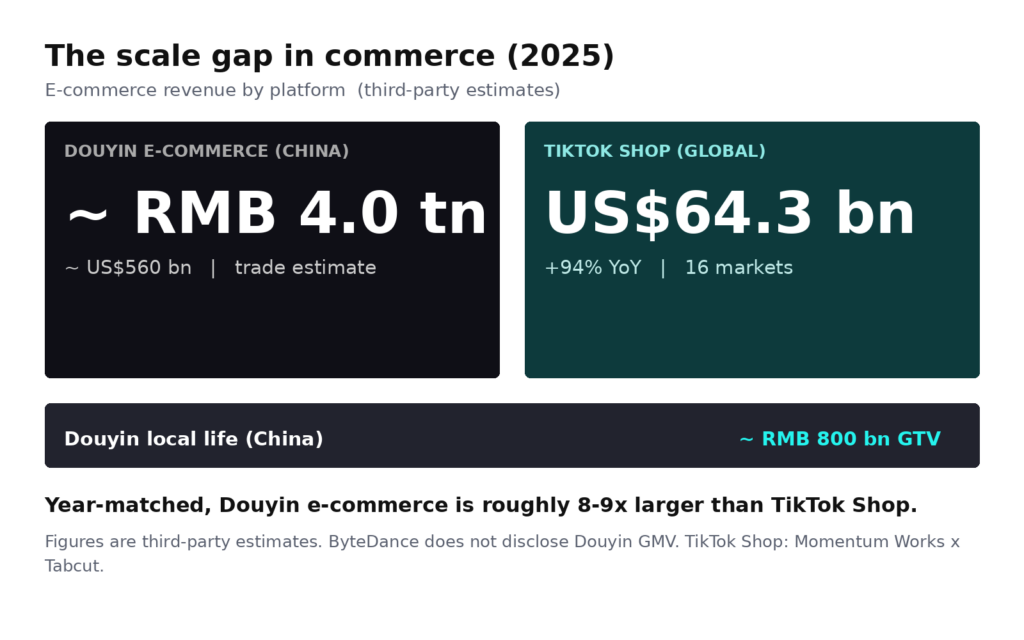
On Douyin, e-commerce is not a feature bolted onto a social app. It is the business. 36Kr’s reporting puts Douyin’s 2024 GMV at roughly RMB 3.5 trillion, up about 30%, and several trade reports in late 2025 put full-year 2025 above RMB 4 trillion. ByteDance does not disclose the number, so treat these as sound third-party estimates rather than audited figures. Either way, it is on the order of half a trillion dollars, moved through one app, past one payment layer, inside one attribution system.
TikTok Shop is younger and structurally different. It reached US$64.3 billion globally in 2025, up 94%, across 16 markets, with Southeast Asia alone contributing US$45.6 billion. Impressive. But match the years and Douyin’s commerce is still roughly eight to nine times larger, and it took Douyin years to build a payment habit that TikTok has to construct market by market.
The feed’s job
Douyin’s feed is tuned toward intent. Watch, want, tap, buy, in the same minute. TikTok’s feed is tuned toward attention, and the purchase intent it creates often gets harvested somewhere else: a marketplace tab, a brand site, a retail store.
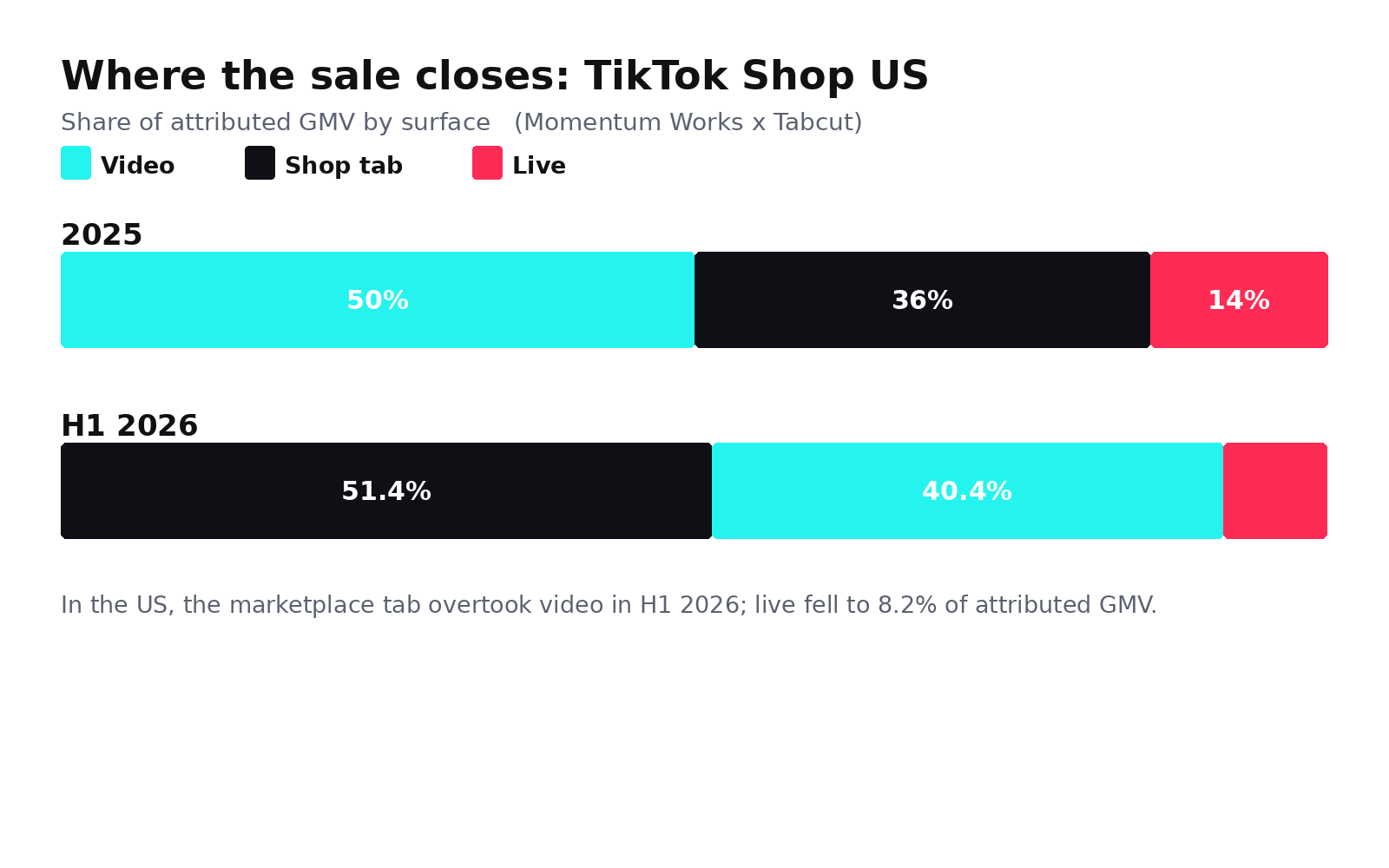
That difference shows up in the numbers. In the United States, TikTok Shop’s marketplace tab went from 36% of attributed GMV in 2025 to 51.4% in the first half of 2026. Video’s share fell to 40.4%. Live fell to 8.2%.
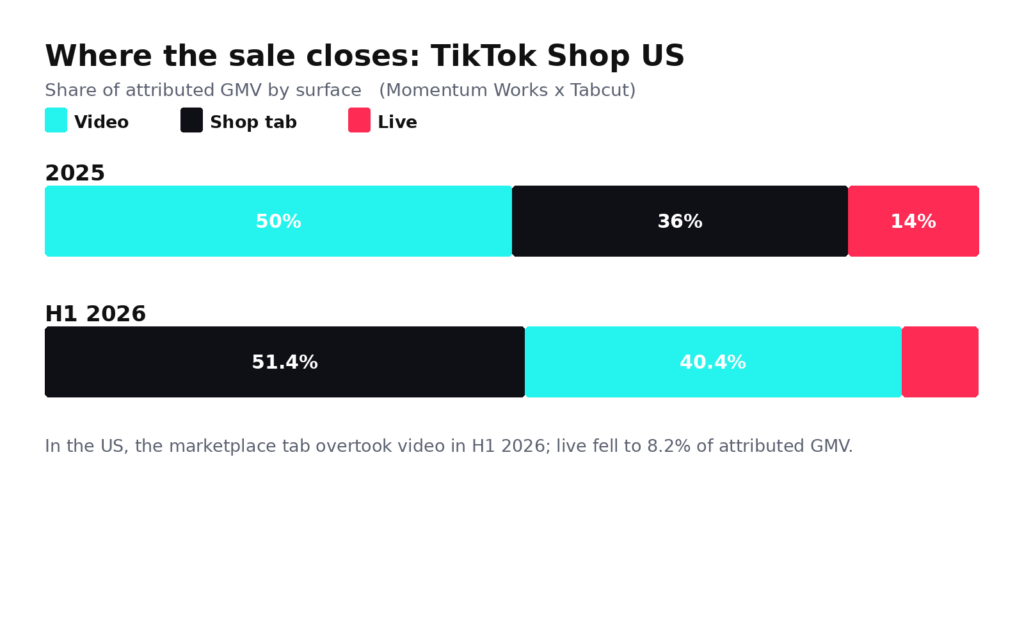
Read that again, because it contradicts most cross-border advice published in the last three years. Americans are not buying on TikTok because a livestream convinced them. They are buying because a video created interest and a product page closed it.
The plumbing
China’s internet reached 1.125 billion people by December 2025, an 80.1% penetration rate, according to the national statistical report from the China Internet Network Information Center. Six hundred and two million of those people, 42.8% of the population, already used generative AI by the end of 2025, a jump of 141.7% in a year.
That matters for a marketing reason. When payments, identity, logistics and messaging are already wired together, a short-video app can plug into an existing commerce layer and inherit it. When they are not, every market needs its own version of the layer: different rails, different regulators, different return policies, different delivery expectations.
Attention, measured properly
Numbers about attention get sloppy fast, so here are the ones that hold up, straight from Nomura’s app tracker citing QuestMobile data.
In July 2026, Douyin passed WeChat in average time spent per user for the first time. Douyin users averaged roughly 112 to 120 minutes a day; WeChat users averaged 82 to 85. WeChat still led on daily actives, 931 million against Douyin’s 714 million, but Douyin’s daily base grew 19% year on year while WeChat’s grew 3%. Across the whole mobile internet, ByteDance apps captured 40.9% of usage time and Tencent’s captured 29.1%.
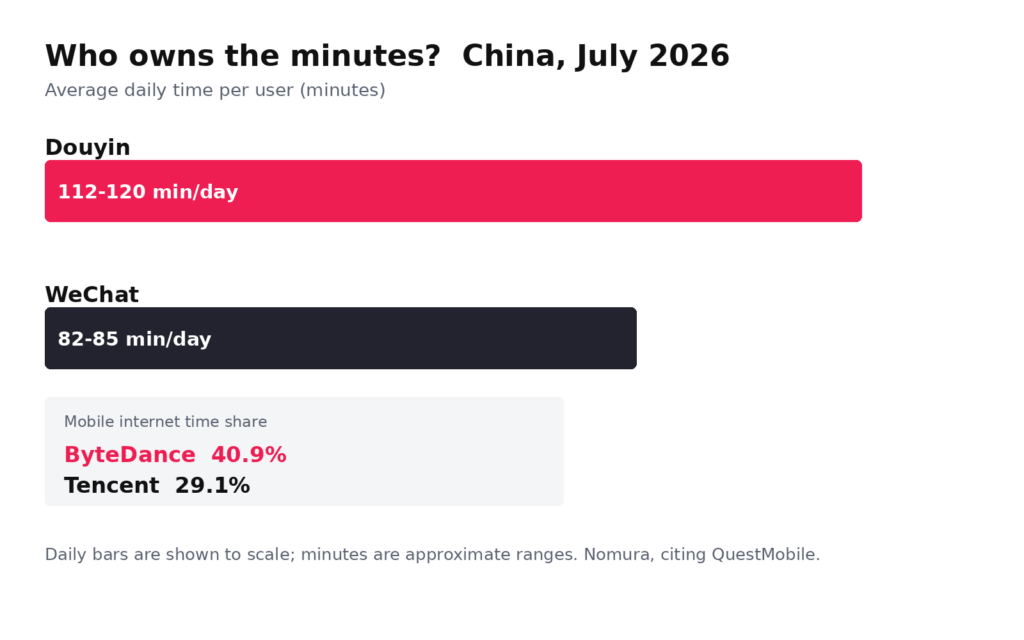
Two conclusions follow. First, Douyin is no longer a challenger in China; it is the default place where attention sits. Second, TikTok’s global reach is broad rather than deep. Its advertising tools reported reach of about 1.59 billion people in January 2025, but that audience is spread across dozens of markets with wildly different shopping habits. Reach is not the same asset as density.
Douyin stopped being a feed four years ago
The most useful correction to Western assumptions about Douyin is this: it is no longer primarily a content-commerce platform. It is a marketplace with a very good content engine on top.
Douyin set an explicit target in 2022: shelf e-commerce should reach 50% of GMV. Trade reporting traces the path at 30% in 2023, 40% in 2024, and roughly half by 2025, when 36Kr reported shelf GMV of about RMB 200 billion across the June 618 window, close to half of the platform’s sales in that stretch. Overall e-commerce GMV grew 34% between August 2024 and July 2025, KrASIA reported, and shelf GMV grew 49% over the same stretch, outrunning the platform itself.
What that means for planning is subtle and easy to miss. On Douyin, content is the top of the funnel and the mall is the conversion layer. Brands that treat Douyin as a video channel and ignore product pages, search terms and store operations are leaving the majority of the money on the table.
How Douyin marketing actually works
One: content earns the impression. Short video and live still decide who gets seen. But the metric that matters downstream is not views; it is whether the viewer reaches a product page.
Two: search and the mall convert. Douyin’s own search box has become a shopping surface, and the platform has spent years pushing users toward it. This is also where AI is entering. ByteDance’s assistant Doubao started charging users in June 2026 and is being wired into Douyin commerce, which means natural-language product questions now have a route into a transaction. On top of that, Chinese regulators require AI-generated content to be labeled, so the assistant’s answers arrive inside a governed format.
Three: creators are merchants. On 36Kr’s estimate, accounts above one million followers generate about 9% of GMV, and accounts below one million followers generate about 21%. The middle of the market, not the top, does the selling. Most serious creators operate storefronts, which blurs the line between media and retail.
Four: ads are subordinated to commerce. In March 2025, per 36Kr, ByteDance folded the Qianchuan e-commerce advertising team into Douyin E-commerce, and the combined team was measured against GMV and merchant return on ad spend rather than ad revenue alone. The consequence is structural: attribution lives in one place because the org chart lives in one place.
Five: the platform is buying merchant loyalty. Douyin paid out more than RMB 19 billion in merchant subsidies by the end of August 2025, cut commissions, refunded ad fees and rewrote its traffic algorithm to favor quality supply. By 2026, the strategic language had shifted from growth to profitability for merchants.
TikTok is becoming a marketplace, not a shopping channel
Globally, GMV reached US$64.3 billion in 2025, up 94%, across 16 markets. Southeast Asia doubled to US$45.6 billion. Brazil is now a live market with its own reporting. In the United States, GMV reached US$15.1 billion in 2025, up 68% from about US$9 billion, then US$11.8 billion in the first half of 2026 alone, up 103%, which pushed the US back ahead of every other market.
Then the interesting part. In that first half of 2026, TikTok Shop counted more than 5,700 US stores above US$1 million in GMV, an eightfold jump year on year, with 506 stores above US$10 million. Average prices fell in 21 of 27 categories. Eight of the ten highest-GMV influencers were new to the ranking. Third-party marketplace analysis suggests roughly 1% of sellers account for about 60% of GMV.
So TikTok Shop is getting easier to enter and harder to win. That is the signature of a maturing marketplace, and it changes what a marketer should optimize for: not virality, but catalogue depth, review quality, price competitiveness and fulfilment reliability.
Momentum Works, the Singapore research firm that tracks this ecosystem with data partner Tabcut, made the sharpest observation of the cycle: many of the tactics that drive time spent and conversion in China and Southeast Asia simply did not work in the United States. The American version of the playbook is quieter, more search-driven, and less dependent on charismatic hosts.
Why your Douyin playbook underperforms abroad
- Live is a novelty, not a habit. In the US, live commerce fell to 8.2% of attributed GMV, against 14% in 2025. In China, live selling is a permanent channel.
- Delivery is the product. A seller optimized for conversion but not returns loses the margin on the second order.
- The audience is fragmented by market. Sixteen markets means sixteen sets of payment habits, tax rules, languages and content norms.
- AI-generated supply is inflating competition. Synthetic video and livestreams push prices down; Momentum Works expects the flood to intensify in 2026.
The ad products are not parallel
Douyin’s stack is commerce-first. Qianchuan sits inside the e-commerce organization, so bidding, creative, coupons and attribution are governed by one team chasing one number. You can trace a campaign from impression to repayment in a single system.
TikTok’s stack is being rebuilt around shop conversion, but it remains a media business with commerce ambitions. GMV Max pushed campaign management toward a single ROI target. In October 2026 TikTok opened its global advertising network, roughly 400,000 third-party apps, to US advertisers, and separately expanded shopping, lead-generation and search-automation tools.
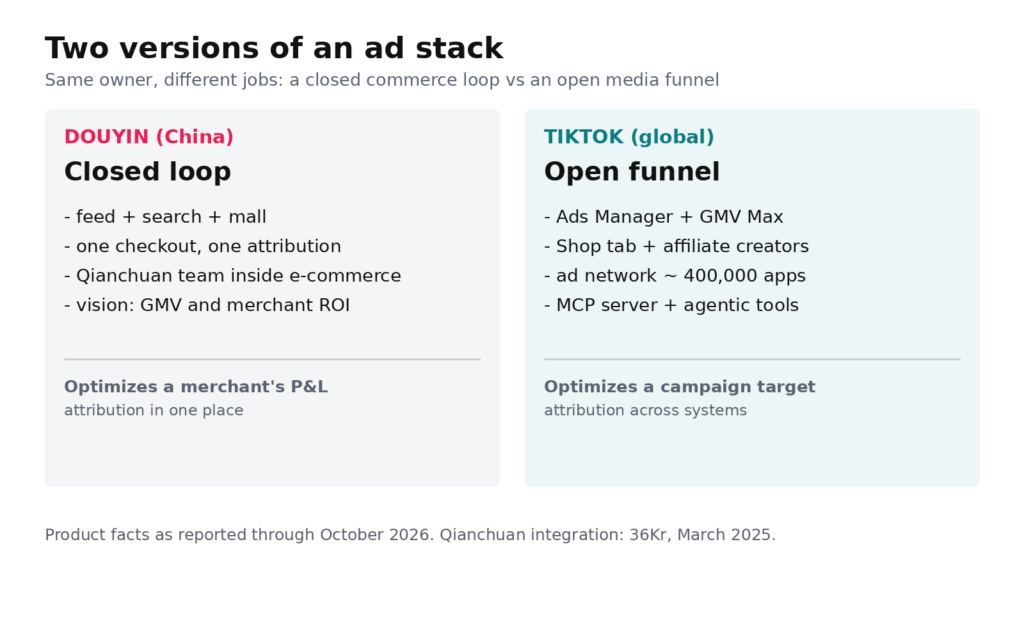
The strategic read: TikTok is automating the work of the media buyer while Douyin automates the work of the merchant.
Regulation: two different kinds of risk
TikTok. The existential phase ended. The American operation moved into a joint-venture structure, and the ownership transfer completed in January 2026, leaving ByteDance with a 19.9% stake. In early August 2026 the US government lifted restrictions on installing TikTok on federal government devices. In May 2026 a US senator pressed the joint venture and Oracle on data safeguards, and by October 2026 the venture was scouting four gigawatts of computing capacity by the early 2030s.
Douyin. The risk there is operational and legible. China’s rules on labeling AI-generated content took effect on 1 September 2025, and in April 2026 the cyberspace regulator publicly warned ByteDance properties over labeling compliance. Douyin removed more than 13 million non-compliant videos and revoked 470,000 livestream selling permissions in a single year.
Translated for a marketer: on TikTok you hedge against structural change. On Douyin you staff for compliance.
Creator economics, briefly
Douyin fuses creator and merchant. A creator can earn from tips, brand deals, commissions, and a storefront they run themselves. TikTok keeps the roles more separate: there were 15.4 million US influencers on TikTok Shop in 2025, and more than half of US stores recorded no sales. A million-view video does not guarantee a thousand orders.
What transfers and what does not
Transfers cleanly: the first-second hook, native pacing, phone-shot product demos, creator-led storytelling, and the discipline of earning a place in the feed.
Transfers partially: live selling mechanics, but as an event format, not an always-on channel.
Does not transfer: the assumption of one payment rail, of cheap next-day delivery, that the feed is where the transaction closes, and that a big-follower account moves volume.
A decision framework
Choose Douyin when the goal is measurable revenue inside China and you can staff product pages, search terms, store ops and compliance. Douyin rewards operators.
Choose TikTok when the goal is demand creation in the US, UK, Southeast Asia or Brazil, and you accept the final purchase may happen off-app. Build for video-led discovery, then capture demand in the marketplace tab.
Run both when you are a China-born brand going global or a global brand entering China. Just do not run one playbook twice. Douyin’s local life services cleared about RMB 800 billion in GTV in 2025, and its first-half 2026 trading passed RMB 600 billion.
Five moves for the next two quarters
- Rebuild the TikTok plan around the marketplace tab, not the livestream.
- Audit seller economics before spending on reach — prices fell across 21 of 27 categories.
- Treat Douyin as a retail operation, not a content channel.
- Assume automation — GMV Max and Qianchuan both push toward a single target.
- Put AI disclosure into the workflow — labeling rules are already enforceable in China.
The one thing both reward
Neither platform rewards interruption. An ad that behaves like an ad gets swiped on both. Content that earns its place gets watched; content that earns its place and hands the viewer a clear next step gets bought.