Brand Budget Came Back: The Quiet Reversal in China’s Ad Market
China’s advertising market is not exploding. It is reshuffling itself, and the two things look similar on a spreadsheet. The measured internet advertising market will land near 836.26 billion yuan in 2026, up 5.4 per cent from 793.08 billion yuan in 2025. Those are mid-single-digit numbers, the kind a finance director skims past. The story worth telling is not the total. It is where inside the total the money quietly changed hands.
1. The headline number is a forecast, not a fact
Anyone who has skimmed a China report in 2026 has seen the figure 8,362亿元 — 836.26 billion yuan — attached to something about internet advertising. Before you put that number in your own deck, know what it actually is.
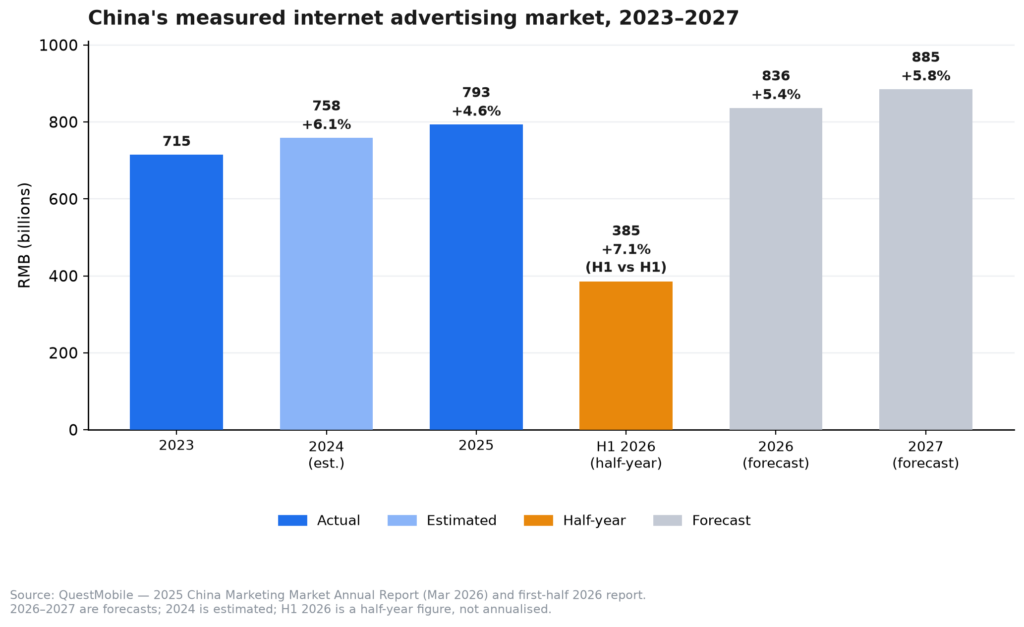
It is not an audited total. It is QuestMobile’s forecast for China’s measured internet advertising market in 2026, up 5.4 per cent on the 793.08 billion yuan booked in 2025. The 2025 figure is real; the 2026 figure is a projection made in March 2026, and two quarters of actuals have landed since. The first half of 2026 came in at 385.34 billion yuan, up 7.1 per cent, running hotter than the full-year forecast implies.
If you quote 8,362亿元 as China’s internet ad market in 2026, you are quoting a forecast as though it were a census. Cite it as a forecast, dated and sourced, or do not cite it at all.
2. Two official totals, one market
China publishes two numbers for advertising, and the gap between them is wide enough that people pick whichever backs their point.
The State Administration for Market Regulation counted 2.05 trillion yuan in total advertising business revenue for 2025, with internet advertising business revenue at 1.36 trillion yuan. Xinhua reported in April 2026 that the industry cracked the 2 trillion mark for the first time, with internet taking 89.1 per cent of media advertising publishing revenue.
QuestMobile, working from what media platforms actually book, put internet advertising at 793.08 billion yuan for the same year.
Neither is wrong. They measure different things. The regulator counts advertising businesses above a reporting threshold, so agencies, production houses and service providers sit inside its total alongside media owners. QuestMobile counts platform revenue only. Use the regulator’s number to size an industry and count jobs. Use the platform series to compare channels, because it is the only one that puts sellers on a consistent basis.
The gap also changes the growth story. The wider count grew 32.6 per cent in 2025, which mostly tells you the reporting base widened. The measured series grew 4.6 per cent. When somebody shows you a chart of Chinese advertising exploding, ask which denominator they used.
3. Four years of mid-single-digit growth
Set the series out and the shape is obvious. The measured market read 714.61 billion yuan in 2023, 758.4 billion in 2024, 793.08 billion in 2025, and it is forecast to reach 836.26 billion in 2026 and 884.76 billion in 2027.
That is four years of compound growth near 5.5 per cent, and not a single double-digit year. 2025 was the slowest year in the series at 4.6 per cent. 2026 opened faster, at 7.1 per cent in the first half, but a strong half does not mean the market reaccelerated to 2018 levels. It means the base was soft and campaign timing shifted.
Two things to hold onto here. First, these are nominal rates, in a category where both ad load and price move; a 4.6 per cent year is a real increase in spend and only a modest increase in the value of inventory. Second, the market is growing faster than the demand it serves. Retail sales of consumer goods rose 1.1 per cent in the first three quarters of 2026. Brands are paying more to reach people who are spending less, and that gap, not platform innovation, is the pressure behind every efficiency conversation in Chinese marketing right now.
4. The increment went to short video
The useful question is not how big the market is. It is which part of it is still moving.
QuestMobile’s first-half 2026 report reads like a budget memo, and its summary is direct: budgets tilted further toward short video, in-platform e-commerce advertising held its position, and news, long-form video and search gave ground.
Short video is the only surface where attention still compounds. Douyin alone reported 1.009 billion monthly users and 712 million daily users on 18 June 2026, with monthly users up 14.4 per cent year on year. That is not a channel inside a plan. It is the floor of the market.
The mechanic that matters to a buyer is that the auction rewards creative volume — content shipped daily, not monthly. That is why Chinese creative production industrialised: not because brands love making content, but because the algorithm prices newness.
5. A decade-long trend reversed: brand budget came back
This is the single most important line in the whole 2026 data, and it is easy to miss because it hides inside a share.
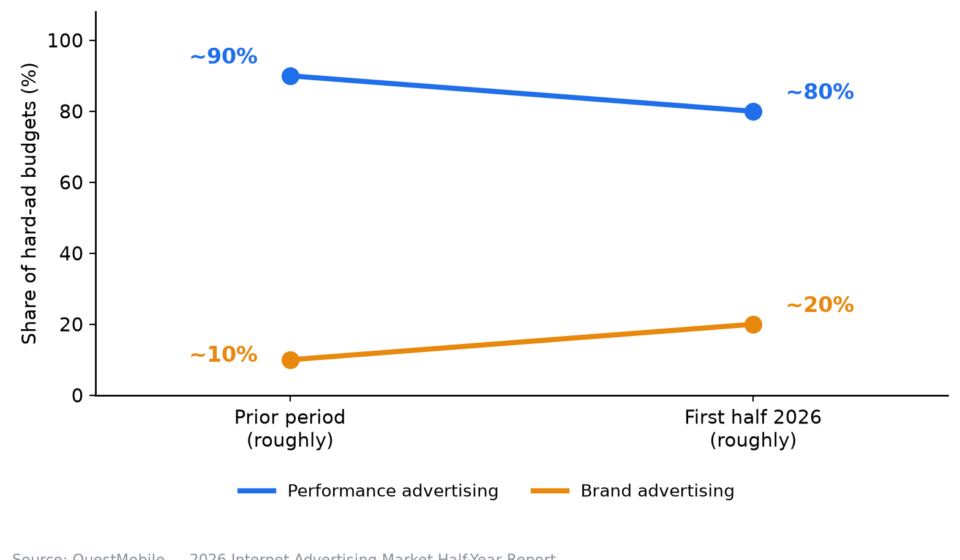
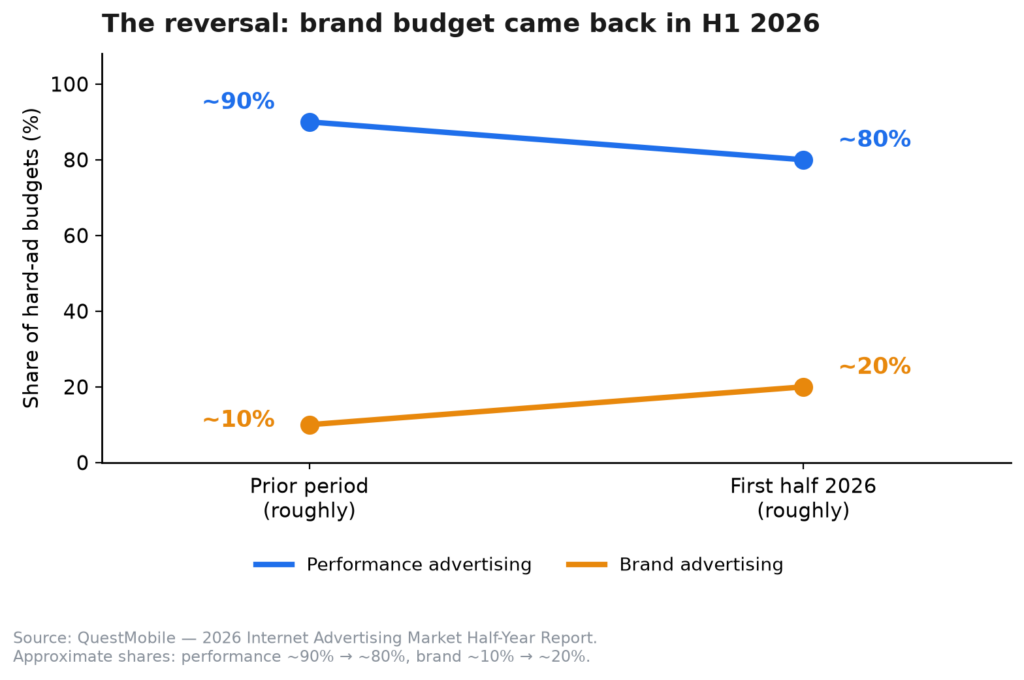
For years, performance advertising ate the market. It sat at roughly 90 per cent of hard-ad budgets. In the first half of 2026 that share fell to about 80 per cent, with brand advertising taking the difference. After a decade in which every yuan had to be accountable, brand budget came back.
Two forces produced the reversal. Cheap performance inventory thinned out as e-commerce platforms pulled back from public-domain buying, so the marginal return on performance spend fell. At the same time, short-video auctions reward recall and creative quality — brand metrics wearing performance dashboards.
Do not overread a single direction, though. Eighty-twenty is still a performance-dominated market. What changed is the direction of travel, for the first time in ten years.
6. Search lost share without losing money
Search is the channel everyone has buried twice — once when super apps arrived, and again when chatbots did. The measured data says its share is being squeezed, not that its revenue collapsed.
AI assistants now answer the generic question before a results page loads, and the clicks that used to fund those queries are thinning. What survives is the query with commercial intent attached: a price, a warranty, a dealer in a named city, a part number. The surviving queries are the expensive ones, which is why search can lose share and still add revenue.
Globally the same shift is being priced rather than mourned. WPP Media’s midyear 2026 forecast puts traditional search plus generative search at 21.8 per cent of total ad revenue, and treats generative search as the fastest-expanding channel in advertising history — growing from 5.1 billion dollars in 2026 toward more than 100 billion by 2030.
The takeaway for a plan is not to cut search. It is to stop buying generic search and defend the branded and local-intent queries that still convert.
7. The AI companies became an advertiser, not just a channel
For two years, the marketing industry talked about AI as a place to buy ads. In 2026 the more interesting story is that AI companies became the ones buying them.
Chinese AI application firms now spend the way venture-funded companies always do: fast, concentrated and in public. QuestMobile found that 70 per cent of the hard-ad budget placed by AI application companies went to three products, split 38.5, 21.2 and 12.6 per cent. That is a category spending at scale before it has a revenue model of its own, which is exactly how launch markets behave.
For a media plan this cuts two ways. AI companies are part of the reason some feed inventory got more expensive this year. They are also the first large advertiser category in years that behaves like a launch market rather than a maintenance market, which means the money moves, and re-prices inventory, on a different clock than incumbents are used to.
8. Three apps, half the hard-ad money
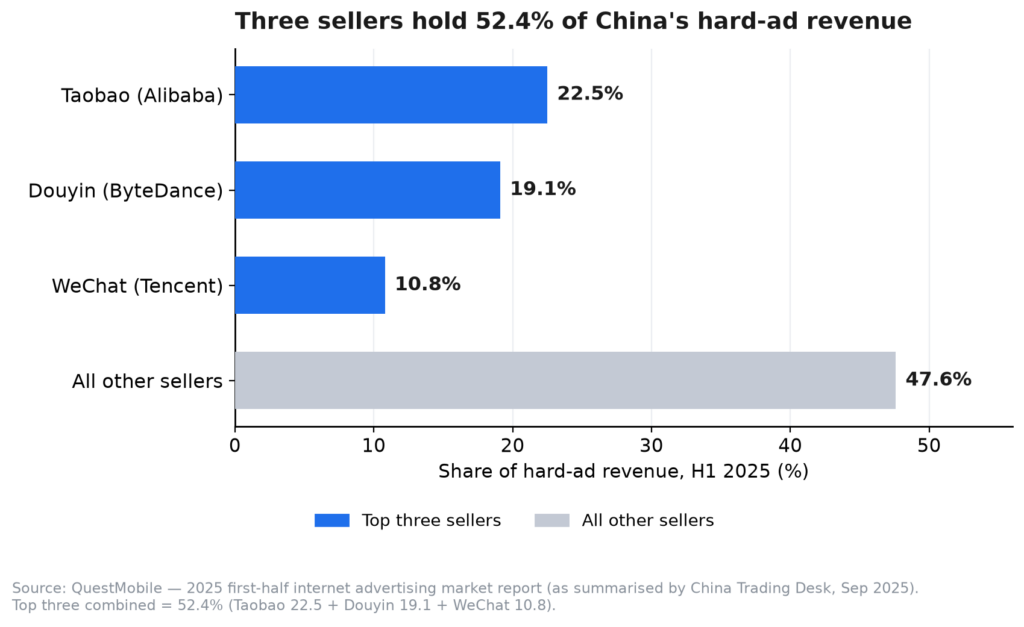
China’s hard-ad revenue is extraordinarily concentrated. In the first half of 2025, three sellers took 52.4 per cent of it: Taobao at 22.5 per cent, Douyin at 19.1 per cent and WeChat at 10.8 per cent.
Read that table as the paid-media layer only. It excludes soft advertising — the creator content and seeding bought through agencies and key opinion leaders — which is a large, separately measured pool. But even at the paid layer, the shape is unusual for any market: below the top three, the sellers that matter number fewer than a dozen.
The practical consequence is negotiating power. A brand that wants reach in China does not assemble forty publishers. It negotiates with three companies, each of which also owns the storefront, the wallet and, increasingly, the assistant. When your media partner is also your checkout and your discovery engine, the word channel stops describing anything useful.
Taobao holds the e-commerce layer, the largest single pool of hard-ad inventory. But the merchants funding it are shifting, which the next section covers.
Douyin is the surface attention sits on. Its 19.1 per cent share understates its role, because short video is where the increment keeps landing.
WeChat reached 1.281 billion deduplicated users, flat year on year. Flat is the right expectation: there is no growth left in reach, only depth per user. Its advertising share understates its role too, because WeChat’s value is not impression inventory; it is the layer where a customer relationship persists after the campaign ends.
Xiaohongshu is the interesting case, because two numbers circulate and they differ by 155 million. The company’s own figure, reported through Chinese business media in July 2026, is over 400 million monthly users, with 800 million searches a day. QuestMobile’s panel counts the app alone at 245 million monthly users in March 2026 — down 1 per cent, its first decline in six years of tracking. Read together, the shape is clear: the surface is wider than the app, the app has stopped growing, and the habit has not, because the searches keep rising. A platform running 800 million searches a day is not a social network with a shopping tab. It is a decision engine with a feed attached.
9. What got cut, and who cut it
Every re-sort has losers, and here the losers are easy to name. QuestMobile’s first-half 2026 work lists news, long-form video and search among the channels that lost share. By surface, PC is down to 2.1 per cent of measured ad revenue, while OTT and smart hardware have climbed to 9 per cent, steadily absorbing budget that used to sit on desktop.
The sharper cut is on the advertiser side of e-commerce. In-platform e-commerce advertising held its share of the market, but the merchants behind it changed their behaviour: online shopping brands cut public-domain ad budgets and pushed money into user subsidies and live rooms. In plain terms, the platforms still sell the same share of ads, but the buyers are purchasing fewer impressions and more discount.
Read this as a squeeze on the advertiser, not the seller. Any plan that assumes rising e-commerce ad prices through 2027 is building on a trend that has already turned.
10. The global yardstick
Put China next to the world and the contrast is the point.
Global advertising revenue is forecast at 1.3 trillion dollars in 2026, up 8.9 per cent, on WPP Media’s midyear count — revised up from the 7.1 per cent it forecast in December. WARC’s third-quarter forecast is higher still: 1.34 trillion dollars, up 11.9 per cent, on the strength of AI-company spending and a heavy events calendar. The two differ by about 40 billion dollars on methodology; use WARC for channel splits, WPP Media for the search-to-answer migration, and never blend them into one chart without saying so.
Adobe Analytics adds the number that should anchor any AI argument: AI-referred traffic to US retail sites was up 71 per cent year on year in September 2026, and Adobe forecasts a 130 per cent jump across the holiday season. The quality gap is the part that matters — AI-referred visitors generated 83 per cent higher revenue per visit and converted 90 per cent better. Fewer visits, better buyers.
And one per-capita figure to keep every China-is-huge claim honest: WARC puts per-capita ad spend at 170 dollars in China for 2026, against 1,395 dollars in the United States and 13 dollars in India. China is a large market because it has a lot of people, not because it has a saturated one.
11. What this structure says about confidence
Strip the numbers down and they describe a market that is cautious at the top and decisive in the middle.
Cautious, because no full year since 2023 has grown faster than 6.1 per cent, and the 2026 forecast sits at 5.4 per cent. Decisive, because inside that flat total, advertisers are moving money with intent: into short video, back into brand, out of generic search, out of public-domain e-commerce buying.
The brand-budget reversal is the tell. You do not shift a point or two back into brand in a panic year. You do it when you have decided the cheap-performance era is over — that the supply of cheap inventory has thinned, and that reach has to be bought on purpose again instead of grabbed by default.
That is the confidence story hiding in the data: not that advertisers are spending wildly, but that they are spending deliberately for the first time in a decade.
12. How to read these numbers
Close with the caveats, because they stack up into the real constraint on Chinese advertising in 2026: measurement.
Four instruments appear in any serious China analysis, and they do not substitute for each other. Government census counts users by application on a national sample — CNNIC is the only series covering the whole country on one definition. Third-party panel measures app activity across a device panel — QuestMobile is fast and granular, but an estimate, not an audit. Platform disclosure gives selected metrics from Douyin, Xiaohongshu and Alibaba — directional, and chosen by the seller. Forecast houses such as WARC, WPP Media and iResearch model markets from disclosed revenue plus panel data, and their totals differ by method.
The measured market of 793 billion yuan and the regulator’s 1.36 trillion describe the same market at two scopes. Hard-ad shares are not a marketing budget split — soft advertising and creator spending sit outside them. And every 2026 figure in circulation is a forecast that will move as actuals land.
Any sentence that mixes these without saying which is which will be quoted out of context. That is not a warning about other people’s writing. It is a warning about your own.
Summary
China’s advertising market in 2026 is large, slow-growing and unusually concentrated. Measured internet advertising will land near 836 billion yuan, up about 5 per cent, in an economy where retail sales grew 1.1 per cent. Three platforms take half the hard-ad money. Short video took the increment, search lost share but kept its revenue, and brand budget returned for the first time in a decade — roughly doubling its share of hard-ad spend from about 10 per cent to about 20 per cent. The AI layer stopped being experimental: AI companies became a major advertiser category, and AI assistants became a front door that is quietly rewriting which queries still pay. What limits performance is not access to tools or audience; it is the ability to prove what worked in a market where the journey now runs through walls, assistants and agents.