China Measures in a Loop. The West Measures in Models.
Most comparisons of Chinese and Western AI marketing start in the wrong place: the vendor list. Teams line up the models, the agents, the CDP features and the creative tools, then conclude that the stacks look broadly similar. They do. Then the same stack produces different results in Shanghai and in Chicago, and everyone blames execution.
Execution is not the problem. The substrate is. In China, AI marketing runs inside a handful of super apps that own discovery, checkout, payment and identity at the same time. In the West, it runs across an open web of publishers, an auction, a consent regime, and a measurement layer that has spent four years being rebuilt and still does not close.
Put the same model on two different substrates and you get seven structural differences. Not one of them is about budget. Each one changes what a marketer may know, and therefore what a marketer can do.
Here is the short version, then the argument, then what each side should steal from the other.
The seven differences in one breath
- Distribution is a partnership problem in China and a portfolio problem in the West.
- Measurement is a closed loop in China and a modelled gap in the West.
- Creative is a scheduled operation in China and a versioned asset in the West.
- AI enters at the transaction in China and at the answer in the West.
- Labour cost comes out of the client’s payroll in China and out of the agency’s margin in the West.
- Regulation labels everything in China and discloses selectively in the West.
- Reasoning cost is a design variable in China and a rationed resource in the West.
Read them in that order and the rest of this article is detail. Read them out of order and you will conclude, wrongly, that one market is simply ahead.
1. Distribution: the super app versus the open web
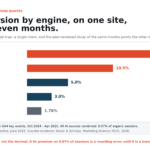
China’s advertising market has no meaningful long tail. Three sellers — Taobao, Douyin and WeChat — took 52.4 per cent of hard-advertising revenue as measured by QuestMobile in the first half of 2025, split 22.5, 19.1 and 10.8 per cent respectively. Below them, the sellers that matter number fewer than a dozen. Douyin alone reported 1.009 billion monthly and 712 million daily users in June 2026.
That is not a channel list. It is a set of landlords who also run the storefront, the wallet and, increasingly, the assistant that answers the customer’s question before the brand is ever considered.
The West has concentration too, mostly in retail media and in the two-platform mobile duopoly. But the Western planner can still buy attention outside the walled garden, assemble a portfolio of publishers, and trade reach against frequency with diminishing returns. The Chinese planner, at scale, cannot. There is no long tail to arbitrage.
What follows from that is a difference in professional skill. When distribution is fragmented, marketing rewards media maths: reach curves, frequency caps, marginal CPMs. When distribution is concentrated, marketing rewards joint business planning: who gets the inventory in the 11.11 window, what data comes back, which co-marketing budget pays for it.
Now add AI. In a concentrated market, the assistant sits inside the same company that owns the checkout, so an AI recommendation can be wired directly to a transaction. In a fragmented market, the assistant sits somewhere else entirely and has to hand the customer back to a browser. Same technology, two different physics.
One number makes the demand side concrete. WARC put advertising spend per capita at USD170 in China in 2026, against USD1,395 in the United States. China is a large ad market because it has a lot of people, not because it has a saturated one. Which means the Chinese growth story is about frequency and conversion inside an existing habit, while the Western story is still about reach efficiency across a scattered field.
2. Measurement: the closed loop versus the modelled gap
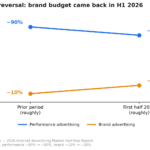
Chinese marketing measurement defaults to the platform. QuestMobile’s read of the first half of 2026 shows performance advertising falling from roughly 90 per cent of hard-advertising budgets to about 80 per cent, with brand money taking the difference — and even the returning brand money is still judged on dashboards the platform supplies. The loop closes because the same company sees the impression, the click, the basket and the delivery.
The West spent four years promising to replace that loop with something open. On 17 October 2025, Google retired most of the Privacy Sandbox instead, including the Attribution Reporting API that was supposed to measure conversions without cookies, and left third-party cookies running in Chrome. GA4 now offers three attribution models, not five. Meanwhile the money grew: IAB and PwC measured USD294.6 billion of US digital advertising revenue in 2025, up 13.9 per cent, and WPP Media forecast USD1.14 trillion globally for 2026.
So the Western marketer runs on a triangulation habit: platform numbers, analytics numbers, finance numbers, plus a marketing mix model that nobody fully trusts and everybody needs. The clickless AI path makes it worse. Ask an assistant for a recommendation, buy a week later through branded search, and the influence exists while the session does not.
Two operating styles fall out of this, and neither is ranked above the other. A closed loop gives you a clean reward signal, which is exactly what a machine-learning system needs to optimise against. It also gives you a blind spot where the system’s own incentives sit. Modelled attribution gives you coverage of everything the loop cannot see, and an argument you will never win outright. Speed against coverage. Neither is free.
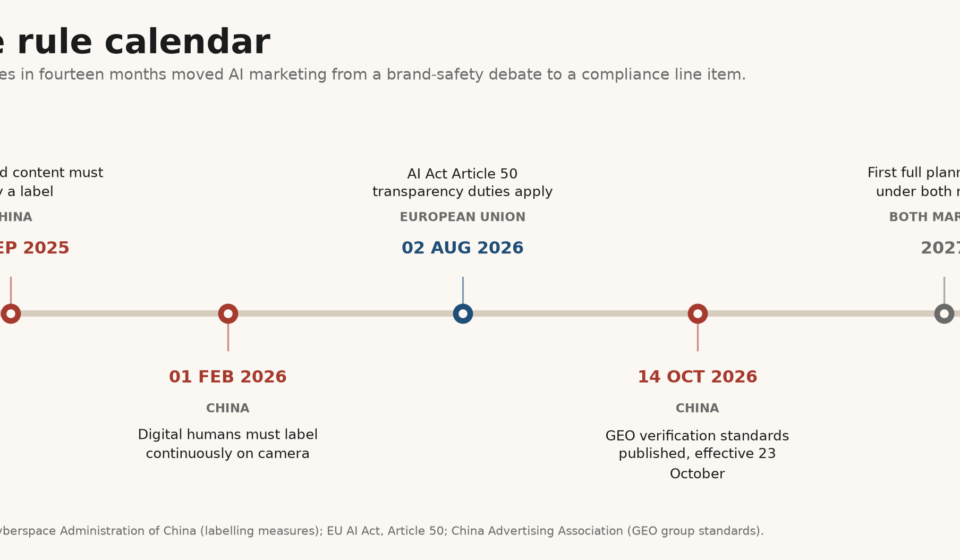
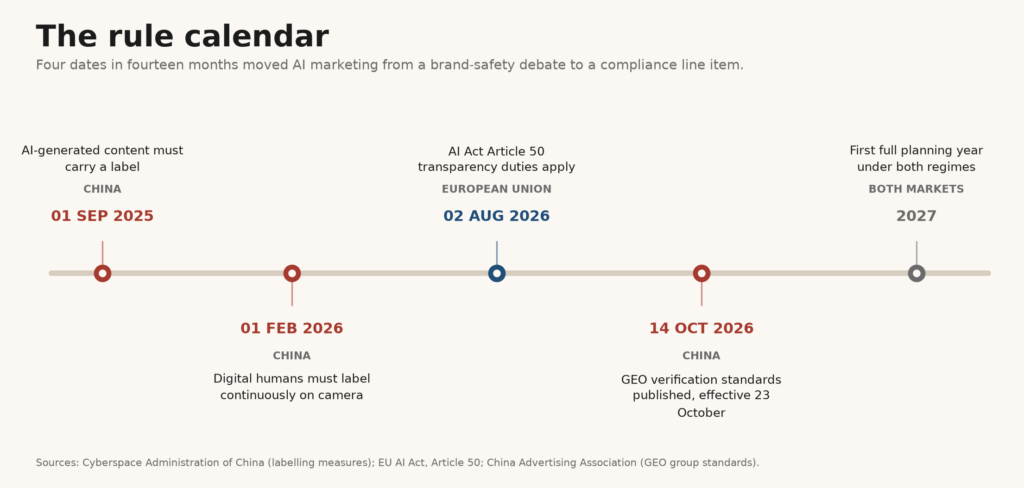
There is an irony worth naming. On 14 October 2026 the China Advertising Association published three group standards for generative engine optimisation, effective 23 October, including one on monitoring and verifying how a brand appears inside AI answers. A market that had the tightest measurement loop in the world went ahead and standardised the one surface its loop could not reach — while most Western measurement teams are still arguing about whether an AI answer counts as media.
3. Creative: the live room versus the finished asset
China’s creative output is continuous. Livestream commerce passed the RMB5 trillion mark in 2025, close to a third of online retail, with roughly 664 million buyers taking part. That is about 59 per cent of the country’s internet users, according to research published by a research group at the Ministry of Commerce’s academy. Live transaction value grew 11.3 per cent while online retail grew 8.6 per cent.
When selling looks like a broadcast that never ends, creative becomes an operations problem: script rotations, staffing the night band, restocking the carousel, triaging comments. AI enters as labour inside that operation.
The Western creative model is a finished asset. A campaign is conceived, produced, approved, scheduled and then measured, and the agency’s economics depend on producing fewer, better things. AI enters upstream, as ideation and versioning, and the deliverable is still an asset.
This is why the two markets keep misunderstanding each other’s AI creative tools. A Chinese tool that rotates 40 scripts a day looks like spam to a Western brand team. A Western tool that generates 300 on-brand variants looks like a rounding error to a live-room operator in China, who needs the next hour filled, not the next campaign.
The KPI differs too. China optimises revenue per streaming hour and the return rate. The West optimises recall, consideration and cost per completed view. Both are defensible. They just produce different org charts.
4. Where AI enters: commerce first versus content first
China’s AI audience arrives through several doors at once. QuestMobile put AI-native apps at 546 million monthly users in September 2026, AI functions inside existing apps at 639 million, and phone-maker assistants at 783 million. AI-native apps were up 82.1 per cent year on year. Count every surface, accept that they overlap, and 1.157 billion people use a comprehensive assistant each month.
The important part is not the size. It is the placement. In China, the assistant is wired into shopping: browse, compare, ask, buy, all inside one app that already has the payment credential.
In the West, the assistant has arrived through the answer. Search summarisation, AI overviews and chat interfaces intercept the question before the click, and then hand the journey back to a website that will be measured badly. WPP Media projects traditional and generative search together at 21.8 per cent of total advertising revenue in 2026 — which tells you where the Western fight is being fought, and it is not at the checkout.
The consequence is a difference in what AI is asked to prove. Chinese teams ask an assistant to lift conversion, and can measure whether it did. Western teams ask an assistant to earn influence, and then model whether it did. One is an engineering brief. The other is a research brief.
5. Labour: digital hosts versus agency retainers
China turned the digital presenter into a supply chain. iiMedia sizes the country’s digital human core market at RMB33.92 billion in 2024, forecasting RMB93.56 billion by 2030. Platform pricing published in China puts a digital host at roughly a tenth of the hourly cost of a human presenter.
That is a payroll calculation, not a technology purchase. The return shows up in the night band, the fixed pitch, the long tail of SKUs too small to staff, and the second-language audience nobody was going to staff for.
The Western equivalent sits in a different P&L line. Agencies absorbed AI into their delivery model, which means the savings land in agency margin and get renegotiated at the next scope-of-work conversation. A client that deploys AI often sees the benefit as faster turnaround and a higher retainer, not as a lower headcount.
This is the quietest of the seven differences and possibly the most consequential. In China, AI is a cost line the marketer can defend in a budget review. In the West, AI is a margin line the agency defends in a pitch. Same capability, two entirely different political economies inside the same company.
6. Regulation: label everything versus disclose sometimes
China made synthetic media a labelled, traceable object early. AI-generated content has required a label since 1 September 2025. Since 1 February 2026, a digital human selling on camera must carry a label continuously, and the legal liability for what it claims sits with the operator, not the vendor.
The European Union reaches a comparable position on 2 August 2026, when Article 50 of the AI Act brings transparency obligations for providers and deployers into force. The United States continues to work sector by sector and state by state.
The counterintuitive effect is on deployment speed. A knowable rule lets a product team design compliance into the interface and ship. An unknowable rule raises the expected cost of being wrong, so legal review expands and brands under-deploy. China’s regime is not simply consumer protection — it is also a control regime, and pretending otherwise is dishonest — but its clarity has a commercial side effect that Western regulators are rarely credited with.
7. Reasoning cost: a design variable versus a rationed resource
Juniper Research reported in September 2026 that Chinese models are up to 90 per cent cheaper than US frontier rivals, and described two markets forming: one competing on price, one on quality. Western labs still hold the accuracy edge on complex, long-horizon and heavily regulated work, and buyers pay a real premium for that reliability.
Read that as a design constraint rather than a scoreboard. If inference is cheap enough, you put a model in front of every low-value interaction: every product page, every FAQ, every abandoned basket, every night shift. If inference is expensive, you ration it to the moments where being wrong is costly, and you staff the rest with rules.
Two marketing organisations, two different automation boundaries. The Chinese team automates breadth and supervises exceptions. The Western team automates depth and staffs breadth by hand. Neither is sloppy. They are optimising against different prices.
The West’s premium buys something real, and brand safety is the clearest example. In Integral Ad Science’s 2026 Industry Pulse, 87 per cent of respondents said brand safety and suitability of an influencer or creator is essential in digital video. That is a constraint Chinese teams face less often, because a closed loop removes most of the third-party inventory where suitability goes wrong — and, with it, most of the independent checking that catches it.
8. What the West is already copying
Four features have crossed the Pacific, and all four are being copied without their substrate.
Retail media networks are the West’s version of closing the loop: own the shelf, own the ad, own the receipt. Creator-led selling is the West’s version of the live room, minus the habit. Assistant-at-checkout is the West’s version of commerce-first AI, minus the payment credential that makes it one tap. Platform clean rooms are the West’s version of the closed loop, minus the concentration that makes a loop possible in the first place.
The copying works best where the substrate already exists — retail media, because retailers genuinely own a transaction — and worst where it does not. Live shopping in the West is a channel that a brand can buy. In China it is a behaviour that a brand must join. Those are different marketing problems wearing the same name.
9. What China should copy back
Three things, and they are less fashionable than the traffic tactics that usually get exported.
First, independent verification. The West built an ad-verification industry — viewability, invalid traffic, suitability — because fragmented media forced it. A closed loop makes verification feel unnecessary, right up to the point where a brand needs a second opinion on the platform’s own numbers, or goes abroad and discovers that nobody accepts platform-reported results.
Second, incrementality discipline. Marketing mix modelling and holdout testing exist in the West for an unglamorous reason: when attribution is unreliable, you test causation instead. Chinese teams moving into Southeast Asia, the Gulf or Europe inherit exactly that condition, usually without the habit.
Third, provenance as an export requirement. A Chinese seller shipping into the EU after August 2026 meets the AI Act’s transparency rules whether or not it has a European entity. Provenance is no longer a domestic compliance chore. It is a market-access cost.
10. Where the gap narrows by 2027
Four forces are already moving, and they push in one direction: convergence of method, persistence of structure.
Agentic checkout makes the Western funnel more like China’s, because an assistant that completes a purchase creates exactly the closed loop that cookies failed to deliver. When the purchase happens inside the answer, attribution stops being a modelling exercise and becomes a receipt.
China’s answer-engine standards give the West a vocabulary it lacks. A published method for verifying how a brand appears inside an AI answer is more useful than another dashboard, and it is the kind of thing that gets adopted quietly by procurement teams.
Inference prices converge, slowly, in the direction Juniper warns about: as open-weight models close the capability gap, the premium for reliability compresses, and the Western automation boundary moves outward.
Regulation converges on labelling. Two large jurisdictions now require disclosure of synthetic media within eight months of each other. That is the fastest harmonisation this industry has managed on anything.
What does not converge is distribution. Super-app concentration is a market structure produced by a specific history of payments, messaging and retail consolidation. No amount of AI changes it, and no Western platform has assembled the same combination. Plan for the methods to converge and the substrate to stay put.
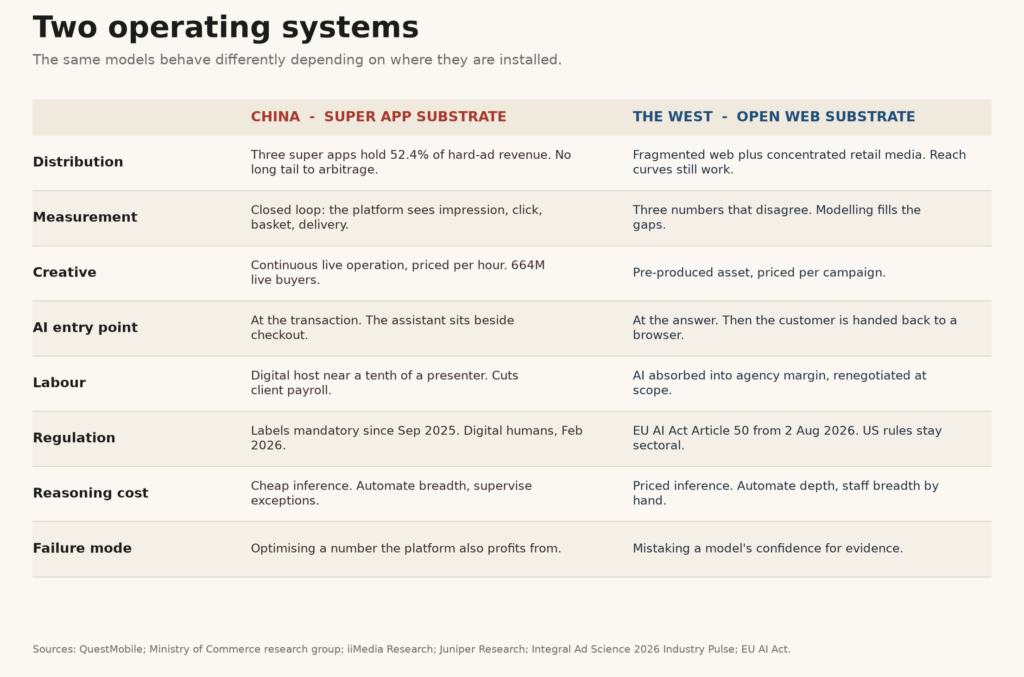
11. The two-column table
| Dimension | China | The West |
| Distribution | Three super apps, 52.4% of hard-advertising revenue, no long tail | Fragmented web plus concentrated retail media |
| Measurement | Closed loop, platform-reported, fast and narrow | Triangulated: platform, analytics, MMM, all disagreeing |
| Creative | Continuous live operation, priced per hour | Pre-produced asset, priced per campaign |
| AI entry point | At the transaction | At the answer |
| Labour | Digital host displaces client payroll | AI absorbed into agency margin |
| Regulation | Mandatory labelling, operator liability, from 2025–26 | EU Article 50 from August 2026, US sectoral |
| Reasoning cost | Cheap inference, automate breadth | Priced inference, automate depth |
| Failure mode | Optimising a number the platform also profits from | Confusing a model’s confidence with evidence |
12. Three things a cross-border team can do on Monday
Decide which substrate you are optimising for, and stop porting KPIs from one to the other. A Chinese team judged on return on ad spend inside a closed loop will look brilliant and learn little. A Western team judged on modelled incrementality will look cautious and learn slowly. Name the substrate in the brief, and the argument about performance mostly resolves itself.
Run one closed-loop test and one independent estimate on the same campaign, then manage the delta. Not the number — the delta. The gap between what the platform says and what an independent read says is the most informative metric most teams never report. Adobe’s 2026 global survey found 84 per cent of organisations missed at least one marketing opportunity in any given quarter because a workflow could not respond in time, and only 7 per cent had embedded AI in ways that produced measurable business results. Latency, not intelligence, is the binding constraint.
Budget inference per interaction, not per campaign. Once you know what a single automated conversation costs, the decision about which interactions deserve a model becomes arithmetic instead of ideology. That is the whole practical difference between the two markets: one has already done the arithmetic, and the other is still arguing about whether the maths applies.
Key takeaways
- The tooling has converged; the substrate has not, and the substrate decides what is measurable.
- China’s advantage is a closed loop, which is also its blind spot. The West’s advantage is independence, which is also its expense.
- Cheap inference moves the automation boundary outward. Expensive inference moves it towards depth. Both are rational.
- Regulation arrives faster than most brand teams expect, and clarity is a competitive asset.
- By 2027, methods converge and structure does not. Plan accordingly.
FAQ
Is China’s AI marketing edge just cheaper models? No, and the framing is a trap. Cheap inference matters, but Juniper Research’s finding is that the gap is a ceiling, not an average — up to 90 per cent cheaper on price-led models, while Western labs keep a paid premium on reliability. The bigger advantage is structural: an assistant wired into checkout can be measured, and a measurable assistant gets optimised. Price gets you started; the loop gets you compounding.
Can a Western brand run live commerce at China’s scale? Not by buying the format. China’s RMB5 trillion livestream market rests on a shopping habit — roughly 664 million buyers, about 59 per cent of internet users — that took a decade of payment, logistics and creator infrastructure to build. In the West, live selling is a channel inside a campaign plan. Copying the studio without the habit produces expensive broadcasts with small audiences.
Why does China measure better but verify less? Because a closed loop makes third-party verification feel redundant. The platform sees the impression through to delivery, so the numbers cohere. That coherence is genuine, and it is also a conflict of interest: the party reporting the result is the party selling the inventory. The West’s verification industry is slow, political and expensive, and it exists for a reason that does not disappear when the loop closes.
Does the EU AI Act slow Western AI marketing down? It changes the shape of the delay rather than the size. Article 50’s transparency obligations from 2 August 2026 are knowable and can be designed for — labelling, disclosure, documentation — and teams that build them into the interface ship on schedule. The slowdown shows up where the rules are unclear, because legal review expands to fill the uncertainty. Predictability, not permissiveness, is what accelerates deployment.
What breaks first when a Chinese team runs Western media? Measurement, then creative volume. The team arrives expecting a receipt and finds three disagreeing estimates and no shared identifier. It then applies live-room creative velocity to a market where frequency is capped by consent and where brand suitability review rejects half the output. The fix is not more AI. It is an incrementality habit and a suitability process, adopted before the first campaign rather than after the first scandal.