Big Tech’s $3 Trillion Shadow AI Debt Is Rewriting the Risk Playbook
Big Tech carries about $3 trillion in AI commitments that never reach the balance sheet. Here is how that debt reaches your contract, and the clauses that push it back.
On 3 November, Meta went to the bond market and raised $15 billion in five parts. Five days earlier, Microsoft sold $25 billion of bonds across ten tranches running out to 2066 — its first US offering since 2017 — and drew orders above $115 billion. The Monday before, Oracle sold $10 billion of debt and $10 billion of stock.
None of them needed the money to keep the lights on. Meta closed the second quarter with $90.3 billion of cash and securities. Microsoft is rated AAA. Oracle has run a profitable software business for four decades.
They borrowed because the thing they are building costs more than the thing they sell. That is where the story stops being about them, because the balance sheet you can read is no longer the balance sheet that carries the risk. The obligations that matter now sit in footnotes, in joint ventures, in lease schedules that will not start for two years, and in contracts signed with customers who are told they are buying capacity.
The number nobody can pin down
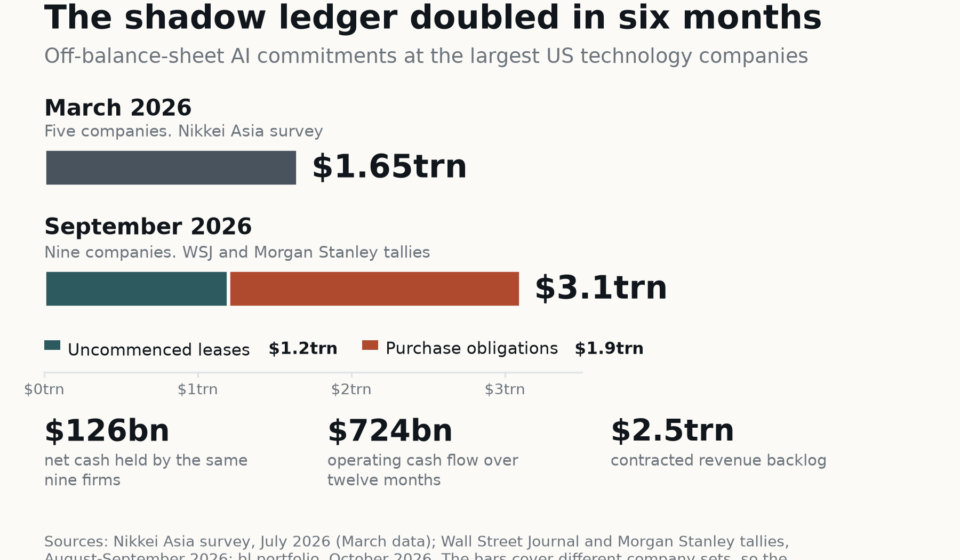
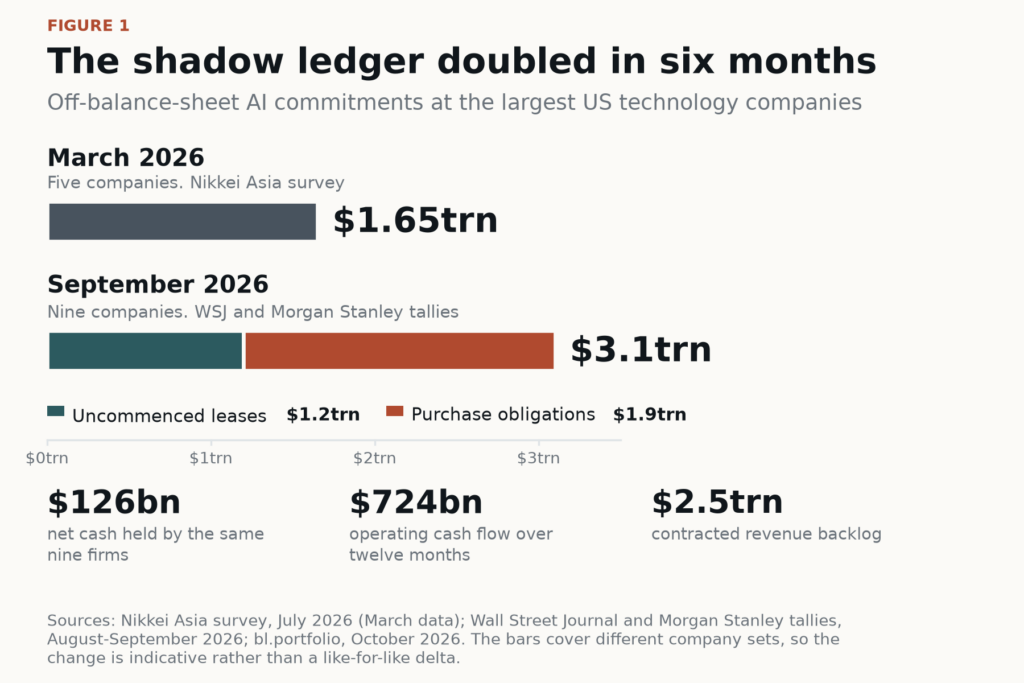
Nikkei Asia surveyed the five largest US technology companies — Microsoft, Alphabet, Amazon, Meta and Oracle — and put their combined off-balance-sheet obligations at roughly $1.65 trillion, about eight times the level four years earlier, and larger than their reported debt. Later tallies that add chipmakers and SpaceX come in somewhere around $3 trillion to $3.1 trillion: roughly $1.2 trillion in leases for facilities not yet in service and $1.9 trillion in purchase commitments for chips, equipment and power.
Two totals, one subject, a factor of nearly two between them. That gap is not a scandal. It is arithmetic. The lists of companies differ, some figures are undiscounted, and every analyst draws the boundary between “commitment” and “obligation” slightly differently.
So treat any single headline number as a rhetorical device rather than a measurement. The direction is what travels. One tally grew by about $1.3 trillion in three months. Whatever the true perimeter, the line is going up faster than the revenue meant to service it.
Four ways a commitment stays off the books
Leases that have not started. Under ASC 842, a lease liability begins on the commencement date — the day the lessor hands over the asset. A hyperscale data center takes two to four years to build. So the contract is signed, the rent is fixed, the term runs fifteen to nineteen years, and the balance sheet shows nothing. Oracle disclosed $288 billion of these at the end of August, substantially all for data centers, against $125.3 billion of borrowings. That is $2.30 of rent for every dollar of debt.
Purchase obligations. Take-or-pay contracts for accelerators, memory, networking gear and electricity. Alphabet’s purchase commitments went from $332 billion at the end of March to $811 billion at the end of June. One quarter. A 152% rise.
Joint ventures and special-purpose vehicles. This is where the accounting becomes a matter of judgment rather than arithmetic. A developer and an investor own the building; a vehicle they control issues the bonds; the technology company signs a long lease and, often, a residual value guarantee that protects the lender if the tenant walks. If the technology company is not the “primary beneficiary” under ASC 810, none of it consolidates. Meta’s Hyperion campus was financed this way: $27.3 billion of bonds through an entity 80% owned by Blue Owl and 20% by Meta, with a lease commitment running at least twenty years. Meta’s auditor, EY, flagged the consolidation judgment as a critical audit matter — the label auditors use when a conclusion was defensible but hard.
Guarantees. Nvidia has been in talks to backstop roughly $250 billion of financing for OpenAI’s data centers. A guarantee is a liability that appears only if the future goes wrong, which is precisely when you need it on the balance sheet.
The cash flow turned before the debt did
Look at what happened to the money, not the promises. Meta generated $31.9 billion of operating cash flow in the second quarter and spent $31.1 billion of it on capital projects. Free cash flow came to $784 million, against $8.55 billion a year earlier. Full-year capital spending guidance runs from $130 billion to $145 billion.
Oracle’s quarter is more instructive, because the company discloses enough to see the plumbing. Operating cash flow of $23.1 billion sounds healthy until you read the note: $11.4 billion of it was customers paying in advance. Strip that out and the business generated $11.7 billion while spending $28.5 billion. The gap was closed with $19.9 billion of shares sold through an at-the-market program, which lifted the share count 5% in three months.
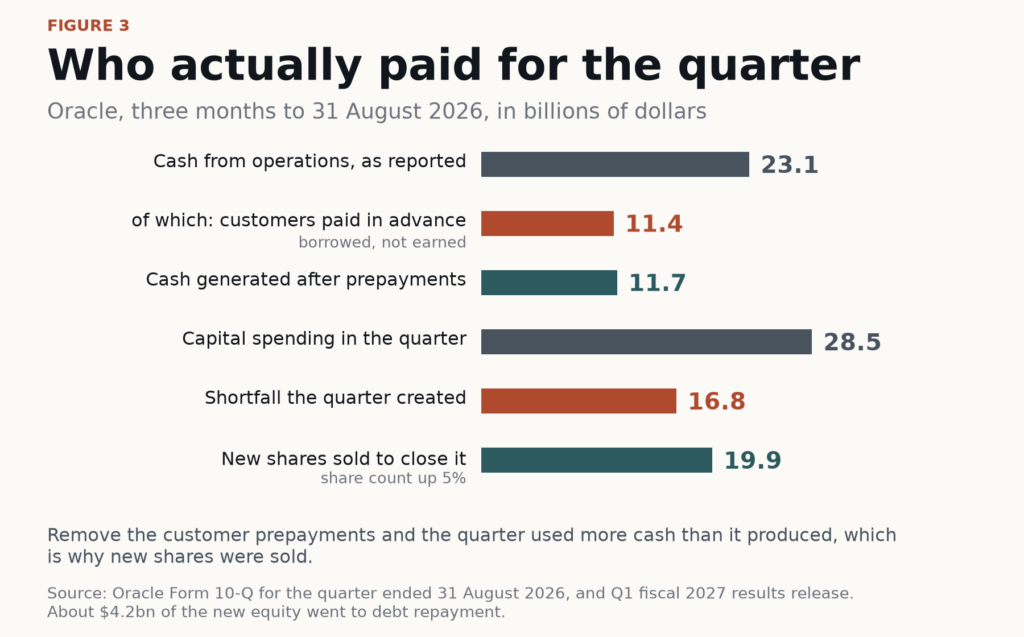
Read that sequence again, because it is the whole argument in miniature. The AI buildout is now funded by three parties: bondholders, shareholders through dilution, and customers through prepayment. The first two are visible in public markets and get repriced daily. The third shows up in your contract, and it does not get repriced at all.
The credit market has started grading your vendors
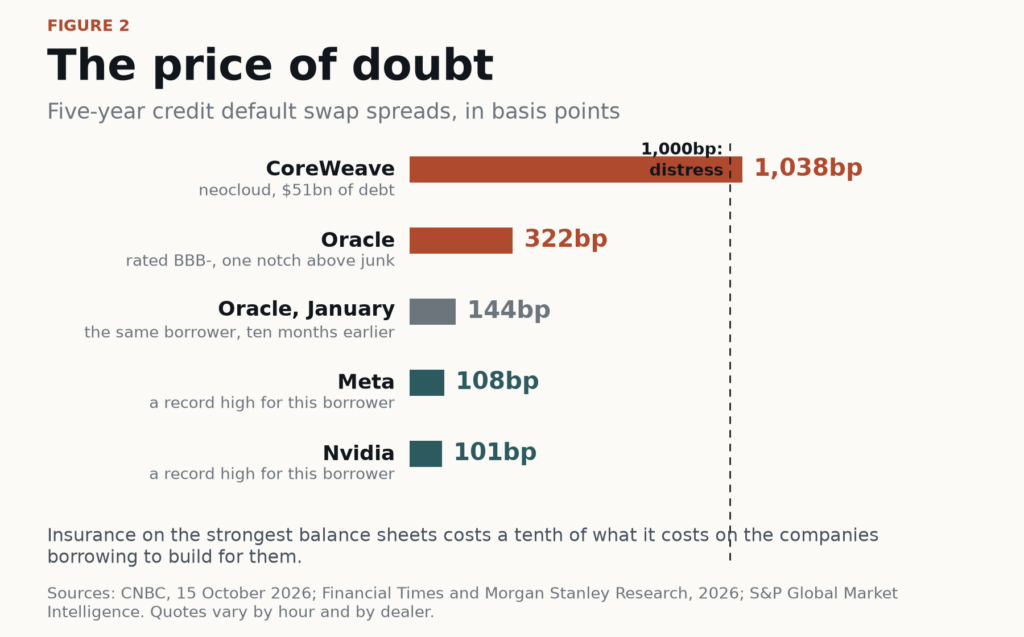
Insurance against default is the cleanest read on how lenders feel, because a buyer of protection has no upside beyond being right. Five-year spreads on the biggest AI borrowers hit records this autumn: Meta at 108 basis points, Nvidia at 101, Oracle at 322 — more than double its January level of 144. CoreWeave, the neocloud that borrowed to build capacity and rents it out, traded above 1,000 basis points, the conventional marker of distress, with its 2031 bonds yielding 15.8%.
The dispersion is the point. Insuring Meta’s debt costs a tenth of insuring CoreWeave’s. S&P cut Oracle to BBB- in July, one notch above junk, which matters less for Oracle than for the investors who are only allowed to hold investment-grade paper: a further downgrade forces them to sell.
Then there is the pricing gap between issuers for the same maturity. Microsoft’s 40-year tranche priced at 105 basis points over Treasuries; Alphabet, Meta and Oracle have paid 130 to 140 for comparable paper. The bond market is not treating “Big Tech” as one credit anymore. It is grading balance sheets, lease schedules and customer concentration, one issuer at a time.
Power is the longest-dated promise of all
In October, Google contracted for 3,590 megawatts from Constellation Energy, including 890 megawatts of nuclear capacity under a twenty-year agreement that will pay for upgrades at eleven reactors, plus 2,700 megawatts of long-term supply. Constellation will invest more than $4.3 billion to deliver it. First power is expected in 2028.
That is not a purchase. It is a twenty-year annuity, and Google is the one paying. It is also the template now: PJM, the largest US grid operator, has proposed that data-center customers either bring their own generation or accept being curtailed at peak.
Here is the mismatch worth carrying into a meeting. A power contract runs twenty years. A transformer takes three years to build. The accelerator inside the building is depreciated over five or six years and will be economically obsolete sooner than that. The financing has been matched to the life of the concrete, and the revenue has to be earned on the life of the silicon.
The circular part
The IMF’s October financial stability report counted fourteen disclosed transactions since 2023 in which hyperscalers put about $300 billion of equity into financially weaker AI companies, alongside $650 billion of debt, in exchange for $1.4 trillion of future revenue commitments. About $320 billion of that debt sits with the investees, some of it backed by investor guarantees.
The fund’s phrase for the resulting exposure is “wrong-way risk”: the equity and the debt lose value at the same moment the revenue tied to them disappears. Translate that into plain language. A hyperscaler’s backlog is only as good as its customers’ financing, and part of that financing comes from the hyperscaler.
About $2.5 trillion of contracted backlog sits across these companies, and roughly 40% of it is owed by two labs that do not yet make money. That is not a reason to panic. It is a reason to ask, in writing, who is standing behind the capacity you are being sold.
Where this lands on your desk
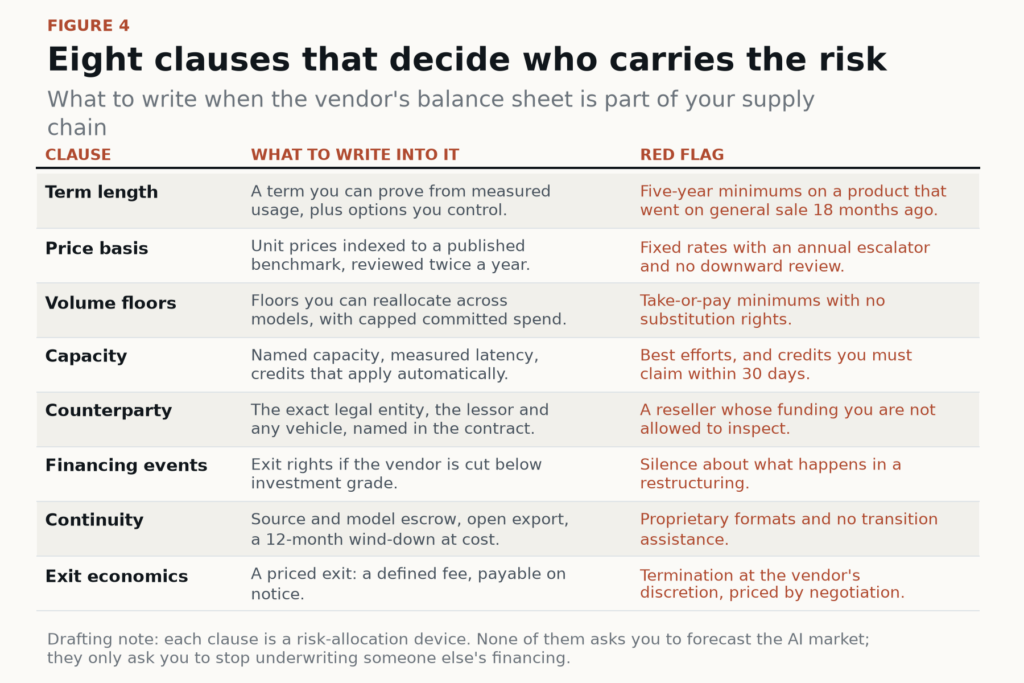
You are not going to underwrite a hyperscaler’s lease schedule. You do not have to. What you can do is stop signing contracts that quietly make you part of the financing structure. Five channels carry their risk into your agreement.
Your price is their revenue certainty. A vendor servicing $51 billion of debt at 15% has a model that requires a price floor. A three-year fixed price is exactly the instrument that provides one. You are not buying compute at a discount; you are selling them a hedge.
Your prepayment may be their working capital. Customer advances now fund a meaningful share of quarterly capital spending. Ask what your prepayment buys: reserved capacity, a discount, or a general obligation of a company that needs the cash.
The market price is falling while your commitment is fixed. The average cost of a million tokens fell from $1.15 at the March peak to $0.68 in August, according to payment data compiled by Ramp. Roughly 41% in five months. A multi-year agreement at today’s unit price is a wager that a deflationary market will stop deflating.
Reserved capacity is a claim on an unfinished building. Oracle issued a force majeure notice to a developer on a Stargate-linked project in September over a missed deadline, while remaining contractually liable for the rent. Projects slip. Permits fail. Financing gets pulled. Your “guaranteed” capacity is only as guaranteed as the entity that has to deliver it.
Restructuring decides who keeps their contract. When a neocloud or a developer runs into trouble, the question is not whether the service is good. It is whose agreement survives, whether your data is exportable, and how long you have before the lights go out.
Twenty minutes with a vendor’s footnotes
You do not need a credit analyst to do a first pass. Five lines in a filing will tell you most of what you need.
Read the purchase obligations table in the commitments note, and compare this year with last. Read the lease commitments line and look for the phrase “not yet commenced”. Divide the lease number by the backlog; Oracle’s works out to about 43 cents of undiscounted rent for every dollar of contracted revenue. Look at how much of operating cash flow came from customer prepayments. Find out which legal entity is actually signing your order — the parent, a regional subsidiary, or a vehicle you have never heard of — and check whether that entity shows up in the guarantee disclosures. Then compare its credit default swap spread with its closest peers, because the market has already done that work.
Where the Enron comparison breaks
It is tempting to call all of this Enron with better branding. Resist it, for two reasons.
First, the disclosure is genuinely better than it was in 2001. Consolidation rules were rewritten after Enron precisely to catch the structures that hid its debt, and auditors now have to name the judgments they found hardest. EY’s critical audit matter on Meta is evidence the system is working, not evidence it has failed.
Second, these are mostly profitable, investment-grade companies with real cash flow. The plausible outcome is not bankruptcy. It is repricing and renegotiation: wider spreads, slower projects, and vendors returning to customers for longer terms and better economics. That outcome does not wipe out equity holders first. It arrives as a renewal quote.
Five things to watch
The year ahead will be decided by a handful of observable numbers.
The pace at which uncommenced lease commitments roll onto balance sheets, because each one is a real liability arriving on schedule. The ratio of backlog growth to commitment growth, because backlog that grows slower than the obligations it is meant to cover is a warning. The share of operating cash flow coming from customer prepayments, the cleanest signal that a vendor is borrowing from its customers. Credit default swap spreads against peers, which reprice before the filings do. And the tenor of new power contracts, because a twenty-year electricity deal signed for a five-year asset is the clearest statement a company can make about how long it expects this cycle to last.
None of this requires you to forecast the AI market. It requires you to notice that the people selling you capacity have arranged their finances so that the first loss lands somewhere other than their own balance sheet — and to make sure that somewhere is not yours.
Summary
Big Tech has accumulated roughly $3 trillion of AI-related commitments that do not appear as debt, most of it in leases for data centers that are not finished and take-or-pay contracts for chips and power. The buildout has outgrown operating cash flow at several of the largest companies, which is why Meta, Microsoft and Oracle all returned to the bond market this autumn, and why Oracle’s quarter was half-funded by customer prepayments and a 5% increase in its share count. Credit markets have started to price the difference between balance sheets, with spreads on the weakest AI borrowers above the distress threshold. For anyone buying AI capacity, the consequence is narrow and actionable: your contract is now part of someone else’s capital structure, and the clauses that govern term, price indexation, capacity, counterparty, financing events, continuity and exit decide who absorbs the loss if the arithmetic stops working.
Frequently asked questions
What exactly is “shadow AI debt”?
Contractual exposure that carries the economics of debt without sitting in the debt line of a balance sheet: leases signed but not yet commenced, take-or-pay purchase obligations for chips and power, bonds issued through joint ventures that do not consolidate, and guarantees extended to customers or partners. The cash is committed; the disclosure lives in footnotes.
How much is there, really?
Estimates run from $1.65 trillion for the five largest US technology companies in Nikkei Asia’s survey to about $3 trillion to $3.1 trillion when nine companies are counted. The range reflects different perimeters and undiscounted figures rather than disagreement about the trend, which is steep in every version.
Why are cash-rich companies borrowing?
Because capital spending has overtaken operating cash flow. Meta’s free cash flow fell to $784 million in the second quarter against $8.55 billion a year earlier; Oracle spent $28.5 billion in a quarter while generating $11.7 billion before customer prepayments. When the gap is that wide, the choice is bonds, equity, or someone else’s money in advance.
Does this affect a company buying AI tools rather than building data centers?
Yes, through price and continuity. A vendor with a fixed cost base and a leveraged balance sheet needs long commitments at stable prices, so multi-year deals get priced to protect its revenue rather than to share the benefit of falling token costs — which fell roughly 41% between March and August.
What is the single most useful clause to add?
A financing-event termination right: the ability to exit at a pre-agreed price if the vendor is downgraded below investment grade or a facility supporting your capacity is cancelled. It costs little to ask for while demand is strong, and it is the only clause that turns the vendor’s balance-sheet risk into your option.