Mentioned, Recommended, Transacted: The Three Numbers That Actually Matter in AI Search
Being Named by an AI Is Not the Same as Being Chosen
The most expensive mistake in marketing right now is measuring visibility and calling it demand.
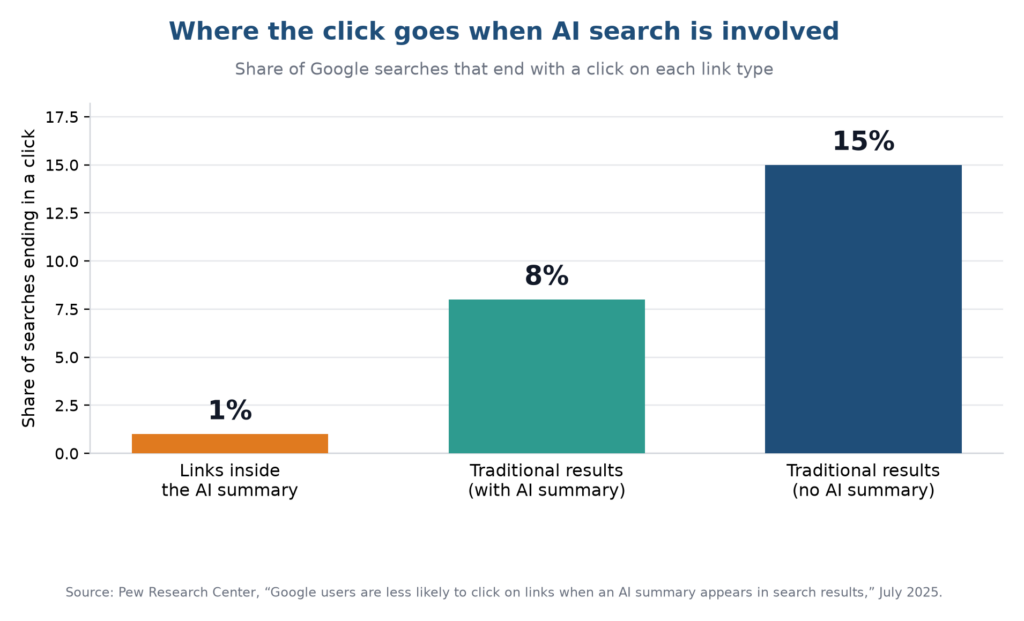
There is a number that should be printed on the wall of every marketing department. When Google shows an AI summary at the top of its results page, a user clicks a traditional organic link in only 8% of searches. Without that summary, the figure climbs to 15%. And the links embedded inside the summary itself? Those get clicked in about 1% of searches.
Those figures describe a structural change in how attention moves. They come from an analysis of real U.S. Google search behavior, not a vendor survey. And they demolish a comfortable assumption: that being surfaced by an AI system is the same thing as being visited, considered, or bought from.
At a glance
- Click-through to organic results with an AI summary present: 8%
- Click-through without a summary: 15%
- Click-through on links inside the AI summary: ~1%
- Visibility lift from evidence-density optimization: up to ~40%
Share of Model is not market share
Over the past two years the industry has converged on a new phrase — Share of Model, or SOM — and a new habit of misreading it. SOM measures how prominently a brand appears in a large language model’s answers relative to its competitors. The category is now real enough to carry serious capital: a platform built specifically around measuring this metric raised $180 million at a $1.8 billion valuation in September 2026, as brands scramble to understand where they surface inside ChatGPT, Gemini, Claude, and Perplexity.
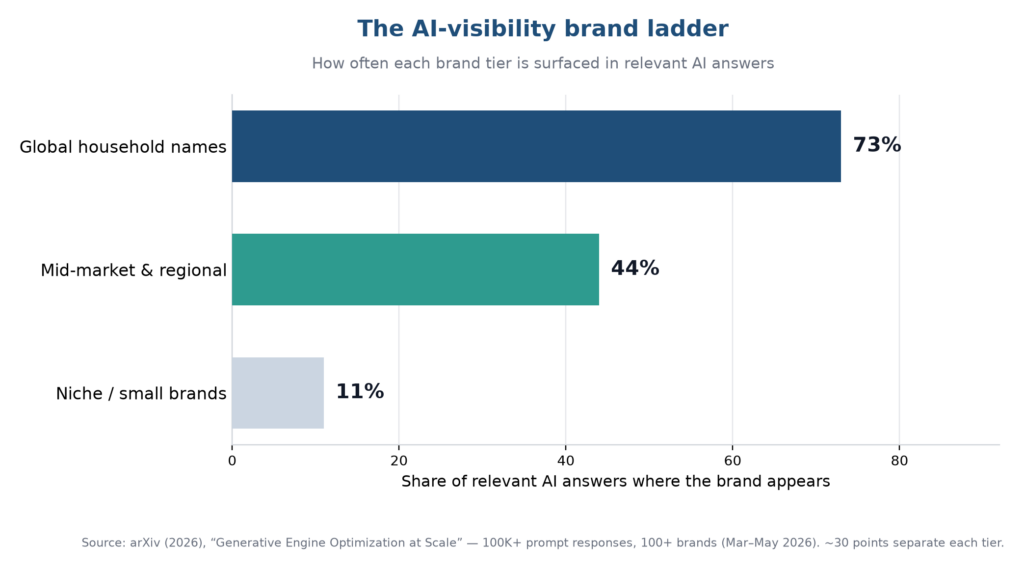
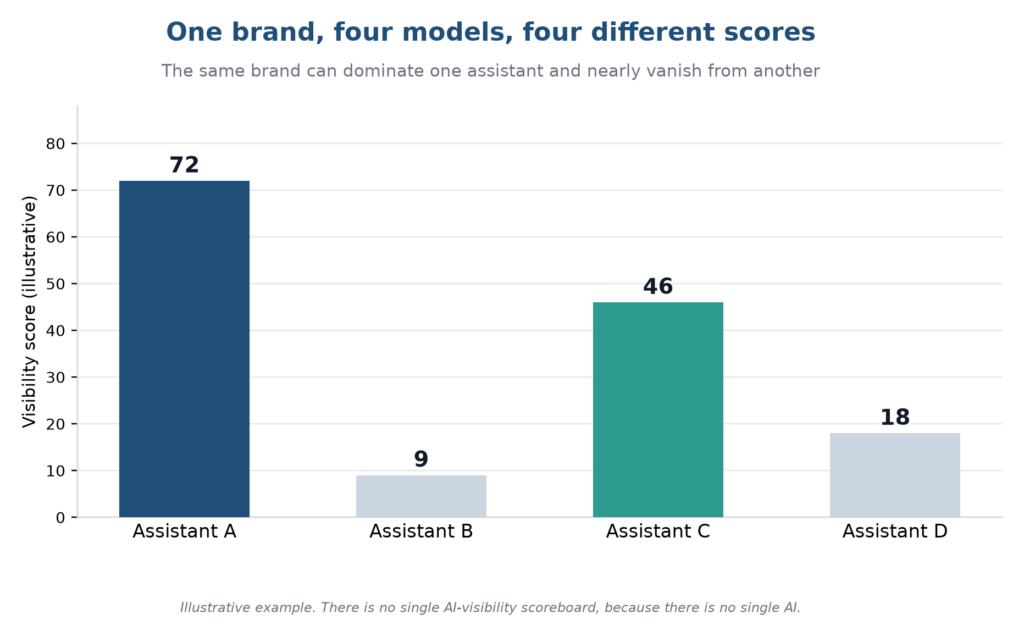
The finding that matters is not that some brands score well. It is that the same brand scores very differently across different models. A brand that dominates one assistant can be nearly absent from another. The spread is stark. In a 2026 study spanning more than 100,000 prompt responses across over 100 brands, global household names appeared in about 73% of relevant AI answers, established mid-market brands in 44%, and niche or small brands in just 11% — a gap of roughly 30 percentage points at every step.
There is no single “AI visibility” scoreboard, because there is no single AI. Marketers who collapse SOM into one dashboard number are repeating the oldest mistake in measurement: treating a proxy as an outcome.
Three numbers, not one
The useful way to model this is a three-stage funnel, with a different metric at each step.
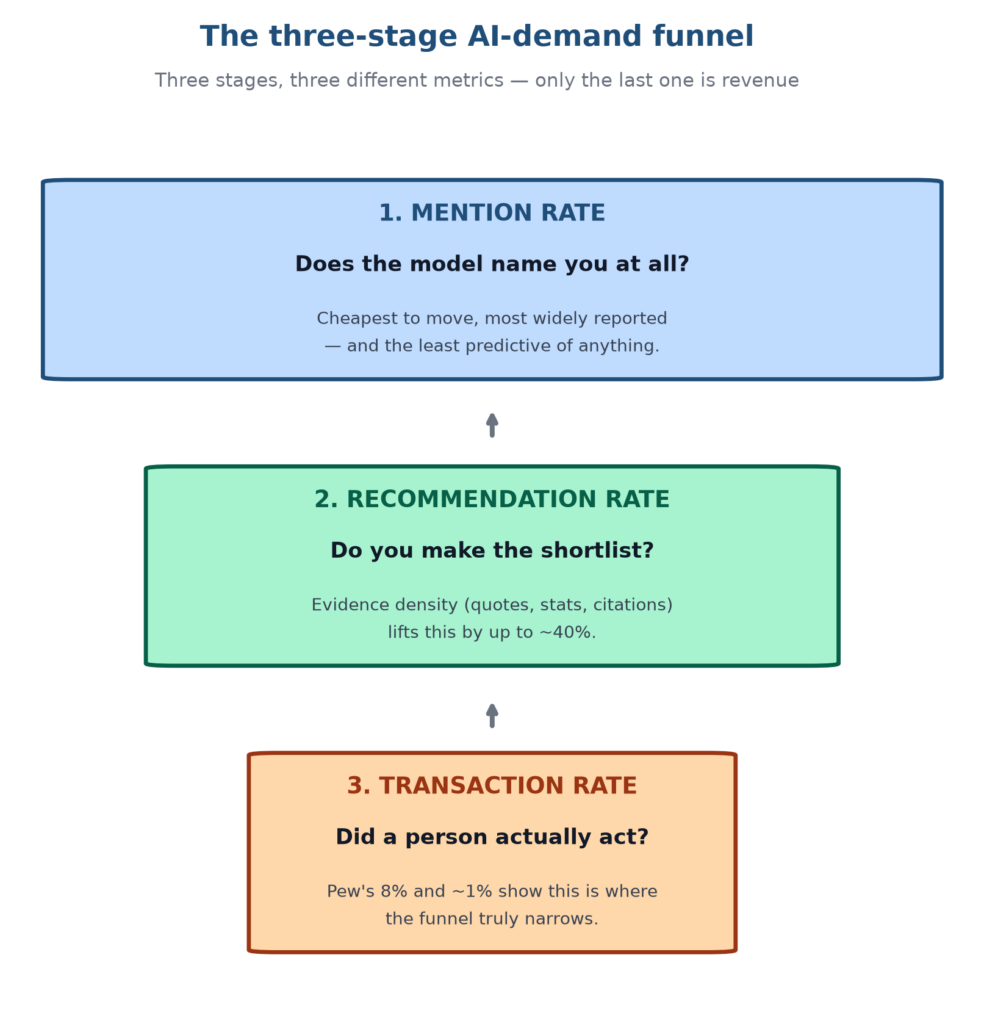
Stage one: mention rate. Does the model name you at all when asked a category question? This is the cheapest stage to move and the most widely reported. It is also the least predictive of anything that matters.
Stage two: recommendation rate. When the model is forced to shortlist, rank, or pick, do you appear in the top set? Research on generative engine optimization presented at KDD 2024 found that specific content interventions — adding quotations, statistics, and cited sources — can lift visibility in generative answers by up to around 40%. Note what those interventions really are: evidence density. Models reward content that looks checkable.
Stage three: transaction rate. Did a person act? The 8% and 1% figures tell you this is where the funnel actually narrows — and no amount of mention-rate optimization touches it. A brand with high mention and low recommendation has simply bought awareness inside a channel that converts poorly. That is an expensive place to be.
Why the gap between stages is wide
Language models do not rank. They compose. Given a prompt, the system retrieves candidate material, weighs what looks authoritative, and writes an answer that reads like advice rather than a list. Three consequences follow.
Consistency beats volume. A model that sees your brand described the same way across many independent sources has less reason to hedge. A model that sees contradictory claims will hedge by omission.
Structured facts beat adjectives. “Rated best” is unciteable. “Holds 24.8% of global shipments in the first half of 2026, according to three research firms” is citeable — and citeable material is what survives into the final answer.
Category framing beats brand framing. Models are asked questions like “what should I buy for X,” in which you are one option among many. Brands that only publish about themselves never enter the candidate set.
What actually moves recommendation rate
- Publish numbers with a methodology attached. Not claims. Measurements.
- Get described consistently off-site. Third-party descriptions carry more weight than your own.
- Answer the comparison question directly. “X versus Y” content is where shortlists get decided.
- Track per model, not in aggregate. One blended visibility score will hide the model where you are invisible.
- Stop treating the click as the only conversion. Zero-click exposure still moves consideration — but you cannot prove it with last-click attribution.
The metric to retire
Retire the single “AI visibility score.” Replace it with a panel: mention rate by model, recommendation rank when shortlisted, and downstream branded search or direct traffic lift in the weeks following a visibility change.
That last one is imperfect and lagging. It is also the only number in the set that a CFO will accept.