The Shelf, the Assistant and the Coupon: How Douyin E-commerce Actually Grows Now
For most of its life, Douyin was where shopping happened by accident. You opened the app for a recipe, stayed for a dog video, and left with a vacuum cleaner you had no plan to buy. That version of Douyin grew at triple-digit rates and made retail executives outside China nervous.
That version is gone.
What replaced it is a mature retail channel growing at roughly five times the pace of growth in China’s online goods market, propped up by larger discount coupons, a shopping mall it is still teaching people to use, and an AI assistant that can complete a purchase inside a chat window but barely registers in the revenue line.
The short version
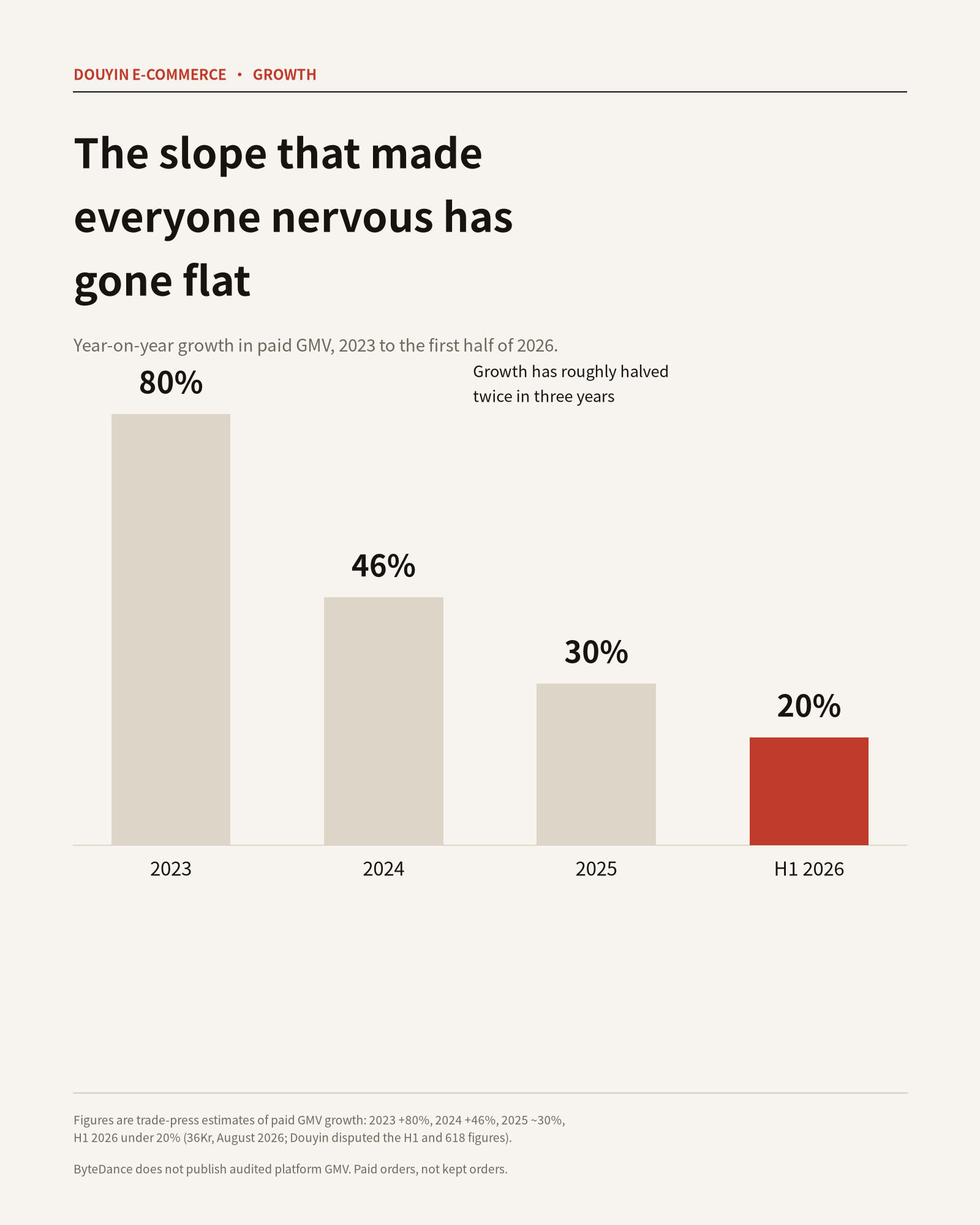
- Douyin’s paid GMV cleared RMB 4 trillion in 2025 and is estimated at close to RMB 4.4 trillion, but growth has fallen from 80% in 2023 to under 20% in the first half of 2026.
- That is still roughly five times the growth of China’s online goods market, which makes Douyin a share-taker in a flat economy rather than a source of new demand.
- Shelf-based surfaces are reported to account for 40% to 50% of GMV, yet genuine in-app mall search is only about 10%, which is why search-first strategies still underdeliver.
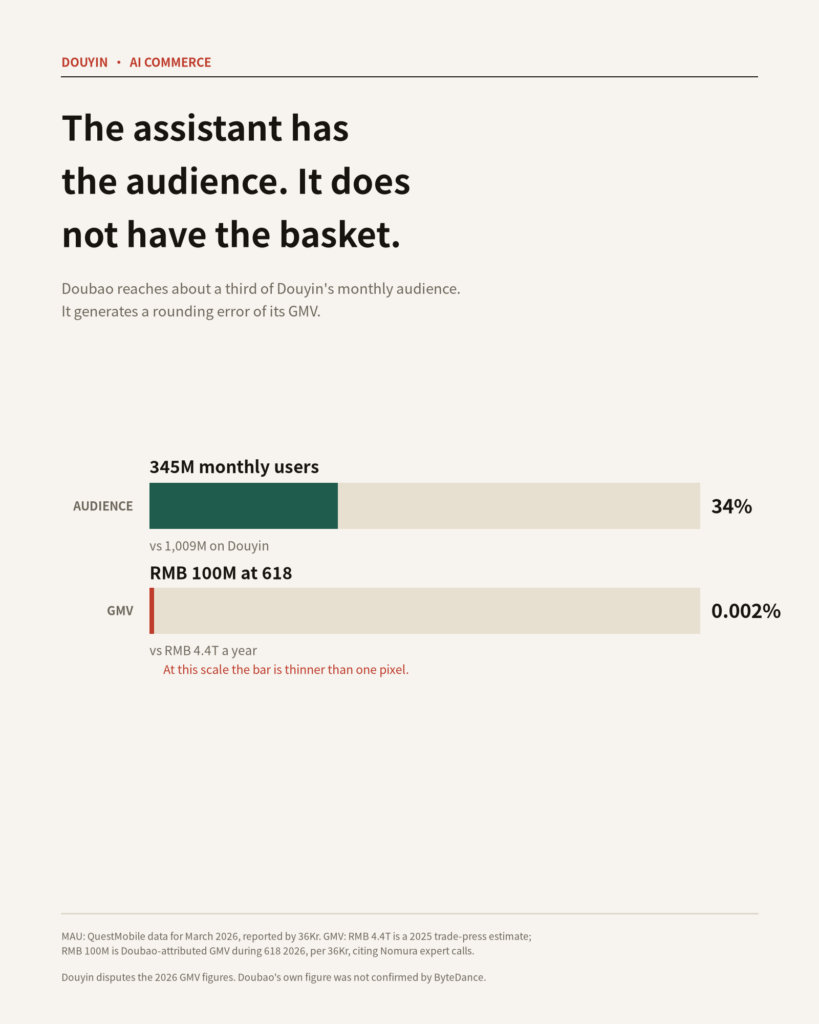
- The AI assistant Doubao now sits in front of the shop with 345 million monthly users, but generated roughly RMB 100 million in GMV at 618, or 0.002% of the platform’s annual volume.
What the latest numbers actually show
The 2025 base: just over RMB 4 trillion
LatePost reported in November 2025 that Douyin’s paid GMV grew more than 30% in the first ten months of the year and would clear RMB 4 trillion for the full year, putting it close to Pinduoduo. Trade press has since put the 2025 total at roughly RMB 4.4 trillion, about US$620 billion at RMB 7.1 to the dollar.
Both figures are estimates. ByteDance does not publish audited GMV, and Chinese platforms count paid orders rather than kept orders. In apparel and beauty, where return rates run high, settled GMV trails the headline by a wide margin. Anyone building a forecast on the 4.4 trillion number should haircut it first.
2026: the slope flattens
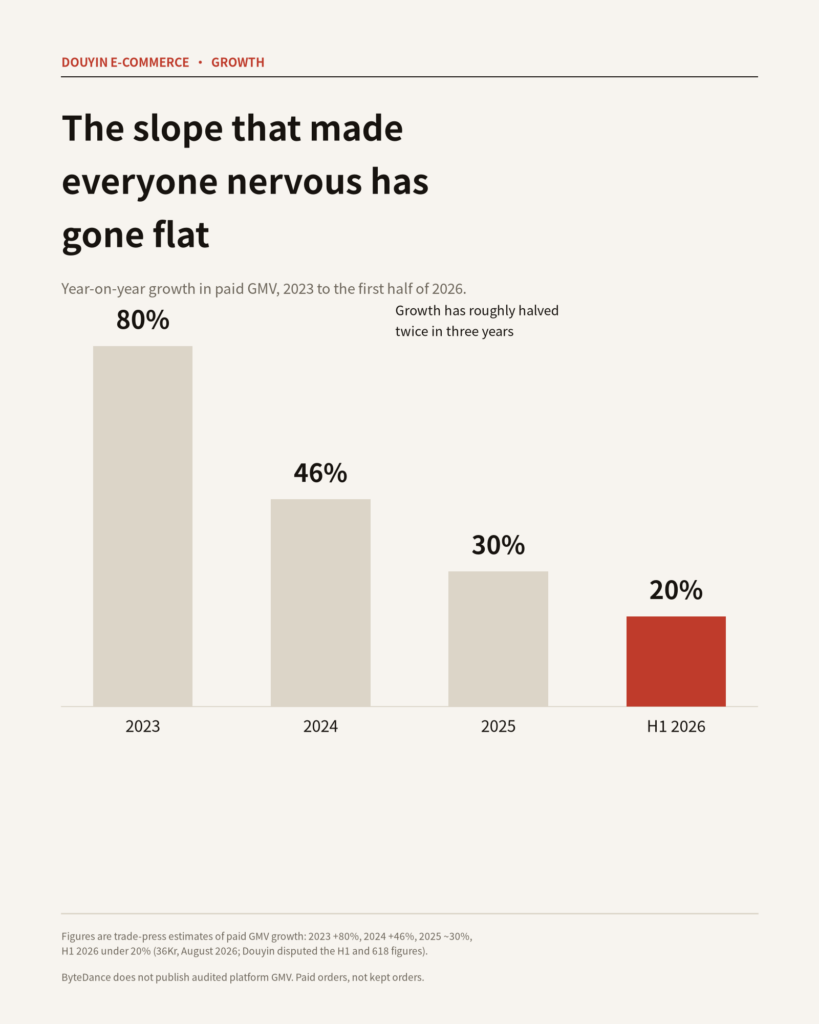
In August 2026, 36Kr reported that Douyin’s GMV growth was close to 20% in the first half and about 19% during the 618 mid-year festival, below an internal target of 24% to 25%. Douyin called the report inaccurate and declined to publish its own figure.
The direction is not in dispute. Growth has fallen every year since 2022, when the platform was still compounding at triple-digit rates.
| Period | GMV growth | Note |
|---|---|---|
| 2023 | ~80% | Content-commerce peak |
| 2024 | ~46% | GMV ~RMB 3.5 trillion; overtook JD.com |
| 2025 | ~30% | GMV above RMB 4 trillion |
| H1 2026 | under 20% | 618: ~19% |
A platform that halves its growth rate twice in three years is not collapsing. It is entering the phase where every extra point of share has to be bought, borrowed from a competitor, or squeezed out of the same customer.
Why 20% is still an extraordinary number
Set the platform against the country. China’s National Bureau of Statistics reported that from January to August 2026, total retail sales rose 1.1% year on year, and online retail sales of goods rose 4.3%. In August alone, total retail sales grew 0.4%.
So Douyin grew roughly five times faster than the online goods market while the consumer economy was barely moving. That is the part Western coverage tends to miss. Douyin is no longer a growth story in the sense of new demand; it is a share-shift story, and the share it takes comes mostly from shelf-based marketplaces and offline retail.
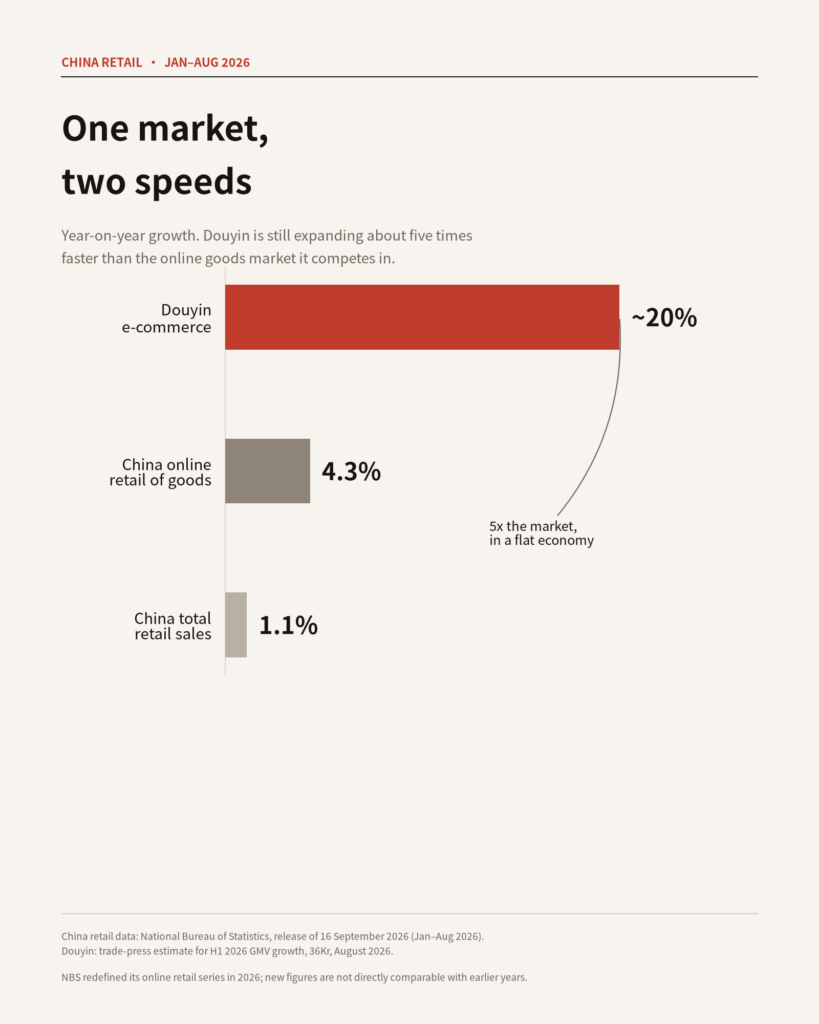
One measurement caveat is worth flagging, because it will trip up anyone comparing year-on-year charts. In 2026 the statistics bureau redefined the online retail series, splitting out online retail sales of services and renaming the goods series. The new numbers are not directly comparable with older “online retail sales” figures.
The structural shift: the feed learned to be a shelf
Douyin spent years trying to convince users that it is also a place to search. By 2025, shelf-based surfaces — the mall, search, store pages — were reported to account for 40% to 50% of GMV. That sounds like a triumph for intent-driven shopping.
It is not quite that.
A large share of those mall orders still start in the feed. A short video pushes a product card, a livestream hands out a coupon, and the buyer finishes in the mall. The order is booked as shelf GMV even though the intent was manufactured by content. Former Douyin employees quoted by 36Kr estimated that orders placed through genuine in-app mall search were only around 10% of total GMV as of Q3 2025, up from about 7% previously.
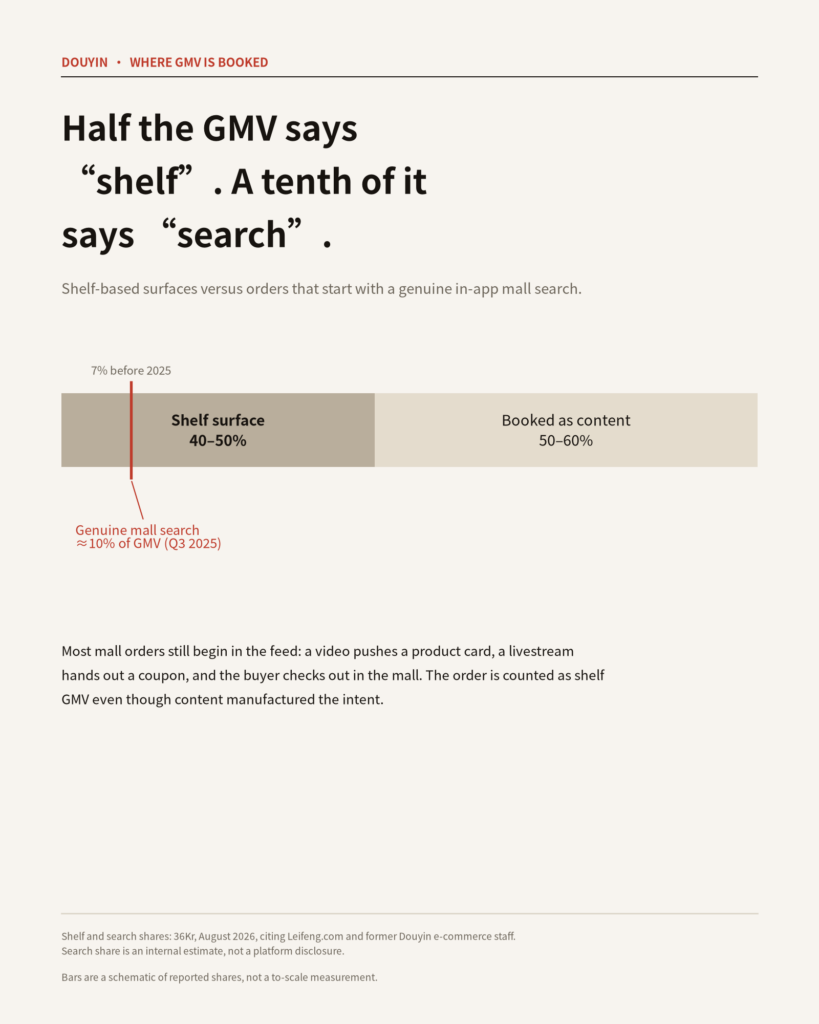
Keep that gap in mind. The distance between 45% shelf share and 10% search share is the difference between a platform that has trained shopping intent and one that has learned to route impulse through a checkout page.
Douyin is trying to close it. It has pushed a dedicated mall app with app-only pricing, and QuestMobile data showed mall app users growing 231% in the first quarter of 2026 — fast, off a small base. Platform-run stores that sell only through shelf surfaces are part of the same experiment.
AI at the front door
The more consequential change is not in the mall. It is in the assistant.
ByteDance’s Doubao had roughly 345 million monthly users by March 2026, according to QuestMobile, and Douyin itself crossed 1 billion monthly users that month — the second Chinese app after WeChat to do so. That puts a general-purpose AI assistant and a billion-person video feed inside the same company — and, increasingly, the same checkout.
The integration has moved fast.
- October 2025: Doubao began recommending products in conversation and linking to Douyin orders; the short-drama app Hongguo added an order entry and began testing “search the same item” inside episodes.
- May 2026: Doubao launched “帮你选” (Help You Choose), an AI shopping feature wired into Douyin’s full purchase path, so a user can order without leaving the chat.
- Before 618: “买前问豆包” (ask Doubao before you buy) was promoted to the assistant’s top navigation bar, and Douyin extended coupon access to seven sibling apps, including Doubao, Hongguo, Toutiao and Tomato Novel.
That is about as clear a statement of strategy as ByteDance ever makes in public. The feed brings attention, the assistant captures intent, and the transaction closes wherever the user happens to be.
The RMB 100 million problem
Then there is the money. 36Kr reported that Doubao generated about RMB 100 million in GMV during the 618 festival — roughly US$14 million, against a platform base above RMB 4 trillion.
That is not a rounding error. It is a rounding error’s rounding error.
Nomura analysts, cited in the same reporting, said the current focus of the Doubao–Douyin partnership is not near-term GMV but product iteration, data integration, supply-chain integration and catalog comprehension. In other words, the assistant still has to learn what is in the warehouse before it can sell it.
Brands have noticed the gap. Operators interviewed by 36Kr described AI commerce as a future rather than a present, and said marketing budgets are being defended on provable returns. When a channel cannot yet show incremental sales, it does not get a line item.
Why AI checkout is slow, and why that will change
Three constraints explain the gap, and none of them is permanent.
Catalog comprehension. A conversational assistant has to resolve hundreds of millions of SKUs, with variants, sizes, bundles and conflicting listings, into a recommendation a shopper will trust. Feeds do not need to explain themselves. Assistants do.
Trust and returns. A creator’s pitch borrows credibility from a face. An assistant has no such collateral. In categories where fit and texture decide satisfaction, a chat recommendation carries more risk for the buyer and more return cost for the seller.
Incentive design. This is the uncomfortable one. Chinese e-commerce monetizes through ad auctions and traffic allocation. An assistant that gives a perfect answer on the first try removes the inventory those auctions sell. Platforms have every reason to make AI helpful enough to keep users, and not so decisive that it cannibalizes the ad business. Douyin’s own reorganization hints at how it plans to manage that tension: the advertising team Qianchuan was folded into the e-commerce unit in April 2025, and campaign buying was consolidated into “全域投放” in May 2025, blending paid and organic traffic under one budget logic.
The rules now have teeth
AI-generated selling is also being regulated as it scales.
China’s measures on labeling AI-generated content took effect on September 1, 2025, requiring synthetic content to be marked. Douyin has gone further on its own platform, banning fully AI-generated livestreams and requiring sellers to disclose digital hosts. In June 2026, the market regulator opened consultation on draft advertising rules that would hold livestream platforms accountable for health-product claims.
The practical implication is boring but real: AI creative is no longer a free experiment. It needs disclosure, platform review, and in some categories a pre-approval path. Budget for compliance, not just generation.
The October test: what Double 11 2026 already shows
The festival that starts in mid-October is the industry’s annual stress test, and the opening window gives an early read on the fourth quarter.
Ebrun, a Chinese e-commerce trade outlet, reported that in the first four days of Douyin’s Double 11, merchants clearing RMB 1 million in GMV were up 59% year on year, while those clearing RMB 100 million were up about 200% — a figure 36Kr also carried. The number of livestreams clearing RMB 100 million rose 80%, and the number of store-broadcast rooms clearing RMB 10 million nearly doubled.
Read those lines together and the pattern is clear. Growth is concentrated at the top of the merchant base. It is increasingly powered by coupon subsidies that reward large baskets, and it is led by merchants broadcasting from their own stores rather than by celebrity hosts. None of that is the profile of a platform still adding demand. It is the profile of a platform redistributing it.
What this means if you sell in China
Five working conclusions, in order of how much money they affect.
Model net of subsidy. Growth is increasingly coupon-driven: bigger face values, higher thresholds, deeper discounts. Gross GMV flatters the platform and thins the brand. Build your P&L on post-discount contribution, not on campaign screenshots.
Do not plan search-first yet. With genuine mall search still near 10% of GMV, a Douyin strategy built around keyword capture is premature. Content still manufactures most of the demand you will harvest.
Treat the assistant as an answer surface. If Doubao becomes a place where people ask what to buy, the brands that get recommended will be the ones whose product information is clean, structured and consistent across listings. That is a content-operations job, not a media-buying one.
Assume paid share keeps rising. After the Qianchuan merger and the shift to unified campaign buying, the line between organic reach and bought reach is thinner than it was. Plan for a higher paid ratio each year.
Keep AI hosts compliant. Synthetic hosts remain cheaper than humans. They are not free of liability.
What it means if you sell on TikTok Shop
TikTok Shop’s global GMV grew nearly 70% in 2025, according to reporting from Jiemian, and overseas revenue passed 30% of ByteDance’s total. The international business is now the growth engine; the Chinese business is the laboratory.
Which is why the Douyin sequence is worth watching rather than the Douyin numbers. Live commerce came first, then the shelf, then the assistant. TikTok Shop is somewhere in the middle of that sequence. When an in-app assistant starts answering “what should I buy” questions in your market, the rules of discovery change faster than most media plans can absorb.
Five numbers to watch next quarter
- H2 2026 GMV growth, against the 20% first-half line. A print above 20% would suggest the coupon strategy is working; a print below 15% would suggest the platform is running out of share to take.
- Doubao’s shopping GMV, against the RMB 100 million baseline. Anything in the billions would mark the first real shift in shopping entry points since the feed.
- Genuine mall-search share, against 10%. This is the number that decides whether Douyin becomes a marketplace or stays a content machine with a checkout attached.
- Livestream’s share of GMV. It still carries most transactions; the pace of decline tells you how fast the format is maturing.
- AI-host disclosure compliance. Watch how many rooms get penalized, not how many use avatars.
Bottom line
Douyin has stopped being a growth anomaly and started being infrastructure. Its growth is still several times the market, its scale is now measured against the whole of Chinese retail, and its next advantage is being built at the interface rather than in the feed.
For marketers, the useful shift in thinking is this: stop asking how fast Douyin is growing and start asking where the decision now happens. In 2021 it happened in a video. In 2024 it moved halfway into a mall. In 2026 it started moving into a chat box. The money has not followed yet. The habits have.
FAQ
Is Douyin bigger than Taobao?
No, not on settled GMV. Douyin’s 2025 paid GMV was estimated above RMB 4 trillion; Taobao’s paid GMV has been put at roughly RMB 6 trillion by investors cited in Chinese trade reporting. Douyin has overtaken JD.com on GMV, but the gap to Taobao stays wide once returns are stripped out. On advertising revenue, Douyin moved ahead of Alibaba more than a year before late 2025 — a different scoreboard.
How fast is Douyin e-commerce growing in 2026?
Close to 20% in the first half, with about 19% during the 618 festival, according to 36Kr. Douyin disputed the figures. For comparison, China’s online retail sales of goods grew 4.3% in the first eight months of 2026.
Is livestream still the main channel on Douyin?
It still carries the majority of transactions, but the mix is shifting toward short video, store pages and mall search. Merchant self-broadcast and small creators generate more GMV than celebrity hosts, which is why the platform’s creator strategy has tilted toward mid-tier and specialist accounts.
Can foreign brands sell on Douyin?
Rarely directly. Douyin requires a Chinese entity, a local business license and either domestic or bonded inventory. TikTok Shop is the export-facing equivalent, and it usually runs a year or two behind Douyin in product development.
What should a marketer do first if Douyin’s AI layer takes off?
Clean up product data before buying media. An assistant recommends what it can parse: consistent titles, structured attributes, accurate stock and price. Brands with messy catalogs are invisible to a chat interface in a way they are not to a feed.